Pudding cookie recipe has an out-of-this-world name: Martian droppings : NPR

Pudding cookie recipe has an out-of-this-world name: Martian droppings : NPR

Allison Stines holds a photo of her family while she eats a family-favorite cookie: Martian droppings.

Allison Stines/Collage by NPR


hide caption

toggle caption

Allison Stines/Collage by NPR


Allison Stines holds a photo of her family while she eats a family-favorite cookie: Martian droppings.

Allison Stines/Collage by NPR

All Things We’re Cooking is a series featuring family recipes from you, our readers and listeners, and the special stories behind them. We’ll continue to share more of your kitchen gems throughout the holidays.

Growing up in Louisville, Ky., Allison Stines loved Christmas Eve. It was the day when all of her extended family would come to town and gather for a massive dinner party that her mom hosted. Her mom would make tons of food and cookies, including divinity, forgotten cookies, no-bake cookies and Martian droppings.

The Martian droppings got their unique name from one of Stines’ older brothers, who associated the color from the Jell-O pudding mix with the fictional inhabitants of the planet Mars.

“We would get pistachio pudding, and it becomes bright green, kind of like Martians,” Stines said. “You know, basically they’re Martian poop … but we call them droppings because that sounds a little bit better than calling them Martian poop.”

Despite the name, Stines promises these are quirky, delicious pudding cookies — a family favorite that she holds close to her heart today.

“They just remind me so much of home and being young and just able to spend time with your family,” said Stines, who still lives in Louisville. “Now that we’ve gotten older, you know my siblings have all moved away except for my sister. And then my mom, she passed away in 2015.”

Stines said she has tried to carry on her mom’s cookie-making extravaganza.

“It’s just something special. I think after my mom passed away … these traditions mean so much more to me than they used to,” she said.

Today, Stines’ children get excited when they see her pull out the Bisquick and the pistachio pudding mix, she said. The appreciation for Martian droppings has also reached beyond her family. Both her and her husband’s co-workers all love the cookies, and they’ve become a staple at the family’s holiday drive-by.

Stines and her family load up their house with lots of lights and approximately 40 inflatable lawn decorations before telling her friends to come by.

“We pass out cookies … my mom’s famous Christmas cookies and other things that she would make,” Stines said. “But everybody is always like, where are those Martian droppings?”

Martian Droppings (Pudding Cookies)

Recipe submitted by Allison Stines
Louisville, Ky.

Ingredients

  • 1 3.4 ounce package of pistachio-flavor instant pudding (Jell-O brand preferred)
  • 1 cup all-purpose biscuit mix (Bisquick preferred)
  • 1/4 cup vegetable oil
  • 1 egg
  • 1 tablespoon of water if needed (adjust amount if needed)

Directions

Mix dry ingredients. Add oil, egg and water (if needed). Mix well.

Drop by small cookie scoop onto a cookie sheet 2 inches apart.

Bake at 375 degrees for 8-10 minutes, checking on the cookies often. Enjoy!

The Creole Cocktail, an Early Manhattan Variation, Made Modern

The Creole Cocktail, an Early Manhattan Variation, Made Modern

The Creole Cocktail is not the most famous drink to come out of New Orleans—probably because, despite the name, it didn’t originate there at all. “I’ve never really treated that cocktail as part of the New Orleans canon,” says Neal Bodenheimer, author of Cure: New Orleans Drinks and How to Mix ’Em. “The Creole Cocktail,” he notes, “was an ode to New Orleans by an outsider.” That outsider was Hugo Ensslin, a German immigrant to New York whose relative obscurity during his lifetime failed to presage the legacy of his self-published Recipes for Mixed Drinks.

Originally a stirred, equal-parts mixture of rye and sweet vermouth with small measures of Bénédictine and Amer Picon, plus a lemon twist, the Creole Cocktail reflects both its birthplace—New York—as well as the city that inspired it. It is, essentially, a modified Manhattan in the style of that drink’s earliest decades, before it became more whiskey-forward and ditched the liqueurs and syrups. One could speculate that the French origin of both of the Creole Cocktail’s supporting liqueurs is the reason for the nod to New Orleans.


When Ben Hatch was beverage director at The Elysian Bar in New Orleans’ Hotel Peter and Paul, he was on the hunt for a lesser-known template associated with the city that he could make his own. One of the bartenders on staff told him about the Creole Cocktail, describing it as a cross between an Old-Fashioned and a Manhattan. Hatch was intrigued.


The recipe development process began with one of Hatch’s favorite American whiskeys: Stellum Rye. He describes the barrel-proof expression as having a silky mouthfeel with “amped up” spice notes. Because his aim was to showcase the rye, he opted for a stepped ratio that departs from the original, with rye in the top slot at one and a half ounces, followed by an ounce of vermouth, a half-ounce of one liqueur and just a quarter-ounce of the next. 

For the vermouth, Hatch wanted something super light, so as not to distract from the rye. He reached for Bèrto Ross da Travaj, a Piedmontese vermouth that, he notes, isn’t too “inky” (sweet, heavy and vanilla-forward), but has a subtle herbaceous profile.

The choice of the first liqueur felt obvious to Hatch. Amer Picon is not available in the U.S., but he knew he wanted to use a similar product. Bigallet China-China is a common substitution for Picon, as it has the original ABV of the pre-Prohibition French digestif (40 percent) and similarly features a classic bitter orange profile with spice and vegetal notes.

When it came to choosing the second liqueur, Hatch, an amaro fanatic, forwent the Bénédictine and worked an Italian digestivo into the recipe—a choice that makes sense considering the influence Italian culture has had on New Orleans. After some deliberation, he settled on Amaro Lys, from the Valle d’Aosta producer Alpe. “I like the heathered honey notes that Bénédictine has, but I think those are showcased better in this amaro,” he explains. Hatch also appreciates the amaro’s dried Alpine herb notes, gentian-forward bitterness and what he describes as “chew”—referring to the product’s pleasant combination of viscosity and bitterness. To finish the drink, Hatch serves it up with an orange twist, rather than the brighter lemon called for in the original recipe.

What began as a quest to find a spirit-forward New Orleans drink beyond the expected Sazerac or Vieux Carré ended up becoming an ode to Hatch’s favorite Alpine producers, resulting in a drink with a deep sense of terroir, effectively taking the drinker on a virtual trip from the French Alps, near Grenoble, through Torino and up to the Valle d’Aosta.

Hatch’s Creole Cocktail makes the case that authenticity of origin isn’t a prerequisite for entry into the New Orleans canon. The bitter, Alpine take on the northern drink reflects many changes to cocktail culture that have come down in the century since it was born, including an emphasis on the base spirit in Manhattan-style drinks, as well as the outsize influence of amaro. 

Though some may see this interpretation of the Creole Cocktail as an ideal cold-weather nightcap (and it is), Hatch says that, in a town where Sazeracs are a perennial standard, this drink sells well year-round. “New Orleans is such a boozy town that people aren’t afraid to pull up a bar stool when it’s 110 degrees outside,” he says. “They order a very spirit-forward cocktail like this and enjoy it just as much.”

The 20 best Cyber Monday kitchen deals of 2022

The 20 best Cyber Monday kitchen deals of 2022

Black Friday may be over, but top retailers — like Amazon and Target — are still cooking up some of the best deals for Cyber Monday (we’re talking hundreds of dollars off select items!)

While the top-rated coffee machines and Dutch ovens still have deals a-simmering, there are plenty of other kitchen finds to buy at a discount, like a newly minted cookware set.

To help make your weekend shopping easier, we hand-picked the 20 best Cyber Monday kitchen deals of 2022 to shop, save and savor.

From buzz-worthy brands like KitchenAid and Le Creuset, you’ll be well-stocked with this array of truly unbeatable deals (and trust us, if you cook or bake often — or know someone who does — you don’t want to skip out on any of these).

Get your credit cards ready — it’s time to shop.

KitchenAid Artisan Mini Plus 3.5 Qt. Tilt-Head Stand Mixer
Amazon

What we like: It’s one of the most versatile models on the market and can be color-customized to match your kitchen’s aesthetic.

Meet the King of all Kitchen Items: the KitchenAid Stand Mixer. For Amazon’s extended Black Friday sale, save more than $100 on the brand’s 3.5 Qt. Tilt-Head model, which comes in an array of colors and boasts a flex-edge beater.

To pair with your newly minted machine, take a look at our guide to the best KitchenAid Mixer attachments.


KitchenAid All Purpose Shears
Amazon

What we like: The shears are practical for a variety of uses, including cutting poultry or even cutting gift wrap.

If our readers are obsessed with anything, it’s the KitchenAid All Purpose Shears. We have them ourselves, and love that they come with a protective sheath (oh, and are less than $10 right now!)


All-Clad D3 10-Piece Stainless Cookware Set
Amazon

What we like: Its stainless steel make is durable, the pieces are all practical and it’s 40{d2b09b03d44633acb673e8080360919f91e60962656af8ade0305d5d8b7e4889} off right now.

The All-Clad D3 10-Piece Stainless Cookware Set is one of the buzziest on the market — and for a good reason. It’s shiny, practical, stores well and is on an unbeatable discount during Cyber Week.


Cuisinart Classic Forged 15-Piece Knife Set with Block
Amazon

What we like: The knives are sharp and effective with a stylish design, which won’t be an eye-sore in your kitchen.

If you have a white kitchen, especially, you’ll be glossing over the Cuisinart Classic Forged 15-Piece Knife Set. It comes with a block, of course, and is 50{d2b09b03d44633acb673e8080360919f91e60962656af8ade0305d5d8b7e4889} off on Amazon right now.

For more options, check out our guide to the best knife sets.


Le Creuset Classic Round Wide Oven
Le Creuset

What we like: The oven can go from stovetop to oven, and its lid makes cooking anything a snap.

During Cyber Week, Le Creuset is offering deep discounts on many of its items (you can shop the full catalog here). Namely, its best-selling Classic Round Wide Oven is more than $100 off, comes in a suite of colors and is perfect for all of your homemade dinners.


Our Place Always Pan
Our Place

What we like: It’ll be the only pan you need on your stovetop as it’s incredibly versatile and also boasts an on-trend design.

Ah, let’s introduce you to the star of the show: the Our Place Always Pan. As recommended by nearly every outlet and social media account known to man, its fan-adored pan (which we reviewed) replaces eight pieces of cookware and is less than $100 right now.


Mikasa Parchment 40-Piece Dinnerware Set (Service for 8)
Macy’s

What we like: This dinnerware set practically matches any home design and its pieces are bordered with platinum for an extra-durable touch.

OK, this Macy’s Black Friday deal is so good, we bought it for ourselves. How can you pass up an elegant fine China set that’s a whopping $700+ off? This service for eight even comes with mugs and saucers.

For more options, check out our guide to the best dinnerware sets.


PowerXL Vortex Pro 6 Qt. Air Fryer
Kohl’s

What we like: This air fryer does the job while saving space in your kitchen.

The PowerXL Vortex Pro 6 Qt. Air Fryer is a great buy if you’re on the market for a brand-new air fryer and, impressively, is nearly $75 off at Kohl’s right now. It has a space-saving design and ensures food will be cooked evenly, too.


Made In Cookware Blue Carbon Steel Paella Pan
Made In Cookware

What we like: This paella pan isn’t just for paella; it’s incredibly versatile for frying chicken cutlets or making a stir-fry.

Spice things up this Black Friday and Cyber Monday with a paella pan! We personally love this one from Made In Cookware. For a limited time, it’s 20{d2b09b03d44633acb673e8080360919f91e60962656af8ade0305d5d8b7e4889} off and is even great for making shrimp pasta dishes and chicken Francese, due to its depth.


360 Cookware 5-Piece Bakeware Set
360 Cookware

What we like: It’s an elevated set on sale and perfect for someone who bakes quite often, as the need to replace the individual pieces is slim to none.

For the supreme baker you know, treat them to this 360 Cookware 5-Piece Bakeware Set. It’s on sale for $669, but with code BFCM30, you’ll receive an additional 30{d2b09b03d44633acb673e8080360919f91e60962656af8ade0305d5d8b7e4889} off to make your final purchase less than $475.

Inside, you’ll find two 9″ round cake pans, a pie pan, a 9″ x 13″ bake and roast pan and a large cookie sheet — perfect for your kitchen’s restock!


Vitamix 5200 Blender
Amazon

What we like: The blender is performance-grade with customizable blending settings and an ergonomic, easy-to-clean design.

We reviewed the Vitamix 5200 Blender and don’t have enough good things to say about it. It’s $250 off right now on Amazon, has a self-cleaning feature and is equipped with aircraft-grade blades to spin whole ingredients into fresh, warm soup. It’s that good.

For more options, check out our guide to the best blenders.


Keurig K-Mini Coffee Maker,
Amazon

What we like: It’s one of the simplest to use, is relatively affordable and doesn’t take up much space.

For nearly 50{d2b09b03d44633acb673e8080360919f91e60962656af8ade0305d5d8b7e4889} off, the hype is real for the Keurig K-Mini Coffee Maker. Not only is it ideal for small spaces (specifically, small countertops), but it’s one of the easiest to use on the market (and we love The Original Donut Shop K-Cup Pods).


Nespresso VertuoPlus Deluxe Coffee & Espresso Machine with Milk Frother
Amazon

What we like: The coffee machine is the closest to a barista-style model you’ll get, and it comes with a standalone milk frother you can use with our without the machine.

If you’re looking for a new coffee machine that’ll craft magnificent, creamy cappuccinos with an irresistibly delicious topped-foam, the Nespresso VertuoPlus Deluxe Coffee & Espresso Machine is for you. We have one, love that it includes the standalone frother and, for a limited time, is just $175.


Ooni Koda 16 Pizza Oven
Williams Sonoma

What we like: It amplifies your pizza-making experience, has wonderful heat retention and is perfect for your next dinner party.

We’re hailing down to the Ooni outdoor pizza oven this Black Friday and Cyber Monday, namely because it changes the game when it comes to outdoor entertaining. Whether you desire to make fresh Margherita pizzas or whip up something else fancy, this $100+ off discount is yours for the taking.


Fullstar 50-Piece Food Storage Container Set
Amazon

What we like: These containers have a near-vacuum-seal lid and are offered at a magnificent value.

One of the most practical buys you can add to your cart are some meal prep containers. The Fullstar 50-Piece Food Storage Container Set is on a wonderful discount (less than $35!) and you’ll have more than you’ll ever need.


KitchenSmith by Bella 2-Slice Toaster
Target

What we like: It’ll toast your bread just fine, and the price is unheard of.

The Hamilton Beach 2-Slice Toaster is just $10. Enough said.


Lipper International Acacia Wave Serving Bowl for Fruits or Salads
Amazon

What we like: Its durable wooden construction makes this a kitchen must-have, either for salads or storing fruits or other ingredients.

How elegant is this salad bowl? Crafted with stunning acacia wood, it’s great for presenting a tossed salad at the dinner table or storing your week’s load of fresh fruit and produce. For less than $40, we’re eyeing one, too.


GE 12-Cup Food Processor
Best Buy

What we like: This food processor will crush and mince your ingredients while fitting nearly in the palm of your hand.

Need a quick and easy food processor that doesn’t take up much space? The GE 12-Cup Food Processor is the model calling your name. Not only is it just $100 at Best Buy but you can actually store it in your kitchen cabinet to save counter space.


Breville Creatista Plus Coffee & Espresso Machine
Amazon

What we like: This espresso machine has an elegant stainless steel design and can make both coffee and espresso, saving you precious real estate on your counter.

As far as espresso machines go, the Breville Creatista Plus Coffee & Espresso Machine is next in its class, much ado to its dual coffee and espresso design. Its chic look and ease of use make it a winner in our books, too. Plus, it’s nearly $200 off.


Umite Chef 33-Piece Nonstick Cooking Utensils Set
Amazon

What we like: It’s the perfect match-all set for anyone who’s in the kitchen often, and its wooden handles are the icing on the cake.

If you’re moving into a new home or simply want all of your kitchen utensils to match, the Umite Chef 33-Piece Nonstick Cooking Utensils Set is offered at a great value for less than $30. It comes with everything you’ll need, too.


Check out the New York Post Shopping section for more content.

Thanksgiving tips: How to cook the turkey, and more, stress-free

Thanksgiving tips: How to cook the turkey, and more, stress-free

First and foremost, take a deep breath. Prepping a Thanksgiving feast shouldn’t be stressful if properly planned.

DALLAS — Want to avoid the stress of cooking a Thanksgiving meal?

Ask someone else to do it! Just kidding.

Cooking for Thanksgiving should be an enjoyable experience. What better way to celebrate those you love than by spending hours in the kitchen making a meal that you’ll be too tired to eat, anyway? Just kidding. Sort of.

I’m not a trained chef, but I am the self-proclaimed best home cook in the WFAA newsroom and I’m here to save you from holiday stress. Don’t believe me? I made Buc-ee’s Beaver Nuggets ice cream from scratch.

Here are my top five tips for ensuring an anxiety-free Thanksgiving meal prep.

1) Set the table the night before

It’s often one of the last things on our to-do lists before eating. In my family, one of the adults yells at a child to “Come set the table!” and it’s a mad dash to make sure the forks are on the left, spoons and knives (blade facing the plate) are on the right, and water glasses in their proper place before the turkey hits the table. 

So, why wait and risk the rush? 

Setting the table the night before you plan to eat. Get this chore out of the way so you can focus on making sure the food is ready on time.

Plus, setting the table the night before gives you a chance to look over the seating arrangement and make last-minute adjustments to prevent any …unsavory…dinner arguments.

2) Get baking ahead of time!

Many of your side dishes can be baked a day ahead of time, stored safely in the refrigerator, and warmed in the oven on Thanksgiving — even mashed potatoes!

A perfectly executed Thanksgiving meal prep means the only food you’re actually cooking on Thanksgiving is the turkey.

Casseroles, dressing (yes, I said dressing – not stuffing), mashed potatoes, desserts, you name it — can be made ahead. 

Look at it this way — if your family came in early and you need a break, now you have an excuse to go to the kitchen for a couple of hours. 

On Thanksgiving day, reheat your casseroles and dressing in the oven. cover them with aluminum foil so they don’t dry out. For side dishes like mashed potatoes, you can reheat them on the stovetop. Pro-tip for reheating mashed potatoes: go low and slow. Reheating at too high a temperature can scorch them. If the mashed potatoes seem dry, don’t be afraid to add more butter!

Whatever you do — do NOT reheat anything in the microwave. I don’t care how tempting it may be. Don’t do it. 

3) Time to play Refrigerator Tetris

We all know the delicate balance of trying to store everything in the refrigerator the night before Thanksgiving. Dishes large and small are stacked on top of each other in hopes that nothing comes crashing onto the floor when you open the refrigerator door. 

Save time and anxiety by doing a dry run with empty dishes before you begin cooking. Figure out what fits best in different parts of your refrigerator and freezer so that when the time comes to store your food, you’ll know exactly where everything goes.

Storing leftovers comes with its own stress. Remember to let food cool completely before they go into the refrigerator. Putting hot food in the fridge not only can create bacteria that cause foodborne illness, but it also can lower the overall temperature inside the refrigerator putting your already-stored items at risk of spoiling. 

Here’s a handy FDA checklist on how to safely store food in a refrigerator or freezer.

This tip also gave me a good excuse to use this ridiculous stock photo. 

4) Double the gravy!

Gravy is the unsung hero of every Thanksgiving meal.

Let’s be real. There’s a solid chance that you won’t be able to get all the food on the table … at the same time … and HOT!

Don’t worry about it! You have a secret stovetop weapon that will save the day.

Double your gravy recipe. When it’s finished, keep one batch in the gravy boat on the table. Keep the second batch on the stove on low heat with a lid so it stays hot. 

If you’re like me, you pretty much pour gravy all over your Thanksgiving plate. Pouring hot gravy all over your Thanksgiving plate means the rest of the food gets a warm gravy hug. 

When your gravy boat runs dry, you’ll have a hot backup batch on the stove ready to go.

5) Clean 👏 as 👏 you 👏 go 👏

Do not wait until after the meal to clean the kitchen.

Do not wait until after the meal to clean the kitchen.

You’re asking for trouble. The dishwasher will be full, dishes will be stacked in the sink, the garbage bin will be overflowing, and Aunt Karen will be yelling for you to clean the kitchen. (No offense to anyone who has an Aunt Karen.)

Clean as you go. As you make each dish, take a minute or two, stop down, and clean up your prep space. 

Also, divide and conquer! If you’re cooking the meal, you shouldn’t have to clean the kitchen. I don’t make the rules. I help everyone follow them.

This is, by no means, an exhaustive list of wisdom to make your Thanksgiving cooking stress-free. But, it’s a start! 

Or, you could just order pizza. No one said you had to have turkey on Thanksgiving.

From me to you this holiday season, here’s to a safe, joyful, and delicious Thanksgiving 2022!

Meet the farmers trying to grow healthier food in the Southwest

Meet the farmers trying to grow healthier food in the Southwest

LA UNION, N.M. — Shahid Mustafa is talking about the importance of soil on a chilly November morning on Taylor Hood Farms, as he and Lindsey McKee lead a workshop on regenerative agriculture, a way of farming that focuses on soil health and biodiversity.

Three participants from Las Cruces sit on the raised carrot beds as Chico the bearded, brown billy goat grazes nearby. They’re eager to learn how to grow their own food. But before these students get their hands on a shovel, they learn about how nutrition starts underground.

“Soil is a living entity,” Mustafa said. “It’s not just something you walk on or kick off your shoes. There are more microorganisms in a teaspoon of soil than people on the planet. When you bring life back into soil, consequently that’s what happens with your food. If you ingest that, it becomes part of your own biology.”

That’s the crux of what Mustafa and McKee teach: Healthier soil leads to healthier food, which can lead to healthier people. They’re among a small group of farmers in the Paso del Norte region who are growing food with this mindset.

Research seems to support the link between healthy soil and healthy food. A study published in 2022 shows farms that practiced soil regeneration grew crops with higher levels of vitamins and minerals than farms using conventional farming methods.

The end of World War II ushered a boom in agricultural output, bolstered by improved machinery, genetically-modified seeds and the widespread use of pesticides and chemical fertilizers. But mounting evidence shows many of our fruits, vegetables and grains are less nutritious than they were 40 to 70 years ago: In other words, the apple you’re eating today has fewer nutrients than an apple in 1950.

Mustafa would like to see more research address the connection between farming practices and public health, but doesn’t think it’s a topic that the industrial food system prioritizes.

“In terms of measuring nutrient density, it’s generally not a focus on production because they (industrial farms) grow for volume and they grow for appearance, so it looks a certain way and hopefully the farmer was able to get enough yield to be profitable,” Mustafa said. “But beyond that there’s not a lot of data to support its nutrient value.”

Regenerative farms feed families across the borderland

Mustafa shares a 2.5-acre plot with an artist residency in La Union in southern New Mexico just west of El Paso. Taylor Hood Farms and other small-scale food growers in this area serve customers from El Paso to Las Cruces.

Less than five miles north, Andre Gutierrez of O.G. Farms spent his summer trialing different, drought-resistant melon varieties in a pruned pecan orchard, saving the seeds for next season. In Berino, N.M., just eight miles away from O.G. Farms, Yvonne Diaz of De Colores Farms tends to a field of Mexican June, a white corn historically grown in the Southwest, without using synthetic pesticides. The fruits and vegetables grown on O.G. Farms and De Colores go to distributors like Desert Spoon Food Hub in El Paso that offer weekly grocery boxes for delivery or pickup online.

Andre Gutierrez carries freshly harvested chard at Granja La Capilla in Mesilla, New Mexico on Nov. 5. (Corrie Boudreaux/El Paso Matters)

Most of the farmers from these operations have some kind of connection to La Semilla Food Center, such as Gutierrez, who worked on La Semilla’s farm before starting his own. Established in 2010, the nonprofit center’s programs include farm training, youth camps and produce deliveries.

“We support farmers while they get established and even after establishment,” said La Semilla farm manager Josh Jasso. “Whether that’s stipends to come co-teach and share their knowledge with other beginning farmers or supplies if we can afford them or space.”

On a recent November morning, Jasso checks on a row of rainbow chard, pulling back the tarp that protects the crops from wind and freeze. He points out an assassin bug, which is known for being beneficial to plants because they prey on insects that eat foliage.

La Semilla grows food using organic and regenerative practices, but Jasso said labels are a tricky issue: They help people make decisions when purchasing food, but many people don’t know what those labels entail. The organic certification requires farms to not use prohibited substances – such as synthetic fertilizers – but doesn’t go far enough, he believes.

“Organic practices, even at a large scale, are ripping up the earth and extractive,” he said. “They’re just paying for the label and using the required materials, so it’s not like a mindset. … Regenerative ag is sort of a buzz word right now. The word we use is agro-ecological. It’s about your relationship with soil more than any standards or certificates.”

Josh Jasso sits among beds of chard at La Semilla Farm in Anthony, New Mexico on Nov. 11. (Corrie Boudreaux/El Paso Matters)

At La Semilla, the farmers try to minimize tilling because tilling breaks up soil structure and disturbs mycelium, the network of fungal strands that help plants absorb nutrients and water. This disruption also causes soil to erode faster.

A couple weeks prior, they planted cover crops of barley, oats, yellow field peas, clover and bitter vetch. Legumes like peas, clover and vetch have a relationship with soil-dwelling bacteria that fix nitrogen out of the atmosphere and into the soil. Since the crops grown for harvest suck out nitrogen from the soil, it’s essential to replenish the soil for the next crop, Jasso said.

Researchers recently conducted what they call a first-of-its-kind study to test these practices. Published in the journal PeerJ this year, the study analyzed 10 farms across the country that had practiced no-till, cover cropping and crop rotations for at least five to 10 years. The farmers grew peas, sorghum, corn or soybeans on one acre using the regenerative practices, and the same crop on a neighboring plot using conventional farming methods.

The crops grown with regenerative practices had higher levels of vitamins K, E, B1 and B2, the results show. These vitamins are essential for the human diet because they’re involved with building bones, protecting cells from damage and converting food into energy. The regenerative crops also had more calcium, a mineral that supports the development of healthy bones and strengthens teeth.

Desiree Miller, a 22-year-old intern at La Semilla, grew up in El Paso where she didn’t pay much attention to the environment or where her food came from. Fresh fruits and vegetables weren’t a significant part of her diet, she remembers. She came to the farm because she cares about transforming the food system.

While completing her undergraduate degree in environmental biology at the University of Texas at El Paso, she researched the gut microbiome and examined soil nutrients. She didn’t connect the two separate assignments – soil health and human health – until after she graduated and started farming at La Semilla.

Ultimately, she hopes to combine her science background with her knowledge of regenerative farming to make food both healthier and more accessible. 

“Getting people to actually see where their food comes from I think would be a big step in addressing nutrition because I think we’re just very disconnected,” Miller said. “Buying stuff from a store just feels like buying a product on a shelf, like any other thing you buy. When you come here and see where your food comes from, you’re like, ‘Oh, I understand what it’s like to be part of an ecosystem.’”

How industrial agriculture affects public health

On a recent tour of O.G. farms, Andre Gutierrez pulls a bunch of radishes from the ground, adding them to the bouquet of leafy fall harvest he’s carrying. There was a freeze overnight, but the hardy root vegetable survived. Under the light of day, the sun now warms the rows of beets, onions, carrots and turnips.

The former landscaper from El Paso started helping his dad care for livestock in Anthony, New Mexico, about 12 years ago, mostly cows and sheep – “expensive pets” he refers to them in jest. He eventually took an interest in growing food.

It’s a good sign when he finds earthworms in the beds, he said. The animals break down organic matter into forms of nutrients that plants can use.

Gutierrez scoops a handful of soil out of a wheelbarrow. It contains fungal compost from Full Circle Mushrooms, a farm that grows specialty mushrooms just north of O.G. Farms.

“In essence, I’m farming the soil and I let the soil do the work,” Gutierrez says.

Gutierrez grows a variety of fruits and vegetables, and tries to avoid planting the same type of crop in the same bed in back-to-back seasons, a practice called crop rotation.

This stands in contrast to monoculture, the practice of growing a single type of crop on the same plot of land repeatedly. This practice depletes the soil of nutrients and organic matter, which are vital for plant growth. Farmers then lean on synthetic fertilizers to provide their plants the nitrogen, phosphorus and potassium that’s been depleted. But long-term application of synthetic fertilizers can decrease bacterial biodiversity in soil.

Some scientists warn that decades of soil degradation has created a public health problem.

In 2004, researchers from the University of Texas at Austin published a study in the Journal of the American College of Nutrition that analyzed USDA nutrient data published in 1950 and 1999. They found changes in dozens of different crops including strawberries, watermelon, broccoli, asparagus and cucumbers.

Overall, there were declines in protein, calcium, iron and vitamin C, along with other essential vitamins and minerals, though the level of decline varied. Protein is a fuel source and building block for body tissue. Iron is needed for transporting oxygen throughout the body while vitamin C is critical to the growth and repair of body tissue.

When asked what it would take for farmers to transition to more regenerative practices, Mustafa says the agriculture industry doesn’t easily allow farmers to take that financial risk.

“I wouldn’t say it’s the farmer’s fault, especially because they’re so entrenched in their infrastructure,” Mustafa said. “Changing it for us on two acres is a lot easier than someone growing a thousand acres of anything. The amount of input to add or change in terms of how they practice, they’d have to take out a loan and there’s no subsidy supporting that.”

Andre Gutierrez harvests radishes from rows planted between pecan trees at Granja La Capilla in Mesilla, New Mexico on Nov. 5. (Corrie Boudreaux/El Paso Matters)

Mustafa, as well as other farmers and food activists, point to various ways to improve public health through agriculture.

Jasso suggests collaborative relationships between regenerative farms and universities, so farmers and scientists can work directly together to produce more research. The problem, he said, is that many regenerative growers tend to bounce around different plots of land in their lifetime. Soil health and microbial communities are dynamic, so these types of studies would need to be long term, he said.

The Bionutrient Food Association is one organization trying to collect more data. In 2020, the nonprofit published a report that identified mostly positive correlations between soil health and nutrient density. There were significant variations, however, and no single farming practice is a “silver bullet,” said Dan Kittredge, executive director of the Bionutrient Food Association.

The data collected is also used to fine-tune a handheld bionutrient meter, which would allow a grocery shopper to measure the nutrients in their produce before buying. This could incentivize the agriculture industry to grow food for nutrients, Kittredge said.

Shahid Mustafa, left, explains the “double dig” technique to workshop participants at Taylor Hood Farms in La Union, New Mexico on Nov. 5. (Corrie Boudreaux/El Paso Matters)

Mustafa agrees that it’s going to take a combination of factors to change the food system: increasing demand for more nutrient-dense food and educating people. Some people have suggested change through policymaking, such as the investment of federal dollars into regenerative farming practices.

“Policy would be helpful but there’s so much economy tied into this existing infrastructure,” Mustafa says.

He believes it will take the next generation of farmers coming up to help move the needle.

Standing among the carrot beds, Terrill Currington, one of the participants at Mustafa’s workshop, describes eating as a temporary satisfaction for people. They don’t think about how it interacts with their body in the long run, he says.

“It’s not as important to them until they have a health crisis,” Mustafa adds. “That’s when I see, ‘Oh, something happened!’ And now you’re paying a lot more attention.”

Satay and sambal: 12 foods every Indonesia visitor needs to try

Satay and sambal: 12 foods every Indonesia visitor needs to try
Editor’s Note — This CNN Travel series is, or was, sponsored by the country it highlights. CNN retains full editorial control over subject matter, reporting and frequency of the articles and videos within the sponsorship, in compliance with our policy.

(CNN) — As the world’s largest archipelagic nation, Indonesia is filled with different cultures and influences spread out over 1,904,569 square kilometers (735,358 square miles).

This makes it a huge challenge to try to summarize the flavors of the country in just a few paragraphs.

“Indonesian food culture is based on regional cooking among 17,500 islands, 38 provinces and 700 dialects,” says Indonesian cookbook author William Wongso.

“Flavors of Indonesia are very diverse. From Aceh (the westernmost province of Indonesia) to West Sumatra (also a western province), it’s only about a 1.5-hour flight, yet their food and taste profiles are totally different.”

The 75-year-old author of “Flavors of Indonesia: William Wongso’s Culinary Wonders.” says that even though he’s been traveling and eating around Indonesia for decades, he still hasn’t tasted every local dish.

For instance, chefs in the Moluccas in the eastern side of Indonesia, once nicknamed the “Spice Islands,” prefer using fresh spices like cloves, nutmeg and cinnamon. Aceh, on the other hand, frequently incorporates dried spices thanks to the influence of India, Arabia and China.

Padang (or Minangkabau) cuisine in West Sumatra uses lots of coconut cream, chiles, shallots and some curry spices, as well as ginger and galangal with aromatic herbs such as turmeric leaves, kaffir lime leaves and lemon grass.

Javanese are experts in using the three colored spice pastes — red (made of chiles, shallots and garlic), white (candle nuts, shallots and garlic) and yellow (candlenuts, shallots, garlic and turmeric).

“The taste profile of Central Java is sweeter than Eastern Java,” Wongso adds.

Ready to enjoy the overwhelming diversity of Indonesian cuisine? Here are a few dishes that offer a sample of the many delicious flavors on offer.

Beef rendang

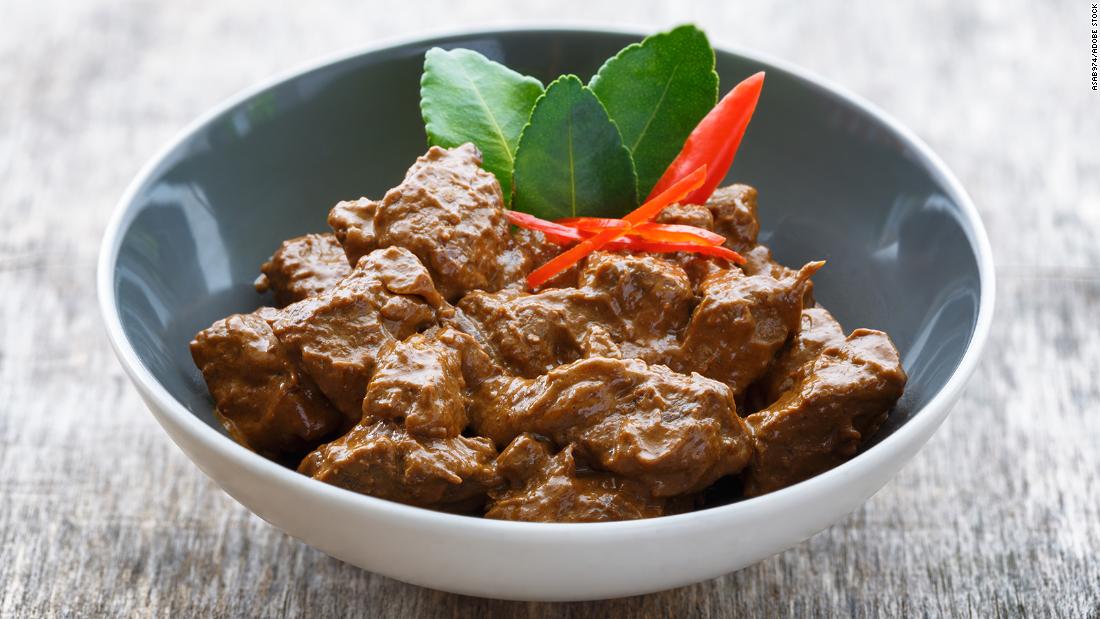
Beef rendang is unbelievably tender. The beef is coated with dry curry that has been stewed for hours.

Beef rendang is unbelievably tender. The beef is coated with dry curry that has been stewed for hours.

asab974/Adobe Stock

It isn’t an exaggeration to say that beef rendang is one of the world’s most flavorful foods.

A dry curry dish linked to the Minangkabau ethnic group, which is indigenous to West Sumatra, rendang is a great way to preserve meat — essential for the Minangkabau people during their travels.

There is no one recipe for rendang. “In West Sumatra, there are about 900 districts and each has their own style of rendang,” says Wongso.

But one of the most common meats to appear in rendang is beef. It’s stewed in coconut milks and spices including lemongrass, galangal, garlic, turmeric, ginger and chiles for hours until the meat is unbelievably tender and the curry mixture is reduced to a relatively dry coating around the meat.

Tempeh

A rising star in plant-based diets around the world, tempeh has in fact been a constant in Javanese culture for more than four centuries.

The low-fat, high-protein meat substitute is made of soybeans fermented in banana leaves — and sometimes, other leaves — for two to three days before it turns into a white moldy and chunky block.

Its flavor is often described as nutty and mushroom-y with a slight sweet soy scent.

It can be cooked the same way as any meat — baked, fried, grilled or boiled into different dishes. In Indonesia, it’s often deep-fried and served as a tasty snack.

Satay

A staple at Southeast Asian restaurants around the world, satay — or sate in the local tongue — is said to have originated in Java.

Preparation of these skewers varies from region to region, often featuring different meats or vegetables, spices, sauces and marinades.

One of the most loved versions in Indonesia is satay chicken served with a sweet peanut sauce that has just a hint of spice.

Nasi goreng

Nasi goreng: So much more than just fried rice.

Nasi goreng: So much more than just fried rice.

Jairson/Adobe Stock

If there’s one staple that represents Indonesia’s multi-faceted culture, it’s nasi goreng — literally translated as fried rice.

Each household has a different recipe made with various ingredients and sides, but the use of terasi (shrimp paste) and kecap manis (a sweet and thick Indonesian soy sauce) unite most — if not all — versions.

These condiments create Indonesian fried rice’s unique taste.

Topped with a perfect sunny-side-up egg and a side of crunchy shrimp crackers (or kerupuk), nasi goreng is a versatile meal consumed throughout the day.

A dish influenced by Chinese cooking, nasi goreng is as popular in Singapore and Malaysia as it is in Indonesia.

Kerupuk

While prawn crackers are commonly found in several countries’ diets — especially in Indonesia and Malaysia — it was thanks to Indonesia that the snack was introduced to the Dutch and then brought to Europe.

Arguably the best sidekick to any dish, a piece of kerupuk can also serve as an edible spoon to scope up extra sauce or sambal.

Indonesian kerupuk is also used as a topping for soto — a type of Indonesian soup. (See below)

Soto Ayam

Similar to many other dishes in Indonesia, soto, or soup, tastes different depending on which part of the archipelago you are in.

One of the most commonly featured soto on Indonesian menus is the comforting soto ayam (chicken soup) — but that too, comes in countless variations.

Among all the chicken sotos, the ones from East Java — such as soto ayam Madura or Ambengan — are some of the most popular. They have a clear broth and include a generous amount of garlic, shallots, turmeric and chunks of chicken meat.

Koya powder, a unique mix of grounded prawn crackers and fried garlic, is sometimes added to give the already-rich soup — such as soto ayam Lamongan — an extra umami boost.

Gado gado

A classic gado gado is served with chopped vegetables, an egg and sometimes, slices of tofu or tempeh. It is often dressed with roasted peanut sauce.

A classic gado gado is served with chopped vegetables, an egg and sometimes, slices of tofu or tempeh. It is often dressed with roasted peanut sauce.

galitskaya/Adobe Stock

Chop up blanched vegetables, hard-boiled eggs and add a ladle of peanut sauce and you have the humble but tasty Indonesian national salad — gado gado.

A classic Indonesian peanut sauce for gado gado is made with ground roasted peanuts, chiles, shrimp paste, tamarind pulp or juice and some sugar and salt.

Translated as mix mix, this ubiquitous salad dish sometimes includes slices of fried tofu or tempeh as well as deep fried fish cakes.

Sambal

Sambal may not be one of Indonesia’s five official national dishes — alongside nasi goreng, rendang, soto, sate and gado gado — but no meal is complete without it for many Indonesians.

It’s a relish made by mixing chile peppers with a host of different ingredients such as shrimp paste, sugar, salt and lime juice.

Today, you can find it in many renowned Indonesian dishes — from nasi goreng to gado gado.

Legend has it that Portuguese and Spanish sailors brought a variant of chile peppers to Indonesia — but it was in Java that they were first pounded into sambals.

It’s believed there are more than 100 styles of sambal served across Indonesia. One of the most common is sambal terasi, which is made with chile peppers, garlic, tomatoes, shrimp paste, limes, salt and sugar.

Indomie

Not technically a dish but it might just be the country’s most famous food brand.

Wowing the market since 1972, Indomie’s flavorful and convenient packaged noodles have amassed a huge following worldwide.

If you’re an Indomie newbie, start with a packet of Indomie mi goreng (barbecue chicken) and you’ll likely be converted as well.

Jamu

Jamu is a concentrated herbal drink made with ginger and turmeric.

Jamu is a concentrated herbal drink made with ginger and turmeric.

galitskaya/iStockphoto/Getty Images

When Indonesian President Joko Widodo was asked about the secret to his good health during the Covid-19 pandemic, he cited jamu.

A traditional Indonesian herbal drink made from various combinations of plants and spices — ginger and turmeric are two common ingredients — jamu is believed to boost one’s immune system.

There are many ways to make jamu.

The plants and spices are blended into a concentrated juice and it’s often served warm.

The president also said that he has been drinking it daily for the last two decades and boosted his daily jamu consumption to three times per day during the pandemic.

In recent years, jamu-inspired juice brands have been popping up around the world.

Babi guling

There are a few things that make us dream of Bali — the pristine beaches, the endless rice fields and, for some, babi guling, the vacation island’s famed roasted suckling pig.

The animal is rubbed with turmeric and stuffed with a spice paste made up of coriander seeds, lemongrass, Asian lime and salam leaves, chilies, black pepper, garlic, red shallots, ginger and kencur. Then, it’s roasted on a spit.

Every part of the pig — meat for satay, juicy pork slices, crispy crackling as well as the richly flavored intestines — will be enjoyed.

It’s mostly served with rice, spicy soup and a series of condiments.

The dish is rarely seen in the rest of Indonesia, where a majority of the population is Muslim and considers pork consumption haram, or forbidden. On Bali, most people identify as Hindu.

Rijsttafel

And lastly, one can’t forget about rijsttafel, or rice table, in Dutch.

It’s an elaborate spread of small Indonesian plates featuring different tastes and levels of spiciness in one meal.

Rijsttafel is technically not part of traditional Indonesian food culture. It was first introduced during Dutch colonial rule in Indonesia, when the Europeans would serve small plates of sumptuous Indonesian dishes — from sweet to spicy — to their visitors.

It’s still a common offering at Indonesia restaurants in the Netherlands as well as in its country of origin.

According to Wongso, rijsttafel culture is one of the reasons many traditional Indonesian dishes grew popular outside of Asia.