

Virginia Sole-Smith on Kids, Weight, and Healthy Eating

Virginia Sole-Smith on Kids, Weight, and Healthy Eating

In an early episode of her podcast, Burnt Toast, Virginia Sole-Smith joked about starting a regular segment called “Can my kid eat that?” where the answer would always be “Yes!” A self-described anti-diet journalist, she wasn’t really joking: “I get a version of this question every single week, so I’m going to keep answering it.” How many days per week can a 2-year-old eat ice cream? “There are seven days in a week. Your child can have ice cream seven days a week. There is no law against this.” What about a 13-year-old who, left to their own devices, would eat an entire box of Oreos? “Pour a glass of milk — so they can dunk them?”

“Oreos come up a lot, man,” Sole-Smith says, laughing while snacking on a bowl of Cheez-Its in her home office in the Hudson Valley. “I mean, I like Oreos fine, but it’s really the fact that you’re not letting yourself have Oreos that makes it feel like Oh my God, I’ll be powerless over them.” She seems more amused than exasperated, though she finds herself repeating this point often — that restricting food only makes us more obsessed with it. A 41-year-old mother of two, she knows her generation has been programmed to believe that allowing their kids unlimited access to sugar and processed foods is unhealthy or even bad parenting. A central premise of her work is that, actually, it isn’t.

I’m a parent of a toddler, and my Instagram feed is full of advice from pediatric dieticians and guides for introducing your baby to kale and branzino. When I first came across Sole-Smith’s newsletter about how we’d all be better off if we chilled out about what’s in our kids’ lunch boxes, it felt like a relief. Since launching Burnt Toast on Substack in 2021, Sole-Smith has gained a following among millennials who recognize that they’d rather not pass on their screwed-up relationships with food and with their bodies to their kids. “We all know the diet culture we grew up with in the ’80s and ’90s did a lot of damage. We don’t want to be like our moms with their point counting,” she says. The problem is that most parents are still deeply afraid of having fat kids.

After publishing her first book, The Eating Instinct, about the U.S.’s cultural relationship to food, Sole-Smith heard from a lot of parents who were trying to do better. “It was clear that they really wanted their kids to feel good about their bodies and have a healthy relationship with food and not get eating disorders — but also to be thin,” she says. It’s not hard to understand why: Her reporting documents the many ways the world is horrible to fat people — children included. But she’s convinced that real progress isn’t possible until we all start to recognize and unlearn our anti-fat bias. Her new book, Fat Talk: Parenting in the Age of Diet Culture, argues that if we really care about raising healthy and happy children, we need to get over our fear of fatness.

Even before my daughter was born, doctors instilled in me the fear that I might make her too big. When I was diagnosed with gestational diabetes, my OB warned that if I didn’t follow a strict diet, the baby would gain too much weight, putting us both at risk for birth complications. The assumption that weight corresponds directly with health is reinforced at every pediatrician appointment, which typically begins with a weigh-in and assessment of where your child falls on the growth chart. And if it weren’t already clear where doctors stand, the American Academy of Pediatrics recently doubled down on its commitment to fatphobia: The organization’s new obesity guidelines recommend diets for kids as young as 2 and weight-loss medication and surgery for adolescents.

If you’ve grown up alongside messaging about the “childhood-obesity epidemic,” it may come as a surprise that the link between weight and health is far less straightforward than we’ve been led to believe. In Fat Talk, Sole-Smith lays out a robust body of research debunking the idea that high body weight alone is a cause of negative health outcomes. “The real danger to a child in a larger body is how we treat them for having that body,” she writes. That’s because it is clear that experiencing weight stigma is associated with all sorts of health issues including heart disease, diabetes, and high cholesterol. Making kids (or anyone) feel bad about their weight — including subjecting them to weight-loss interventions — is not only cruel but demonstrably bad for their physical and mental health.

Sole-Smith wants her readers to understand that there’s no harmless way to keep pursuing thinness — for your child or yourself. She knows it’s a tough pill to swallow. Her inbox is full of emails from women who read her newsletter but find themselves getting stuck. “A lot of them say, ‘I totally get what you’re saying. I don’t want to discriminate against people. But I personally cannot give myself permission to be fat, because I feel better if I’m thin,’” she says. “They’ll attribute it to health, but what they really mean is ‘Society makes my life easier when I’m thin.’”

By obsessing over thinness, Sole-Smith argues, we’re complicit in upholding a pervasive system of oppression with deep roots in racism and classism. But somehow, reading her work still feels more comforting than confrontational. She wants to help us recognize our biases — not to make anyone feel bad. “If I make every thin white woman feel like shit, they’re not going to engage and we’re not going to get anywhere,” she says. Sole-Smith knows that fatphobia is all around us, and she’s not offended by the fact that most people have internalized it. “I try to help people understand that it’s actually not about you,” she says. “I really fundamentally believe it’s a ‘hate the game, not the player’ situation.”

Her own evolution on these topics has been a multi-decade process. She grew up in Connecticut, where her dad was a political-science professor at Yale and her mother worked in insurance. As a thin kid, she didn’t feel like her body was viewed as a problem. “I was a really picky eater,” she says. “I lived on, like, spaghetti, peanut butter and jelly, turkey sandwiches, and strawberry yogurt until I was about 12.” She feels lucky her parents weren’t pushy or panicked about it. But she still had the sense that for the adults in her life, weight was something they had to think about a lot and manage. “When I came home from my freshman year of college, both my parents noticed in subtle ways that I had gained weight,” she says. “They weren’t harsh about it, but it was like, ‘Oh, your shorts are fitting differently.’”

After graduating, Sole-Smith spent the early 2000s writing weight-loss stories for women’s magazines like Glamour and Marie Claire. “That was a time where we weren’t calling them diet stories anymore. We were calling them ‘wellness’ or ‘portion control.’ ‘Eat smarter.’ ‘Eat whatever you want but not sugar,’” she says. Even then, advising women on how to change their bodies didn’t sit right with her. But her real shift of perspective came after her daughter Violet was born in 2013. At 1 month old, Violet stopped eating as a result of medical trauma and had to be put on a feeding tube.

Over the next year, Sole-Smith and her husband struggled to help their infant regain interest in food. “I’d spent my whole career trying to map out rules for how we eat,” she says. “They were all predicated on the idea that someone else knows better than you and if you follow these rules, you will be thin, you will be happy, everything will work.” But when Violet refused to nurse or take a bottle, even her doctors were at a loss. In the end, the approach that worked wasn’t about pressuring or rewarding her to eat. Instead, they had to help Violet relearn how to listen to her internal hunger cues — and trust her to decide when and how much she wanted to eat.

Trusting children to listen to their bodies is now a defining principle of Sole-Smith’s work. Having a baby with a feeding disorder, she learned firsthand that “obsessing over it doesn’t fix it — it makes it worse.” Even for parents fighting far more mundane dinner-table battles, research shows that exerting too much control over what your kid eats — whether it’s pressuring them to eat vegetables or restricting sweets — usually backfires. So what does “healthy eating” for kids look like? When it comes to feeding her daughters, who are now 9 and 5, Sole-Smith’s priority is respecting their autonomy. “It’s the power to say no, to be curious and try new things, and to decide when and how much they want to eat.”

Photo: Yael Malka

She has accepted that the reality of life with young children is sometimes that they eat Cheerios for three meals per day, and it’s fine. “Vegetables are the least important part of it to me,” she says. “They have their whole lives to decide if they want to eat kale.” Her pantry is stocked with Puff’d Cheez-Its, Extra Toasty Cheez-Its, and Goldfish — “Yes, that’s three different kinds of orange crackers” — plus Girl Scout cookies and Chewy chocolate-chip granola bars. A handwritten list of “Family Dinner Rules” hanging in the kitchen includes “No pressure/Listen to your body” and “You don’t have to earn dessert.” It’s not that she doesn’t care at all about nutrition, but she’s convinced that fixating on it leads nowhere good. “We know from research that the nutrition piece tends to work itself out,” she says. “If we’re serving a variety of foods, over the course of a week, kids will hit a lot of different food groups.”

That moms make up the majority of Burnt Toast’s 28,000 subscribers isn’t surprising. “Women are held to more rigid body ideals and parenting ideals,” Sole-Smith says. “We’re socially conditioned to be the ones who make the meal plans and worry about picky eating, and then worry when the pediatrician says they’re too high on the growth chart.” Fat Talk makes clear that our dysfunctional relationship with food is tightly wound up in misogyny and assumptions about motherhood. According to Sole-Smith, in almost every interview she has done with someone who struggled with disordered eating, they mention something their mother said or did that made things worse.

That’s not to say dads have no role in this: Sole-Smith writes that when she asked her readers what was stopping them from taking a nonrestrictive approach to food with their kids, the most common answer was “my husband.” She says a lot of the pushback she gets comes from men. “It’s like a greatest-hits album that they play: ‘It’s bad parenting.’ ‘It’s lack of willpower.’ ‘It’s people who are lazy and don’t care about eating well or exercising.’”

“I sometimes joke that my role in all this is to bring the thin white women along,” Sole-Smith says. It doesn’t bother her that her audience is mainly women: They’re the ones who are open to the change she’s advocating, which is deceptively radical.

For me, the permission to stop stressing about how often my 2-year-old eats only French fries for dinner has been a welcome relief. But after years of telling myself to just eat salad or jog a few more miles, I know I’m still a long way from viewing my body or my daughter’s with anything approaching neutrality. Truly relinquishing control is hard to do. “If you give up chasing weight loss, you invite in all of the shit that comes with being a fat person or even with being a less-thin person,” Sole-Smith says. But she has convinced me that it’s worth it to keep trying. The way she sees it, it’s really about the willingness to give up a little bit — or a lot — of privilege. She knows that’s scary. “But it’s also incredibly liberating.”
New Restaurant Will Link Himalayan Food, Culture, Art, Religion

New Restaurant Will Link Himalayan Food, Culture, Art, Religion

New Restaurant Will Link Himalayan Food, Culture, Art, Religion

By ELIZABETH COOPER
COOPERSTOWN

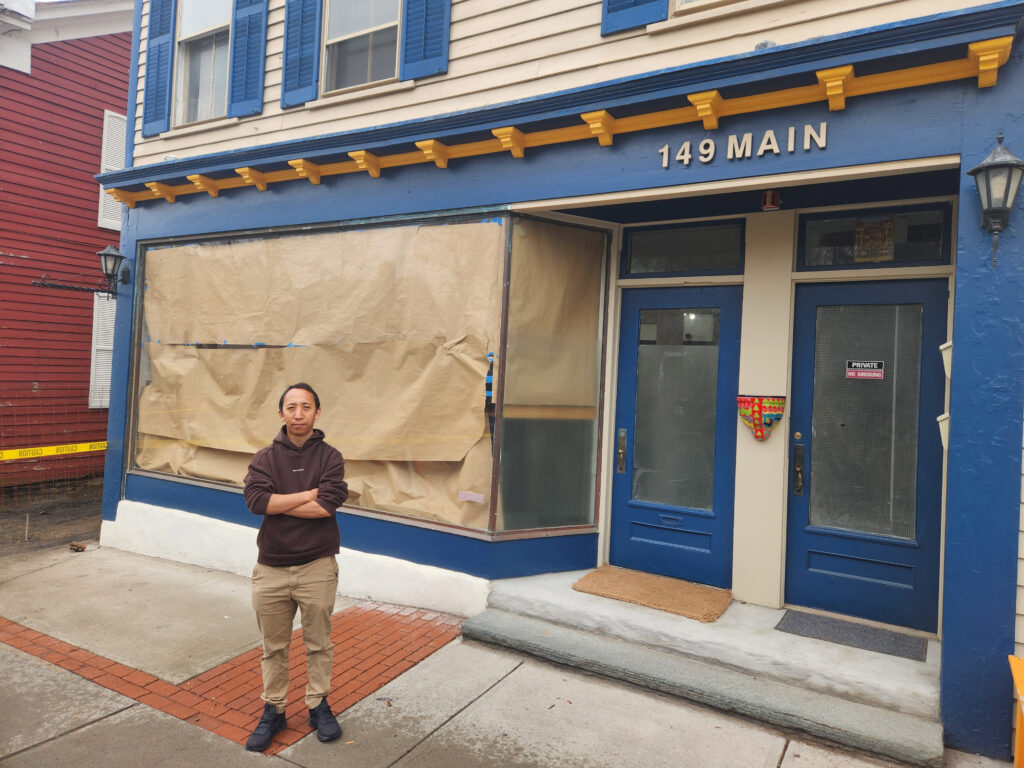
It has been more than a year since Alex’s World Bistro on Main Street closed its doors, but the spring sunshine has awoken more than the flowers this year.

The long empty storefront is suddenly a hive of activity. Contractors, an attorney and even a small child could be seen there on a recent Wednesday.

It’s all part of the next segment in the life journey of a Nepalese man who started out as a shepherd boy in a remote village without electricity or cars.

Nawang Gurung will be opening his restaurant, Norbu, in May. It will feature Nepalese and Indian food and he hopes it will also be a place where people can learn about Himalayan culture, art and religion.

He and his partner, Diki Bista, have two young daughters and they want them to grow up in a beautiful, natural surrounding like this one.

“I feel like it’s a home away from home,” he said of Cooperstown and his Himalayan homeland. “It’s like moving back to the mountains, compared to New York City.”

Norbu means jewel in Tibetan.

“For us, Cooperstown is a jewel and precious,” he said.

To Gurung, food, culture and art are linked and he wants to share it all. Norbu will be decorated with photographs of his homeland, and he is particularly excited to serve momo, a form of Nepalese dumpling.

“It is kind of like a Japanese gyoza,” he said. “In Tibet it has become a very popular food in the mountain areas.”

Cooperstown Chamber of Commerce Executive Director Tara Burke said residents and business owners were eagerly awaiting the restaurant’s opening.

“Alex’s was a beloved spot for locals,” she said. “I think there is a lot of excitement and questions about who is going into that space and what they will offer. It’s going to be a great, diverse option.”

As for Alex Webster, former owner of Alex’s, he said he “could not be happier” to see Gurung taking over the space.

“They seem like wonderful people and I am thrilled with the plans for the restaurant,” he said. “I am excited that in many ways they will continue in my effort to bring exciting, fun, quality food to the area.”

Alex’s old bar, made from sections of a bowling alley, remains in place and Gurung is in the process of getting a liquor license.

Here Because of Chocolate

Gurung’s unlikely trajectory from the mountains of Nepal has taken him through Dallas, Boston, New Haven, and New York, with time logged in some of America’s greatest universities, and the dining rooms of a number of Indian restaurants. He has worked for scholars and non-profits, but also waited tables to support himself and his family members back home.

It all began with the hope for a piece of chocolate.

“Chocolate was the only English word I knew,” said Gurung, now 37. “I am here because of that chocolate today.”

His village in the Mustang region of Nepal had been closed to tourists because of its holy connection to Buddhism, but that changed in the early 1990s when he was still quite young. Gurung and the other local children loved the chocolate that some of the outside visitors gave them and would ask for it whenever they could.

One day when 8-year-old Gurung was tending his flock of about 200 goats and sheep, he spotted a European man who seemed a likely prospect. The man didn’t have any chocolate, but he offered something that turned out to be far better. Charles Ramble was a professor of Tibetan culture at Oxford University. He spoke Nepalese and took a shine to little Gurung. He soon met Gurung’s parents and offered to take the boy to Kathmandu to get an education. They declined, but when Ramble returned a year later they accepted.

Gurung did well at the school and became interested in the study of culture and religion. After graduating he worked as an assistant for an American Fulbright scholar in Kathmandu. He then worked for an organization helping people with tuberculosis while searching for the next opportunity.

Because of his interest in religion, Gurung applied to a Baptist university in Dallas, Texas, but when they required him to be baptized in order to continue his scholarship he declined and had to leave.

Next, he went to Boston, because he had heard of Harvard University there. He couldn’t afford it and instead went to a community college nearby while working at an Indian restaurant frequented by Harvard students. They liked him and soon they were helping him sneak into classes so he could learn there.

Later he did the same in New Haven at Yale. Along the way, Ramble introduced Gurung to a Dartmouth professor, whom he briefly worked for doing research. He finally applied and was admitted to Columbia University, where he planned to major in cultural anthropology, but soon realized his small scholarship would not be enough to live on if he was to continue sending money home.

Instead of attending, he started his own project, Voices of the Himalayas, which seeks to document cultural change in Nepal, Tibet and other parts of the region. That work was funded by Dartmouth and other foundations. Later, he started working with young people from the Himalayas who live in New York, teaching them about their heritage. He is also working to document the experience of Himalayan people during the pandemic.

To Cooperstown

Gurung learned of Cooperstown from Daniel Kaufman, a linguist at Queens College whose family owns property near Fly Creek.

The two were good friends and Kaufman had mentioned Cooperstown to Gurung several times.

Gurung said it wasn’t until fall of 2022 that he considered coming up to see the place for himself after a dinner with Kaufman in Brooklyn. Starting fresh seemed more appealing to Gurung, because he had invested much of his savings in a childcare center Bista was hoping to operate, but COVID-19 had struck and the business was having difficulties.

So he and Bista hired an Uber and came up to have a look. He then spotted the empty Alex’s space and in short order put in a bid.

“It was one of the most impulsive acts I have ever seen in my life,” Kaufman said. “He wasn’t looking to move here, but he visited Alex’s and he bid on it. It was extremely spontaneous.”

Gurung, however, says there were many hints that Fate was at work.

“Always things [about Cooperstown] kept coming up,” Gurung said of the time after the Brooklyn dinner. “It was a karmic connection.”

It didn’t hurt that baseball is full of numbers that have significance in Buddhism. Nine innings, three strikes, four balls, 108 stitches on the ball.

“One hundred and eight is a very precious, holy number,” he said.

Kaufman said he had even suggested Gurung make a momo in the form of a baseball.

“I regularly come up with absurd ideas like that and usually people brush them off,” Kaufman said. “He decided he would give it a try!”

Gurung said it might be harder than he thought.

“It might be challenging,” he said. “I tried to do research on that.”

Whatever their form, Gurung will make sure they are delicious, he said.

People Are Sharing The Budget Meals That Get Them Through When They’re Low On Funds

People Are Sharing The Budget Meals That Get Them Through When They’re Low On Funds
“Broke ‘Til Payday”: People Are Sharing The Budget Meals That Get Them Through When They’re Low On Funds

A one-bowl almond cake recipe that’s nutty and not too sweet

A one-bowl almond cake recipe that’s nutty and not too sweet

Almond Cake

Active time:15 mins

Total time:1 hour 10 mins

Servings:10 to 12 (makes one 9- or 10-inch cake)

Active time:15 mins

Total time:1 hour 10 mins

Servings:10 to 12 (makes one 9- or 10-inch cake)

This recipe comes from the Eat Voraciously newsletter. Sign up here to get one weeknight dinner recipe, tips for substitutions, techniques and more in your inbox Monday through Thursday.

I rarely mention sweets in this column because it’s primarily about interesting, adaptable and relatively easy dinner-appropriate recipes. But this week we’ve gone off script in honor of my one true love, pastry. To celebrate eating voraciously and as a special treat, I’m sharing one of my favorite cake recipes ever. It’s a one-bowl almond cake that comes together quickly, requires fewer than 10 ingredients and takes less than an hour to bake.

It’s a recipe I learned when I worked in restaurant kitchens in college, and I have since adapted it to be buttery and nutty but not too sweet. I make it often, for fancy dinner parties or weekend snacking, birthdays or brunches. I was reminded of it earlier this year when I tasted a similar cake at the Duck and the Peach in D.C.’s Capitol Hill neighborhood. That night, my friend and I went all in on pastry chef Rochelle Cooper’s desserts.

This is a longtime habit of mine. Whenever I go out to dinner, there’s a good chance I’ll ask my dining companion to linger a little longer at the table with me so I can order the entire dessert menu. Sometimes I’ll do it when I’m dining alone, but it’s more fun to share. I love the drama of it, the glee, the way the server at first thinks I’m joking, the way a procession of plated desserts through a dining room causes other diners to turn their heads, the way the table looks when it’s covered in cakes, tarts, custards and all sorts of sweet pastry.

This habit started in high school, continued through college and then cemented itself in my life when I went to pastry school and began working as a pastry chef in New York. My first pastry assistant job was at a Midtown restaurant that was known for its desserts. The chef and owner paid close attention to the pastry department. He (rightly!) believed that last impressions were important. When a table of his friends or investors or some other Very Important People came in to dine, he’d make sure they finished their meal with what he called a “Dessert Storm” — he would tell the server to order all of the desserts on the menu for that table and then, as the pastry department scrambled to plate everything, he’d flicker the lights in the kitchen on and off, mimicking a thunderstorm’s lightning.

On an adrenaline high, I loved the rush of sending out so much dessert, loved peeking into the dining room to see the diners murmur and gush with delight as the plates landed on the table, loved watching their lips curl into smiles as they took a bite.

At the next restaurant I worked at, the chef didn’t pay as much attention to dessert. He didn’t ask to taste our latest experiments or order rounds of dessert for his favorite tables. The servers preferred to sell cocktails and wine; dessert was an afterthought. What bummed me out the most was when I would be standing in front of my station, ready to plate dessert for the last few tables around midnight or 1 a.m., and a server would come into the kitchen to say the diners were too full for dessert. Crushed, I’d (often) have to toss all of my prep — the unbaked souffles, the freshly made pastry shells, the delicate cakes and cookies, the sauces, the ice cream and sorbet.

That’s when I realized that ordering the whole dessert menu wasn’t just fun for me and my friends. It was also a way to support pastry chefs, their creativity and their labor. So, when you’re out to dinner, especially if it’s a special occasion, if you’re physically and financially able, don’t skip dessert. There’s probably a pastry cook in the back of the kitchen hoping against hope that you’ve saved some room.

And the next time you’re in the mood for cake at home, give this almond cake recipe a try. Everyone I’ve ever made it for has loved it. Unlike a lot of almond cakes, it doesn’t sink in the center but stays evenly aloft after it cools. It needs no frosting, though you could turn it into a layer cake with vanilla buttercream and strawberry or peach jam filling. Its adaptability and plush density make it easy to love — and ensure it keeps well on your counter for a few days. A dollop of crème fraîche or whipped cream is nice on the side, though it’s not necessary. I love serving it simply with fresh, roasted, macerated or sauteed seasonal fruit.

  • This recipe will work with vegan butter, but I have not tested it with a vegan egg substitute.
  • If you can’t find almond paste >> you can make it.
  • I love this cake with fruit in every season: fresh citrus in the winter, lightly sugared berries in the spring, fresh or roasted stone fruit in the summer, and sauteed apples or pears in the fall.

Want to save this recipe? Click the bookmark icon at the top of this page, then go to Saved Stories in My Post.

Scale this recipe and get a printer-friendly, desktop version here.

  • 16 tablespoons (2 sticks/226 grams) unsalted butter, at room temperature, plus more for greasing the pan
  • 7 ounces (198 grams) almond paste, at room temperature
  • 3/4 cup plus 2 tablespoons (175 grams) granulated sugar
  • 1 teaspoon baking powder
  • 1/2 teaspoon almond extract
  • 1/4 teaspoon fine salt
  • 6 large eggs, at room temperature
  • 1 1/4 cups (155 grams) all-purpose flour, sifted
  • Powdered sugar, for serving (optional)
  • Fresh or cooked fruit, for serving (optional)

Position a rack in the middle of the oven and preheat to 325 degrees. Lightly grease a 9- or 10-inch cake pan, line the bottom with parchment and lightly grease the parchment.

In a stand mixer fitted with the paddle attachment, or using a large bowl and a handheld mixer, beat the butter, almond paste, sugar, baking powder, almond extract and salt on medium speed until well combined and smooth, about 5 minutes.

Add the eggs one at a time, beating well after each addition. Stop to scrape down the bowl a few times to ensure the batter is well combined. After you’ve added the last egg, scrape down the bowl again and beat the batter on medium speed for about 30 seconds. It will look slightly separated at this point, and that’s normal.

If using a stand mixer, unlock the bowl. Using a silicone spatula, partially fold in the flour. Relock the bowl and mix on low speed just until the batter looks smooth, about 30 seconds.

Transfer the batter to the prepared pan and, using a small offset spatula or butter knife, smooth the top. Bake for 40 to 55 minutes, or until the cake springs back when lightly pressed in the center and the top is deep golden brown. (It will take longer to bake if you use a 9-inch pan and less time in a 10-inch pan.)

Cool in the pan on a wire rack for 30 minutes, then invert the cake onto the rack, remove the parchment paper and turn right side up. Allow to cool about 20 more minutes, or until slightly warm. Serve immediately or at room temperature with powdered sugar and fresh or cooked fruit on top or on the side, if desired.

Per serving (1 slice), based on 12

Calories: 350; Total Fat: 22 g; Saturated Fat: 11 g; Cholesterol: 134 mg; Sodium: 119 mg; Carbohydrates: 33 g; Dietary Fiber: 1 g; Sugar: 21 g; Protein: 6 g.

This analysis is an estimate based on available ingredients and this preparation. It should not substitute for a dietitian’s or nutritionist’s advice.

From staff writer G. Daniela Galarza.

Tested by G. Daniela Galarza; email questions to voraciously@washpost.com.

Scale this recipe and get a printer-friendly, desktop version here.

Browse our Recipe Finder for more than 10,000 Post-tested recipes.

Did you make this recipe? Take a photo and tag us on Instagram with #eatvoraciously.

Catch up on this week’s Eat Voraciously recipes:

Monday: One-Bowl Cheesy Jumbo Muffins With Prosciutto and Chives

Tuesday: Spring Onion and Ham Tart

Wednesday: Sourdough Gruyere Popovers

More recipes from Eat Voraciously

Recipes from around the world

Recipes from around the world

After a heavy dose of rich food during the Eid holidays, the body craves something simpler. Here are some recipes that you could try after the holiday season.

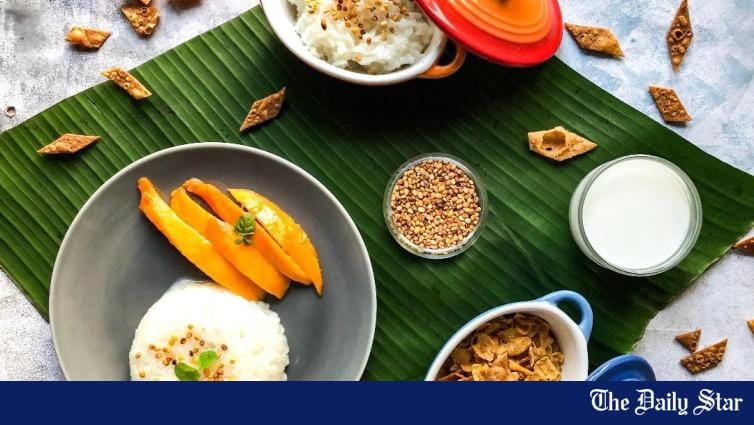
MANGO STICKY RICE

Ingredients
½ cup glutenous rice
1 cup coconut milk
½ cup coconut cream
2 tbsp sugar
1 tsp salt
For the topping —
Fried lentils (can be altered with toasted sesame seeds)
Mango slices, as per need

Method
First, cook the glutenous rice properly following the regular method (steaming or in water). Then mix in the salt, sugar, and coconut milk. Cook for another two minutes. Slice up your mangoes and keep them in the refrigerator to be able to serve cold. Once the rice cools down, on a plate, serve the rice, top with coconut cream, and mango slices. Then top with choice of crisps for texture. Add extra coconut cream on the side for extra goodness.

SUSHI BAKE

Ingredients
3 sheets fried nori (regular ones used for sushi)
3 cups cooked glutenous rice
15-17 pieces large prawns, de-veined and cleaned
2 tbsp cream cheese
1½ tbsp mayo
1 tbsp sriracha
1 tsp soy sauce
A pinch of black pepper
2 tsp vinegar

Method
First, marinate the prawns with soy sauce and pepper, for 10 minutes. Prepare rice by mixing vinegar to the cooked rice. In a bowl, mix the cream cheese, mayo, and sriracha properly. Pour that cheese mix into the prawns and mix well.

Cut the whole large nori sheets into four. Brush hands with oil, then in the nori sheets, place in 1 tablespoon of the cooked rice in the middle of the sheet. Then using your hands, place the rice properly spreading it through the corners, but leave gaps in the corners.
Take your muffin mould, brush oil in it. Then, press the nori with rice in them into the mould — they will look like flowers. After that, place in one tbsp of the prawn cheese mix into the rice cups. Bake in pre-heated oven for 18-20 mins at 175° C. Serve topping with spicy mayo/kewpie mayo, and soy sauce dip mixed with wasabi.

STREET STYLE THAI BASIL CHICKEN

Ingredients
½ chicken breast (around 200g)
5 cloves of garlic, if you like it garlicy
Red chilli, as per preference
3 tsp soy sauce, light
1½ tsp oyster sauce
1½ tsp sugar (better if adjusted as per taste)
1 tsp soy sauce (dark)
Oil
Thai basil, as per taste (Fresh mint leaves can also be used, but it will not be basil chicken by name. However, it will not differ much in terms of flavour or taste. Just make sure the mint is fresh)

Method
Cut your chicken into bite-sized pieces. Roughly crush together garlic and red chillies.

In a hot pan, add oil. Now, add the crushed garlic and chilli. This is my favourite part of the cooking, for the aroma it sets around. Stir fry that for just about a few seconds until flavours come out, and add in your chicken.

Fry the chicken for about a minute or so, and then pour in your light soy sauce, oyster sauce, sugar, and finally, the dark soy sauce. The reason for using both soy sauces is because of the depth of flavours they add individually and also to hit intricacy right!
Stir it all, and cook for about a few minutes. Right during the end, add in your basil, and give it just one stir and get off heat, because we do not want to overcook the leaves.

I highly recommend the dish with steamed rice, and oozing yolky fried egg; the yolk gives a silky texture to rice.

CRISPY FISH TACO WITH PICKLED CARROTS

Ingredients
1 fillet dory fish
1 tsp soy sauce
2 tsp oyster sauce
½ tsp pepper
1 tsp lemon juice
A pinch oregano
Tempura (A classic regular tempura batter made with ice-cold water for crispiness)
Flour, for regular tortilla
2 tbsp mayo
5-7 mint leaves, crushed
½ tsp lemon juice
½ carrot
½ cup vinegar

Method
First, slice the carrots using a peeler for a finer finish. Leave them to be pickled by taking in small glass bowl, and drenching in vinegar, a pinch of ground black pepper. Rest for at least 25 minutes.

Prep the fish by cleaning and cutting. Marinate using soy sauce, oyster sauce, pepper, lemon juice, and leave for 15 minutes. Make the tempura batter with ice cold water. Now, on the side make the tortilla with flour, water, and salt (regular taco tortilla). Once done toasting the tortillas, make the lime-mint aioli by mixing in mayo, lemon juice, and the mint with little bit of ground pepper.

Finally, fry the fish dipping in tempura batter in deep fry. Then assemble the tacos by placing first the fish, then the pickled carrots, and finally the aioli on top.

Enjoy hot and crispy. 

DATE FRAPPE

Ingredients
1 cup liquid milk
1 cup vanilla Ice cream
4-6 dates, depending on sweetness preferred
2 tsp coffee

Method
First cup the dates into smaller pieces and get rid of the seeds. Blend all the ingredients together, and serve cold.


Photo: Fatduck21

Coffee Talk Episode 2 drink recipe list and how to unlock all special drinks in Hibiscus and Butterfly

Coffee Talk Episode 2 drink recipe list and how to unlock all special drinks in Hibiscus and Butterfly

Knowing all of the drink recipes in Coffee Talk Episode 2: Hibiscus and Butterfly will help you complete the game’s storyline, as well as the Brewpad.

These special drinks not only have unique appearances, but can change pivotal plot moments in Coffee Talk Episode 2: Hibiscus and Butterfly.

Below you’ll find all of the drink recipes for the base ingredients, from Coffee to Milk, along with how to unlock all of the special drinks in Coffee Talk Episode 2 Hibiscus and Butterfly.

If you want to know where some of these special drinks appear in the story mode, then check out our Coffee Talk Episode 2 best endings walkthrough.

On this page:

Drink lists:

Coffee Talk Episode 2: Hibiscus & Butterfly – Announcement Trailer – Nintendo Switch

How to unlock all special drinks in Coffee Talk Episode 2 Hibiscus and Butterfly

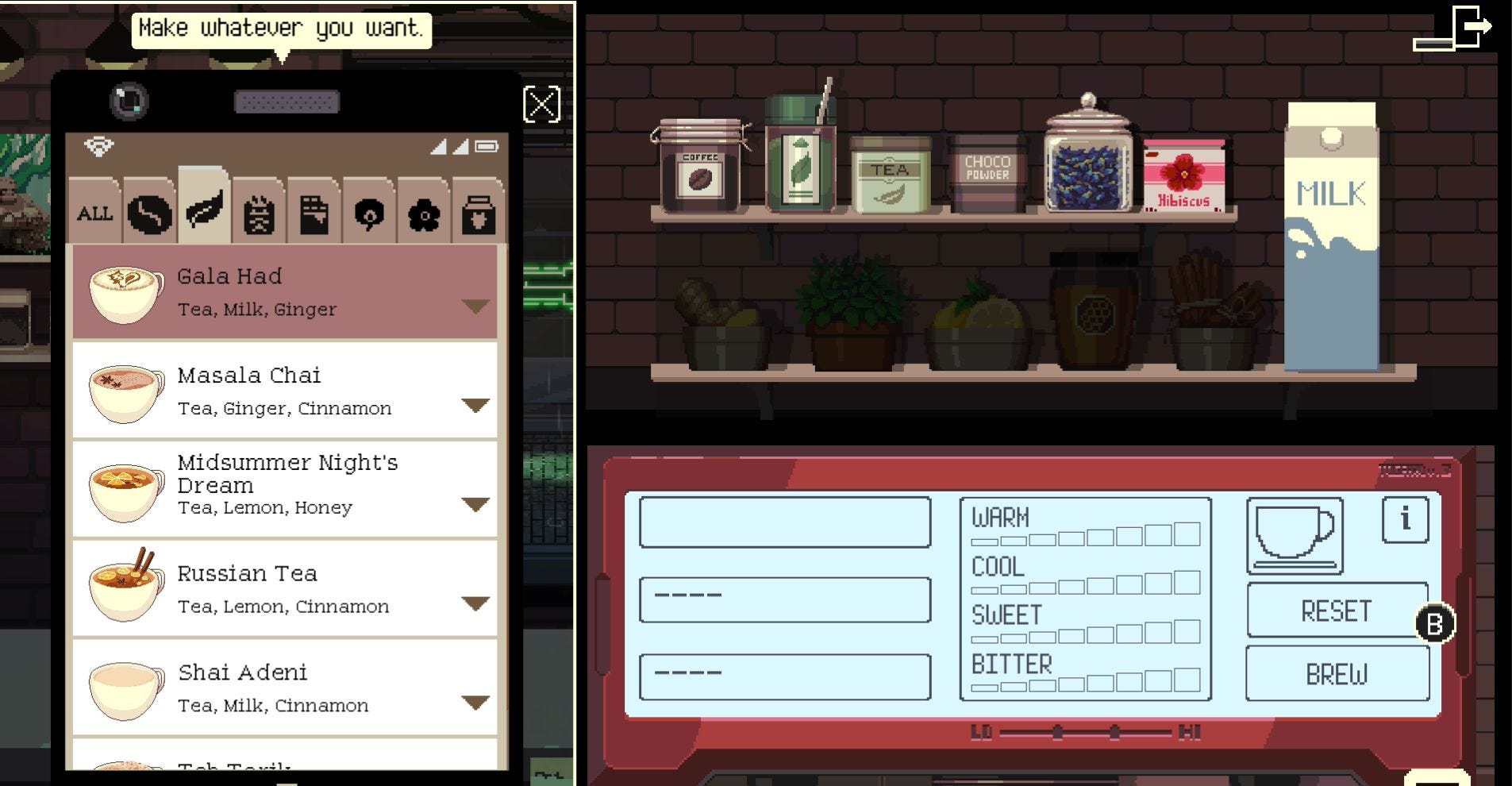
Special drinks in Coffee Talk Episode 2: Hibiscus and Butterfly refers to the drink recipes recorded in your Brewpad, which require you to put three ingredients in a specific order to make. This means that standard drinks, like Honey Chocolate, do not count as a special drink as they’re not recorded in the Brewpad.


Honey Chocolate is not considered a special drink.

You’ll know when you’ve brewed a special drink, because it will usually have a distinct appearance when compared to the standard drinks and, as mentioned, its recipe will be recorded in the Brewpad.

You also only need to brew a special drink once for it to be recorded and this can be done in the Story mode and both Endless modes – Free Brew and Challenge. So, if you’re missing a special drink from your Story mode playthrough, you can easily unlock it by jumping into Free Brew and making it without affecting the storyline.


Unlocking all of the special drinks in Coffee Talk Episode 2: Hibiscus and Butterfly will unlock the Master Brewer achievement.

Coffee-based drink recipes in Coffee Talk Episode 2 Hibiscus and Butterfly

Below you’ll find every special Coffee-based drink recipe, organised by the order they appear in the Brewpad, in Coffee Talk Episode 2: Hibiscus and Butterfly:

  • Black Lemon – Coffee, Coffee, Lemon
  • Black Magic – Coffee, Mint, Honey
  • Caffé Latte – Coffee, Milk, Milk
  • Cappuccino – Coffee, Coffee, Milk
  • Espresso – Coffee, Coffee, Coffee
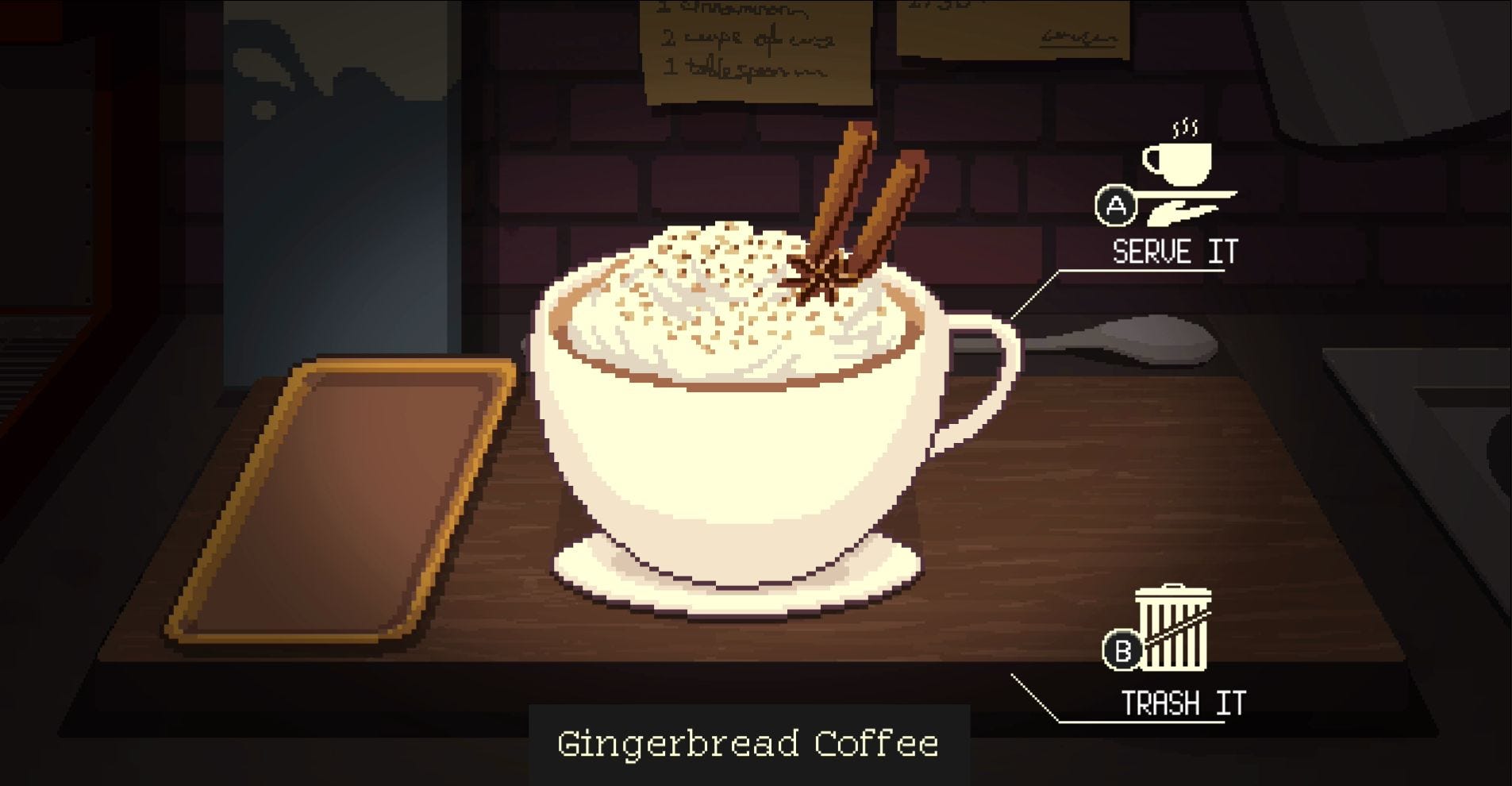
  • Gingerbread Coffee – Coffee, Ginger, Cinnamon
  • Ginger Latte – Coffee, Ginger, Milk
  • Jahe Tubruk – Coffee, Coffee, Ginger
  • Sugar and Spice – Coffee, Honey, Cinnamon
  • Bee’n Buzzy – Coffee, Honey, Milk
  • Cinnamon Latte – Coffee, Milk, Cinnamon
  • Sweet Coffee – Coffee, Coffee, Honey
  • Queimada – Coffee, Honey, Lemon
  • Jingle Bells – Coffee, Coffee, Cinnamon

Tea-based drink recipes in Coffee Talk Episode 2 Hibiscus and Butterfly

Here you’ll find every special Tea-based drink recipe in the order they appear in the Brewpad of Coffee Talk Episode 2: Hibiscus and Butterfly:

  • Gala Had – Tea, Milk, Ginger
  • Masala Chai – Tea, Ginger, Cinnamon
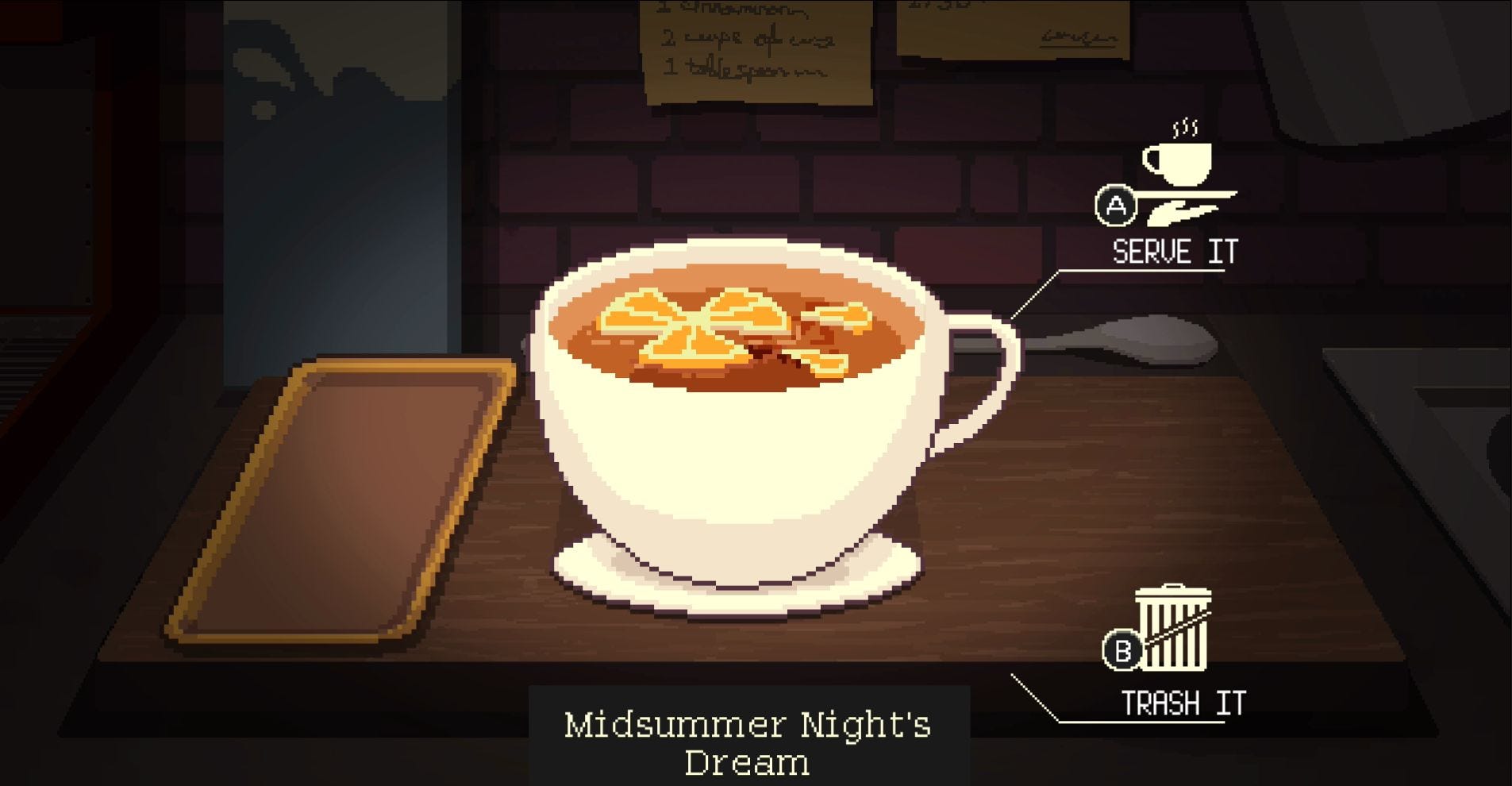
  • Midsummer Night’s Dream – Tea, Lemon, Honey
  • Russian Tea – Tea, Lemon, Cinnamon
  • Shai Adeni – Tea, Milk, Cinnamon
  • Teh Tarik – Tea, Tea, Milk

Green Tea-based drink recipes in Coffee Talk Episode 2 Hibiscus and Butterfly

Here are all of the special Green Tea-based drink recipes, listed in the order they appear in the Brewpad, in Coffee Talk Episode 2: Hibiscus and Butterfly:

  • Cough Syrup – Green Tea, Lemon, Honey
  • Green Tea Latte – Green Tea, Milk, Milk
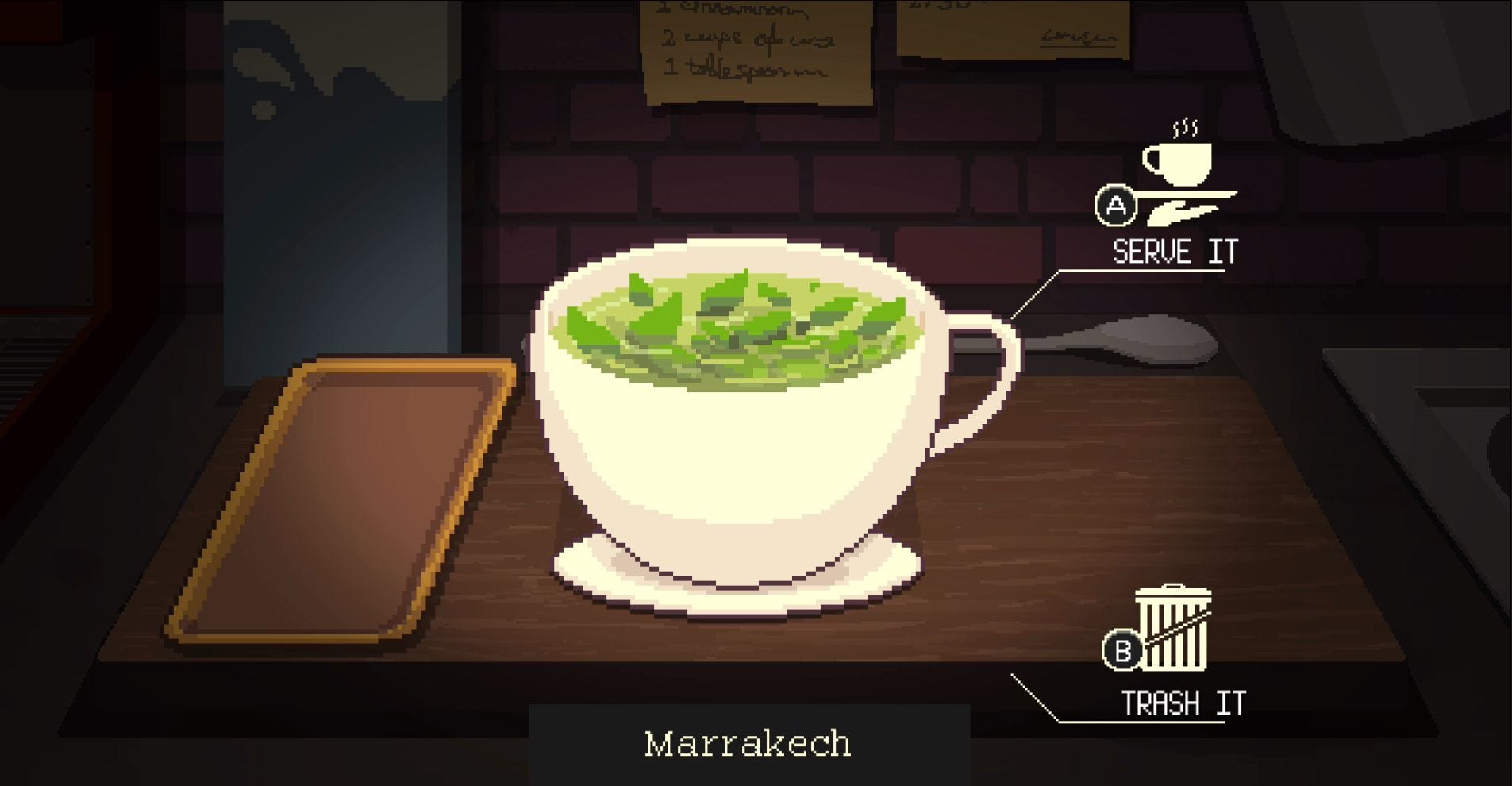
  • Marrakech – Green Tea, Mint, Mint
  • Shin Genmaicha – Green Tea, Green Tea, Ginger
  • The Grinch – Green Tea, Ginger, Cinnamon
  • Matcha – Green Tea, Green Tea, Green Tea
  • “Detox” Tea – Green Tea, Ginger, Lemon
  • “Five Stars!” – Green Tea, Honey, Milk

Chocolate-based drink recipes in Coffee Talk Episode 2 Hibiscus and Butterfly

Below lie all of the special Chocolate-based drink recipes, organised by the order they appear in the Brewpad, in Coffee Talk Episode 2: Hibiscus and Butterfly:

  • Bitter Heart – Chocolate, Ginger, Cinnamon
  • Chocobee Miruku – Chocolate, Honey, Milk
  • Dark Chocolate – Chocolate, Chocolate, Chocolate
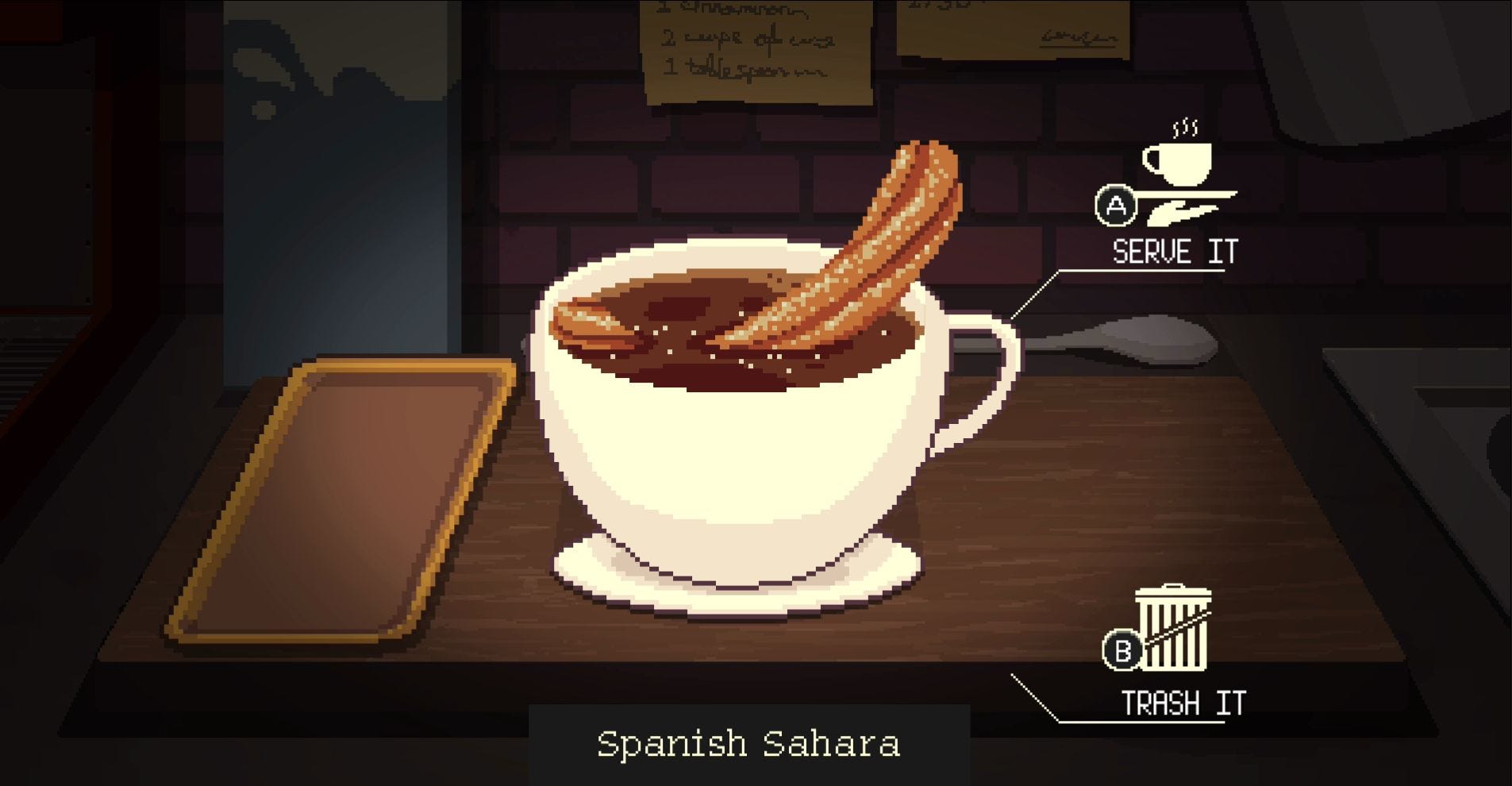
  • Spanish Sahara – Chocolate, Milk, Ginger
  • Spiced Lady – Chocolate, Milk, Cinnamon
  • 299.792.458 – Chocolate, Honey, Ginger
  • After Midnight – Chocolate, Honey, Mint

Blue Pea-based drink recipes in Coffee Talk Episode 2 Hibiscus and Butterfly

Here are all of the special Blue Pea-based drink recipes in the order they’re listed in the Brewpad of Coffee Talk Episode 2: Hibiscus and Butterfly:

  • Butterfly Pea – Blue Pea, Blue Pea, Blue Pea
  • Galaxy Mint-tea – Blue Pea, Mint, Lemon
  • Dreamin’ Blue – Blue Pea, Milk, Honey
  • Aqua’s Tranquilitea – Blue Pea, Mint, Mint
  • Blue Lightning – Blue Pea, Ginger, Ginger
  • Flowerbed – Blue Pea, Honey, Mint
  • Gala Tea – Blue Pea, Milk, Ginger
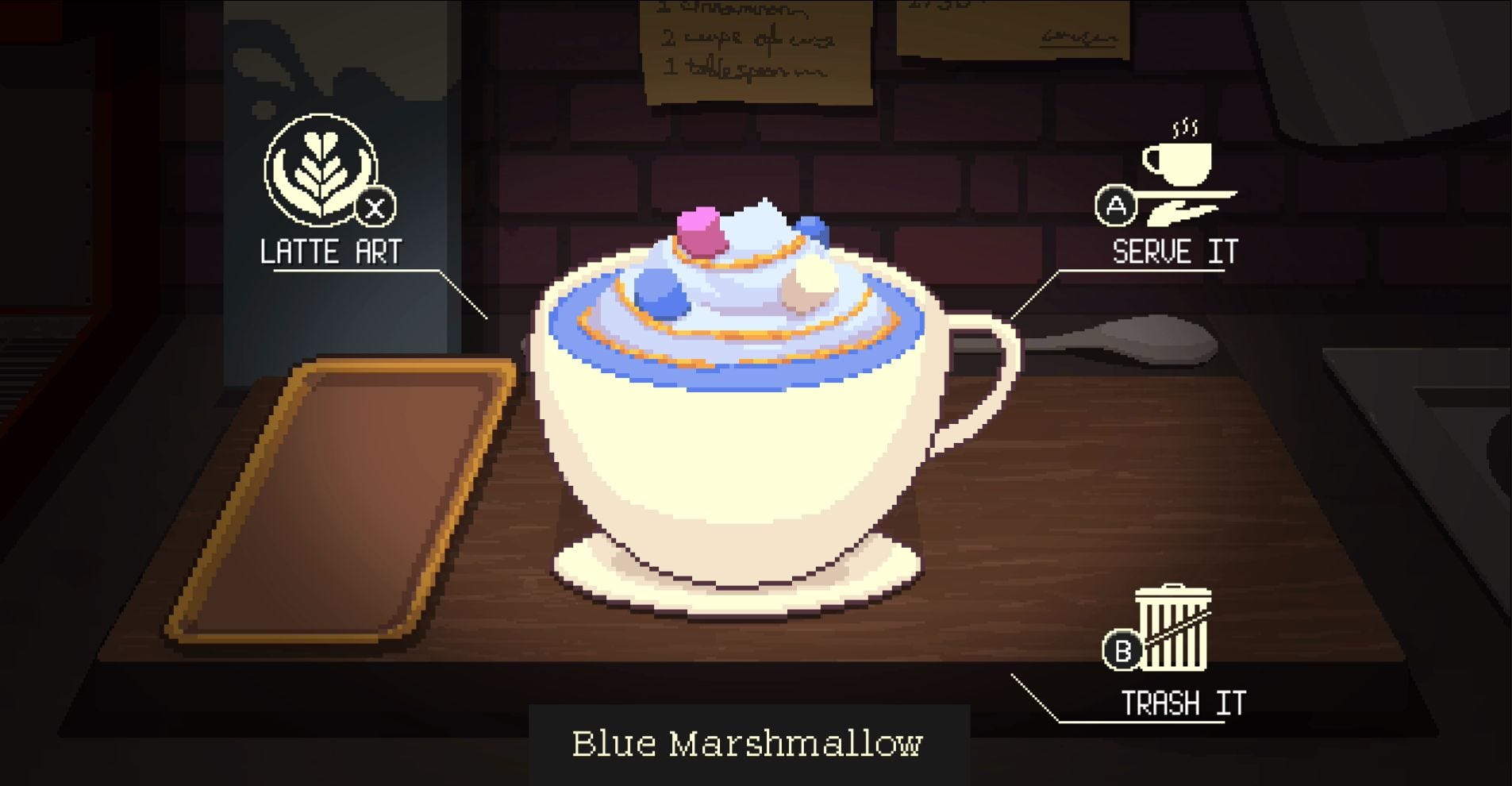
  • Blue Marshmallow – Blue Pea, Honey, Milk

Hibiscus-based drink recipes in Coffee Talk Episode 2 Hibiscus and Butterfly

Below are all of the special Hibiscus-based drink recipes, arranged in the order they appear in the Brewpad, in Coffee Talk Episode 2: Hibiscus and Butterfly:

  • Hibiscus Tea – Hibiscus, Hibiscus, Hibiscus
  • Bissap – Hibiscus, Ginger, Lemon
  • Teh Jahe Rosella – Hibiscus, Ginger, Honey
  • Sweetheart Latte – Hibiscus, Milk, Honey
  • Pink Spice – Hibiscus, Milk, Cinnamon
  • Zobo – Hibiscus, Ginger, Ginger
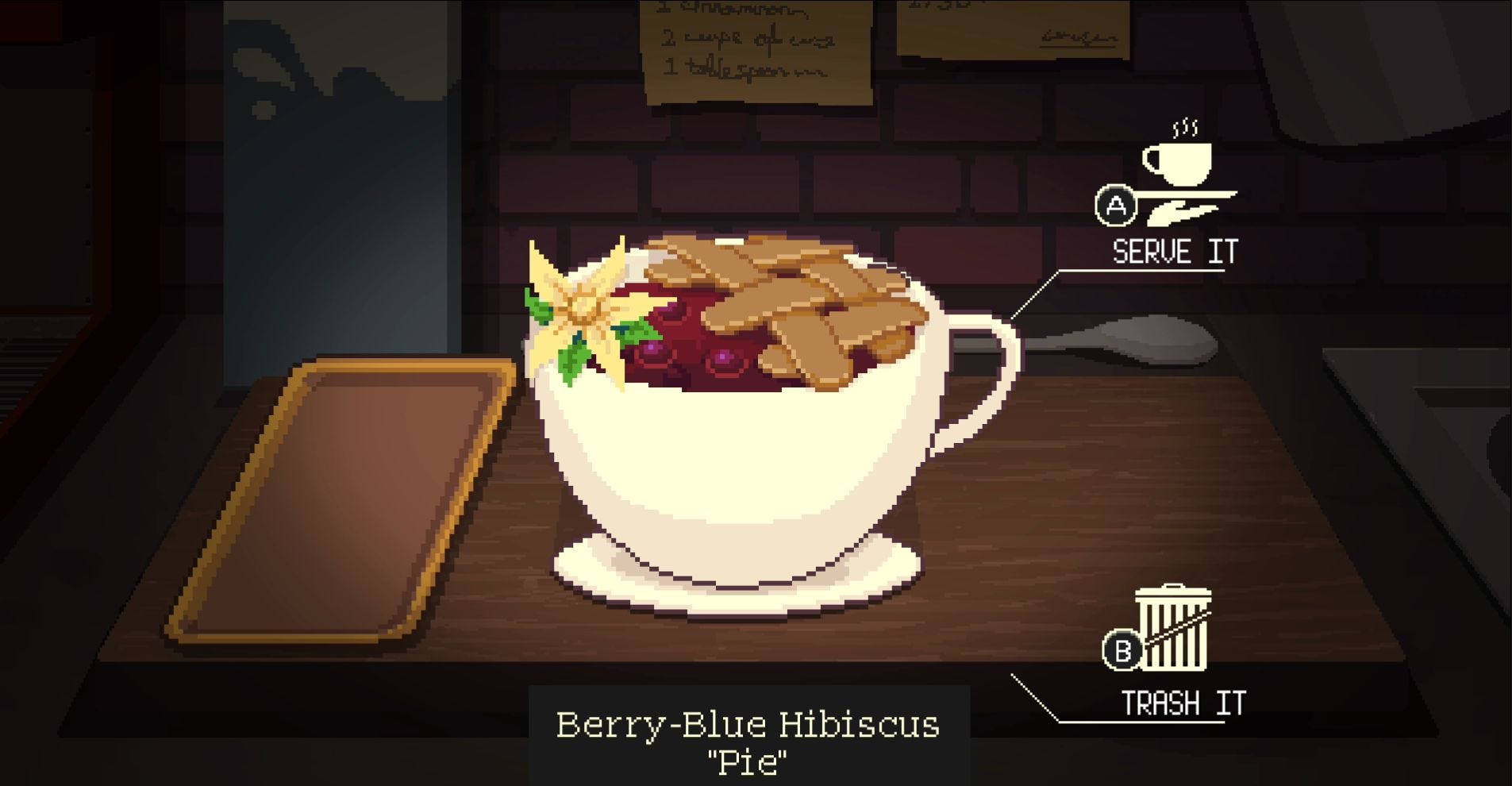
  • Berry-Blue Hibiscus “Pie” – Hibiscus, Honey, Mint

Milk-based drink recipes in Coffee Talk Episode 2 Hibiscus and Butterfly

Here are all of the special Milk-based drink recipes, arranged in their Brewpad order, in Coffee Talk Episode 2: Hibiscus and Butterfly:

  • Bedchamber – Milk, Cinnamon, Honey
  • Le Menthol – Milk, Mint, Lemon
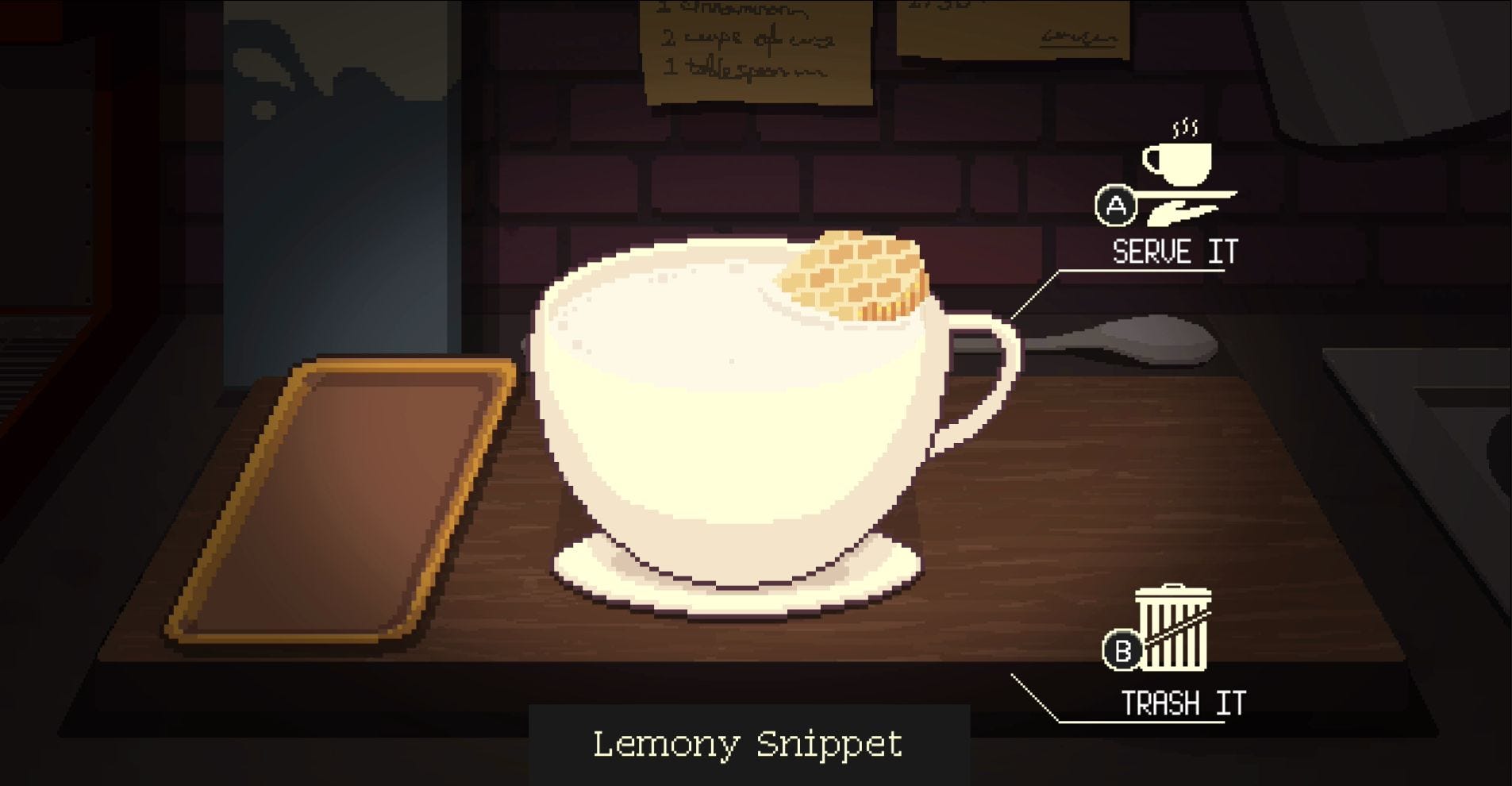
  • Lemony Snippet – Milk, Honey, Lemon
  • Milky Way – Milk, Honey, Mint
  • STMJ – Milk, Ginger, Honey

Good luck unlocking all of the special drinks in Coffee Talk Episode 2: Hibiscus and Butterfly!