This Vintage Dolly Parton Recipe Is My All-Time Favorite Dessert

This Vintage Dolly Parton Recipe Is My All-Time Favorite Dessert
dolly parton cookbook

You Have To Try This Vintage Dolly Parton DessertJulie Tremaine

“Hearst Magazines and Yahoo may earn commission or revenue on some items through the links below.”

Dolly Parton is good at everything. She has a music empire, a theme-park empire, a TV and film empire, and quite possibly the most goodwill of any living human on the planet.

On top of all that, she’s a really good cook. Dolly has often discussed how much she loves food. “My weaknesses are food and men,” she has said, “in that order.”

Her delightful cookbook Dolly’s Dixie Fixin’s came out in 2006, but the holy grail of Dolly Parton culinary memorabilia is 1989’s Dollywood Presents Tennessee Mountain Home Cooking. It’s out of print, but thanks to a grandmother who 1) took me to Dollywood and 2) never threw anything away, I have a copy that she purchased in 1990 on a trip to the theme park.

The book is filled with recipes gathered from Dollywood employees. “Good food, friends, and family are three things that folks here in these mountains have in abundance,” Dolly writes in the preface. “We have selected the favorite recipes of members of our Dollywood family that we wanted to share with you, our friends. We hope that as you serve these recipes to your family, they remind you of us and your visit to our area.”

dolly parton cookbook

Julie Tremaine

One of those members of the Dollywood family is the theme park’s official “Dreamer-in-Chief,” Dolly Parton herself. She contributed several recipes to the book, including her signature coleslaw, which includes pickles and pickle brine, and her recipe for cowboy beans.

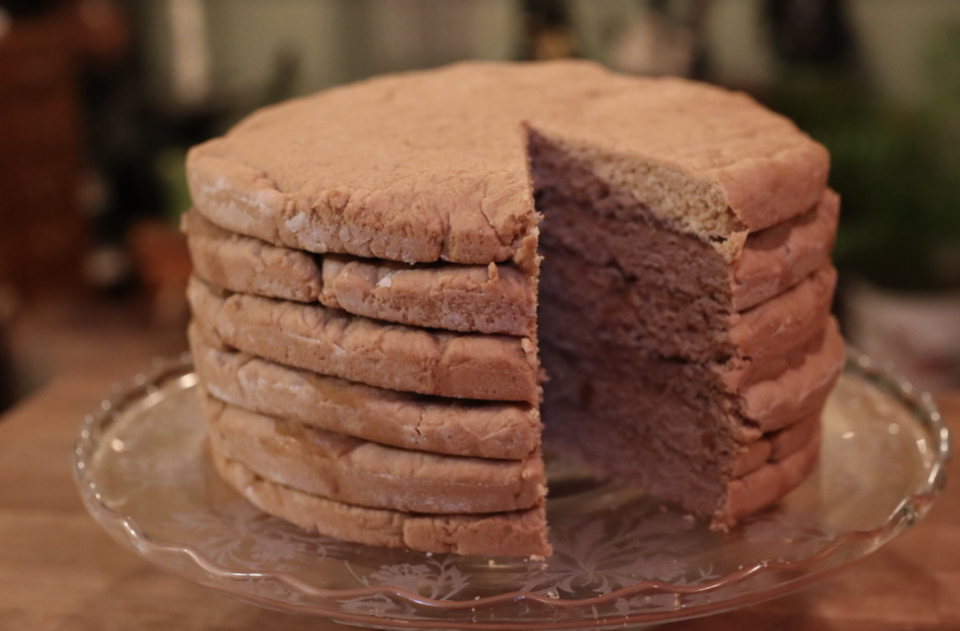
But the recipe I love the most—and the one you’re going to want to make over the holidays—is Dolly Parton’s Apple Stack Pie, her version of a classic Appalachian stack cake.

“There’s no recipe more rooted in Appalachian culture: stack cake is an ingenious expression of traditional mountain foodways,” writes Appalachian food expert Sheri Castle. “The first cook to make one almost certainly baked her cake layers one at a time, patting the dough into her skillet, baking them over a campfire or on the hearth, turning them out onto a plate, stacking and filling as she went.”

The dessert uses a simple, slightly sweet dough made with molasses and spices. You divide the dough into six equal portions and bake them into thin discs, then stack each one on top of another with an apple compote in the middle. The cakes are a little bit closer to quick bread or scones than to moist cake, and they aren’t too sweet. It’s a great breakfast for a special occasion—say, the morning of Thanksgiving or Christmas.

apple stack pie

Julie Tremaine

Dolly notes in her recipe that the cake is best after it sits for a few days, ostensibly so that the moisture from the apples softens the cake, and the fruit flavor permeates throughout. I do, though, think Dolly made one mistake. When I recently made the cake, I tripled the quantity of apples from one pound to three pounds, but I think the cake would have been even better with double what I made. (If you’re doing the math, multiply the whole filling by six and you should have a generous amount to layer with the cakes.)

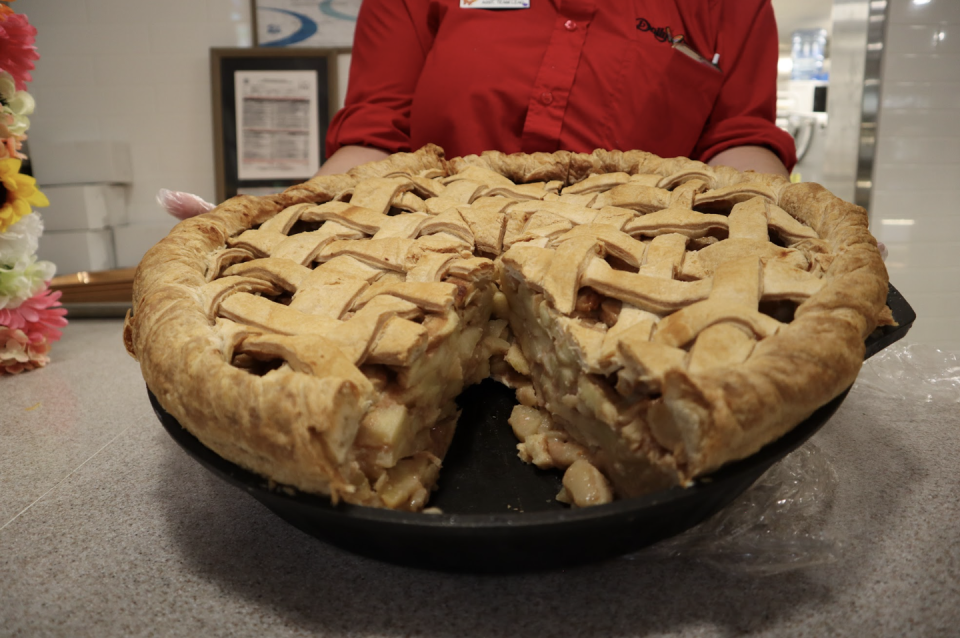
Apples are an important part of Appalachian cooking, and the sweets made from them are an important part of Dollywood. In fact, the Tennessee theme park—widely known for its surprisingly excellent food—serves an enormous apple pie that you can’t get anywhere else.

It weighs 25 pounds.

Made with 35 apples and priced at $189.99, the pie is bigger than you could possibly imagine. If you buy the whole thing, you get the cast-iron skillet that the pie was baked in, which explains a lot of the cost. But you can also grab an $18.99 slice, which still weighs three pounds, and is worth every penny.

dollywood apple pie

Julie Tremaine

When I bought a slice on my last trip to Dollywood, it took me days to eat, and I still couldn’t finish it before it was time to check out of my hotel. But if you’re having a big holiday celebration, you can order one by calling Dollywood and they’ll ship it to your house. If you’d rather make a taste of the Smoky Mountains at home, here’s the recipe for Dolly Parton’s Apple Stack Pie from the 1989 cookbook, reprinted with permission from Dollywood.

P.S. The Dollywood cookbook is out of print, but if you look hard enough, you can find used copies. And thanks to the wonders of the internet, you can read it in its entirety here.

You Might Also Like

Why the worst recipes imaginable are blowing up on TikTok

Why the worst recipes imaginable are blowing up on TikTok

Eli Betchik has always had a stomach of steel, but it wasn’t until they went to art school that they realized it could make them famous.

“I was perfectly willing to eat random things for the entertainment of my friends. I would take a ketchup packet from the diner and suck it up or eat an entire block of Parmesan cheese,” remembers Betchik, now 23, who makes and sells jewelry from their basement in Ohio. “The more I did that, the more I started realizing I could do this on the internet. I thought that I would be able to entertain people.”

In November 2020, the nonbinary jewelry maker was at art school in Cleveland, where they’d made friends with a group of performance artists. Soon, Betchik’s food performances became their own kind of art — particularly once they started putting the act on TikTok.

“I get compared to a car crash or a train wreck a lot, where people can’t look away.”

Their first few posts — things like fried mayonnaise, ramen noodles stewed in chocolate milk or cookie-and-milk-based slop warmed in the microwave, all consumed on camera — were sent out to a small circle of friends. A month later, clips of Betchik eating bologna glazed in Jolly Rancher-based syrup and instant hot chocolate brewed in hot dog water began to pick up thousands of views from people outside of their social circle. They scored their first truly viral video in 2021 after they created “cheesy mashed potatoes” from Lay’s chips boiled in water and rice wine vinegar. The clip was watched more than a million times, generating a string of copycats and press coverage that ranged from fawning to horrified.

Betchik, it seemed, was on to something. People were horrified but captivated. The more outrage they caused, the more their following grew. Their account, @elis_kitchen — which carries the official tagline “the most evil chef on TikTok” — has drawn more than 100,000 followers since launch. 

“It’s just a lot of disgust, really — disgusted fascination,” says Betchik. “I get compared to a car crash or a train wreck a lot, where people can’t look away, which I enjoy hearing very much.”

In the comments, the most common question is whether Betchik is doing all this just for attention. “I am,” Betchik confirms. “I try to take time out of my day to reply [to the commenters] and say, ‘Yes. Yes, I am.’”

Betchik is one of TikTok’s premiere rage-bait chefs: influencers who make videos of gruesome and often disgusting recipes, which they then consume in front of a camera. Most creators in the space claim to be driven by curiosity rather than fame, but their reliance on outrage to fuel their online presence is undeniable. On TikTok and other platforms, algorithms favor engagement — and nothing inspired engagement quite as reliably as disgust. 

Like a nightmare version of the Food Network, the rage-bait chef genre is both distinctive and diverse. Some members — like @joshandlisa, who produced the countertop mac-and-cheese video, and @mchausfun, the TikToker who made a banana-filled pastry with a catheter-like tool — are clearly prank channels and label themselves as satire on platforms outside of TikTok. Others like Sylvia Ferreira and The Shaba Kitchen (who brought terrifying chicken lollipops and strawberry and chocolate cream cheese spaghetti to TikTok) seem to be trying their best to make innovative food, even if the results can be alarming. There are, of course, conspiracy theories: one TikToker recently went viral with claims that creators like Ferreira are secretly making fetish content, backed up with a clip of Ferreria cooking a vagina-shaped chicken breast. (Ferreira and The Shaba Kitchen did not respond to The Verge’s requests for interview.)

Some members of the niche insist that their culinary intentions are pure. “On the internet, you start to see all these crazy cooking channels and recipes, and you think, what would it be like to make this? So, I was really interested in trying them out and seeing for myself,” explains Jane Brain, a 27-year-old tech worker and rage-bait chef from Ontario, Canada, with over 200,000 followers on her TikTok account, @myjanebrain. (Brain asked The Verge to withhold her real last name for privacy reasons.) 

Brain’s most viral videos include ramen noodle lasagna and a chicken baked in a pumpkin, which was described as “Halloween salmonella” by chef and TikToker Gordon Ramsay. Viewers are often shocked to see that Brain samples her creations at the end of each clip. “I always like to give [the recipes] a try,” continues Brain, who shoots and stars in most of her TikToks with her creative partner and best friend, Emma. “I think it’s only fair to judge for myself.”

Others claim they purposely seek out terrible recipes in an effort to challenge themselves and see if their culinary expertise can improve the end product. Liz and her 30-year-old partner, Zach — who also asked The Verge to withhold their last names for privacy reasons — have more than 50,000 followers on their joint account, @packagedfoodgourment; their most viral videos have included their attempts to recreate the worst-rated mac and cheese on Yummly and the worst-rated French toast on AllRecipies.com. 

“Some of [the recipes] are very polarizing,” says Liz, who noted many of the worst-rated recipes online have a mixture of one-star and five-star reviews. “I kind of thought, ‘Where’s the truth? What’s happening here?’ I wanted to see if they were really that bad.”

According to experts, creating content that sparks outrage in viewers makes sense in an attention-based economy. “When we’re scrolling through social media posts, I think there’s something about negativity and pain that might capture our attention better,” explains Steve Rathje, a postdoctoral researcher in psychology at New York University who focuses on social media, political polarization, and misinformation. He has previously published work on the way strong emotions like outrage and hate predict and drive the virality of social media posts. 

“Social media might be creating perverse incentives for the creation of polarizing content,” added Rathje, “because this is the kind of content that gets attention online.”

Capturing attention consistently over time is not easy, however, and the art of keeping viewers engaged with each recipe can involve long and arduous work. Betchik has spent as long as five hours threading raisins on to raw spaghetti strands or even days freezing sheets of SpaghettiOs. 

They feel they’ve discovered the recipe for viral success: ruining recipes that viewers hold dear to their hearts. “Using foods that people would perhaps associate with their childhoods and really bastardizing those — people will get really upset about that,” explains Betchik. The frozen SpaghettiOs, for example, were used as “bread” in a version of a PB&J sandwich in which jelly was swapped for mayonnaise. The video Betchik made of it has been viewed over two million times. “I try to not make things that I wouldn’t be willing to eat,” adds Betchik, who eats roughly 60 percent of their creations and tries to compost or reuse the rest. “But sometimes I do cross that line.”

Brain is also opposed to food waste — she often takes her successful recipes to friends and family, who now look forward to her video shoots — although it’s no easy task to avoid it. “There have been a few recipes that I’ve definitely struggled with,” she says. In some videos, like her widely mocked pumpkin chicken clip or her one-pan quesadilla, Brain’s expressions appear strained when she tastes the food. “I think viewers can see the look on my face when I bring the fork up to my mouth.”

Such moments seem to bring rage-bait followers great joy. They leave comments expressing their glee about the disastrous food, tag friends and other influencers, or berate and poke fun at the influencers themselves. Zach and Liz listed everything from their Canadian accents to their appearance as reasons that their viewers were outraged. Their comment sections are flooded with vitriol over everything from the cultural hegemony of the American pancake to critiques of their choices in the kitchen. “The idea is to test out the recipe as it is,” says Zach, who is often left frustrated by such attacks. “So they’re kind of missing the point of the video.”

The chefs have even given way to a horrible food economy on TikTok, in which other influencers stitch the videos of rage-bait chefs to attract views of their own. Betchik’s videos have been stitched by TikTokers like @sashaandnate, @ethagoat._, and @chubby_hoochie — creators who have built large followings by reacting to shocking videos, including those of rage-bait chefs. “Those people need someone to react to,” they say.

Experts like Rathje, however, are not convinced the culinary TikTok vibe shift is a good thing. “People stop and pay attention to negative content because it’s kind of like stopping to watch a car crash — you can’t really look away,” he added. “That might be good for influencers to learn, but I think it’s somewhat bad for the world.”

Betchick, meanwhile, doesn’t think that hate-based content is negative as long as its focus is on something like food. “I think that people who are simply viewing my videos are able to find joy in the amount of hatred they feel,” they say. “I might as well provide that service to them.” 

It’s a sentiment that Brain can get behind. While she doesn’t see herself as a rage-bait chef — she claims her cooking attempts are in earnest — she has seen firsthand how much content can be produced from a single questionably executed recipe. Tapping into the trend for financial gain, in her eyes, is a smart move — as long as those who dare to cook badly are prepared for the hateful comments. 

“If your goal is strictly to make as much money as possible — and if hate and anger is the way to do that — then I can totally see why it makes sense,” says Brain. “To each their own with that one.”

Thanksgiving leftover recipes: Stuffing cakes, turkey pasta & more

Thanksgiving leftover recipes: Stuffing cakes, turkey pasta & more

Too much turkey and stuffing overload isn’t a problem for those who like Thanksgiving leftovers. Chef Eric LeVine, partner at 317 Main restaurant in Farmingdale, has these recipes for a fresh twist: 

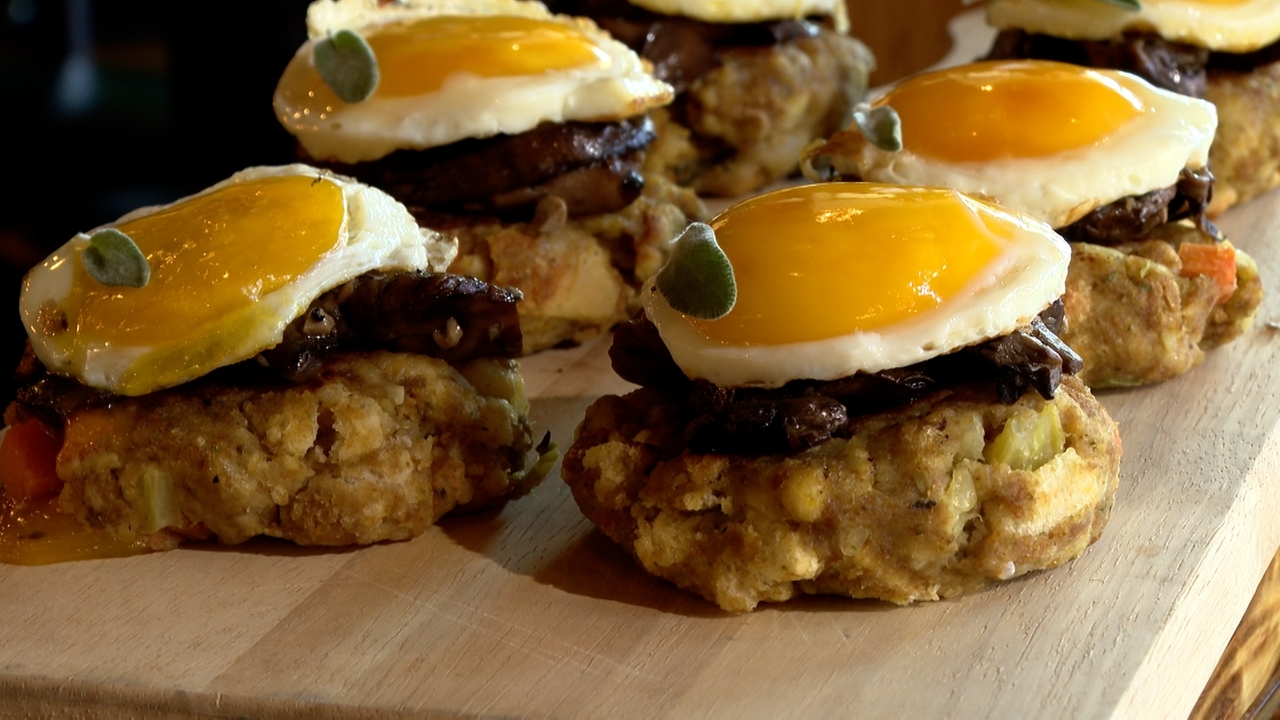
Stuffing Cakes with Roasted Mushrooms

For stuffing cakes:

2 cups leftover stuffing

2 eggs 

1/2 cup Italian breadcrumbs 

2 tablespoons olive oil 

12 thin slices pancetta

1 tablespoon fresh lemon juice 

1 tablespoon kosher salt 

6 eggs, at room temperature 

1. Place the stuffing in a large bowl, breaking up any large clumps. Add the eggs and breadcrumbs and stir to combine, making sure all of the stuffing is evenly coated with the eggs.

2. Scoop 1/3 cup of the stuffing into your hands and shape into a patty, about 3-inches wide and 1/2-inch thick. Repeat to make 6 stuffing cakes.

3. Heat the oil in a medium skillet over medium-high heat and cook the cakes, two at a time until golden brown, 2 to 3 minutes per side. Transfer to a paper-towel-lined plate and repeat with the remaining cakes. Loosely cover with foil to keep the cakes warm.

Roasted mushrooms:

1 1/2 pounds cremini mushrooms

4 cloves garlic

3 tablespoons olive oil

1 1/4 teaspoons kosher salt

1/4 teaspoon freshly ground black pepper

1 tablespoon 

balsamic vinegar

Chopped fresh chives or parsley, for serving (optional)

1. Arrange a rack in the middle of the oven and heat the oven to 450°F.

2. Trim and quarter 1 1/2 pounds cremini mushrooms and place on a rimmed baking sheet. Smash and peel 4 garlic cloves and add them to the baking sheet. Drizzle with 3 tablespoons olive oil and season with 1 1/4 teaspoon kosher salt and 1/4 teaspoon black pepper. Toss to coat and spread out in a single layer.

3. Roast, tossing halfway through, until the mushrooms are tender and caramelized, 18 to 20 minutes total. Remove from the oven, drizzle with 1 tablespoon balsamic vinegar, and toss to coat. Garnish with chopped fresh chives or parsley

Add roasted mushrooms on top of stuffing cake and top with a fried egg.

Turkey bucatini pasta

2½ teaspoons kosher salt

¾ pound bucatini or gluten-free noodles

½ cup (1 stick) + 2 tablespoons salted butter

½ cup slivered almonds

½ cup panko or gluten-free panko

2 garlic cloves, minced

¾ teaspoons garlic powder

¼ teaspoons ground nutmeg

½ teaspoons freshly cracked black pepper

1½ cups heavy whipping cream, room temperature

2 cups freshly grated Grana Padano or Parmesan cheese

2 cups cubed leftover turkey

¼ cup minced flat-leaf parsley, for serving

1. Fill a large pot with 4 quarts of water and add 2 teaspoons of the salt. Bring to a boil over high heat. Add the bucatini and cook until al dente according to the package instructions. Drain.

2. Meanwhile, heat a small dry skillet over medium-high heat. Add the almonds and toast, about 4-5 minutes. Transfer the almonds to a small bowl. In the same skillet, melt 2 tablespoons of the butter over medium-high heat until sizzling. Add the panko and cook, stirring, until golden brown, 3-4 minutes. Transfer the panko to a separate small bowl.

3. Melt the remaining ½ cup of butter in a large skillet over medium-high heat. When the butter begins to sizzle, add the garlic, garlic powder, nutmeg, remaining ½ teaspoon salt, and pepper, stirring, until the garlic is fragrant, about 1 minute.

4. Gradually stir in the heavy cream and bring to a simmer. Add the Grana Padano and stir until fully incorporated, about 2 minutes. Reduce the heat to low and cook until thickened, about 5 minutes. Stir in the turkey and continue cooking until warmed through.

5. Remove the pan from heat. Add the bucatini and toss to coat.

To serve, divide the pasta among 4 bowls, sprinkle with toasted panko, almonds, and parsley.

Ham croquet recipe

4 tablespoons unsalted butter room temperature

1 tablespoon finely chopped onion

1 cup whole milk room temperature

1 cup all-purpose flour divided

1/4 teaspoon nutmeg

Salt and pepper to taste

1 tablespoon dry cooking wine (vino seco)

1 pound ground ham* (see note)

2 large eggs room temperature

1 cup bread crumbs (or finely ground saltine crackers)

Vegetable oil for frying

1. In a saucepan, melt butter at medium-low heat. Add onion and cook for 1 minute.

2. Slowly whisk in milk, 1/3 cup of flour, nutmeg, salt and pepper. Continue to whisk until it becomes a very thick sauce (a roux).

3. Add in the cooking wine and ground ham to the sauce. Mix together slowly until combined. Reduce heat to low and let simmer for 5 minutes.

4. Transfer the filling to a bowl. Let it rest at room temperature then refrigerate for 2 hours or overnight (the longer the better). The mixture has to harden in order to form into logs and coat evenly. If this step is skipped, it will be very hard to form logs, coat with the breading, and fry.

5. Remove the filling from the refrigerator. Form logs from the mixture straight from the fridge. It’s OK if they are cold, it will be easier to form the logs this way. You want the logs to be approximately 3″ long and 1″ wide. If the mixture is sticky as you’re making the logs, add bread crumbs, 1 tablespoon at a time, to the mixture until it’s no longer sticky.

6. Continue forming the logs until you have all the croquette logs done then place them back in the fridge to firm up once again, about 30 minutes.**

7. To bread the croquette logs, you want to set up a breading station. In one bowl, whisk eggs and set aside. In another bowl, mix the remaining flour and bread crumbs.

8. Remove the logs from the fridge. Dip each croquette log in the egg wash and then coat in breadcrumb/flour mixture. Repeat with each one until they are all breaded. Let the croquettes rest at room temperature for 5 minutes before frying.

9. In a large pot or pan, heat enough vegetable oil to cover the croquettes completely. Fry each croquette until golden brown, approximately 3-4 minutes. Don’t crowd the pot too much as you are frying. This will help them all get evenly cooked.

Sweet potato risotto

2 tablespoons olive oil

1 large onion, finely chopped

Kosher salt and black pepper

2 small sweet potatoes (about 1 pound), cut into 1/4-inch pieces

2 cloves garlic, chopped

1 cup Arborio rice

1 cup dry white wine

½ cup grated Parmesan (2 ounces)

2 teaspoons chopped fresh oregano

1. Heat the oil in a large saucepan over medium heat. Add the onion, ½ teaspoon salt and ¼ teaspoon pepper. Cook, stirring occasionally, until soft, 3 to 5 minutes.

2. Add the sweet potatoes and garlic and cook, stirring occasionally, for 1 minute.

3. Add the rice and cook, stirring, for 2 minutes. Add the wine and cook, stirring frequently, until absorbed.

4. Measure 3½ cups of water. Add ¾ cup at a time and cook, stirring occasionally and waiting until each addition is absorbed before adding the next. It should take 25 to 30 minutes for all the water to be absorbed.

5. Stir in the Parmesan and oregano.

Broccoli casserole frittata

2 tablespoons olive oil

1 garlic clove (thinly sliced)

3 ½ cups broccoli florets

¼ teaspoon crushed red pepper

Salt

Pepper

8 large eggs

½ cup grated Parmigiano-Reggiano cheese (1 1/2 ounces)

1. Preheat the oven to 350°. In a 10-inch ovenproof nonstick skillet, heat 1 tablespoon of the olive oil. Add the garlic and cook over moderately high heat for 30 seconds. Add the broccoli and crushed red pepper and cook for 1 minute. Stir in 2 tablespoons of water, season with salt and pepper and cover. Cook over moderate heat until the broccoli is crisp-tender, 2 minutes; let cool.

2. In a bowl, whisk the eggs with 1/4 teaspoon each of salt and black pepper. Stir in the broccoli. Return the skillet to the stovetop and heat the remaining 1 tablespoon of oil. Pour in the eggs and cook over moderately low heat until set around the edge, 3 minutes. Sprinkle the frittata with the cheese. Transfer the skillet to the oven and bake the frittata until the center is just set, about 12 minutes. Serve warm or at room temperature.

How Chefs Use Tools and Kitchen Heirlooms Passed Down from Generations

How Chefs Use Tools and Kitchen Heirlooms Passed Down from Generations
food memories passing down generations kitchen tools

Design by Maitane Romagosa for Thrillist

Welcome to Recipes to Remember, a collection of passed-down recipes that remind us to gather around the table, share a meal prepared with our own hands—or, perhaps even better, the hands of our loved ones—and simply enjoy each other’s company. As the holiday season arrives, let’s try new-to-us recipes and make new memories along the way.

Many kitchen memories begin with a single tool. Perhaps it’s a wooden spoon stirring bubbling lentil soup, a lop-sided wok that perfectly caramelizes kimchi for the tangiest fried rice, or a cake stand that always displays a nostalgic slice of fluffy coconut cake.

For me, it’s a stone mortar and pestle that’s been in my family for more than 50 years. The stout body weighs over 10 pounds and the convex end of the pestle is worn smooth from use. I remember standing on a kitchen stool, hovering over my mom and grandma as they made fresh curry pastes, chili dips, or garlicky marinades—my eyes undoubtedly watering from the spices.

Although my grandma passed away almost 20 years ago, her presence is always there anytime my mom is grinding peppercorns or mashing chilies. “One day, this will be yours,” she frequently tells me, gesturing to the heavy granite bowl—like she can’t stand the idea that the mortar and pestle, and subsequently my grandmother’s memory, could be lost.

Families across the world have stories like mine, where generations of cooking can be found in an heirloom tool.

Chris Viaud, the chef and owner of New Hampshire’s Greenleaf and Ansanm and former Top Chef contestant, thinks about his Haitian mother’s pilon, a wooden mortar and pestle found in kitchens throughout the Caribbean. “I remember specifically just sitting on the floor, mashing up herbs and spices,” he says. “For the most part, we would use the pilon to make our spice blend called epis.”

From there, the blend of citrus, peppers, garlic, and onion seasoned everything: fish, rice, vegetables, and even the pilon itself. “Especially with wood, there’s that sense that some of the vegetable oils seep into the wood and continue to enhance the flavor of the next batch that goes in,” Viaud says. “In a way, we have the history of 30 years ago going into the batches we’re doing today, which is great.”

Some family kitchen heirlooms are out of commission, but remain treasured artifacts. Such is the case for Amanda Maneesilasan, the chef behind Los Angeles’s legendary Chao Krung Thai and newly revamped Tuk Tuk Thai.

At over 50 years old, Chao Krung Thai is one of LA’s oldest operating Thai restaurants. With that storied history comes a lot of memories—including how Maneesilasan first became interested in cooking when she was only nine.

“My grandma had this coconut grater that’s called a kratai, which means ‘rabbit’ in Thai,” Maneesilasan explains. The reason it’s called a rabbit is because that’s exactly what it looks like: a wooden rabbit with a metal blade that’s angled upward from the rabbit’s mouth. “I got into the kitchen because it didn’t look like a tool. It looked fun, like a toy. I wanted to see what my grandma was playing with.”

Instead of playing, Maneesilasan’s grandmother put her to work, grating coconuts to make coconut milk for one of her favorite dishes, green curry. Maneesilasan didn’t see it as work though; playing with the kratai and getting a bowl of green curry at the end was rewarding, and put her on the track to becoming the chef she is today.

Although there are much easier ways to grate a coconut now—besides, Maneesilasan’s grandmother’s rabbit is fully retired—she still sees the value in keeping the artifact around (even if it’s just decor.) “If I ever have kids, I can get them into cooking because of this tool right here,” she laughs.

Amethyst Ganaway’s grandmother is also at the heart of her cooking journey. Although she’s the only professional chef and recipe developer in the family, everyone can cook, thanks to Granny’s wisdom.

“My grandmother and her kids were the black sheep of our family, but she was the daughter that was always around her mom learning to cook for herself,” Ganaway says. “When my grandmother’s siblings passed, she was the one they asked for specifically on their deathbed, to cook X, Y, and Z, because she was the only one who knew how.”

Ganaway, being the eldest granddaughter—and the only grandchild to meet her great-grandmother—followed in her footsteps. She has distinct memories of being three years old and crowding the kitchen with her grandmother and great-grandmother while they stirred a hefty pot of greens.

The pot, Ganaway says, is nothing particularly special. She guesses it must have come from JCPenney or some other department store. The handles of the pot have fallen away. Its bottom sits wobbly on the stovetop, and the pot bravely wears scratchy battle scars from its year of use. But no other pots make greens quite like this pot.

“If you make something in this pot, it’s going to come out good,” Ganaway asserts. Ganaway’s family doesn’t have fancy China decorated with delicate flower petals or jewelry to pass on, but she has this pot, which she has already staked her claim on (much to her siblings’ and cousins’ dismay).

The pot is still fully in use, and will make an appearance at this year’s Thanksgiving, where Ganaway will be in charge of preparing the greens so her grandmother can simply rest and enjoy time with family this year. Although Ganaway is not fully in possession of the pot yet, she’s already claimed a pair of spoons that belonged to her grandmother, noting that their hefty weight somehow make ice cream taste better.

“To be able to visually see a piece that has been within the family and to continue to share that with future generations—that’s for sure going to be special.”

With so many new kitchen appliances and gadgets constantly being produced, it’d be easy to let these heirlooms collect dust or suffer a worse fate in a storage box or landfill. But they are more than just tools—they are keepers of genealogical gastronomy.

Maneesilasan remembers her parents telling her grandma that the green curry they crafted together, using the rabbit, was the best they had ever tasted. Her grandmother proudly gave her all the credit. “For me, it was just all about spending time with my grandmother,” Maneesilasan reminisces. “But after that I knew I could be a good cook.”

For Ganaway, the ancestors who have used the pot make the food within its walls that much more delicious. “When people talk about southern food, they talk about soul food; you’re putting your soul into whatever dishes you make,” she says. “What really makes our pot special and seasoned in its own way is that this pot has seen every member in our family.”

Although the tools contain secrets of the past, if cherished and respected, they can also be a culinary bridge for the future. That’s what Viaud envisions for his family’s pilon, which he hopes to pass down to his three-year-old daughter. “I think the biggest thing is that it shares a story and evokes memories,” he says. “To be able to visually see a piece that has been within the family and to continue to share that with future generations—that’s for sure going to be special.”

I don’t know what the future holds for me. What will my career look like in 10 years time? Will I have kids, a family, a home I’ve built with a marble kitchen island? This remains a mystery. But something I know that will remain steadfastly through it all is my grandmother’s mortar and pestle—a tribute to my heritage and ancestry, and a deliciously spicy look to the future.

Want more Thrillist? Follow us on Instagram, Twitter, Pinterest, YouTube, TikTok, and Snapchat!

Kat Thompson is a senior staff writer of food & drink at Thrillist. Follow her on Twitter @katthompsonn.

How to cook a turkey: Thanksgiving recipes, cooking times from Butterball

How to cook a turkey: Thanksgiving recipes, cooking times from Butterball

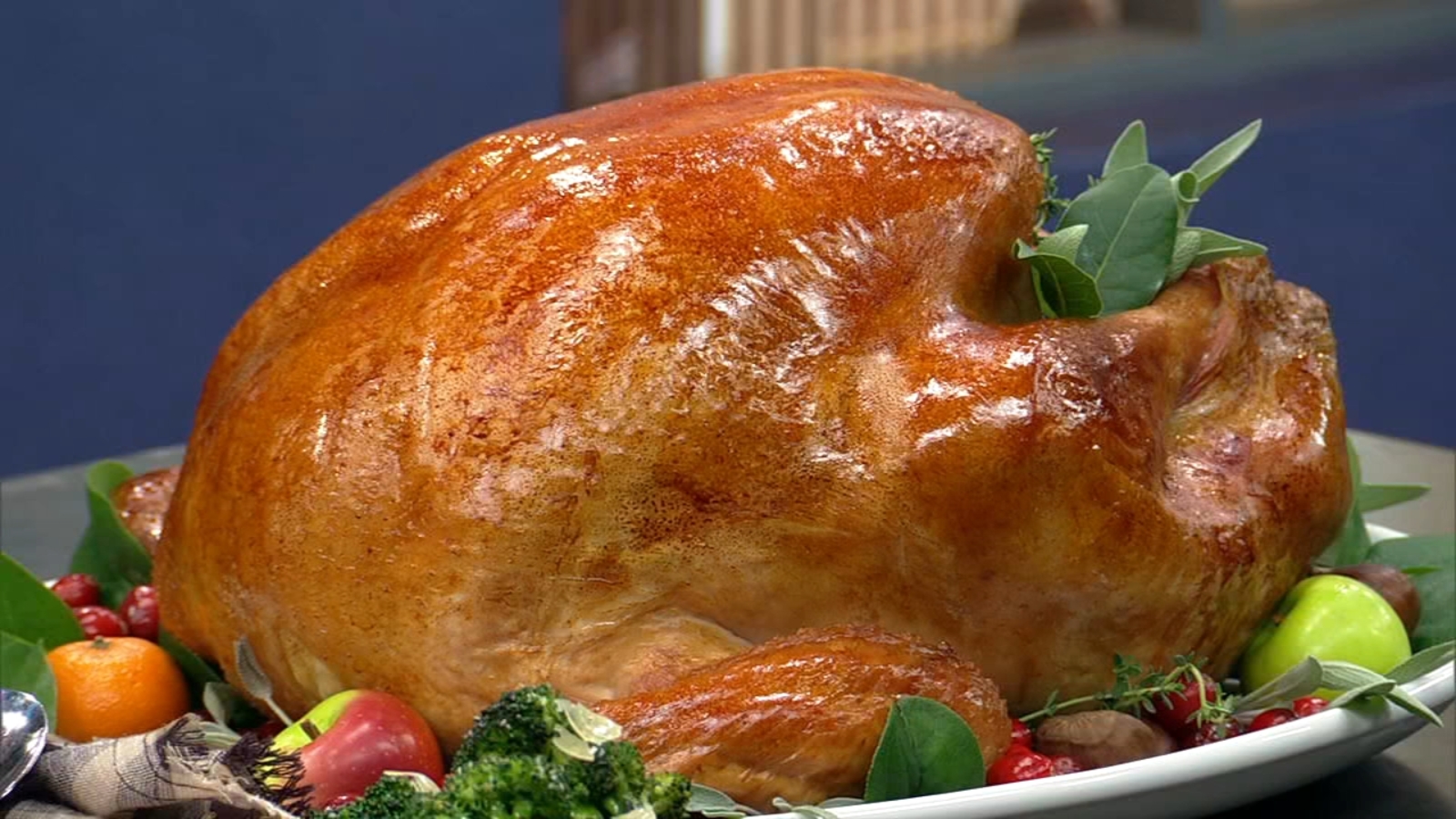
Wondering how to cook a turkey or how long to cook a turkey? Butterball has your answers.

Roasting in an oven is one of the most popular ways to cook a turkey. It’s simple, convenient and gives your turkey a classic flavor.

We’ll start with roasting a turkey, then scroll down for instructions on how to brine a turkey, roasting pre-cooked turkeys, boneless roasts, baking a turkey, and cooking whole turkey breasts. Whether you’re a first-time cook or a seasoned pro, we’ve got answers to all of your questions.

Spatchcock, deep-frying, Turducken: 5 alternative ways to prepare Thanksgiving turkey

Turkey roasting questions

If you’re using a convection oven, be sure to consult Butterball’s adjusted cooking instructions. Consult your manufacturer’s handbook for tips to use your specific oven.

The Butterball Turkey Talk-Line provides answers to all turkey questions in English and Spanish at 1-800-BUTTERBALL (1-800-288-8372) or text 844-877-3456.

Fresh or thawed whole turkeys

Roasting a whole turkey is easier than you think. Just follow these simple instructions for a fresh or thawed turkey:

Preheat oven to 325° F. Drain juices and pat dry with clean paper towels.

Place turkey breast side up on a flat rack in a shallow roasting pan 2 to 2 1/2 inches deep.

Turn the wings back to hold the neck skin in place. (Tucking the wings will help stabilize the turkey in the pan and when carving) Brush or spray skin lightly with vegetable or cooking oil for best appearance.

Insert an oven-safe meat thermometer deep into the lower part of the thigh without touching the bone. When the thigh is up to temperature, and if the turkey is stuffed, move the thermometer to the center of the stuffing.

Place your turkey in the oven.

When the turkey is about done, loosely cover breast and top of drumsticks with a piece of foil to prevent overcooking.

How do you thaw a turkey? Here are 3 safe ways to defrost your bird for Thanksgiving

Doneness: Your turkey is done when the temperature is 180° F in the thigh and 165° F in the breast or stuffing. Lift turkey onto a platter and let stand for 15 minutes before carving.

Cooking Times in a Regular Oven (325°F)

Weight / Cook Time (Unstuffed) / Cook Time (Stuffed)

4.5 – 7 lbs. / 2-2 1/2 hrs. / 2 1/4-2 3/4 hrs.

7-9 lbs.- 2 1/2-3 hrs. / 2 3/4-4 1/2 hrs.

9-18 lbs.- 3-3 1/2 hrs. / 3 3/4-4 1/2 hrs.

18-22 lbs.- 3 1/2-4 hrs. / 4 1/2-5 hrs.

22-24 lbs.- 4-4 1/2 hrs. / 5-5 1/2 hrs.

24-30 lbs.- 4 1/2-5 hrs. / 5 1/2-6 1/4 hrs.

Why we eat turkey on Thanksgiving

Roasting Tip: If you don’t have a rack, crunch aluminum foil into a coil or use vegetables like carrots to keep your turkey off the bottom of the pan.

Cooking in a Convection Oven (325°F)

Weight / Cook Time (Unstuffed) / Cook Time (Stuffed)

6-10 lbs.- 1 1/2 -2 hrs. / 1 3/4-2 1/2 hrs.

10-18 lbs.- 2-2 1/2 hrs. / 2 1/2-3 1/4 hrs.

18-22 lbs.- 2 1/2-3 hrs. / 3 1/4-3 3/4 hrs.

22-24 lbs.- 3-3 1/2 hrs. / 3 3/4-4 1/4 hrs.

First-time Thanksgiving cook? Advice on turkey thawing, leftover storing and avoiding disaster

Frozen Stuffed Whole Turkeys

Frozen stuffed turkeys go from freezer to oven without thawing. Just follow these simple instructions for a perfectly roasted turkey:

Preheat oven to 325° F. Hold under running water and remove giblets, neck, and gravy packets.

Place turkey on flat rack in a shallow roasting pan, 2 to 2 1/2 inches deep.

Brush or spray skin lightly with vegetable or cooking oil for best appearance.

Cover neck and exposed stuffing with foil to prevent over-browning. Place turkey in pre-heated oven.

When turkey is about 3/4 done, loosely cover breast and top of drumsticks with a piece of foil to prevent overcooking.

After about 3 hours, insert an oven-safe thermometer deep into the thigh without touching the bone.

Begin checking the turkey for doneness about 30 minutes before the recommended cook time.

Your turkey is done when meat thermometer reaches 180° F in thigh and 165° F in center of stuffing.

Lift turkey onto platter and let stand for 15 minutes before carving.

Cooking in a Regular Oven (325°F)

Weight / Cook Time

7-9 lbs. / 4-4 1/2 hrs.

9-12 lbs. / 4 1/2-5 hrs.

12-14 lbs. / 5-6 hrs.

How to brine a turkey: Recipes, times

How to brine a turkey

Brining is similar to marinating, but is primarily focused on moistening the meat as opposed to adding flavor. Brining your turkey prior to cooking will help ensure you end up with a deliciously moist and flavor-packed turkey for your next gathering.

Brining Steps

The first step in the process is selecting your brine recipe. Savory Turkey Brine made with Kikkoman Soy Sauce is a simple and versatile choice that works for any occasion. Once you’ve selected your brine you’ll need to:

Purchase a fresh turkey to eliminate the need to thaw, or completely thaw a frozen turkey.

The night before roasting, remove the giblets and turkey neck. Rinse the turkey inside and out.

Prepare your brine. Be sure to mix ingredients until all of the salt is dissolved. If your brine is heated, be sure to cool it to room temperature before brining.

Place your turkey, breast down, in a large container made of food-grade plastic, stainless steel, glass, or a brining bag. Be sure the container will fit in your fridge.

Add brine, covering the entire turkey.

Place in the refrigerator for the specified period of time.

Remove turkey from brine after recommended time. Rinse and pat dry with paper towels. Cook turkey as desired.

Perfect brine time

12 lbs. or less 8 to 12 hrs.

12 to 14 lbs. 9 to 14 hrs.

20 lbs. and over 15 to 20 hrs.

Savory Turkey Brine Recipe

2 gallons cold water

10 ounces Soy Sauce

1/2 cup kosher salt

1/2 cup sugar

2 tablespoons dried sage

2 tablespoons dried celery seed

1 tablespoon dried thyme

1 16 ? 24 lbs. Butterball? Whole Turkey

Mix all ingredients until the salt is dissolved and brine.

As a rule of thumb, you should brine your turkey 45 to 60 minutes per pound.

Pre-cooked whole turkeys

Fully cooked turkeys are an easy way to get a great tasting turkey on the table in less time. Follow these special directions for a delicious meal:

Preheat oven to 325° F. Remove wrapper. Do not stuff.

Place thawed turkey, breast side up, on flat rack in shallow roasting pan 2 to 2 1/2 inches deep.

Brush or spray skin lightly with vegetable or cooking oil for best appearance.

Insert oven-safe meat thermometer deep into the thigh without touching the bone.

Place turkey in pre-heated oven and heat until hot (140° F).

How do you thaw a turkey? Here are 3 safe ways to defrost your bird for Thanksgiving

Baked turkey

Cover breast loosely with foil after 1 to 1 1/4 hours to prevent over-browning and drying.

Begin checking the turkey for doneness about 30 minutes before the recommended cook time.

Your turkey is done when the meat thermometer reaches 140° F in thigh.

Carve and serve immediately.

Cooking in a Regular Oven (325°F)

Weight / Cook Time Baked (Thawed) / Cook Time Baked (Frozen) / Cook Time Smoked (Thawed)

8-10 lbs.- 1 1/4-1 3/4 hrs. / 2 1/4-3 1/4 hrs. / 1 1/4- 1/2 hrs.

10-16 lbs.- 1 3/4-2 1/4 hrs. / 2 3/4-3 3/4 hrs. / 1 1/2-2 hrs.

16-18 lbs.- 2 1/4-2 1/2 hrs. / 3 1/4-4 hrs. / 2-2 1/2 hrs.

Whole Turkey Breasts

Turkey breasts cook up tender and delicious, and are easy to roast when you follow these instructions:

Preheat oven to 325° F.

Remove whole breast from bag. Drain juices and pat dry with clean paper towels.

Place breast, skin side up, on a flat roasting rack in a 2-inch deep roasting pan. Do not add water to pan.

Brush or spray skin lightly with vegetable or cooking oil for best appearance.

Roast uncovered according to Cooking Schedule or until meat thermometer in thickest part of breast reaches 170° F. If breast is stuffed, center of stuffing should be 165° F.

Roasting time will vary if turkey is covered or placed in an oven-cooking bag.

Before you remove the stuffing and carve, let your turkey breast stand for 15 minutes to allow the juices to set.

You can roast a frozen turkey breast too. Just follow these steps:

Roast skin side down, uncovered, on a flat rack in a 2-inch deep open roasting pan at 325° F for the first hour.

Remove from oven and carefully remove gravy packet and refrigerate packet for future use.

Turn breast skin side up, and brush or spray skin lightly with vegetable or cooking oil for best appearance. Return to oven.

Roast uncovered according to Cooking Schedule or until meat thermometer in thickest part of breast reaches 170° F. If breast is stuffed, center of stuffing should be 165° F.

Let breast stand for 10 minutes before carving.

Cooking in a Regular Oven (325°F)

Weight / Cook Time (Unstuffed) / Cook Time (Stuffed)

3-5 1/2 lbs. – 1 1/2-2 1/4 hrs. / 2-2 3/4 hrs.

5 1/2-9 lbs. – 1 1/4-2 3/4 hrs. / 2 3/4-3 1/4 hrs.

Cooking in a Convection Oven (325°F)

Weight / Cook Time (Unstuffed) / Cook Time (Stuffed)

3-5 1/2 lbs. – 1 1/2 -2 hrs. / 1 3/4-2 1/2 hrs.

5 1/2-9 lbs. – 2-2 1/2 hrs. / 2 1/2-3 1/4 hrs.

18-22 lbs. – 2 1/2-3 hrs. / 3 1/4-3 3/4 hrs.

22-24 lbs. – 3-3 1/2 hrs. / 3 3/4-4 1/4 hrs.

Cooking in a Regular Oven (325°F)

Weight / Unstuffed

3-5 1/2 lbs. 3-3 3/4 hrs.

5 1/2-9 lbs. 3 3/4 -4 1/2 hrs.

Boneless Roasts

For smaller groups that love that roasted turkey taste, try a boneless roast. It’s easier than ever with these directions:

Preheat oven to 325° F.

Remove outer plastic netting and packaging. Leave inner string netting on the roast.

Drain juices and pat dry with clean paper towels. Refrigerate gravy packet.

For easier net removal before serving, lift string netting and shift position on roast.

Place roast, skin side up, on a flat roasting rack in 2-inch deep roasting pan. Do not add water to pan.

Roast uncovered according to Cooking Schedule or until meat thermometer in center of breast roast reaches 170° F and in center of turkey roast reaches 175° F.

Roasting time will vary if turkey is covered or placed in an oven-cooking bag.

For easier net removal after roasting, wrap roast in foil and let stand 10 minutes. Remove netting and slice roast.

Cook roast from frozen

Preheat oven to 325° F.

Remove gravy packet with spatula and refrigerate.

Place roast, skin side up, on a flat roasting rack in a 2-inch deep roasting pan. Do not add water to pan.

Roast uncovered according to Cooking Schedule or until meat thermometer in center of breast roast reaches 170° F and in center of turkey roast reaches 175° F. For easier net removal after roasting, wrap roast in foil and let stand 10 minutes. Remove netting and slice roast.

Cooking in a Regular Oven (325°F)

Thawed / Frozen

1 3/4-2 hrs. / 2 1/2-3 hrs.

Cooking in a Regular Oven (325°F)

Frozen

2 1/2-3 hrs.

Roasting Tip

Since you can’t adjust the string netting when roasting from frozen, be sure to wrap the roast in foil after it comes out of the oven.

Copyright © 2022 WLS-TV. All Rights Reserved.
The 3 Billion People Who Can’t Afford a Healthy Diet

The 3 Billion People Who Can’t Afford a Healthy Diet

The 3 Billion People Who Can’t Afford a Healthy Diet

While they aren’t often the focus of news media, hunger and undernourishment are problems plaguing millions of people every day.

According to the UN Food and Agriculture Organization (FAO), more than 3 billion people could not afford a healthy diet in 2020, an additional 112 million more people than in 2019. The increase was partly because of rising food prices, with the average cost of a healthy diet rising by 3.3{d2b09b03d44633acb673e8080360919f91e60962656af8ade0305d5d8b7e4889} from 2019 levels.

As of August 2022, the FAO food price index was up 40.6{d2b09b03d44633acb673e8080360919f91e60962656af8ade0305d5d8b7e4889} from average 2020 levels. Unless income levels increased by a similar magnitude, the healthy diet crisis is likely to have worsened, especially in low-income countries experiencing rampant food inflation.

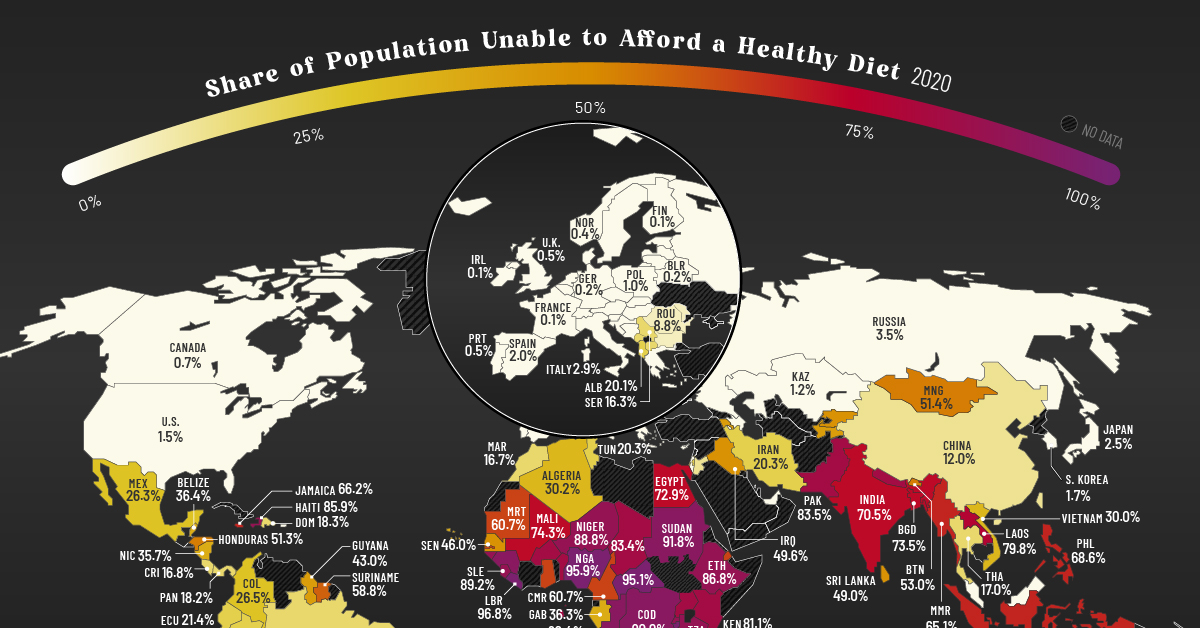
Using data from the FAO, the above infographic maps the share of people unable to afford a healthy diet in 138 different countries as of 2020 (latest available data).

The Cost and Affordability of a Healthy Diet

According to the FAO, a healthy diet is one that meets daily energy needs as well as requirements within the food and dietary guidelines created by the country.

The (un)affordability is measured by comparing the cost of a healthy diet to income levels in the country. If the cost exceeds 52{d2b09b03d44633acb673e8080360919f91e60962656af8ade0305d5d8b7e4889} of an average household’s income, the diet is deemed unaffordable.

Here’s a look at the share of populations unable to afford a healthy diet, and the cost of such a diet around the world:

Country Percent of population unable to afford a healthy diet Cost of Healthy Diet (USD per Person per Day)
Burundi 🇧🇮 97.2{d2b09b03d44633acb673e8080360919f91e60962656af8ade0305d5d8b7e4889} $2.9
Madagascar 🇲🇬 97.0{d2b09b03d44633acb673e8080360919f91e60962656af8ade0305d5d8b7e4889} $3.2
Liberia 🇱🇷 96.8{d2b09b03d44633acb673e8080360919f91e60962656af8ade0305d5d8b7e4889} $3.9
Malawi 🇲🇼 96.6{d2b09b03d44633acb673e8080360919f91e60962656af8ade0305d5d8b7e4889} $3.1
Nigeria 🇳🇬 95.9{d2b09b03d44633acb673e8080360919f91e60962656af8ade0305d5d8b7e4889} $4.1
Central African Republic 🇨🇫 95.1{d2b09b03d44633acb673e8080360919f91e60962656af8ade0305d5d8b7e4889} $3.6
Guinea 🇬🇳 94.9{d2b09b03d44633acb673e8080360919f91e60962656af8ade0305d5d8b7e4889} $4.1
Angola 🇦🇴 94.3{d2b09b03d44633acb673e8080360919f91e60962656af8ade0305d5d8b7e4889} $4.5
Congo 🇨🇬 92.4{d2b09b03d44633acb673e8080360919f91e60962656af8ade0305d5d8b7e4889} $3.4
Sudan 🇸🇩 91.8{d2b09b03d44633acb673e8080360919f91e60962656af8ade0305d5d8b7e4889} $4.3
Mozambique 🇲🇿 91.5{d2b09b03d44633acb673e8080360919f91e60962656af8ade0305d5d8b7e4889} $3.2
Democratic Republic of Congo 🇨🇩 90.0{d2b09b03d44633acb673e8080360919f91e60962656af8ade0305d5d8b7e4889} $2.1
Sierra Leone 🇸🇱 89.2{d2b09b03d44633acb673e8080360919f91e60962656af8ade0305d5d8b7e4889} $2.9
Niger 🇳🇪 88.8{d2b09b03d44633acb673e8080360919f91e60962656af8ade0305d5d8b7e4889} $2.9
Zambia 🇿🇲 88.0{d2b09b03d44633acb673e8080360919f91e60962656af8ade0305d5d8b7e4889} $3.3
Tanzania 🇹🇿 87.6{d2b09b03d44633acb673e8080360919f91e60962656af8ade0305d5d8b7e4889} $2.7
Guinea-Bissau 🇬🇼 87.2{d2b09b03d44633acb673e8080360919f91e60962656af8ade0305d5d8b7e4889} $3.5
Ethiopia 🇪🇹 86.8{d2b09b03d44633acb673e8080360919f91e60962656af8ade0305d5d8b7e4889} $3.4
Rwanda 🇷🇼 86.3{d2b09b03d44633acb673e8080360919f91e60962656af8ade0305d5d8b7e4889} $2.7
Haiti 🇭🇹 85.9{d2b09b03d44633acb673e8080360919f91e60962656af8ade0305d5d8b7e4889} $4.5
Sao Tome and Principe 🇸🇹 84.7{d2b09b03d44633acb673e8080360919f91e60962656af8ade0305d5d8b7e4889} $3.6
Nepal 🇳🇵 84.0{d2b09b03d44633acb673e8080360919f91e60962656af8ade0305d5d8b7e4889} $4.4
Lesotho 🇱🇸 83.5{d2b09b03d44633acb673e8080360919f91e60962656af8ade0305d5d8b7e4889} $4.3
Pakistan 🇵🇰 83.5{d2b09b03d44633acb673e8080360919f91e60962656af8ade0305d5d8b7e4889} $3.7
Chad 🇹🇩 83.4{d2b09b03d44633acb673e8080360919f91e60962656af8ade0305d5d8b7e4889} $2.8
Benin 🇧🇯 82.9{d2b09b03d44633acb673e8080360919f91e60962656af8ade0305d5d8b7e4889} $3.7
Uganda 🇺🇬 82.2{d2b09b03d44633acb673e8080360919f91e60962656af8ade0305d5d8b7e4889} $2.7
Kenya 🇰🇪 81.1{d2b09b03d44633acb673e8080360919f91e60962656af8ade0305d5d8b7e4889} $3.0
Burkina Faso 🇧🇫 80.1{d2b09b03d44633acb673e8080360919f91e60962656af8ade0305d5d8b7e4889} $3.3
Laos 🇱🇦 79.8{d2b09b03d44633acb673e8080360919f91e60962656af8ade0305d5d8b7e4889} $4.1
Mali 🇲🇱 74.3{d2b09b03d44633acb673e8080360919f91e60962656af8ade0305d5d8b7e4889} $3.1
Bangladesh 🇧🇩 73.5{d2b09b03d44633acb673e8080360919f91e60962656af8ade0305d5d8b7e4889} $3.1
Egypt 🇪🇬 72.9{d2b09b03d44633acb673e8080360919f91e60962656af8ade0305d5d8b7e4889} $3.4
Eswatini 🇸🇿 71.8{d2b09b03d44633acb673e8080360919f91e60962656af8ade0305d5d8b7e4889} $3.4
India 🇮🇳 70.5{d2b09b03d44633acb673e8080360919f91e60962656af8ade0305d5d8b7e4889} $3.0
Indonesia 🇮🇩 69.1{d2b09b03d44633acb673e8080360919f91e60962656af8ade0305d5d8b7e4889} $4.5
Philippines 🇵🇭 68.6{d2b09b03d44633acb673e8080360919f91e60962656af8ade0305d5d8b7e4889} $4.1
Jamaica 🇯🇲 66.2{d2b09b03d44633acb673e8080360919f91e60962656af8ade0305d5d8b7e4889} $6.7
South Africa 🇿🇦 65.2{d2b09b03d44633acb673e8080360919f91e60962656af8ade0305d5d8b7e4889} $4.3
Myanmar 🇲🇲 65.1{d2b09b03d44633acb673e8080360919f91e60962656af8ade0305d5d8b7e4889} $4.2
Gambia 🇬🇲 64.0{d2b09b03d44633acb673e8080360919f91e60962656af8ade0305d5d8b7e4889} $3.1
Djibouti 🇩🇯 63.9{d2b09b03d44633acb673e8080360919f91e60962656af8ade0305d5d8b7e4889} $3.1
Botswana 🇧🇼 61.4{d2b09b03d44633acb673e8080360919f91e60962656af8ade0305d5d8b7e4889} $3.7
Ghana 🇬🇭 61.2{d2b09b03d44633acb673e8080360919f91e60962656af8ade0305d5d8b7e4889} $4.0
Cameroon 🇨🇲 60.7{d2b09b03d44633acb673e8080360919f91e60962656af8ade0305d5d8b7e4889} $2.8
Mauritania 🇲🇷 60.7{d2b09b03d44633acb673e8080360919f91e60962656af8ade0305d5d8b7e4889} $3.7
Fiji 🇫🇯 60.4{d2b09b03d44633acb673e8080360919f91e60962656af8ade0305d5d8b7e4889} $3.9
Suriname 🇸🇷 58.8{d2b09b03d44633acb673e8080360919f91e60962656af8ade0305d5d8b7e4889} $5.7
Namibia 🇳🇦 56.8{d2b09b03d44633acb673e8080360919f91e60962656af8ade0305d5d8b7e4889} $3.5
Bhutan 🇧🇹 53.0{d2b09b03d44633acb673e8080360919f91e60962656af8ade0305d5d8b7e4889} $5.0
Mongolia 🇲🇳 51.4{d2b09b03d44633acb673e8080360919f91e60962656af8ade0305d5d8b7e4889} $5.1
Honduras 🇭🇳 51.3{d2b09b03d44633acb673e8080360919f91e60962656af8ade0305d5d8b7e4889} $3.5
Iraq 🇮🇶 49.6{d2b09b03d44633acb673e8080360919f91e60962656af8ade0305d5d8b7e4889} $3.5
Kyrgyzstan 🇰🇬 49.6{d2b09b03d44633acb673e8080360919f91e60962656af8ade0305d5d8b7e4889} $3.2
Sri Lanka 🇱🇰 49.0{d2b09b03d44633acb673e8080360919f91e60962656af8ade0305d5d8b7e4889} $3.9
Senegal 🇸🇳 46.0{d2b09b03d44633acb673e8080360919f91e60962656af8ade0305d5d8b7e4889} $2.3
Guyana 🇬🇾 43.0{d2b09b03d44633acb673e8080360919f91e60962656af8ade0305d5d8b7e4889} $4.9
Armenia 🇦🇲 42.9{d2b09b03d44633acb673e8080360919f91e60962656af8ade0305d5d8b7e4889} $3.2
Tajikistan 🇹🇯 42.1{d2b09b03d44633acb673e8080360919f91e60962656af8ade0305d5d8b7e4889} $3.5
Cabo Verde 🇨🇻 38.1{d2b09b03d44633acb673e8080360919f91e60962656af8ade0305d5d8b7e4889} $3.6
Belize 🇧🇿 36.4{d2b09b03d44633acb673e8080360919f91e60962656af8ade0305d5d8b7e4889} $2.1
Gabon 🇬🇦 36.3{d2b09b03d44633acb673e8080360919f91e60962656af8ade0305d5d8b7e4889} $3.6
Nicaragua 🇳🇮 35.7{d2b09b03d44633acb673e8080360919f91e60962656af8ade0305d5d8b7e4889} $3.3
Algeria 🇩🇿 30.2{d2b09b03d44633acb673e8080360919f91e60962656af8ade0305d5d8b7e4889} $3.8
Vietnam 🇻🇳 30.0{d2b09b03d44633acb673e8080360919f91e60962656af8ade0305d5d8b7e4889} $4.1
Colombia 🇨🇴 26.5{d2b09b03d44633acb673e8080360919f91e60962656af8ade0305d5d8b7e4889} $3.1
Mexico 🇲🇽 26.3{d2b09b03d44633acb673e8080360919f91e60962656af8ade0305d5d8b7e4889} $3.3
Bolivia 🇧🇴 24.7{d2b09b03d44633acb673e8080360919f91e60962656af8ade0305d5d8b7e4889} $3.8
Palestine 🇵🇸 23.1{d2b09b03d44633acb673e8080360919f91e60962656af8ade0305d5d8b7e4889} $3.4
Ecuador 🇪🇨 21.4{d2b09b03d44633acb673e8080360919f91e60962656af8ade0305d5d8b7e4889} $2.9
Saint Lucia 🇱🇨 20.6{d2b09b03d44633acb673e8080360919f91e60962656af8ade0305d5d8b7e4889} $3.6
Peru 🇵🇪 20.5{d2b09b03d44633acb673e8080360919f91e60962656af8ade0305d5d8b7e4889} $3.3
Iran 🇮🇷 20.3{d2b09b03d44633acb673e8080360919f91e60962656af8ade0305d5d8b7e4889} $3.6
Tunisia 🇹🇳 20.3{d2b09b03d44633acb673e8080360919f91e60962656af8ade0305d5d8b7e4889} $3.6
Albania 🇦🇱 20.1{d2b09b03d44633acb673e8080360919f91e60962656af8ade0305d5d8b7e4889} $4.2
Brazil 🇧🇷 19.0{d2b09b03d44633acb673e8080360919f91e60962656af8ade0305d5d8b7e4889} $3.1
Dominican Republic 🇩🇴 18.3{d2b09b03d44633acb673e8080360919f91e60962656af8ade0305d5d8b7e4889} $3.9
Panama 🇵🇦 18.2{d2b09b03d44633acb673e8080360919f91e60962656af8ade0305d5d8b7e4889} $4.5
North Macedonia 🇲🇰 18.0{d2b09b03d44633acb673e8080360919f91e60962656af8ade0305d5d8b7e4889} $3.4
Paraguay 🇵🇾 17.8{d2b09b03d44633acb673e8080360919f91e60962656af8ade0305d5d8b7e4889} $3.5
Montenegro 🇲🇪 17.5{d2b09b03d44633acb673e8080360919f91e60962656af8ade0305d5d8b7e4889} $3.5
Thailand 🇹🇭 17.0{d2b09b03d44633acb673e8080360919f91e60962656af8ade0305d5d8b7e4889} $4.3
Costa Rica 🇨🇷 16.8{d2b09b03d44633acb673e8080360919f91e60962656af8ade0305d5d8b7e4889} $4.1
Morocco 🇲🇦 16.7{d2b09b03d44633acb673e8080360919f91e60962656af8ade0305d5d8b7e4889} $2.8
Serbia 🇷🇸 16.3{d2b09b03d44633acb673e8080360919f91e60962656af8ade0305d5d8b7e4889} $4.2
Jordan 🇯🇴 14.9{d2b09b03d44633acb673e8080360919f91e60962656af8ade0305d5d8b7e4889} $3.6
Mauritius 🇲🇺 13.5{d2b09b03d44633acb673e8080360919f91e60962656af8ade0305d5d8b7e4889} $3.6
China 🇨🇳 12.0{d2b09b03d44633acb673e8080360919f91e60962656af8ade0305d5d8b7e4889} $3.0
Trinidad and Tobago 🇹🇹 11.6{d2b09b03d44633acb673e8080360919f91e60962656af8ade0305d5d8b7e4889} $4.2
Romania 🇷🇴 8.8{d2b09b03d44633acb673e8080360919f91e60962656af8ade0305d5d8b7e4889} $3.2
Bulgaria 🇧🇬 8.5{d2b09b03d44633acb673e8080360919f91e60962656af8ade0305d5d8b7e4889} $4.1
Seychelles 🇸🇨 6.8{d2b09b03d44633acb673e8080360919f91e60962656af8ade0305d5d8b7e4889} $3.8
Moldova 🇲🇩 6.7{d2b09b03d44633acb673e8080360919f91e60962656af8ade0305d5d8b7e4889} $2.8
Chile 🇨🇱 3.8{d2b09b03d44633acb673e8080360919f91e60962656af8ade0305d5d8b7e4889} $3.4
Croatia 🇭🇷 3.8{d2b09b03d44633acb673e8080360919f91e60962656af8ade0305d5d8b7e4889} $4.3
Bosnia and Herzegovina 🇧🇦 3.7{d2b09b03d44633acb673e8080360919f91e60962656af8ade0305d5d8b7e4889} $4.0
Uruguay 🇺🇾 3.6{d2b09b03d44633acb673e8080360919f91e60962656af8ade0305d5d8b7e4889} $3.4
Russia 🇷🇺 3.5{d2b09b03d44633acb673e8080360919f91e60962656af8ade0305d5d8b7e4889} $3.4
Greece 🇬🇷 3.2{d2b09b03d44633acb673e8080360919f91e60962656af8ade0305d5d8b7e4889} $3.1
Italy 🇮🇹 2.9{d2b09b03d44633acb673e8080360919f91e60962656af8ade0305d5d8b7e4889} $3.1
Japan 🇯🇵 2.5{d2b09b03d44633acb673e8080360919f91e60962656af8ade0305d5d8b7e4889} $5.8
Hungary 🇭🇺 2.0{d2b09b03d44633acb673e8080360919f91e60962656af8ade0305d5d8b7e4889} $3.5
Spain 🇪🇸 2.0{d2b09b03d44633acb673e8080360919f91e60962656af8ade0305d5d8b7e4889} $2.8
Malaysia 🇲🇾 1.9{d2b09b03d44633acb673e8080360919f91e60962656af8ade0305d5d8b7e4889} $3.5
Latvia 🇱🇻 1.8{d2b09b03d44633acb673e8080360919f91e60962656af8ade0305d5d8b7e4889} $3.2
South Korea 🇰🇷 1.7{d2b09b03d44633acb673e8080360919f91e60962656af8ade0305d5d8b7e4889} $5.2
United States 🇺🇸 1.5{d2b09b03d44633acb673e8080360919f91e60962656af8ade0305d5d8b7e4889} $3.4
Maldives 🇲🇻 1.4{d2b09b03d44633acb673e8080360919f91e60962656af8ade0305d5d8b7e4889} $3.9
Estonia 🇪🇪 1.3{d2b09b03d44633acb673e8080360919f91e60962656af8ade0305d5d8b7e4889} $3.3
Kazakhstan 🇰🇿 1.2{d2b09b03d44633acb673e8080360919f91e60962656af8ade0305d5d8b7e4889} $2.7
Lithuania 🇱🇹 1.2{d2b09b03d44633acb673e8080360919f91e60962656af8ade0305d5d8b7e4889} $3.1
Slovakia 🇸🇰 1.2{d2b09b03d44633acb673e8080360919f91e60962656af8ade0305d5d8b7e4889} $3.2
Israel 🇮🇱 1.0{d2b09b03d44633acb673e8080360919f91e60962656af8ade0305d5d8b7e4889} $2.5
Poland 🇵🇱 1.0{d2b09b03d44633acb673e8080360919f91e60962656af8ade0305d5d8b7e4889} $3.2
Austria 🇦🇹 0.8{d2b09b03d44633acb673e8080360919f91e60962656af8ade0305d5d8b7e4889} $3.0
Australia 🇦🇺 0.7{d2b09b03d44633acb673e8080360919f91e60962656af8ade0305d5d8b7e4889} $2.6
Canada 🇨🇦 0.7{d2b09b03d44633acb673e8080360919f91e60962656af8ade0305d5d8b7e4889} $3.0
Malta 🇲🇹 0.7{d2b09b03d44633acb673e8080360919f91e60962656af8ade0305d5d8b7e4889} $3.8
Sweden 🇸🇪 0.6{d2b09b03d44633acb673e8080360919f91e60962656af8ade0305d5d8b7e4889} $3.3
Portugal 🇵🇹 0.5{d2b09b03d44633acb673e8080360919f91e60962656af8ade0305d5d8b7e4889} $2.7
United Kingdom 🇬🇧 0.5{d2b09b03d44633acb673e8080360919f91e60962656af8ade0305d5d8b7e4889} $1.9
Denmark 🇩🇰 0.4{d2b09b03d44633acb673e8080360919f91e60962656af8ade0305d5d8b7e4889} $2.5
Norway 🇳🇴 0.4{d2b09b03d44633acb673e8080360919f91e60962656af8ade0305d5d8b7e4889} $3.5
Cyprus 🇨🇾 0.3{d2b09b03d44633acb673e8080360919f91e60962656af8ade0305d5d8b7e4889} $3.0
Belarus 🇧🇾 0.2{d2b09b03d44633acb673e8080360919f91e60962656af8ade0305d5d8b7e4889} $3.3
Belgium 🇧🇪 0.2{d2b09b03d44633acb673e8080360919f91e60962656af8ade0305d5d8b7e4889} $3.1
Czechia 0.2{d2b09b03d44633acb673e8080360919f91e60962656af8ade0305d5d8b7e4889} $3.0
Germany 🇩🇪 0.2{d2b09b03d44633acb673e8080360919f91e60962656af8ade0305d5d8b7e4889} $3.0
Netherlands 🇳🇱 0.2{d2b09b03d44633acb673e8080360919f91e60962656af8ade0305d5d8b7e4889} $3.0
Finland 🇫🇮 0.1{d2b09b03d44633acb673e8080360919f91e60962656af8ade0305d5d8b7e4889} $2.7
France 🇫🇷 0.1{d2b09b03d44633acb673e8080360919f91e60962656af8ade0305d5d8b7e4889} $3.2
Ireland 🇮🇪 0.1{d2b09b03d44633acb673e8080360919f91e60962656af8ade0305d5d8b7e4889} $2.2
Luxembourg 🇱🇺 0.1{d2b09b03d44633acb673e8080360919f91e60962656af8ade0305d5d8b7e4889} $2.7
Slovenia 🇸🇮 0.1{d2b09b03d44633acb673e8080360919f91e60962656af8ade0305d5d8b7e4889} $3.1
Azerbaijan 🇦🇿 0.0{d2b09b03d44633acb673e8080360919f91e60962656af8ade0305d5d8b7e4889} $2.5
Iceland 🇮🇸 0.0{d2b09b03d44633acb673e8080360919f91e60962656af8ade0305d5d8b7e4889} $2.4
Switzerland 🇨🇭 0.0{d2b09b03d44633acb673e8080360919f91e60962656af8ade0305d5d8b7e4889} $2.7
United Arab Emirates 🇦🇪 0.0{d2b09b03d44633acb673e8080360919f91e60962656af8ade0305d5d8b7e4889} $3.1
World 🌎 42.0{d2b09b03d44633acb673e8080360919f91e60962656af8ade0305d5d8b7e4889} $3.5

In 52 countries, more than half of the population cannot afford a healthy diet. The majority of these are in Africa, with the rest located across Asia, Oceania, and the Americas.

By contrast, in four countries—Azerbaijan, Iceland, Switzerland, and the UAE—everyone is able to afford a healthy diet. The picture is similar for most European and developed high-income countries, where more than 95{d2b09b03d44633acb673e8080360919f91e60962656af8ade0305d5d8b7e4889} of the population can afford a healthy diet.

When the percentages are translated into numbers, Asia contains the most number of people unable to afford a healthy diet at 1.89 billion, of which 973 million people are in India alone. Another 1 billion people are in Africa, with around 151 million people in the Americas and Oceania.

While hunger is a worldwide concern, it is particularly acute in African countries, which cover all of the top 20 spots in the above table.

Africa’s Deepening Food Crisis

In many countries across sub-Saharan Africa, more than 90{d2b09b03d44633acb673e8080360919f91e60962656af8ade0305d5d8b7e4889} of the population cannot afford a healthy diet.

Sub-Saharan Africa is particularly susceptible to extreme climate events and the resulting volatility in food prices. Roughly one-third of the world’s droughts occur in the region, and some sub-Saharan countries are also heavily reliant on imports for food.

Russia’s invasion of Ukraine has deepened the crisis, with many African countries importing over 50{d2b09b03d44633acb673e8080360919f91e60962656af8ade0305d5d8b7e4889} of their wheat from the two countries in conflict. The rising food prices from this supply chain disruption have resulted in double-digit food inflation in many African nations, which means that more people are likely to be unable to afford healthy diets.

The Horn of Africa region at the Eastern tip of Africa is particularly in turmoil. All the countries in the region are reliant on wheat from Russia and Ukraine, with Eritrea (100{d2b09b03d44633acb673e8080360919f91e60962656af8ade0305d5d8b7e4889}) and Somalia (>90{d2b09b03d44633acb673e8080360919f91e60962656af8ade0305d5d8b7e4889}) high up in the import dependency chart. Additionally, the region is facing its worst drought in 40 years alongside ongoing political conflicts. As a result, 22 million people are at risk of starvation.

Population Growth and Food Insecurity

In November of 2022, the global population is projected to surpass 8 billion people, and many of the fastest growing countries are also food-insecure.

By 2050, the global population is likely to increase by 35{d2b09b03d44633acb673e8080360919f91e60962656af8ade0305d5d8b7e4889}, and to meet the growing demand for food, crop production will need to double. Given that agriculture is one of the biggest contributors to greenhouse gas emissions, this increase in crop production will also need to be environmentally sustainable.

As the impacts of climate change intensify and food demand increases, reducing food waste, building climate-resilient agricultural infrastructure, and improving agricultural productivity will all play a key role in reducing the levels of food insecurity sustainably.

world at 8 billion report

Get our new “The World at 8 Billion” report and webinar by becoming a VC+ member