
Most Americans Don’t Know What ‘Ultra-Processed’ Foods Are

Most Americans Don’t Know What ‘Ultra-Processed’ Foods Are

d3signal/Getty Visuals


You have likely heard of processed foods—but could you discover an ultra-processed food? If you’re like most People in america, the response is no.


In accordance to a September 2022 study conducted by the Global Meals Information Council (IFIC), about 76{d2b09b03d44633acb673e8080360919f91e60962656af8ade0305d5d8b7e4889} of Us residents are unfamiliar with what qualifies as an ultra-processed foods. Far more precisely, 66{d2b09b03d44633acb673e8080360919f91e60962656af8ade0305d5d8b7e4889} of people claimed they’d never ever listened to the expression “ultra-processed,” though 10{d2b09b03d44633acb673e8080360919f91e60962656af8ade0305d5d8b7e4889} explained they ended up uncertain.

The study was conducted among 1,000 older people ages 18 and more than to figure out buyer perceptions and paying for routines about processed meals. According to professionals in the meals and nourishment business, its results are not astonishing, as the notion of ultra-processed meals is relatively new.


“Most Americans never know exactly which food items depend as extremely-processed because scientists have only just lately started out looking at whether or not highly-processed foods can cause harm,” Bonnie Liebman, MS, Director of Diet for the Heart for Science in the Community Desire (CSPI), who was not affiliated with the survey, explained to Health and fitness. Liebman mentioned that the phrase “ultra-processed foods” was very first launched all-around 2010, when a Brazilian analyze proposed classifying meals by their amount of processing.


Because that time, the concept has gained traction (and clarity) as a rising system of study has described ultra-processed foods and their opportunity to negatively effect wellness. The IFIC study not only sheds mild on how tiny buyers know about extremely-processed foods but may well also be practical as the 2025 Nutritional Tips Advisory Committee starts to look at its messaging about processed foodstuff.


So, what specifically are extremely-processed foods—and ought to you continue to keep them off your plate? 


Apart from an orange picked straight off a tree or a spinach leaf plucked from your backyard backyard garden, the vast vast majority of foods we consume are processed in some way. This is not constantly a bad detail. Processing meals may well simply require heating, canning, cleansing, drying, or packaging them for cargo. Approaches like these protect foodstuff for harmless for a longer period-expression consumption.


Extremely-processed meals, on the other hand, choose processing to the up coming level—and not in a superior way. Even though there’s no one exact definition of ultra-processed foods, the Heart for Epidemiological Scientific studies in Health and Nourishment at the University of Sao Paulo, Brazil, has created a processing classification program referred to as NOVA to present some clarity.


“NOVA classifies food stuff as Group 1, Team 2, Group 3, and Team 4,” registered dietitian Toby Amidor, MS, RD, CDN, FAND, an award-successful nourishment skilled and finest-advertising writer of The Spouse and children Immunity Cookbook, told Well being. “Group 4 is ‘ultra-processed food’ and is described as ‘industrial formulations built completely or mainly from substances extracted from food items (oils, fat, sugar, starch, and proteins), derived from food items constituents (hydrogenated fat and modified starch), or synthesized in laboratories from food stuff substrates or other natural resources (flavor enhancers, hues, and several foods additives utilised to make the products hyper-palatable).’”


In less difficult phrases: “We employed to refer to ultra-processed foodstuff as junk foodstuff,” claimed Bonnie Taub-Dix, RDN, creator of BetterThanDieting.com and author of Study It In advance of You Eat It—Taking You from Label to Desk. “Ultra-processed foodstuff may possibly be sweet, soda, pastries, warm canines, and other food items we should be consuming fewer often—basically food items that incorporate a large amount of sugar, salt, saturated body fat, preservatives, and so on.”


Even though you may possibly associate extremely-processed meals with your community comfort retailer or gas station, according to Taub-Dix, they can be identified anyplace. Even superior-finish grocery suppliers and health food items suppliers may perhaps sell extremely-processed foodstuff.


In addition to made up of concerning nutrition, extremely-processed food items also typically harbor various additives. “A several components typically utilised in extremely-processed foods include things like salt, disodium inosinate, disodium guanylate, mono- and diglycerides, superior fructose corn syrup, hydrolyzed soy protein, potassium sorbate, sodium benzoate, colour additives, modified foods starches, and other folks,” reported Bryan Quoc Le, PhD, foods scientist, food items industry consultant, and author of 150 Foodstuff Science Inquiries Answered.


Scientists have lengthy known that diets superior in some varieties of processed foods could direct to wellbeing complications. But narrowing the emphasis on ultra-processed meals has revealed that far-from-nature objects could have an affect on wellness a lot more negatively than just processed meals like canned beans or whole grain cereals.


A 2022 analyze in BMJ on almost 23,000 topics, for case in point, observed that people today who ate substantial quantities of ultra-processed meals had bigger hazard of coronary heart condition and dying overall. Other analysis, also released in 2022 in BMJ, joined taking in much more extremely-processed foodstuff to an improved risk of colorectal most cancers.


Research has demonstrated that persons received a lot more weight on a diet plan high in really processed foods. Bigger use of people foods is also correlated with better ranges of anxiety and despair.


Still, additional facts is necessary to tease apart whether specific formulations of food items truly lead to well being conditions—and if so, what it is about all those foods which is selling condition.


“Studies have claimed a larger risk of cardiovascular disorder, diabetic issues, and some cancers in people who take in far more extremely-processed foods,” Liebman reported. “However, those experiments simply cannot explain to us whether ultra-processed food items lead to illness, or no matter if a little something else about men and women who eat diet plans higher in extremely-processed foodstuff is to blame.”


Keeping ultra-processed foods out of your diet regime solely may possibly audio like a worthy objective, but that may not normally be sensible or even warranted. “Ultra-processed foods are a lot more like ‘sometimes’ foods, but let us experience it, several are also delicious and enjoyable to try to eat, so I don’t feel any food, until you have a really serious health-related problem or allergy, requires to be eradicated from one’s food plan,” Taub-Dix claimed.


Continue to, she and other authorities inspire restricting extremely-processed meals when doable. To hold them to a least, the to start with action is determining them. The finest area to start out: the diet specifics label.


“The consumer ought to be on the lookout at the nourishment information panel to determine if the meals presents nutrition and determine the greatest healthy for their diet program,” Amidor explained. “For case in point, pastries, cakes, and cake mixes are not your nutrient-dense alternatives, but a food stuff like cereal that is usually fortified with a lot of vitamins and minerals (specially people that Us residents never get ample of) and are extensively consumed with cow’s milk and fruit—that is a food items I would not recommend keeping away from and truly motivate consuming.”


Examining ingredient lists is another basic way to slash via confusion and make healthier selections. “The food items label is the ideal weapon we have to fight against getting elements in our foodstuff that we really really do not want. Food labels tell a story of what goes into every single package deal,” claimed Taub-Dix. Sugars, sodium, additives, and dyes are all hallmarks of extremely-processed foodstuff. Seem for these components as purple flags to prevent.


Lastly, you just cannot go incorrect picking fresh new, complete foods as often as time and finances permit. “People ought to intention for a food plan loaded in unprocessed foodstuff like refreshing fruits and veggies, complete grains, beans, and nuts, rather than junk foods like chips, cookies, donuts, and sugary beverages,” Liebman said. “A great rule of thumb is to fill half your plate with refreshing fruit or vegetables, leave a quarter of your plate for nutritious protein foodstuff, and fill yet another quarter with full grains.”

‘Food’s my love language’: the Palestinian Americans behind San Francisco’s renowned dining scene | Food

‘Food’s my love language’: the Palestinian Americans behind San Francisco’s renowned dining scene | Food

San Francisco’s Reem Assil is a new kind of restaurateur, fusing her work as a chef with activism. She says foods like manakeesh flatbreads she serves at her San Francisco restaurants help diners appreciate Palestinian culture and empathize with her people’s ongoing struggles. “I’m part of a new wave,” said Assil, who is easily the Bay Area’s most high profile Palestinian American food entrepreneur. But she’s not the only one.

If you take a 20-minute drive along South Van Ness Avenue, you can stop for a mint mojito coffee at Philz in Russian Hill, hit the Ike’s Sandwiches eight minutes away in Cathedral Hill for a Super Mario meatball sandwich and then pop into Bi-Rite Market in the Mission for some olive oil and salted caramel ice cream. But here’s something you probably didn’t know these beloved Bay Area chains have in common: they were all founded by Palestinian Americans.

grocery store interior
Inside the Divisadero branch of Bi-Rite. Photograph: Jen Fedrizzi

Most of these entrepreneurs came to San Francisco in the period from the late 1940s to 1960s, when Israeli military forces expelled hundreds of thousands of Palestinians from their homes in the West Bank and East Jerusalem. The relatively warm climate attracted Arab immigrants. In those days, Americans didn’t know hummus from a hammam, so they opened shops selling groceries, later expanding into coffee, sandwiches, ice cream and breakfast foods.

Assil said she was grateful to the people who came before her: “There’s a real subculture of young Palestinians who grew up in the stores and watched the entrepreneurship of their parents.”


Jamal Shamieh, who grew up working in his family’s market, was one of them. Geneva Super Mini Mart sold eggs, milk, cigarettes, and newspapers. Jamal, known as Jimmy, and his siblings worked there every day: after school, after dinner, and on weekends. “The whole family understood that we had to work hard to make it in America,” he said. “They were hard lessons working very long hours.”

Mini markets did much more than provide recent immigrants a way to make a living, said Ramzi Salti, a lecturer in Arabic at Stanford University. Whether in the Sunset, the Mission, or Castro neighborhoods of San Francisco, these stores were a California version of the baqalah, a vital part of Arab culture. “Those are traditional stores in the Arab world and they tend to be a hub for the community,” said Salti, who hosts the Arabology podcast and blog. “You go in to buy milk and you end up in a conversation.”

The Arab community in the Bay Area is estimated at 200,000, according to the Arab Resource & Organizing Center.

Shamieh eventually earned an MBA and in 2010, he and his family launched Cream, a small chain dishing up made-to-order cookie ice cream sandwiches.

Hospitality through food has always been central to Arab and Palestinian culture, says Salti. For Palestinians living in the US, cuisine has become a meaningful way to introduce others to their culture. “They take pride in the food of their ancestors, even if they don’t live in their ancestral lands any more,” said Salti. “Passing it from one generation to the other is an essential part of Palestinian identity.”

The third season of the culinary documentary Migrant Kitchen explored how Assil of Reem’s California is bringing Arab street food like the manou’che flatbread, chicken musakhan with caramelized onions and sumac, and the sweet cheese dessert knafeh to a broader audience.

Reem Assil and Wendy Giron prepare food at Reem’s California.
Reem Assil and Wendy Giron prepare food at Reem’s California. Photograph: San Francisco Chronicle/Hearst Newspapers/Getty Images

Growing up in suburban Boston, Assil knew her maternal grandfather had lost his wealth in Gaza in the 1967 Israeli invasion. He started over in Lebanon and again had his property confiscated when civil war broke out. “People who’ve been at war and displaced, they have this … amazing and incredible will to build up from scratch,” she said. “It’s just like survival. And you could say that about a lot of immigrant groups.”

Assil worked as an organizer and activist, but, as she details in her acclaimed book Arabiyya, she became burnt out. “Food became my love language and also my tool for change,” Assil said. Her colorful restaurants in the San Francisco Ferry Building and the Mission reflect her heritage and the neighborhood’s Latino roots. Assil, who describes herself as an entrepreneur and activist, is turning the restaurant into a worker-owned cooperative.

As a boy, Ike Shehadeh, founder of Ike’s Love & Sandwiches, remembers his parents talking and laughing with friends late into the night over Turkish coffee and mint tea. His drink was milky mint tea with rosewater.

He was five when his mother taught him how to make sandwiches. She cooked three traditional meals daily and didn’t believe in all-day dining. But Shehadeh was a hungry kid who liked snacks. He’d toast bread and mix different jarred condiments to keep his sandwiches juicy. His garlicky Dirty Sauce and spicy names like Ménage a Trois make Ike’s Sandwiches stand out. Today, Ike’s has 80+ locations across the western US.

Shehadeh says it never occurred to him to make Palestinian dishes when he launched in 2007. “I wouldn’t go make some hummus and falafel because my mom made that,” he said with a laugh. Still, his rose iced tea and lemonade are a nod to beloved flavors.

His parents, a former professor turned market owner and stay-at-home mom, taught him important lessons that made Ike’s Sandwiches successful. “I learned to show up to work every single day whatever is going on in the world. I learned that from my father in the market business,” he said. And his mom, who didn’t speak much English, taught him to be brave. “Being uncomfortable, being in a new place … and not letting that faze me,” he says. “I used to do it and figure it out along the way.”

As seen in the Netflix series Mo, meeting over coffee to discuss news and politics is part of daily life for many Palestinians, both in Ramallah and the US. In late-70s San Francisco, the universal love of coffee meant every Palestinian market owner sold it for 70 cents a cup. It brewed all day and was muddy and bitter by the afternoon.

That’s where Phil Jaber, founder of Philz Coffee, saw an opportunity. He started making drip coffee fresh by the cup and creating international bean blends. According to the Philz Coffee website, Jaber moved his kitchen table into his market at 3101 24th Street and launched Philz Coffee in 2003.

A Philz Coffee in San Francisco.
A Philz Coffee in San Francisco. Photograph: Directphoto Collection/Alamy

People loved the fresh grinds, careful attention to each cup of coffee, and original drinks like the chocolaty mocha tesora or the mint mojito, served sweet and creamy. The chain has expanded nationally with close to 70 locations across California, Chicago, and metropolitan Washington DC. When Philz closed a 2016 funding round, bringing its total investment to $75 million, the company was valued at $100m to 500m, according to Crunchbase.


Sam Mogannam was six when he started helping his father Ned and his uncle Jack at Bi-Rite, the little market on 18th Street that the brothers bought in 1964. Over the years, Mogannam learned about life and people, watching neighbors come and go, find partners and start families, and share their lives with his family.

Creating community through food still informs how Mogannam runs his business, including Bi-Rite Creamery and markets, which recently announced a third location. “It’s all about hospitality, when you’re able to make people feel welcome and create a public space where your neighbor would come in and be a part of your daily life,” Mogannam says.

man poses in front of store
Sam Mogannam at Bi-Rite. Photograph: Courtesy Bi-Rite Market

The 2010 documentary Corner Store explores the Arab market’s significance through the story of Yousef, a Palestinian man who works in a corner grocery for 10 years to bring his family to the US. But when he returns to Palestine, he realizes his new community in San Francisco has changed him.

After this first wave of Palestinian immigrants found success in starter businesses, they expanded into other ventures. “Those small stores served their purpose for that group,” Nader Mike Musleh said. “Property values went up like crazy, they naturally migrated to the suburbs, and they’ve become a part of American culture.” His father, Naseef “Nick” Musleh, bought a deli when his family moved to San Francisco in 1979, expanding into real estate investment and restaurants a decade later.

Naseef Musleh’s most influential venture may be the Pork Store Cafe, a Haight Street institution he opened with his sister Nadia. She ran the grill, serving omelets, griddled hash browns, and salty humor in a classic diner setting.

Growing up in a family of store owners and entrepreneurs, their cousin Nimr Musleh says he didn’t consider another career. He and his brother Omar own Flipside Burger near Oakland’s Lake Merritt, plus Main Squeeze juice bars in Oakland and Alameda. “Most of us were in groceries and we ended up in restaurants,” said Musleh. “You are what your father was.”

Nick Musleh sent his sons Mike and Nabiel to college and bankrolled their large DJ dance parties at the Warfield and Bill Graham Civic Auditorium. They went on to become nightlife pioneers and owners of Harlot nightclub. Nabiel Musleh sits on the San Francisco Arts Commission while Mike Musleh is an attorney and real estate investor. Running the Pork Store Cafe keeps him connected to his family’s roots.

woman smiles in front of restaurant
Chef Mona Leena Michael at Lulu. Photograph: Will Blunt

Meanwhile, Musleh’s cousin Mona Leena Michael represents a new generation of Palestinian American food entrepreneurs. The first thing she remembers doing in the home kitchen is helping her mother pull parsley leaves to make tabouleh. Michael studied speech pathology but wasn’t excited about grad school. Instead, she started her restaurant career, spending 12 years working as a barista, opening a wine bar with her cousin Mike at the French-California restaurant Jardiniere and running the kitchen at Dyafa before opening her bustling cafe Lulu in Berkeley.

Every weekend, crowds flock to her Insta-worthy dining room with pink and green fig wallpaper, glittery floors, and a pink neon sign for her fresh, inventive menu. Dishes range from buttery biscuits and harissa lamb breakfast sandwiches to pita salads with fried chicken and a generous brunch mezze platter with eggs in labneh, mini manou’che, bright green falafel, lamb-topped hummus and sprays of champagne grapes. She calls her menu Californian with Palestinian influences. “I didn’t think doing the purest Palestinian restaurant would do all that work justice, and it was very limiting,” she said. “This is my soul food.”

Cook like these Americans and you might add 13 healthy years to your life

Cook like these Americans and you might add 13 healthy years to your life

There are a handful of spots in the world where lifestyles, and in all honesty, food choices alone, make for the highest rate of individuals who reach the age of 100 and beyond.

They’re known as “Blue Zones,” and for 20 years, National Geographic writer Dan Buettner has been studying the habits behind these populations’ longevity, often pulled up around their dinner tables. Why Blue Zones? Simply because the exploration into the mystery of longevity began with blue circles drawn on a map.

Buettner first looked closely at Okinawa, Japan; Sardinia, Italy; Ikaria, Greece; Nicoya, Costa Rica; and a Seventh Day Adventist community in Loma Linda, Calif. He found in these geographies the highest centenarian rate and the highest middle-age life expectancy than pretty much anywhere else in the world. Importantly, he turned his discoveries into a series of journalistic cookbooks, seminars and other resources so that the secrets might be shared.

This year, the best-selling Blue Zones Kitchen author has turned his attention fully to the U.S.

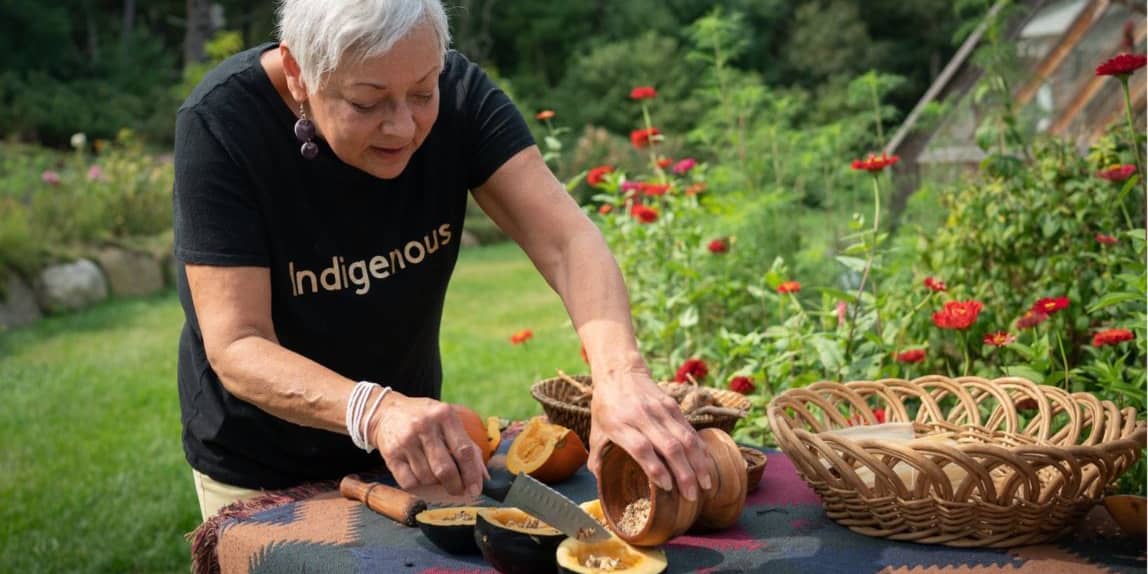
With “The Blue Zones American Kitchen: 100 Recipes to Live to 100,” Buettner aims to convince more American eaters that creating your own Blue Zone with mostly plant-forward suggestions is easier than ever. The shared recipes feature inexpensive and regularly available options in backyard gardens, major grocery stores and specialty food shops. Chapter titles cover dishes and techniques from Indigenous and Early American culture; African American; Latin American; Asian American; and a collection of regional and contemporary American recipes.

Read: Eating 400 calories a day from these foods could raise your dementia risk by over 20{d2b09b03d44633acb673e8080360919f91e60962656af8ade0305d5d8b7e4889}

“ Women can add 10.7 years on average to their lifespan by eating the Blue Zone way, and men can add an average of 13 years. ”


— Dan Buettner

Blue Zone residents experience generally a fifth the rate of heart disease, a sixth the rate of dementia, and a sixth the rate of certain cancers compared with Americans consuming our typical diets, which tend to include processed food and plenty of meat. The obesity and diabetes rates in each Blue Zone historically were under 5{d2b09b03d44633acb673e8080360919f91e60962656af8ade0305d5d8b7e4889} although have been creeping up. The people in the studied areas, who are eating much the same way their ancestors did, live roughly a decade longer than average Americans and spend a fraction of what most of us do on healthcare.

While no food is technically off limits as to avoid the trappings of fad diets that just don’t work, Buettner says, he stressed in an interview with MarketWatch there are notable exclusions.

For one, sugar doesn’t figure much into Blue Zone diets, except occasionally as honey. In all, people within Blue Zones consume about seven teaspoons of sugar a day, about a third of the 22 or so teaspoons the average American takes in both by adding sugar from the canister and via processed foods. Prevalent beverages include water, teas of all kinds, black coffee and wine. Soda pop was unknown to most of the 350 centenarians that Buettner has interviewed over the past two decades.

He’s convinced, and he leans on medical experts for some help, that in the United States, women can add 10.7 years on average to their lifespan by eating the Blue Zone way, and men can add an average of 13 years.

“The largest gains would be made by eating more legumes, whole grains and nuts, and less red and processed meat,” one study concluded.

The research has also suggested that it’s never too late to eat differently. The scientists he quotes estimate that for the U.S. population to improve its diet in this way, a 20-year-old could add up to 13 years to their life, a 60-year-old could add up to 8.8 years, and even an 80-year-old could add 3.5 years.

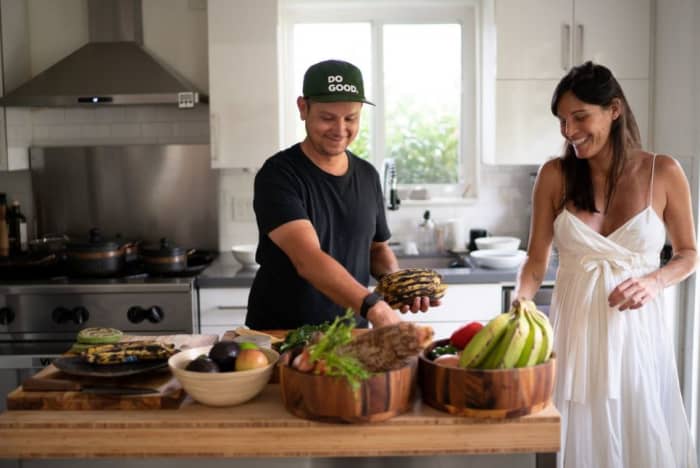
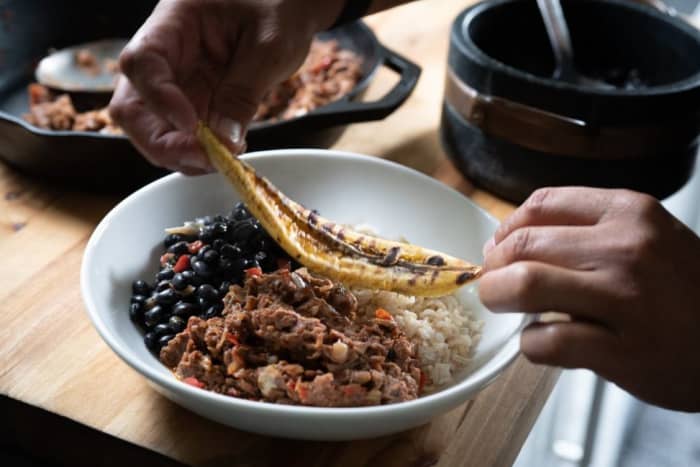
Diego Tosoni and his wife, Veronica Menin, of Miami, grill plantains. American Blue Zone recipes feature Salvadoran, Mexican, New Mexican, Texas-Mexican, Argentine, Venezuelan and other Latin dishes.


David McLain

Our interview with Buettner as his book launched this December follows, edited in part for clarity and length.

MarketWatch: The images are National Geographic-gorgeous, there’s actual field reporting, it’s as much about culture as food, and I can see reading “Blue Zones” both propped up in bed and as a sauce-stained cookbook right on my countertop. How do you want people to use it?

Buettner: I’d considered a stained book a high compliment. We landed on 100 recipes because that makes it easy for people to put it to work in their real lives. And by the way, these recipes aren’t recipes that Dan Buettner made in his kitchen or in a test kitchen. This whole book is like a 300-page National Geographic article. Every one of those recipes were discovered in people’s homes or backyards. The chefs are in their own kitchens. And all the recipes are theirs, but, of course, for final inclusion, we did test them.

“‘I have a maniacal focus on deliciousness.’”


— Dan Buettner

MarketWatch: There are definitely foods that are avoided, and plant-based foods are featured, but my reading of these recipes and habits reveal plenty of texture, flavor, and yes, meat can be included.

Buettner: The people I’ve interviewed eat very little fish and eggs. Meat is a celebratory food, consumed typically only five times a month. And though they enjoy small amounts of sheep and goat cheese, dairy from cows is almost completely absent from the diet.

I think I’ve made the decision that when I write Blue Zone books, they’re 100{d2b09b03d44633acb673e8080360919f91e60962656af8ade0305d5d8b7e4889} plant based. But I also have a maniacal focus on deliciousness. My 87-year-old father Roger Buettner — born on a farm in Minnesota and grew up eating meat and potatoes his whole life — came along with us. We probably went through 200 recipes. But when meat-and-potatoes Roger Buettner gave it the thumbs down, it didn’t make it into the book.

Read: Popular culinary site Epicurious cuts new beef recipes in a ‘pro-planet’ move — its users didn’t complain

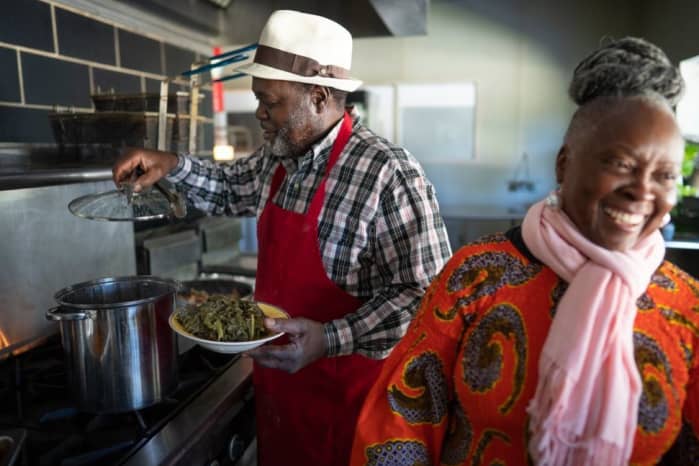
Bill Green and his wife, Sara, have run Gullah Grub on St. Helena Island, South Carolina, for 15 years, a culinary celebration of their Gullah Geechee heritage. His recipes for stir-fried cabbage and beets, and another for red cracked rice, feature in the Blue Zones cookbook.


David McLain

MarketWatch: Sugar, certainly, is a major American issue. We sort of cycle through those glycemic highs and lows. And you’re not just talking about a couple of teaspoons of sugar in your coffee; you’re talking about how packaging and processed food introduce an abundance of sugar into our diets. So when, if ever, do you think Americans will get the message on sugar? And would you argue that because in Blue Zones you were so deliberate with acid and spices and really flavorful recipes, that’s the path for the conversion off sugar?

Buettner: Yes, I mean, we love food that tastes good and there are lots of ways to make food taste good. But you know in general, if you’re overweight and unhealthy in America, it’s probably not your fault. And it always irritates me. These politicians get up and wag their finger at people, saying it’s your individual responsibility to be healthy. But then they send people out into a food environment where 97 out of 100 choices are unhealthy. So, you know, our food environment makes it nearly impossible.

“‘I guarantee you that when consumers increase the demand for whole plant-based foods, the market will respond and make them more available, and make them cheaper.’ ”


— Dan Buettner

There are basically only two sources of solving the problem. The first one is changing these lobbying laws because the big media industries and big food industries have enormous influence on the agricultural belt because of the way lobbying works. And all the subsidies are for grains that are used to make junk food and animal feed: corn, wheat and soybeans. In fact, if you’re a farmer, you can get dinged if you try to grow non-subsidized crops on lands that you’re being subsidized for.

That means the second solution is for the American consumer to start by cooking with whole plant-based foods. Learning how to make them delicious, increasing the demand. And I guarantee you that when consumers increase the demand for these foods, the market will respond and make them more available and make them cheaper.

MarketWatch: Can we lay to rest all the confusion around carbohydrates?

Buettner: As I’ve written, the term carbohydrate is probably the worst dietary term ever coined. It covers everything from jelly beans to lentil beans. Simple carbohydrates like potato chips, white flour and sweets are probably the most toxic foods in our diet, while complex carbohydrates like whole grains, tubers, and beans are probably the healthiest foods we eat.

In Blue Zones, 65{d2b09b03d44633acb673e8080360919f91e60962656af8ade0305d5d8b7e4889} of the dietary intake comes from those healthy complex carbs; in fact, whole grains, greens, tubers, nuts and beans are the five pillars of a longevity diet on four continents.

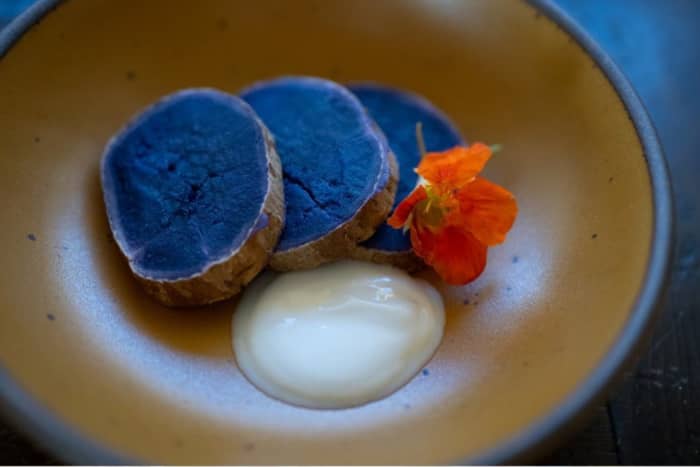
Okinawan sweet potatoes, roasted here with a coconut ginger cream, have been cultivated in Japan since the early 17th century. Now, they’re a staple of Hawaiian cuisine.


David McLain

MarketWatch: People need to eat, period. Calories matter and we have huge food inequity in this country, so processed food may just be one way to get food into American homes. Plus, there’s ease. But none of these recipes seem difficult. Why do we go the seemingly easy route with processed food?

Buettner: As I write in the book, food processing is not new; ancient civilizations used some form of processing to save food to survive. We might not even fully understand how much this has changed. Before World War II, food processing was relatively simple and mechanical — for example, breaking down wheat kernels into still identifiable flour, germ and chaff, and vacuum-sealing vegetables in tin cans. After the war, food technologists began to go much further, breaking raw grains down to their basic molecular structure and reassembling them into foods that bore no resemblance to the raw materials out of which they were fabricated.

MarketWatch: Is there any concern that sourcing some of these ingredients will remain hard for people? I’m just always interested in maybe a class dynamic around healthy food access and whether you agree? But also why should we let, quote unquote, economic burdens, stop anybody from a healthier pursuit?

Buettner: This is an American cookbook. Maybe there’s a few semi-exotic ingredients, but the vast majority of the ingredients are present today. Even with turn-of-the-century recipes, let’s remember that these were poor people. Peasants. The ingredients in this book, by and large, are not expensive ingredients. They’re cheap beans, whole grains, seeds and tubers. You can get a 25-pound bag of beans at Costco for $9.99 and make probably 100 meals.

Opinion: Your diet isn’t just making you obese, it could be speeding up cognitive decline

MarketWatch: And what about cooking methods?

Buettner: 95{d2b09b03d44633acb673e8080360919f91e60962656af8ade0305d5d8b7e4889} of the recipes were done in kitchens where all they had was a stove and a pot. Okay, maybe a knife and a cutting board. We’re actually going to see a gentleman right now whose specialty is cooking over an open fire, throwing candied squash right in the open flame, and of course, knowing when to pull it out. But anybody who’s got a barbecue can do the same. It takes no skill at all. It just takes the courage to throw it in and pull it out at the right time.

MarketWatch: You can practically taste some of these images; color and texture is very important. Talk about that.

Buettner: Remember, even though these people [who originated these practices and recipes] weren’t rich, they’ve spent generations of trial and error to get these recipes so that they have the mouthfeel of robust, fulfilling meals. They’re satisfying. you bite down and you feel a resistance and then you bite down a little bit harder and it gives this sort of meaty mouthfeel and then the herbs and spices hit.

There’s nothing new about throwing a steak and a piece of butter in a pan and frying it up. It’s going to taste good. Where the genius comes in is these Americans, often immigrants, are taking Old World food traditions and fusing them with American sensibilities to come up with something that’s raving genius.

Grilling plantains brings out the sweetness of the fruit. Try them with “drunken’ beans and coconut rice for an easy weeknight meal.


David McLain

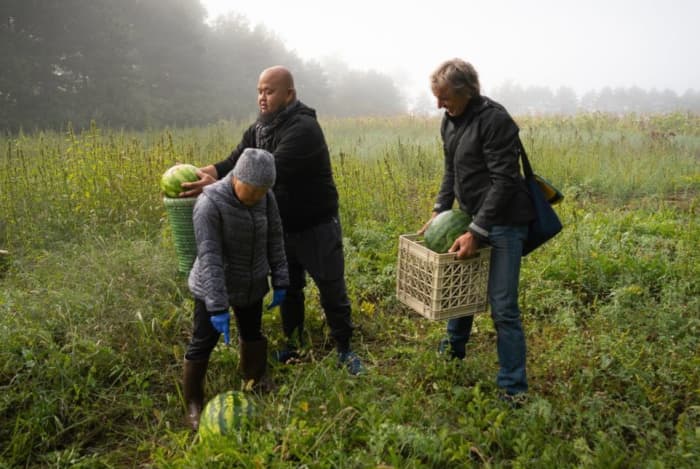
Yia Vang and Dan Buettner help Vang’s mother, Pang Vang, harvest traditional Hmong crops from her backyard garden in a suburb of Minneapolis.


David McLain

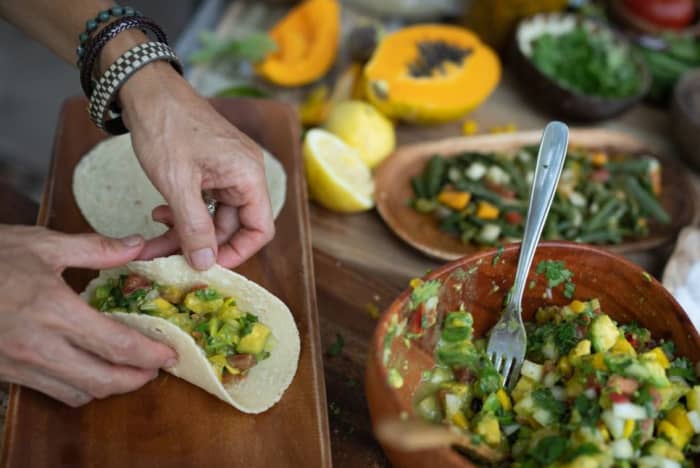
Hawaiian fresh-fruit tacos are prepared by chef Tess Villegas-Rumley at her Barefoot Zone restaurant on the Big Island. Her Blue Zone-approved establishment is part of a healthy-living movement endorsed by the state of Hawaii.


David McLain

MarketWatch: It’s probably not the main point of your exploration, but there’s no ignoring that Blue Zone eating is generally easier on the environment. How so?

Buettner: The animals we eat create somewhere between 20{d2b09b03d44633acb673e8080360919f91e60962656af8ade0305d5d8b7e4889} and 30{d2b09b03d44633acb673e8080360919f91e60962656af8ade0305d5d8b7e4889} of our carbon footprint. For every pound of milk, you have to feed a cow six pounds of soy. And they fart methane and carbon dioxide and all these other greenhouse gases. If you’re interested in the environment, the biggest step you can make is eating whole, plant-based food. And by the way, processing also takes a lot of energy. So I would argue that cooking from this book is an act of environmental awareness.

MarketWatch: I’m sure you love all 100 recipes. But are there a few that you return to or were surprised by? Or maybe that your dad really loved?

Buettner: My dad’s go-to is the tomato, eggplant and sweet potato pasta sauce (page 240). That’s for him and other people who don’t like a lot of spice. Garden tomatoes are best, but any canned tomato puree. Serve with any pasta you love and garnish with chopped macadamia nuts to really play up the sweetness. And I just love a Gullah Geechee dish that has butter beans with benne seeds (like sesame seeds) and okra (page 85): searing hot peppers and this umami flavor from the seeds. When you dig into that, it’s hearty. And you just cry tears of joy.

‘I felt like I failed’: inflation puts healthy food out of reach for millions of Americans | US news

‘I felt like I failed’: inflation puts healthy food out of reach for millions of Americans | US news

In April, Kimberly Hart made a resolution to lose some weight on the advice of her doctor. Hart, who is 61 and lives in New Haven, Connecticut, has high blood pressure and cholesterol. These factors, combined with her age and weight, put her at an elevated risk for developing diabetes, and she wanted to do whatever she could to prevent that from happening.

One element within her control, Hart thought at the time, was her diet. She started seeing a nutritionist, a cost covered by Medicaid, and eating more healthily. But it wasn’t long before her efforts clashed with the reality of rising grocery costs.

In May, Hart began to really feel the pinch of higher prices, and by June, she realized she had to completely upend the way she put food on the table for her and her son.

Kimberly Hart prepares a weekend dinner for her and her son.

She swapped wheat bread for store-brand white bread, “which is too bad” she said, “because I know that wheat bread is healthier for me, but I also know that white bread is cheaper”. She switched from frozen vegetables to cheaper canned ones, despite lower nutritional value and higher sodium content, and no longer buys fresh fruit. Four months since her April resolution, she said, the scale hasn’t budged.

“The more color a plate has the healthier it is, because you get your color from fresh vegetables,” she said. But because of her financial situation, “I can’t really do that”.

Inflation is pushing healthy eating out of reach for millions of people like Hart, a trend that public health experts worry could increase their risk for diet-related diseases in the long run. Over the past year, grocery prices have risen rapidly as agricultural supply chains bowed under the pressure of food scarcity, labor shortages and high fuel costs.

By the end of July, the cost of eating food at home had increased by more than 13{d2b09b03d44633acb673e8080360919f91e60962656af8ade0305d5d8b7e4889} compared to the same period a year ago, according to the Consumer Price Index. According to a survey conducted by the Urban Institute in June and July, more than 20{d2b09b03d44633acb673e8080360919f91e60962656af8ade0305d5d8b7e4889} of adults reported experiencing food insecurity within the past 30 days, an increase of more than 6{d2b09b03d44633acb673e8080360919f91e60962656af8ade0305d5d8b7e4889} from spring of last year.

It might seem counterintuitive but scientists have long pointed to links between poverty and obesity. This week, the Biden administration launched a national strategy to tackle the country’s “urgent, nutrition-related health crisis”, including the “rising prevalence” of diet-related diseases such as obesity.

In response to higher prices, people are buying cheaper, processed foods high in calories, sugar and sodium over costlier options like fruits and vegetables, protein and whole grains, according to public health researchers and anti-hunger experts.

“Highly processed foods are still the most affordable for people and they can stretch longer and they have a longer shelf life,” said Mariana Chilton, professor and director of the Center for Hunger-Free Communities at Drexel University. “People want to buy healthy food, but then they make the choice to get food that is not as healthy but that stays on the shelf longer and can stretch and helps their kids feel fuller.”

Kimberly Hart, 61, gets a can of mushrooms from her pantry to add to a chicken soup.
Hart gets a can of mushrooms from her pantry to add to a chicken soup.

Over the long term, researchers have found that food insecurity – defined by the Department of Agriculture as uncertain access to nutritionally adequate food – is probably associated with obesity, a condition that in turn raises the risk of problems including diabetes, heart disease and strokes.

“People in the United States who are more food insecure have higher rates of overweight and obesity,” said Parke Wilde, a professor of food and nutrition policy at Tufts University. Wilde added that low-income people without access to social safety programs are most harmed by inflation-driven food insecurity, and its associated health risks.

While researchers have investigated the link between food insecurity and obesity for decades, exactly how the two issues are related remains unsettled, Wilde said. One explanation may be in the uncertainty it brings. “Having a boom-and-bust cycle in how much food you have might have sends a signal to your body that it needs to retain food energy, and that might put people at higher risk of overweight and obesity,” Wilde said.

Anti-hunger advocates say that food insecurity driven by inflation illustrates the powerful role that poverty plays in shaping dietary choices and healthy eating, which have historically been framed as a matter of individual decision-making.

“There’s this sense that low-income people don’t know how to eat,” said Thomas Reynolds, the chief executive officer of Northwest Harvest, a network of 300 food banks in Washington state. “I just totally reject that. It’s really about just making very practical decisions, because money is so tight right now.”

a can of unsalted vegetables
Hart cooks a chicken soup with canned unsalted vegetables to watch her sodium intake.

Katrena Ross, 40, a legal assistant and mother of three living in Redford, Michigan, first started worrying about inflation in February. At the time, Ross was already straining to feed her family on a monthly budget of less than $200, a situation that made her especially attuned to even the slightest price increase.

As prices began to rise in the spring, Ross couldn’t afford to buy as much fresh produce and meat. Instead she reached for peanut butter and jelly, pasta, boxed macaroni and cheese and $1 ramen noodles – a food she hadn’t purchased in years.

“I would love to say that I think about what eating like this would do to me and my kids but that’s not really a luxury that I have, because I can only think about: what am I feeding them now? What do I have to make sure that they don’t go to bed hungry?”

Public health experts emphasize that food insecurity takes more than just a physical toll – it can also have harmful psychological impacts.

“A lot of people just think about obesity, diabetes, metabolic syndrome, heart disease and yes, all of those can get exacerbated, but a lot of people tend to forget about the emotional consequences,” said Chilton of Drexel University.

Eventually, Ross made the decision to move her family back home with her mother and stepfather, a move that allowed the merged household to pool resources and shoulder the burden of inflation together. It’s a choice that also gave her a much-needed peace of mind.

“My ability to not provide the basics for my family like food and keeping a roof … that was destroying my mental health,” Ross said. “I felt like I had failed them. I felt like I couldn’t keep them safe or provide for them properly, which for a mom or for any parent really, it really hits your self-worth.”

Reynolds of Northwest Hunger said that there are numerous ways that lawmakers can strengthen the social safety net in order to prevent families like Ross’s from experiencing food insecurity in the first place, as well as help them cope with the unexpected costs of rapid inflation.

“Poverty and hunger are so closely related, it’s almost interchangeable,” he said. He believes policies such as universal basic income, free school meals and higher payments to people in the Supplemental Nutrition Assistance Program (Snap, formerly known as food stamps) could bolster food security and make healthy eating more affordable.

a woman reaches for items in her kitchen
Hart reaches for items in her kitchen.

For Hart, more generous Snap payments could make a significant difference to her life. Before the pandemic, she estimates she received around $400 a month from the program. But her 20-year-old son recently got a part-time job and the additional income caused their household benefits to drop. Her son is now considering taking a higher-paying position, something that she supports, but she worries that will lead to even further cuts in their monthly Snap allotment.

“It’s a catch-22,” she said. These days, she organizes her week around waiting in lines for food pantries, which she relies on for extra produce, dairy and meat.

Hart said she feels demoralized that she hasn’t lost any weight since April. Sometimes, she lies to her nutritionist about following a healthier diet, just to sidestep the fact that she can’t actually afford it. “One day, I might wake up diabetic,” said Hart. “If I could just eat healthier … but I can’t.”