‘The Book of Jewish Food’ Tells the Story of Jewish Food and Jewish Life

‘The Book of Jewish Food’ Tells the Story of Jewish Food and Jewish Life

In 1981, at the Oxford Symposium on Food and Cookery, an annual gathering of some of the finest minds in the food world, the cookbook writer Claudia Roden, already famous for her authoritative first book, A Book of Middle Eastern Food, declared, “There is really no such thing as Jewish food.”

Because the Jewish God has a sense of humor, Roden shortly afterward embarked (at the suggestion of her British editor) on a new project about, yes, Jewish food. The Book of Jewish Food: An Odyssey from Samarkand and Vilna to the Present Day (the American edition is subtitled An Odyssey from Samarkand to New York) took 16 years to finish, plenty of time to consider the Jewish food question.

But, I hear you cry, isn’t it obvious? Bagels! Lox! Gefilte fish! The maddeningly complex laws of kashrut, which have been subject to debate for several millennia! Of course there is Jewish food!

Well, yes and no. There are entire communities of Jews, including the one in Cairo in which Roden grew up, who have never eaten bagels and lox. And not all Jews keep kosher. As Roden traveled the world talking to Jews about their food, she realized that everyone had their own personal idea of what made food Jewish. Jewishness isn’t a place. Jews move around too much for that. Jewishness is a state of mind, and Jewish food is often eaten in exile.

For Roden, Jewish food was the dishes her grandparents had brought to Egypt from Constantinople and Aleppo at the turn of the 20th century: kibbeh and little meat and spinach pies and a chicken soup called melokheya, named after the distinctive-smelling leafy green vegetable that floated in it. For a Jew in Samarkand, it would have been khalti barsh, rice mixed with meat and liver and cooked overnight in a linen bag, and for a Jew in Morocco, couscous with stuffed meatballs. Only an American or Canadian would consider bagels and lox central to Jewish cuisine, and they would argue with a Brit about the proper preparation of gefilte fish because in England, instead of serving the fish balls in cold jelly, they fry them. The only common denominator appears to be matzo, unleavened bread of affliction that’s eaten at Passover, and a cookbook devoted to that would be very short and unspeakably sad.

This lack of consensus is a very big problem for someone who is trying to write the definitive book on Jewish food.

At first, Roden thought she would collect every Jewish dish in every Jewish community in living memory, until she realized this quest would probably take her the rest of her life. So she decided to limit the book to the largest and best-known communities and select the very best she could find. She still ended up with 800 recipes.

Not all Jewish dishes are exclusive to Jews. Everybody in countries like Egypt, Lebanon, and Yemen eats falafel, for example. But Roden found that Jews tend to put their own twists on common regional foods to make them conform to the kosher laws, like using oil instead of butter. Sometimes, after leaving — or being expelled — from one country, they would bring their food to another, like the Yemeni Jews who brought a spicy relish from Arabia to Israel where they served it on falafel and therefore made falafel Jewish. Was this relish considered Jewish in Yemen? Would it have ever been served with falafel if not for the Jews?

Instead of trying to be completist or hand down definitive judgments, Roden decided — and this is the reason this book is wonderful — to put all these recipes back in the context in which they were first eaten by Jews. Food becomes a means of time travel. Even if there were no recipes at all, the descriptions of the Jewish communities of the past and what they ate would make the book worth reading.

The places she brings us are almost uniformly beautiful. Most of them no longer exist. Maybe they never did. Roden describes a series of tight-knit communities, some more prosperous than others, where people always keep the door open for their neighbors and an extra seat at the table for a stray visitor or someone going through a hard time. Friday night is a time to gather, to shake off the worries of the workweek and enjoy a glorious meal that took all day to prepare. Even the Eastern European shtetls, which I firmly believe are the source of much inherited trauma for American Jews, are bathed in this golden light. (The lone exception is America, the land of Crisco, difficult to romanticize because it still exists.) Roden did meticulous research, and the pictures she paints are beautifully detailed. But, like those Renaissance artists who gave Biblical characters the faces of people they knew, Roden is really telling the story of her own lost world.

The Zamalek neighborhood of Cairo, where Roden was born, was a close and cosmopolitan community where Jews mingled freely with their Muslim neighbors. They spoke French and ate Syrian food prepared by their Egyptian cooks. Roden’s relatives were all merchants; the family traveled to Europe for several months every year. At home, in the words of Roden’s father, “we spent our time on the balcony talking to passersby.”

In 1951, when she was 15, Roden left Egypt to go to boarding school in Paris, and then, three years later, to London to study painting at Central Saint Martins. In the fall of 1956, in the wake of the Suez Crisis and the failed invasion of Egypt by Israel, Britain, and France, the Egyptian president Gamal Adbel Nasser expelled all foreigners and Jews, some with as little as 24 hours’ notice. Roden’s parents, Nelly and Cesar Douek, joined her and her two brothers in London, and none of them saw Egypt again for 30 years.

In the immediate aftermath of the exodus, the Doueks’ North London home became a place for the exiles from Zamalek to gather. Many of them were passing through on their way to New York or Jerusalem or South America. They were all grieving. In Cairo, very few of them had cooked — everyone had servants — but they still had their family recipes. Roden would learn later on, once she started reading the work of anthropologists, that every family has its own culinary code. “In the selection of dishes,” she writes in the introduction to The Book of Jewish Food, “there is a logic that combines mythological, historic, and moral significance to create a symbol.” Those codes put a particular stamp on each family’s version of a dish. In Egypt, recipes were closely kept secrets. No one ever shared. But in exile, things were different.

“They were desperate,” Roden has recalled to multiple interviewers. “They would say, ‘Please, give me your recipe for that. It’ll be something I’ll remember you for because I might never see you again.’ And for most of those people, we never, ever saw them again. And those recipes were so precious, I found.”

She tells this story the same way every time because it is her origin story. After a while, she began collecting recipes from outside her family’s immediate social circle. She would go to places like carpet stores and the Iranian embassy and ask random people. This has remained her method throughout her life. People always give them to her. No one has ever gotten angry at her for publishing them. Quite often, she gets multiple recipes for the same dish. The Book of Jewish Food is full of variations: This is how the Syrians make it, and this is how the Iranians do it, and this is how you would have found it in Thessaloniki before World War II, when it was still called Salonika.

Roden’s quest for more recipes eventually took her to the British Museum in search of Arab cookbooks. The only ones she could find were from the Middle Ages. She also found a Ph.D. dissertation about a 13th-century cooking manual from what is now Lebanon. It explored not just how to prepare food but also what the food said about the society: which class of people was eating these dishes and which class of people was preparing them and the trade routes that made foreign ingredients available. For Roden, it was an epiphany. “I just realized how food can tell you so much,” she recalled later.

In The Book of Jewish Food, Roden divides the Jewish world into two cultures: the Ashkenazi of Eastern Europe, and the Sephardi of Mediterranean Europe, North Africa, India, and Southwest and Central Asia. (These non-European Jews are also often referred to as Mizrahi.) The two cultures speak differently, pray differently, and eat vastly different food. Although Roden has by now lived most of her life among the Ashkenazim (including marriage to, and then divorce from, a British Jew of Russian descent), she is still very much Sephardi.

Sephardic recipes take up two-thirds of The Book of Jewish Food, and while Roden makes an effort to give Ashkenazi food its due, her heart is clearly not in it: In a New Yorker profile, the writer Jane Kramer points out to Roden that her matzo balls are a spectacular failure (no seltzer water!) and Roden shrugs and “admit[s] to having been less than discerning when it came to some of the Ashkenazi dishes.” In the section on fish, you can almost hear Roden gloat when she shares her discovery that fish and chips, the most beloved food of her adopted country, was not, in fact, invented by an Eastern European Jew, as was widely believed, but brought to London much earlier by Portuguese Jewish immigrants.

This focus on Sephardic food was quite novel in the English-speaking world in 1996 when the book was first published. But in the past quarter-century, Roden’s disciples, notably Yotam Ottolenghi in England and Michael Solomonov in the U.S., have made many converts. At this point, with the slow and painful death of the Jewish deli and the realization that schmaltz, the central fat of Ashkenazi cuisine, can actually kill you, there are probably more Jews eating eggplant, yogurt, and falafel than pastrami.

The overall experience of cooking from The Book of Jewish Food is less like a lesson from your bubbe or your aunties, the way cooking (allegedly) used to be, and more like a choose-your-own-adventure. With 800 recipes, who has time for hand-holding? This can get challenging when you are making a dish you have never seen or even heard of before, especially if you’re a nervous cook like I am.

I did not attempt the kibbeh, even with the aid of YouTube tutorials. Roden writes that it was “the standard by which once upon a time women were judged,” and the pressure was too much. I also did not attempt any of the many pies because, according to Roden, you can’t make just a few, you have to make dozens, and doing it solo instead of with a kitchen full of friends and relatives makes one tend to feel lonesome and sorry for oneself.

I did make anjuli, a cold fish and potato salad from India, because Roden is very enthusiastic and persuasive about the Indian recipes she’s collected. It had a delicate flavor, and now I think coconut milk is a very underrated ingredient in fish salads. The Sephardi rice pudding, which I made the Egyptian way (baked until it developed a brown crust, like the top of a Portuguese egg tart) and then the Spanish way (unbaked and flavored with vanilla and lemon zest), was also very good.

Rice pudding, as it happens, was one of the dishes Roden ate when she finally returned to Cairo after years of exile. It was in a tiny dairy in Sakakini, the neighborhood where her parents had been born, and after she told this to the shopkeeper, he told her the pudding was on the house. That pudding welcomed her home. Was I tasting it now in Chicago in 2023? I didn’t think so — I had been slightly confused by the recipe and I’m quite sure the rice and milk I used had a different flavor. Plus I was eating it standing in my kitchen, not outdoors at a little table staring up at an old palace. Context is everything.

But I could still flip open the book to the description of old Cairo and I could read and imagine the smells of sizzling garlic and crushed coriander seeds with an overlay of rosewater, the domes and minarets, the courtyards behind metal grilles, and the sound of voices from the balcony, the family chatting with the passersby.

Aimee Levitt is a freelance writer in Chicago.

‘Good Drinks’ Is An Excellent N/A Cocktail Book

‘Good Drinks’ Is An Excellent N/A Cocktail Book

I never genuinely consider in New Year’s resolutions. I’m a large proponent of regularly strengthening your lifestyle and striving to currently being better, but—call me cynical—with resolutions it just feels like you’re setting oneself up for unavoidable disappointment. It’s like in Wander Tricky, when Dewey Cox tells his spouse she doesn’t believe in him, and she replies, “I do feel in you I just know you are gonna fall short!” That’s how I feel when somebody asks me what my New Year’s resolutions are—and then I say the exact same banal shit that everyone else claims.

All of that mentioned, I have frequently been ingesting a great deal less recently (though not entirely Dry January, since I went to a wine bar on January 2) and I have also manufactured it a goal to be a far better recipe-follower. With these “not resolutions” in head, I admittedly did really feel the (N/A) spirit (pun meant, sorry) this month and resolved to eventually delve into my duplicate of Very good Drinks by Julia Bainbridge, which arrived out in 2020.

Bainbridge is a foodstuff and drink journalist who has been released considerably and vast, and Superior Drinks is her breezy, unpretentious journey into the globe of N/A drinks. Contrary to some cocktail publications that are extremely technological and include ingredients and spirits that can make it sense prohibitive to non-professionals, Good Drinks is tremendous approachable, and can make you feel like you could execute any consume in it. Ambivalent about my ingesting these times, I quickly felt empowered by Bainbridge’s introduction, exactly where she writes, “Somewhere in New Mexico, I determined that all you genuinely require to know about my marriage to alcohol is that I’m seeking not to drink it—at minimum not for a very good whilst.” She carries on, “There are a lot of other people like me, and the reasons they don’t drink booze vary: religion, well being issues, material use issues, pregnancy, mindful residing. Perhaps alcoholic beverages merely does not healthy into their lives any longer.” For some motive, this passage (and what followed) hooked me, and designed me want to dedicate to actually mixing some superior beverages.


$22.99$20.99 at Amazon

Very first impressions

The book is set up by the requisite opening sections (equipment, glassware, ice, et cetera) and then breaks up recipes by when you’d want to consume them: midday, afternoon, happy hour, evening, and nighttime. I identified this to be magnificent, due to the fact even though one particular may well affiliate a Bloody Mary with brunch, beer with the afternoon, and a Negroni with anytime after… uh… let us go with 5 p.m., an N/A drink gets rid of the have to have to “drink responsibly” and “not go much too difficult as well early in the working day.” Want to make a 2 p.m. cocktail on a weekday without having guilt? There are zero good reasons not to, and Very good Beverages will counsel a little something that might tickle your extravagant at that hour.

My favourite element of the composition of the recipes is that they every contain a “Commitment Level,” indicated by a person, two, a few, or 4 circles as Bainbridge factors out, they selection from “You’re possibly cooking a syrup or employing your juicer or marinating or infusing something” to “This is a weekend job, for which you have to source a selection of components and devote some really serious time in the kitchen.” As a recipe fiend, I really appreciated that, considering the fact that one of the banes of my cooking existence is discovering a fantastic recipe that appears to be workable but knowing much too late that it demands other entirely different and additional cumbersome recipes to be produced to start with. When you take up a Excellent Drinks recipe, you have a feeling of particularly what it will entail and how extended it ought to just take.

How quick are the drinks to make… actually?

I determined to begin with the “Don’t Contact My Car Keys,” a recipe submitted by Shelby Allison of Chicago’s Misplaced Lake, a beloved Tiki institution that unfortunately shut at the beginning of 2022. I have good memories of going to Dropped Lake (which, nepo-inform, was in my community), so this drink felt essential to near that loop. 1st, I experienced to make coconut syrup, which necessary a can of unsweetened coconut milk and 2 cups of turbinado sugar. My very first slip-up (!) was contemplating I had turbinado sugar, but when I set out to start out, I realized it was actually Demerara sugar I read that they’re frequent substitutes, so I went forth, keenly aware of violating my resolution not to fuck with recipes on the to start with action of the initially recipe. Following generating the syrup (which is unquestionably mouth watering), I looked for a glass—I didn’t have the requisite and suitable Pearl Diver glass, but a Collins glass was also encouraged, so I went with a Collins-design trout fishing glass I inherited from my grandfather.

mocktail.jpg

The drink’s other parts had been lime juice, soda h2o, fragrant bitters, and a sprig of mint for garnish. I did my most effective to be devoted heading ahead, and uncovered the drink to be well balanced and amazingly tasty—it absolutely embodied the sweet and funky, citrus-y flavors I love in a excellent Tiki consume. Also faithful to the book’s “afternoon” designation, I relished the consume although performing immediately after lunch. All in all, it was a superb cocktail-making knowledge.

Since I desired to use my really good juicer (excessively praised below), I also tried using the “Get Very well Soon,” which was contributed by cocktail royalty Jim Meehan. This one essential me to make a syrup by mixing honey with freshly juiced turmeric and ginger as soon as that was performed, I simply included the syrup to a mix of lemon, apple cider vinegar, cayenne pepper, and very hot water, and garnished it with a lemon. It tasted like a impressive, more cosmic version of a incredibly hot toddy, with a hint of the well-known lemon/ACV/cayenne/turmeric combo all people loves (some phone it the “Master Cleanse” I connect with it “God’s lemonade”). 

IMG_2348.jpg

Beyond those people, I just can’t wait around to try the “Dollar Slice” (a Bloody Mary alt) and the “Change of Address,” which brings together citrus, Coca-Cola, soy sauce, and contemporary cinnamon, which appears unreal I’m also really intrigued in Yu the Great (basil-matcha syrup, lime, coconut milk, soda), and if having coffee after noon did not make me an crazy human being, I’d get Bainbridge’s rec to have a late-evening Chilly-Fashioned (easy syrup, orange, cherry, bitters, cold brew concentrate). 

TLDR: 

There are so lots of beverages I want to make from this e-book luckily, I’ll almost certainly continue to not be ingesting substantially in February and further than, so I’ll have a good deal of time to investigate. Good Beverages is unbelievably available for the newbie property mixologist, and whole of neat strategies for the pro looking for N/A inspiration. I astonished myself by generating two really delightful alcohol-cost-free cocktails utilizing homemade syrups, which has specified me the self esteem to go further into extra complicated N/A cocktails. If you are intrigued in exploring fantastic wonderful beverages, glance no even further than this ebook or if you just want to enjoy one particular, just occur thru—I continue to have an unbelievable volume of coconut syrup in my fridge.

Excellent Drinks is out there on Amazon.


The Rec Home team independently chosen all of the stuff showcased in this story. Want much more reviews, recommendations, and red-hot specials? Sign up for our publication. 

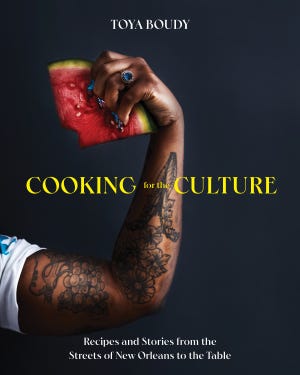
New Orleans chef Toya Boudy’s new book is ‘Cooking for the Culture’

New Orleans chef Toya Boudy’s new book is ‘Cooking for the Culture’

Toya Boudy is a native New Orleans chef. Her new cookbook, “Cooking for the Culture: Recipes and Stories from the New Orleans Streets to the Table,” has the recipes you would expect, like gumbo, jambalaya and barbecue shrimp. Boudy, having said that, is a Black New Orleanian. Her guide is about Black property cooking in the town. The recipes also include collard greens, pepperoni lasagna and yakamein. She shares a society the place cooking is about abundance and thrift is a requirement. And in contrast to so lots of textbooks devoted to home cooking, Boudy includes her individual household on every single web page, from the loving house the place she was elevated, to her expertise as a teenage mom and last but not least to her daily life now, in which she seems on TLC and the Food stuff Network and spreads her joyful, flavorful meals across the web.

5 Must-Make Recipes From Claire Saffitz’s New Book

5 Must-Make Recipes From Claire Saffitz’s New Book

“Asking ‘what’s for dessert?’ is extra than a nightly schedule, it’s a personal work out.” More true, a lot more lovely words and phrases have never been written. In her new cookbook, What is for Dessert, former Bon Appétit editor, Gourmet Tends to make star, and all round baking hero Claire Saffitz delivers more than 100 mouth watering responses. “Historically, dessert to me has usually meant some thing baked,” Saffitz writes, “but this book expands that definition.” 

While her initially guide, Dessert Individual, presents recipes for showstoppers of all problems (I nonetheless have goals about the tarte Tatin), Saffitz’s 2nd book takes numerous things into consideration—time, kitchen area, and budget—for recipes that are as approachable as possible. None of them have to have a stand mixer, only about 50 {d2b09b03d44633acb673e8080360919f91e60962656af8ade0305d5d8b7e4889} call for a hand mixer, and lots of them are no-bake. 

From festive cookies worthy of any holiday tin to advanced cakes that appear like they took hrs to make (they didn’t), we selected 5 of our favored recipes—all proper solutions to the age-previous dilemma: What’s for dessert?

What is actually for Dessert: Easy Recipes for Dessert Individuals

Tiramisù-y Icebox Cake

Saffitz counts this stunner of an icebox cake as a single of her preferred recipes in What’s for Dessert. Her to start with flavor “was a light-weight, espresso-flavored revelation.” It hinges on store-bought ladyfingers (soaked in coffee and Kahlúa) and can be produced times in progress.

An tiramisu ice box cake with a slice showing the layers

This light-weight, espresso-flavored cake is a enjoyment twist on the decadent traditional, with levels of Kahlúa-soaked ladyfingers established between a sweet mascarpone filling.

Perspective Recipe

Mango-Yogurt Mousse

For a do-ahead sweet that can go from fridge to table at a moment’s observe, glance no even further than this mango-lassi-motivated Mango-Yogurt Mousse. Below the flavors of the beloved South Asian drink—sweet mango, tart yogurt, and floral cardamom—come with each other to produce a refreshing dessert.

Two small cups of MangoYogurt Mousse on snow

Inspired by the refreshing sweet-tart flavors of mango lassi, this chilly and silky mousse hits all the spots for a fantastic after-dinner treat.

Perspective Recipe

Flourless Chocolate Meringue Cake

Flourless chocolate cake is superior. Flourless chocolate cake with meringue is even superior. Saffitz figured out meringue could be baked directly on major of a cake when she saw Tartine Bakery founder Liz Prueitt’s recipe for Sweet Potato Tea Cake With Meringue. On 1st glance this masterpiece may well appear much too complicated, but bear in mind: Meringue is nothing at all much more than egg whites whipped with a gradual and continual stream of sugar. You can do it.

A baked Flourless Chocolate Meringue Cake from Claire Saffitz
Flourless Chocolate Meringue Cake

This flourless chocolate cake attributes meringue both of those in the batter and on leading, which bakes into a light-weight and crispy shell with gorgeous swirls.

Check out Recipe

Raspberry-Almond Thumbprint Cookies

Loosely primarily based on ricciarelli, a cookie indigenous to Siena, Italy, these vibrant macaron-like almond cookies would make a welcome addition to any cookie swap. Thanks to a double dose of raspberry—the dough is flavored with each raspberry jam and freeze-dried raspberries—each bite is sure to fulfill your resident berry lover, in particular when the fresh new fruit is out of period. 

Pink thumbprint Christmas cookies on white doilies surrounded by winter greenery.
Raspberry-Almond Thumbprint Cookies

Crispy on the outside the house, chewy on the inside, these raspberry-jam-crammed almond thumbprint cookies are the best teatime snack.

Perspective Recipe

Lime Squiggles

With a title like Lime Squiggles, how could any person resist these soften-in-your-mouth cookies? These treats are a design of shortbread referred to as meltaways adding cornstarch to the dough hinders gluten progress, creating them splendidly tender. Saffitz swaps butter for product cheese, which brings bonus tang on major of the lime juice and zest. If you’re fearful about transporting a Key lime pie to your subsequent get together, these cookies are the up coming ideal matter. 

A bunch of shortbreadstyle Lime Squiggle cookies on a blue background

Make these irresistible soften-in-your mouth shortbread-design cookies, which are topped with lime glaze and zest for a tangy and citrusy punch.

Perspective Recipe

New cocktail book is the Cure for tired New Orleans cocktail recipes

New cocktail book is the Cure for tired New Orleans cocktail recipes

Comment

Even the inside cover of “Cure: New Orleans Drinks and How to Mix ‘Em,” Neal Bodenheimer and Emily Timberlake’s gorgeous new cocktail book, reminded me why the Crescent City is my favorite place in the world to get a drink.

That inside cover is a map of some of the most important watering holes, restaurants and live music joints around the city. For people who have the good fortune to know New Orleans, it’s a map of both remembered pleasures and those still to be explored; for those yet to eat, drink and explore this joyful, sorrowful city, it’s a cartographical to-do list, one the book later supplements with a “New Orleans Cocktail Bucket List.”

The map captures something about the spirit of the book, which is not just a celebration of Cure, one of the country’s best cocktail bars — a perennial James Beard nominee that won for Best Bar Program in 2018 — but a celebration of its community and city. Any number of books teach readers about cocktails through the lens of the bar they’re representing and recipes for drinks its mixologists have created. Far fewer also amplify their city and their neighbors (and nominal competitors) so generously.

Bodenheimer almost had to be hogtied and dragged into writing it.

To be fair, it’s not like the man doesn’t have a few other projects on his hands. Along with Cure, which he opened in 2009 after moving back to his native Louisiana after Hurricane Katrina, Bodenheimer owns Cane & Table in the French Quarter, and over the course of the pandemic, while he was writing, he opened Dauphine’s (a New Orleans-inspired restaurant in Washington, D.C.), as well as Val’s (a taqueria and agave spirits bar in the same neighborhood as Cure) and Peychaud’s (a cocktail bar in the courtyard of a French Quarter building that was once home to Antoine Peychaud, the inventor of the red bitters that now give a licorice-y hit to countless cocktails). And he also serves as a partner in Tales of the Cocktail, the annual bar conference that attracts thousands of industry folks and dedicated tipplers to the city every summer.

“Which all makes it sound like I’m … insane … but it wasn’t meant to be that way,” Bodenheimer says, noting how the pandemic played hell with so many plans and threw off so much original project timing. But he knew he’d never get the book done without help, and Timberlake, a longtime food writer and editor based in Oakland, Calif., proved to be the perfect partner in the project. Their calls and planning sessions for the book helped keep him sane during the pandemic, when so much seemed to be coming apart.

Bodenheimer knew he “didn’t want to do another bar-bar book, because so many bars have made bar books that I think it’s a pretty complete genre. And I didn’t want to do a vanity project either … . I want to talk about what Cure is and what it’s done, but I want to put it into the larger context of New Orleans drinking.”

Thus the book provides plenty of drinks that are original to Cure and the many creative mixologists who have worked there over the years, but it also provides the history of many New Orleans classic cocktails, and recipes for iterations of and riffs on such drinks as the French 75 and the Pimm’s Cup, not originally New Orleans drinks but which, through specific bars (Arnaud’s and the Napoleon House, respectively) have become indelibly associated with the city.

Exploring the historical component of New Orleans drinking required some wrestling with the ghost of Stanley Clisby Arthur, the journalist whose 1937 book, “Famous New Orleans Drinks And How to Mix ’Em” inspired the subtitle of the Cure book.

The Clisby Arthur book helped establish an early history of cocktails and of New Orleans’ place in it. The problem with the history it established is that a lot of it is what Bodenheimer describes with an expletive meaning bovine excreta.

In the intro to his book, for example, Clisby Arthur writes of New Orleans, “It was here that your most modern of American beverages, the cocktail, first came into being and was given its jaunty name,” going on to harrumph about a number of fake stories about how the word “cocktail” came into being, before then insisting that Antoine Peychaud himself was responsible for the name via a bastardization of the French word “coquetier,” which referred to a style of egg cup in which the apothecary once served doses of brandy enhanced with his stomach-settling bitters.

Unfortunately, the word “cocktail” is now known to have appeared in print when Peychaud was still in nappies.

And yet in Clisby Arthur’s book also appear such drinks as the Sazerac — the quintessential New Orleans cocktail, and the city’s official one since 2008 — the Vieux Carré, the Cocktail a la Louisiane, the Ramos Gin Fizz, the Roffignac (see recipe below), and multiple absinthe-focused drinks. (The spirit, which was illegal in the United States for nearly a century, largely due to misconceptions of its purported herbal dangers, has had a deep impact on the city’s cocktails and drink style.)

“We used ‘Famous New Orleans Drinks, and How To Mix ’Em’ as a guide when we were opening Dauphine’s,” Bodenheimer says, and that meant he ended up spending a lot of time with the book. “So I have this deep appreciation for him, because he really created this canon of New Orleans drinks. … Without him, I don’t think New Orleans would hold that important place in world drinking. At the same time, I look at some of his history, and I’m like, ‘Man, you were really winging it.’ But that’s also kind of perfect, because that is like the bar world, too. There are a lot of people who are faking it till they make it.”

Happily the Cure team spent plenty of time refining and rejiggering recipes — the book’s precise spec for the Sazerac provides the preferred amount of Peychaud’s down to the very drop — and developing their own terrific drinks. In that development process, Bodenheimer says, Cure has long followed a very specific hierarchy of considerations: “How does it taste? How does it taste? How does it taste? How does it smell? How does it look?”

That is not necessarily a recipe for success in an Instagram-driven world, he acknowledges, but over time, it seems to have worked for the bar. “With Cure, there was our desire to do what we wanted to do, and then there was what New Orleans had always done” with cocktails and their preservation, he says. “Together it kind of created this magic, where people wanted to take the journey with us and see where we were going to go.”

Scale and get a printer-friendly, desktop version of the recipe here.

This upgrade on an old New Orleans drink makes for a more balanced take on what was originally a very sweet drink. The old recipe in Stanley Clisby Arthur’s classic cocktail book called for whiskey, but this version from the bar Cure’s new cocktail book uses Darroze 8 Year Les Grands Assemblages Bas-Armagnac, a French grape brandy, for the base. Co-author Neal Bodenheimer notes that the recipe works “surprisingly well with any number of unaged spirits,” but doesn’t like it with the original whiskey. The raspberry shrub can be refrigerated for several months and can be added to sparkling water, lemonade or other drinks.

Storage: Refrigerate the shrub for up to 3 months.

  • 1/2 cup fresh raspberries
  • 1/2 cup cold water
  • 1/2 cup granulated sugar
  • 1/2 cup white vinegar
  • Ice
  • 1 1/2 ounces bas-armagnac (or your preferred spirit; see headnote)
  • 1 ounce raspberry shrub
  • 2 to 3 ounces soda water, to top
  • Fresh raspberries, for garnish (optional)
  • Mint sprig, for garnish (optional)

Make the shrub: In a blender, combine the raspberries, water, sugar and vinegar and process on high until smooth. Strain through a fine-mesh sieve or cheesecloth, transfer to a bottle and refrigerate until needed. You should get about 1 1/4 cups (enough for about 12 drinks).

Make the drink: Fill a Collins, large coupe or a stemmed punch glass with ice.

Fill a cocktail shaker with ice, then add the armagnac and raspberry shrub. Shake to chill, about 15 seconds, then strain into the glass and top with the soda water. Garnish with the raspberries and a mint sprig, if you like, and serve.

Adapted from “Cure: New Orleans Drinks and How to Mix ‘Em,” by Neal Bodenheimer and Emily Timberlake (Abrams, 2022)

Tested by M. Carrie Allan.

Jacques Pepin, at 86, talks about his new book, ‘Art of the Chicken’

Jacques Pepin, at 86, talks about his new book, ‘Art of the Chicken’

MADISON, Conn. — In the course of the pandemic, Jacques Pépin’s knives did not uninteresting. The French chef concocted much more than 250 cooking videos on Fb, in which he now has 1.6 million followers. Not long ago, he concluded an 11-day cruise exactly where he was the entree, so to talk, hosting demonstrations while an all-Pépin channel streamed in travelers’ staterooms.

Nevertheless debonair if a little bit creakier, Pépin turns 87 in December. He is among the very last of the 1st wave of culinary legends who turned house names — Julia Youngster, Craig Claiborne and Pierre Franey. For four decades, he’s been a regular in several American kitchens. Pépin democratized formal technique. He instructed legions of American expert and dwelling chefs, not in a constellation of exorbitant white-cloth places to eat but by way of cookbooks, and hosting 13 separate community television collection.

At age 64, debut novelist Bonnie Garmus can make the circumstance for working experience

Pépin may perhaps have built his name as Child’s Television kitchen area comrade, but he has developed further than Poulet à la Crème and Maman’s Cheese Soufflé, even though even now celebrating the yumminess of the two. He understands that a modern-day chef embraces modify — even the microwave and Instagram.

Mention retirement and he appears to be like mystified, probably aggravated, an eyebrow cocked: “Retire from what? Retire from executing what I appreciate? Retire from cooking?”

And he is generally publishing. His newest: “Jacques Pépin Artwork of the Hen: A Learn Chef’s Paintings, Tales, and Recipes of the Humble Fowl.” It is a book most fowl. This gallinaceous volume — perhaps his 32nd, who can continue to keep rely? — consists of a gallery of his paintings of chickens, anecdotes from his exceptional lifetime and recipes that are additional tale than instruction.

As its title suggests, “Jacques Pépin Art of the Chicken” celebrates his paintings, which he has done for five a long time, and his lifelong adore of the hen — the Bresse bird which is a delicacy from his house location in the vicinity of Lyon. “Proust experienced his madeleine. I have chickens,” he writes. “As a chef, I stand in awe of the humble bird’s contributions to environment delicacies. As an artist, I marvel at the iridescent colors and various magnificence of its plumage.”

Like any true French chef worthy of his sel, Pépin has no issue adoring and cooking the identical “gentle, convivial and docile” beast. His portrait of “Stately Chicken” faces his recipe for Gizzards, Gizzards and Extra Gizzards. Pépin no for a longer period retains chickens on his property — way too significantly journey, far too lots of tenacious raccoons — but collects refreshing eggs from a neighbor. How he loves eggs! He writes: “If you requested me to pick out a single ingredient that I could not do without, it would probably be the egg.”

Pépin at first produced his paintings — typically oils and acrylics — for himself and for menus. Though painting is a passion, he is not shy about showing off his function — in his publications, at a community library exhibition and for sale to partially gain the Jacques Pépin Basis, which supports teaching varied and marginalized students culinary competencies to assistance protected gainful work. Painting “remains permanently as a testomony to your creative imagination,” writes Pépin, a member of an informal movie star artisans league that involves George W. Bush, King Charles III and Tony Bennett.

Paintings are almost everywhere in his residence, a former brick manufacturing facility that he at the time shared with Gloria, his wife of 54 several years. She died in December 2020, and photographs of her blanket the walls. There are regular mentions of her in his newest guide — which is dedicated to Gloria — though not of her passing. How did he fare all through the pandemic? “Not very well,” Pépin says barely higher than a whisper, his 8-yr-old miniature poodle, Gaston, resting in his lap.

His longevity and at any time-growing catalogue of textbooks permitted him to update classes in print, to train new cooks and to access younger audiences. “Cooking alterations all the time,” he states in excess of a glass of rosé. (With ice!) Pépin transformed, way too. “He gets new veggies. He attempts new things. He’s always curious,” suggests his pal, photographer and videographer Tom Hopkins. “As he gets more mature, he embellishes significantly less and simplifies much more.” For lunch, Pépin feasts on a tomato from his yard, cradled in olive oil and blessed with coarse salt.

“I’m incredibly Cartesian. I like to split down a recipe and demonstrate how it is performed,” he states. “The paradox here is that I can do that recipe 5 situations, and I will hardly ever do it just the similar way but it will occur out the identical way. When you operate in a restaurant, you never have a recipe. You do it from instruction, from instinct. It’s about modifying balance.”

Overview: ‘Taste,’ by Stanley Tucci

His Chicken Bercy recipe, provided without having measurements, relies on the residence cook’s instincts. It reads in its entirety: “This traditional rooster preparation is produced by cutting rooster into items and sautéing them with shallots and butter until eventually all the parts are uniformly and properly browned. Immediately after that, it is deglazed with a dry white wine, some demi-glace is additional, and lastly it is garnished with sliced mushrooms and smaller pork sausages and completed with a splash of lemon juice and a piece of butter.”

When a chef pens a library of much more than 30 publications, it is understandable that recipes may perhaps be revised and tales retold. Why not? Novelists revive people all the time. Pépin’s newest reserve revisits tales shared in his 2003 memoir, “The Apprentice,” not to be bewildered with the Television demonstrate that helped launch a presidency. Pépin and his editor, Sarah Kwak, made the decision that for this reserve, they would abandon official recipes in favor of art and stories. “This feels extra intimate. He’s talking you through it. It is how he would explain to you to make a little something when you are taking in with him,” she claims.

As he chats audience by way of recipes for chicken Kiev, hen liver mousse, eggs en Cocotte and other gustatory delights, Pépin shares the tale of his increase to culinary glory. He left university at age 13 to start out the arduous climb by the ranks of experienced French kitchens. He proved to be a extraordinary achievements. In 1959, he arrived in the U.S. The approach: continue to be a yr or so to master English. He has lived below at any time due to the fact.

“I’m really existentialist this way,” he says. “You make a selection in existence that you are liable for, and it might ship you into an entirely distinct location. Which is what lifestyle is all about.”

Pépin turned down an offer you to develop into the White Household chef generating point out dinners for Jackie Kennedy. Instead, he opted to operate at Howard Johnson’s, perfecting hen pot pie for the masses. Then yet again, Pépin experienced by now served as chef for President Charles de Gaulle.

He regrets not a single fried clam. He worked at HoJo for a 10 years, mounting to executive chef. The experience taught him about American industrial kitchens whilst exposing him to a much more various workforce, which he champions by means of his basis. It allowed him to examine at Columbia University at night time. In the end, he gained an undergraduate and a master’s degree in French literature.

In 1974, he crashed his motor vehicle into a deer. The incident just about killed him and set an end to cooking comprehensive time in professional kitchens endless several hours on his toes ended up no for a longer time an alternative. The gastronomic existentialist tailored. He grew to become a restaurant expert. He authored cookbooks. He discovered television. Television discovered him. Audiences have been besotted. He gathered an Emmy (resting on the hearth mantle), and 16 James Beard Awards, lots of for his tv get the job done. Does he even now try to eat venison? But of system.

A excellent irony of Pépin’s culinary odyssey is that while his television partner and occasional comedian foil Child became synonymous with French cooking in this country, the immigrant from Bourg-en-Bresse immediately embraced the bounty of his new residence and its gamut of international cuisine. His recipes came to extol grocery store staples. In the fridge, he retains the caviar future to the beer.

https://www.youtube.com/check out?v=H7mtEoMFJ60

The caviar, he stresses, is not beluga but a much a lot more affordable paste mix of roes, marketed with his endorsement. Lifted in modest circumstances all through World War II, the son of a cabinetmaker and a mom who was a experienced cook dinner, Pépin admits to “tightfistedness” and discards very little, freezing vegetable tops and chicken bones in milk cartons to use afterwards for inventory.

“A recipe is a instant in time,” he suggests, changing consistently in its execution and evanescent. A food supplies satisfaction and then — poof! — it is long gone, a memory. “I so wish I could flavor the food stuff that I cooked when I was 25 and cooking for de Gaulle,” he sometimes tells his daughter, Claudine.

He eats pretty much anything, delivered it doesn’t feature too a great deal heat, cinnamon, nutmeg or coconut. “I’m really much a glutton,” he states. He’s not a person to complain in dining establishments — imagine the despair it would bring about — but Pépin is no enthusiast of “punctuation cooking,” nouvelle cuisine operate amok with squeeze-bottle calligraphy. “They contact the food much too a lot. You do not want to torture it.”

He has comfortable his cooking, but not his type of entertaining. Pépin is a member of a spirited boules club that performs weekends from June to September and consists of about 40 gamers. He maintains a court docket on his house, located concerning his two full kitchens. Video games and festivities final from 1 p.m. very well into the evening. When he hosts, it is a sit-down meal, geared up by 3 persons: Pépin, his daughter and son-in-law.

“It is a quite precise and structured detail. There are handed incredibly hot and chilly hors d’oeuvres,” Claudine states. “We have to have a initially program, served on a separate plate. Possibly there is a cheese program, and salad or dessert. We have stemmed glassware and fabric napkins. Which is up to 200 plates.” Cleanup extends into the wee several hours.

When she dared to advise that they use paper napkins, she recollects, “I got the appear,” although she did realize success in substituting bamboo plates for china. Pépin, who abhors throwing away foodstuff, strategies the browsing and menus so successfully that, Claudine claims, “we never have any leftovers. At any time.”

This time, he is endorsing “Jacques Pépin Artwork of the Chicken” on television, at talks and ebook fairs. “I’m pretty outdated. I’m going to be 97 in 10 yrs,” he states. But this ebook will not be the remaining phrase on a cooking job that has endured for more than seven decades. It is not even his last phrase on rooster.

Subscribe to the Reserve Entire world e-newsletter

He a short while ago submitted the manuscript for his future reserve — to be published future fall — which will return to a far more traditional kind: fewer chickens, recipes for price range-minded cooks (people who share his “tightfistedness”), with measurements. And paintings, although not as numerous.

Jacques Pépin Art of the Hen

A Learn Chef’s Paintings, Stories, and Recipes of the Humble Chook

A note to our visitors

We are a participant in the Amazon Solutions LLC Associates System,
an affiliate promoting application intended to deliver a usually means for us to receive costs by linking
to Amazon.com and affiliated web sites.