

Global affair: OSU students return home with food, culture at International Bazaar | Entertainment

Global affair: OSU students return home with food, culture at International Bazaar | Entertainment

Saani Mohammed stands below a connected banner of international flags in traditional Ghanaian attire and basks in the exposure for his country.

Finally, he feels seen, he said.

Not just a statistic or body walking across Oklahoma State University’s campus.

Mohammed finally acted as if he was home. He was. Kinda.

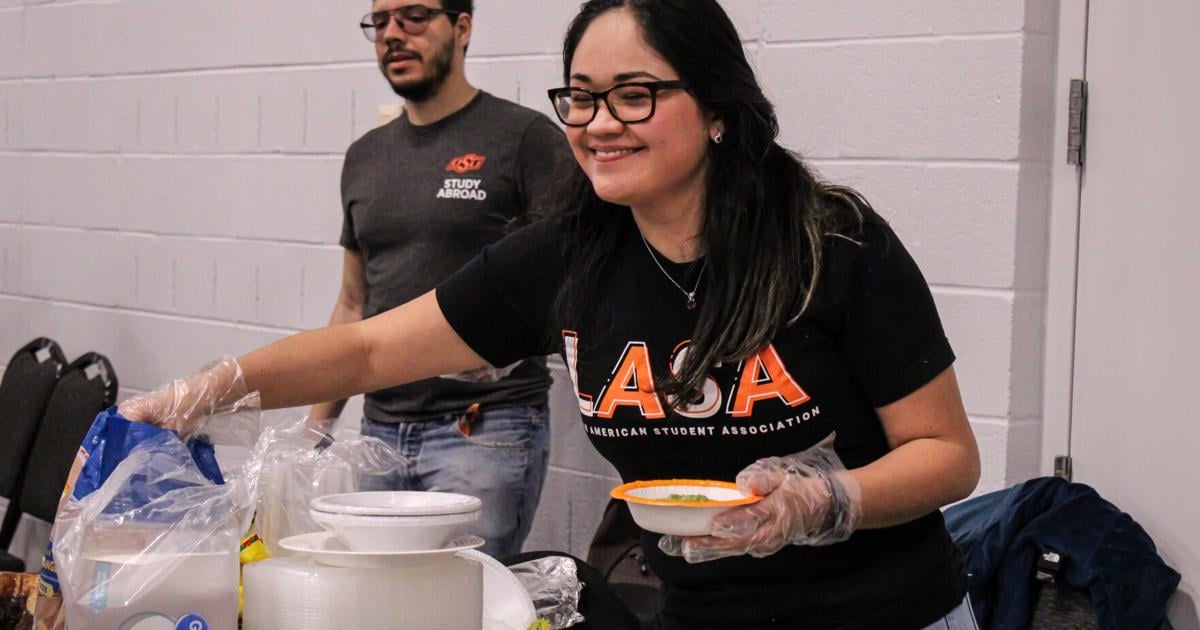
OSU’s International Student Organization hosted its annual International Bazaar, a three-hour fun fest filled with dozens of global foods, strong flavor and music, on Saturday afternoon in the Wes Watkins Center.

“This is big exposure for us,” Mohammed said. “Mostly Africa is not portrayed in the positive light. But we have our food here. Some of us have our national cultural dresses. People seem them and they’re like, ‘Who are these people?’ Then we talk about it. It makes us feel included.”

More than 200 students and Stillwater residents bounced from 12 booths and sampled deserts and entrees from more than 12 countries or regions.

It’s times like Saturday that show food and community can bring folks together.

“The purpose of today is to show Stillwater community the diversity of international students that we have here on campus,” Salome Suarez, International Student Organization president said. “Each area club has prepared different dishes from their own country. We want everybody to see how the dishes are from other parts of the world.”

Foods ranged from the Bangladeshi students’ tandoori chicken to the Latino American students’ cheese empanadas. Lots of desert, too.

Within hours, the exhibit hall transformed into a multicultural kitchen.

Tim Huff, ISO’s adviser, said the event began more than three decades ago. It’s one of ISO’s five annual events and the purpose remains.

“It gives all these students a home,” Huff said. “They feel like they belong when they’re here. You can see them just relax and get into it. It’s very important to see the true nature and culture of these kids because they settle in here.”

Many of the foods appeared similar. Lots of chicken and different meats. But cultural differences appeared in the bite and the food’s preparation.

The Nepalese Student Organization sold about 750 momos, steamed dumplings filled with chicken and vegetables.

Niranjan Pokhrel, a horticulture master’s student from Nepal said the group started making the food at 6 p.m. Friday night. The job wasn’t finished until 3:30 a.m.

It’s no easy task.

“It takes a lot of effort to make that,” he said. “It’s also a skill thing. Not everyone can make it. We had some people’s friends and seniors were really good at making it.”

In Persian culture, kitchens are the realm of women, Yaser Shamsi, Iran native and doctorate student in OSU’s English department, said. Men perform tasks of manual labor such as moving large pots. But women make the food.

“Even looking at the way people celebrate things and the way people cook (are different),” Shamsi said. “You can cook the same ingredient when you just buy it from a shop like Walmart. But when it goes home and it goes through the process that happens in the kitchen, it is the culture, the background and the people that makes the final dish that you see here.”

His wife made most of the Iranian items, such as falafel.

“Having a community of Iranian people just makes me feel as if it’s not that far away from family,” Shamsi said. “OSU is really international friendly. This is one of the events that I really appreciate.”

OSU boasted 1,519 international students in fall 2022, according to OSU international student statistics provided to The O’Colly.

Mayank Talreja, a master’s student from India, represents OSU’s largest international community. The country’s 418 students make it OSU’s biggest international population.

The Indian Student Association also won the event’s best desert content with its kalakand, an Indian milk cake.

“That is what encourages us and gives me a motivation to do something for students,” Talreja said. “We help students transition their life from India to a new country here. It’s been great that a lot of friends are here from our country.”

ISO will also host its Culture Night on April 8 in the Seretean Center for the Performing Arts, another opportunity for OSU’s international students.

CES 2023 food tech exhibitors take on global issues of food waste, healthy cuisine prep

CES 2023 food tech exhibitors take on global issues of food waste, healthy cuisine prep

At the Client Electronics Exhibit in Las Vegas, Nevada, food stuff item know-how is rapidly rising as a key emphasis location.

“VersaWare gives an intuitive option to irritating nourishment apps and cumbersome calorie counting tools,” states co-founder Creed McKinnon.
(Courtesy Kenny Fried)

Courtesy Kenny Fried

The brand’s automatic nourishment motor, McKinnon claims, is developed into the smooth, modern kitchen area products which, when paired with the app, allows people to tailor made-develop any food in true time to meet up with their dietary plans.
(Courtesy Kenny Fried)

Courtesy Kenny Fried

“Here at VersaWare, we are signing up for an market-wide motion groundbreaking an entirely new tactic to the overall health and wellness house centered all-around simplicity, personalization, and smart technology,” McKinnon claimed.
(Courtesy Kenny Fried)

Courtesy Kenny Fried

EverCase is a clever storage container that preserves food products ranging from meats and fish to greens in a soft, pliable issue as opposed to a solid, rock-hard frozen state.
(Courtesy Kenny Fried)

Courtesy Kenny Fried

Made mostly as a B2B merchandise, the EverCase is envisioned to make its community physical appearance towards the finish of 2023.
(Courtesy Kenny Fried)

Courtesy Kenny Fried

The Brava Clever Oven cooks with high-depth pulsating lights that can supply up to 900 degree temperatures.
(Courtesy Kenny Fried)

Courtesy Kenny Fried

The GrowUp Cold Brew Plant-Dependent Residence Milk Maker that makes keep-excellent versions of coconut, oat and nut-based mostly contemporary-brewed milk all set to drink in 6 minutes, entire with a self-cleansing functionality.
(Courtesy Kenny Fried)

Courtesy Kenny Fried

The award-successful X23 wireless meat thermometer from Orka, which measures main, surface and ambient temperatures while calculating the remaining cooking pace and temperatures needed for an ideal remaining product or service.
(Courtesy Kenny Fried)

Courtesy Kenny Fried

Subject areas this kind of as item security, food stuff insecurity and source chain logistics keep on to make headlines, retaining really substantially alive the public’s all round recognition to the fact that irrespective of the proliferation of the world’s food items offer, world starvation and meals waste are even now significant challenges.

At the Customer Electronics Demonstrate in Las Vegas, Nevada, food product technology is quickly emerging as a main concentration spot. While organizations are definitely introducing new technology-pushed techniques to cooking, a lot of of the businesses exhibiting at CES are also having a good, really hard glimpse at healthful foods options, presenting products and solutions created to boost the all round wellness positive aspects of our diet, though also generating our solution to food planning easier and additional practical.


Choose, for illustration, Michigan-dependent VersaWare, producers of what they phone the future technology of smart kitchen area appliances.

“VersaWare offers an intuitive alternate to annoying diet applications and cumbersome calorie counting instruments,” claimed co-founder Creed McKinnon. “Our organization has democratized nourishment with our sensible mixing bowl and slicing board which are enabled with diet AI, wise cell phone connectivity, and a prolonged battery daily life that make it simple to sync data to VersaWare’s cell software.”

The brand’s automated nutrition motor, McKinnon said, is constructed into the smooth, present day kitchen area products which, when paired with the app, allows people to personalized-produce any food in true time to meet up with their nutritional objectives.

“Here at VersaWare, we are joining an industry-huge motion revolutionary an totally new technique to the wellbeing and wellness space centered all-around simplicity, personalization, and clever engineering,” he said.

The products, the anticipated selling price tag of which will be less than $200, is scheduled to strike the marketplace later this spring.

A person Korea-based mostly company has taken a distinctive tactic to the exact issue.

“The Nuvilab AI Food Scanner is an all-in-1 gadget that scans your food stuff in one second with a digicam and then right away gives you with info about the nutrients — protein, carbs and calories,” mentioned enterprise spokesperson Defne Karabenli. “If you have pre-programmed into the product allergic reactions you might have, the scanner will alert you to the presence of any these things.”

The Nuvilab food stuff scanner is presently in market in Korea with far more than 70 models in operations in hospitals, cafeterias, dining establishments and colleges. “We are not but intercontinental, but that’s undoubtedly on the horizon,” Karabenli mentioned.

Nearer to property, Vermont-based EverCase has come up with a foods preservation option they situation less than the premise that they “freeze time, not foods.”

“As we all know, just one-third of all meals in North The united states is squandered at a collective expense of a trillion bucks, and that’s just the foodstuff,” explained co-founder and CEO Chris Somogyi. “If you start off adding in the irrigation h2o, the pesticides, the human labor, it’s challenging to obtain any aspect of modern day civilization that is so inefficient and costly. We created the EverCase to assist with that.”

Formulated by way of 9 a long time of exploration at the College of Hawaii underneath Food and drug administration funding, EverCase is a good storage container that preserves food solutions ranging from meats and fish to greens in a smooth, pliable problem as opposed to a reliable, rock-challenging frozen point out. Designed mainly as a B2B product or service, the EverCase is anticipated to make its general public visual appeal toward the close of 2023.

Other revolutionary merchandise on screen at the CES Food stuff Tech pavilion include things like:

  • The Brava Wise Oven that cooks with substantial-intensity pulsating lights that can supply up to 900 degree temperatures via bursting blasts which — when programmed through the company’s recipe library — can prepare dinner a number of merchandise which typically need diverse temperatures and cooking durations at quicker-than-usual speeds.
  • The GrowUp Chilly Brew Plant-Centered Home Milk Maker that provides shop-top quality versions of coconut, oat and nut-dependent fresh-brewed milk ready to drink in 6 minutes, comprehensive with a self-cleansing functionality.
  • The award-winning X23 wi-fi meat thermometer from Orka, which measures main, floor and ambient temperatures whilst calculating the remaining cooking speed and temperatures essential for an ideal remaining products.

Steve Winter and Kenny Fried are WTOP contributors who perform for Brotman|Wintertime|Fried, a division of Sage Communications.

34 Global Recipes All Food-Lovers Should Try

34 Global Recipes All Food-Lovers Should Try

If you love food, there’s nothing more exciting than discovering new recipes and flavors from different countries, regions, and cultures all around the world. So redditor u/sarriest asked, “Name me a dish from your culture that you think everybody should try.” Here’s how people responded:

1.

“Machaca. It’s a dish from northern Mexico that is scrambled eggs with carne seca (think: super thin, dried out, but incredibly flavorful jerky without all the extra seasonings), chopped tomato, and onion.”

2.

“For Filipino cuisine, the must-try is lumpia — basically an egg roll filled with pork. “It’s so darn tasty I can (and actually have) hurt myself by overindulging!”

3.

“For Indian cuisine, you’ve got to try chaat, which is basically any savory street food. Pani puri specifically is my favorite: it’s fried and puffed dough balls that are hollowed out and filled with mashed potato or chickpeas, flavored water, and spices.”

4.

“Shish Barak, a Lebanese dish made of little fried dumplings (about the size of a quarter) that are stuffed with spiced meat and pine nuts. They’re served in a yogurt sauce with garlic, cilantro, and mint.”

5.

“Fesenjan. It’s a Persian stew typically made with chicken in a pomegranate and walnut sauce. It’s a very interesting combination of flavors because it’s lightly sweet, tangy, and savory all at once.”

6.

“From Brazil, complete feijoada. It’s smokey black bean stew, fluffy white rice, sautéed kale, farofa (toasted cassava flour for soaking up any excess), vinaigrette, tomato and onion salad, and orange slices. For the full experience, you’ll want to pair it with a Caipirinha and some samba music.”

7.

“Jianbing is a Chinese street food breakfast everyone needs to know about. You can find this dish at many street food stalls. It’s a very thin crepe stuffed with your choice of delicious fillings. It’s folded around a sheet of crispy-fried wontons and lettuce so you can hold it and eat as you walk, so it’s great for a meal on the go.”

8.

“Irish soda bread. My relatives only make it around St. Patrick’s day and easter, but IMO it’s so good any time, especially served warm with butter.”

9.

“Kaiserschmarrn is an Austrian breakfast, made with sweet and fluffy scrambled pancake served with rum-soaked raisins. It’s hard to imagine until you’ve tried it, but it’s so good.”

10.

“I’m from Kenya, and my favorite dish is ugali, which is a dough-like cornmeal porridge that you eat by pinching a piece off, rolling it into a ball, then using it to scoop up the other foods you’re eating with it like spiced rice or sukuma wiki (collard greens).”

11.

“Chicken rice is a staple in Singapore and a dish that best represents our cuisine. You can choose from steamed or roasted chicken served over fragrant rice cooked in chicken broth. The highlight of the dish though is the sweet soy sauce and chili-garlic-lime sauce.”

12.

“I’m Latvian, and I would say piragi is the must-try dish. They are warm rolls stuffed with ham, bacon, onion, and black pepper. They are very labor intensive to make but so delicious.”

13.

“Banh Xeo is one of the best Vietnamese dishes everyone should try. It’s a crispy French-inspired crepe made with turmeric and green onions and it’s stuffed with crispy pork belly, shrimp, and bean sprouts.”

14.

“My favorite Indian dish is saag paneer, creamy spiced mixed greens served with chunks of paneer cheese. It’s good, especially with hot fluffy puri for sopping it up.”

15.

“There are so many great Indonesian dishes, but nasi goreng is the crown jewel. It’s our version of fried rice made with meat, vegetables, and a fried egg. It’s flavored with kecap manis, sweet soy sauce, and terasia, an Indonesian shrimp paste.”

16.

“For Cuban cuisine, it’s Ropa Vieja, a dish of thinly shredded flank steak simmered in a rich and flavorful sauce of tomatoes, onions, bell peppers, and spices. Being able to make this single dish well is pretty much what separates a good Cuban cook from a mediocre one. It’s the national dish of Cuba for a reason.”

17.

“My favorite Taiwanese dish is Lu Rou Fan. Nothing can beat this slow-braised, tender pork belly in a rich and fragrant sauce. It’s served over fluffy white rice with a tea egg. Its a common comfort food and a street food dish in Taiwan, but sadly it’s not well known in the western world.”

18.

“One Mexican dish others don’t often know about is albóndigas soup. It’s a beef and rice meatball soup in chicken broth, loaded with a variety of vegetables like carrots, potato, and zucchini. It was my go-to comfort food as a kid paired with warm, fresh tortillas.”

19.

“Vospov Kleyma. It’s an underrated Armenian dish made of red lentils and bulghur with sautéed onions. You form the mixture into patties and top them with parsley and Aleppo pepper. It’s perfect on lavash or any kind of bread with garlic sauce or red pepper paste.”

20.

“Drawing from my Yugoslav heritage, I’d say to try gibanica. It’s essentially a Baltic cheese pie made with Filo pastry, eggs, cottage cheese, ricotta, and sour cream. It’s wildly delicious.”

21.

“From Puerto Rican cuisine, my favorite dish is mofongo. It’s basically mashed up fried plantains mixed with garlic and other deliciousness.”

22.

“From Singapore, my pick would be black pepper crab. Most tourists and foreigners have heard of chili crab, a cousin to this local delicacy, but locals generally prefer the black pepper variety. It’s made with a ton of butter (so what could be bad?) and it’s spicy, savory, with a hint of sweetness.”

23.

“Egyptian Koshari. It’s a very tasty mixture of spaghetti, white rice, macaroni, black lentils, fried onions, and flavorful sauces, it tastes absolutely incredible and best of all, it’s incredibly cheap.”

24.

“Hojaldre is a Panamanian food more people need to know. It’s an egg and flour-based dough, which is typically left overnight to rise. Then in the morning it’s fresh and topped with anything from cheese to eggs. It makes for the best snack, and you can make a big batch and leave it on the stove-top to eat throughout the day.”

25.

“When it comes to Dutch cooking, you’ve got to try snert. It’s our version of split pea soup. It’s very thick and packed with ingredients like carrots, celeriac, bacon, and smoked sausage. It’s perfect for cold, winter nights.”

26.

“Rigatoni alla Bolognese is the one Italian dish I couldn’t live without. The traditional version includes diced vegetables, ground meat, anchovies, white wine, herbs, and tomatoes. My grandmother would always make it on Sundays and now I continue that tradition.”

27.

“For German cuisine you really have to try currywurst, which is sausage with a hot tomato curry sauce. The quality can vary a ton, but the best kind uses high-quality sausage and homemade curry sauce.”

28.

“I’m Native American, and the one dish you have to try from my culture is fry bread, which is basically deep-fried flat dough. I personally like mine with cinnamon and a bit of butter, but lots of people eat it with taco toppings. It’s so bad for you, but it’s oh-so delicious.”

29.

“Sarma, which is a fairly common Slavic recipe. It’s always some kind of minced meat with diced veggies that’s wrapped in cabbage and simmered for about two hours in a spiced tomato sauce.”

30.

“Tadig is an Iranian dish that literally translates to ‘bottom of the pan.’ It’s essentially a large disk of crunchy, golden fried basmati rice. It tastes like heaven for rice lovers.”

31.

“Ochazuke. It’s a Japanese one-bowl dish that is basically a creative way to use up what’s in your kitchen. It’s just green tea, rice and furikake, plus whatever scraps are leftover from yesterday’s meal (salmon, katsu, etc).”

32.

“As a European Jew, a highlight of my culture is babka. It’s a fluffy, moist dessert cake with sweet dough and either apple cinnamon or chocolate filling. It’s fudgy goodness that’s delicious enough to make our thousands of years of exile hurt a little less.”

33.

“I’m from Trinidad, and I wish more people knew about roti and curry chicken. You use the roti to sop up all the saucy chicken. It’s simple, filling, and sooo satisfying.”

34.

“Varenyky! They are Ukrainian dumplings that are similar to pierogi. They can be filled with potato, cabbage, mushrooms, cottage cheese, cherry jam, or really whatever you like. The Polish fry them, but we Ukranians boil them. I could live solely on this dish.”

What’s a dish from your home country or culture that more people should know about? Tell us in the comments below!

Pollination loss removes healthy foods from global diets, increases chronic diseases causing excess deaths — ScienceDaily

Pollination loss removes healthy foods from global diets, increases chronic diseases causing excess deaths — ScienceDaily

Insufficient pollination has led to a 3-5{d2b09b03d44633acb673e8080360919f91e60962656af8ade0305d5d8b7e4889} decline of fruit, vegetable, and nut manufacturing and an estimated 427,000 surplus fatalities on a yearly basis from misplaced healthier meals usage and related illnesses, together with coronary heart sickness, stroke, diabetic issues, and certain cancers, in accordance to investigation led by Harvard T.H. Chan College of Public Health. It is the very first examine to quantify the human health and fitness toll of inadequate wild (animal) pollinators on human wellness.

“A critical lacking piece in the biodiversity dialogue has been a deficiency of immediate linkages to human health. This research establishes that decline of pollinators is previously impacting health on a scale with other world wide wellbeing risk elements, this kind of as prostate cancer or substance use conditions,” stated Samuel Myers, principal investigate scientist, planetary health, Division of Environmental Well being and senior creator of the analyze.

The review will be printed December 14, 2022 in Environmental Well being Perspectives.

Expanding human force on pure programs is leading to alarming losses in biodiversity, the topic of the COP 15 UN Biodiversity Meeting now having area in Montreal. This consists of 1-2{d2b09b03d44633acb673e8080360919f91e60962656af8ade0305d5d8b7e4889} yearly declines of insect populations, primary some to warn of an impending “insect apocalypse” in the coming many years. Vital between insect species are pollinators, which improve yields of three-fourths of crop kinds and are significant to expanding balanced meals like fruits, greens, and nuts. Changes in land-use, use of dangerous pesticides, and advancing weather adjust threaten wild pollinators, imperiling human supply of healthier food items.

The researchers employed a model framework, which integrated empirical evidence from a network of hundreds of experimental farms throughout Asia, Africa, Europe and Latin The united states, that appeared at “pollinator produce gaps” for the most essential pollinator-dependent crops, to clearly show how a great deal crop loss was because of to insufficient pollination. They then employed a world-wide threat-disorder product to estimate the wellbeing impacts the variations in pollination could have on dietary dangers and mortality by place. Additionally, they calculated the decline of economic price from lost pollination in a few case analyze countries.

The results confirmed that dropped foods manufacturing was concentrated in reduce-profits nations around the world but that the health and fitness burden was larger in middle- and increased-earnings nations around the world, exactly where charges of non-communicable conditions are greater. The geographic distribution was fairly unconventional in that typically the wellbeing consequences from international environmental adjust are centered amid the poorest populations in areas such as South Asia and Sub-Saharan Africa. Right here, center-money nations around the world with big populations — China, India, Indonesia, and Russia — suffered the biggest burden.

The examination also showed that lower-income international locations dropped sizeable agricultural income thanks to inadequate pollination and decreased yields, probably 10-30{d2b09b03d44633acb673e8080360919f91e60962656af8ade0305d5d8b7e4889} of complete agricultural price.

“The results might feel surprising, but they mirror the complex dynamics of elements guiding meals systems and human populations close to the earth. Only with this form of interdisciplinary modeling can we get a better correct on the magnitude and impression of the trouble,” explained co-creator Timothy Sulser, senior scientist, Global Foods Coverage Analysis Institute.

Tactics to secure wild pollinators are not just an environmental challenge, but a overall health and financial one particular as very well. “This review reveals that accomplishing far too minimal to enable pollinators does not just hurt mother nature, but human wellness as very well,” said direct writer Matthew Smith, study scientist, Division of Environmental Health.

Guidance for the study was provided by grants from the Gordon & Betty Moore Foundation, Weston Meals Inc., Fifth Technology Inc., and the CGIAR Research Method on Insurance policies, Establishments, and Markets.
