
Abby Lee’s one-pot Malaysian recipes | Food

Abby Lee’s one-pot Malaysian recipes | Food

Malaysia isn’t known for its cold weather, but, when the rainy season arrives in November and December, the temperature does tend to drop – to 25C. During the colder months in Britain, meanwhile, I eat lots of peppery broths spiked with chilli and ginger, and often serve them with “cooling” vegetables to balance the heat, as well as hot-and-sour curries and slow-braised meats. These are dishes to warm the soul and keep you going until the sun returns.

Babi chin, or braised dark soy pork belly

A classic Nyonya dish that’s often served at lunar new year, though a more day-to-day version would simply involve garlic and fermented soya beans. It’s a combination of Chinese and Malay cultures, using the former’s soya beans and the latter’s coriander seeds. Two ingredients that will make a big difference here are good soya bean paste and a thick dark soy. If you like, add a few soaked shiitake mushrooms to the braise, for some extra texture.

Prep 10 min
Marinate 1 hr
Cook 1 hr 45 min
Serves 4

For the braise
600g skin-on pork belly
, cut into 4cm cubes
80ml dark soy sauce
15ml light soy sauce
2½ tsp granulated sugar
1 tbsp vegetable oil
, or other neutral oil
200g round shallots, peeled
Salt and sugar, to taste

For the rempah (paste)
20g coriander root (or stalks)
35g peeled garlic
45g long red chilli
2 tbsp coriander seeds
40g soya bean paste
(or red miso paste)

Put the pork in a bowl with half the dark soy sauce, toss to coat, then leave to marinate at room temperature for an hour.

Meanwhile, make the rempah. Roughly chop the coriander root, garlic and chilli, put them in a food processor with the remaining paste ingredients and blend smooth.

Mix the remaining dark soy, light soy and sugar in a bowl. Put the oil in a deep saucepan on a medium heat and, when hot, add the paste and stir for five to 10 minutes, until you can really smell the aromatics. Add the pork belly and stir to coat each piece. Pour in the soy sauce mixture, swirl a little water in the bowl to pick up any last bits, and add to the pan with the peeled shallots. Top up the water so the pork belly is almost fully covered, bring to a boil, then turn down to a light simmer, cover and cook for an hour and a half.

Season with salt and sugar to taste (different brands of soy sauce have different flavour profiles), and serve with rice.

Ikan assam pedas, or hot-and-sour fish stew

This classic Malay and Minangkabau dish is very aromatic and moreish, and more of a thin broth than a thick curry. It’s traditionally laced with torch ginger flower, a particular fragrance that’s hard to get in the UK, but the more easily found Vietnamese coriander would finish it off nicely. Don’t be afraid of frying the paste in lots of oil: it’s the best way to bring out the fragrance. Similarly, be heavy-handed with the tamarind – this is meant to be lip-smackingly sour.

Prep 15 min
Cook 1 hr
Serves 4

For the rempah
90g red onion, peeled and roughly chopped
80g lemongrass, green tops discarded, the rest roughly chopped
90g long red chilli, roughly chopped
6g shrimp paste (belacan, ideally; otherwise, Thai kapi is widely available)
8 pieces dried kashmiri chilli, soaked in warm water for 15 minutes
½ tsp ground turmeric

For the fish
100ml vegetable oil, or other neutral oil
20g granulated sugar
1 tsp fine sea salt
140g aubergine
, cut into 6cm chunks (they’ll shrink when cooked)
1 plum tomato, cut in half
50g tamarind concentrate (ideally, the light brown south-east Asian type)
120g okra
2
mackerel, cleaned, or 4 x roughly 140g fillets
Chopped mint and coriander, to finish

Put all the paste ingredients in a blender and blitz smooth.

Put the oil in a deep saucepan on a medium heat, then fry the paste, stirring regularly, for about 20 minutes, until the oil separates. Add the sugar and salt, let it caramelise for a couple of minutes, then add the aubergine, tomato, tamarind and 500ml water, bring to a boil, simmer for 15 minutes, then stir in the okra and simmer for five minutes more.

Turn the heat down low, so no bubbles break the surface, then gently poach the fish in the stew for five to seven minutes, until the flesh flakes easily.

Season with extra tamarind, salt and sugar to taste, depending on whether you prefer it more sour, salty or sweet, and serve with rice and chopped mint and coriander.

Chai buey, or mustard green stew

Some of the ingredients are alternatives to traditional ones, but if you have a Chinese supermarket nearby, use salted mustard greens instead of the sauerkraut and kale. Although this is often made using leftover roast meats, it’s a star in its own right and well worth making entirely from scratch.

Prep 15 min
Cook 1 hr 45 min
Serves 4

1 tbsp vegetable oil, or other neutral oil
4 x 280g duck legs
35g piece fresh ginger
, unpeeled, cut into 1cm-thick slices
20g peeled garlic, chopped
12 pieces dried kashmiri chilli (about 10g)
50g carrot, cut into 1cm-thick matchsticks
150g turnip, cut into 1cm-thick matchsticks
120g sauerkraut, ideally with no added flavours
70g vine tomatoes, cut into wedges
½ tbsp white peppercorns, dry toasted and lightly crushed
2½ tbsp light soy sauce
1½ tsp salt
70g kale
, roughly chopped
2½ tbsp tamarind concentrate (ideally, the light brown south-east Asian type)
Sambal belacan, to serve

Put the oil in a deep saucepan on a medium-high heat, then sear the duck legs all over until they are just slightly darker than golden brown. Remove and set aside, leaving the oil in the pan.

Turn down the heat to medium, add the ginger, garlic and dried chilli, and stir for a couple of minutes so they infuse the oil. Add the carrots and turnips, and stir-fry for three or four minutes.

Add the sauerkraut, tomato, crushed white peppercorns, soy sauce, salt and duck legs, then pour in just enough water to cover the duck (depending on the depth of the pan, you’ll need up to a litre). Bring to a boil, then turn the heat as low as possible, cover and leave to simmer very lightly for about an hour and a half. Ten minutes before the end of the cooking time, stir in the kale and tamarind.

Lift out the duck legs and shred all the flesh off the bones. Remove and discard the ginger slices and dried chilli, then stir the duck meat back into the pan and add salt and tamarind to taste – the sourness has to come through here. Serve with rice and our beloved sambal belacan.
Let’s Eat: ‘Chef Ken’ shares Malaysian culture at Kerol’s Kitchen | Food & Drink

Let’s Eat: ‘Chef Ken’ shares Malaysian culture at Kerol’s Kitchen | Food & Drink

Khirularziman Mahmud, recognized around Madison as “Chef Ken,” is now scheduling the menu for his brick and mortar cafe, even however it is possible quite a few months from becoming a actuality. 

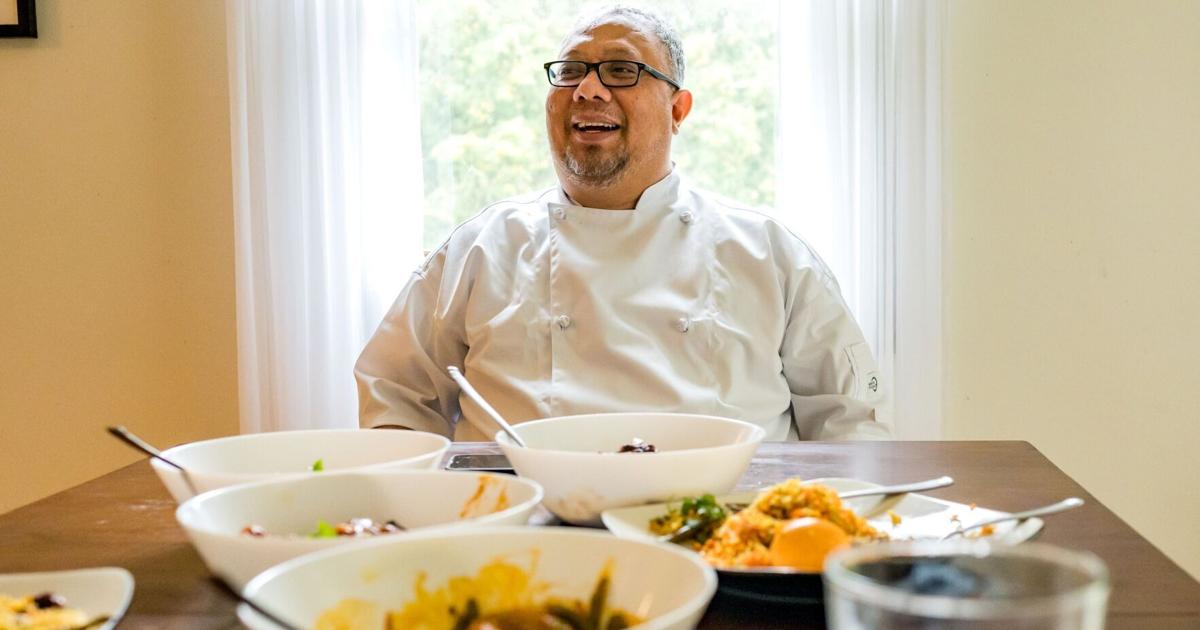
Mahmud is the proprietor of Kerol’s Kitchen, a food items cart and catering small business. On a latest weekday, he leaned back again in his white chef’s coat soon after serving a scrumptious catered lunch based on a standard Malaysian marriage feast. 

At his restaurant, “you have to have nasi lemak,” he mentioned, “That will be the signature dish.” 

The unofficial countrywide foods of Malaysia, nasi lemak virtually interprets to “rich” or “creamy” rice, and with superior motive. The centerpiece of the plate is rice cooked in coconut milk. This is traditionally served with peanuts, sliced cucumbers, a really hard boiled egg and some kind of protein in a rich curry sauce. 


Chef Ken9-.jpg

Kerol’s Kitchen will make nasi hujan panas, saffron seasoned rice with tricky boiled eggs. 


“And pink milk,” Mahmud stated. “You would like this. It’s milk blended with a rose syrup. It’s pretty refreshing. And Malaysian espresso, with a thick foam at the major that’s sweetened with honey. You just can’t have a Malaysian cafe with no that.” 

Sometime, Mahmud would like to serve his food stuff in each important college or university city in the region.

Culinary ‘elder’

Although he queries the city for a good locale with fair lease, Mahmud stays a culinary nomad. For the earlier two many years, Mahmud has mostly cooked and shipped dishes from his homeland to eager diners who come across out about his Malaysian cuisine by phrase of mouth. 

“I am very well regarded on campus,” he claimed. “I do not have so many orders now in September, but wait around just one month. By then, all the Malaysian learners at the university will have run out of the food they introduced with them. They will start out to get homesick and they will seem all around for the kind of cooking they are employed to. The other pupils will ship them to me.” 


Chef Ken11-.jpg

Khirularziman Mahmud, far better acknowledged as “chef Ken,” is the chef and proprietor of Kerol’s Kitchen area, which would make Malaysian cuisine at a food cart and for catering functions. 


In an regular week through the college year Mahmud provides dozens of just take-out meals to eager and hungry learners waiting around in front of the Memorial Union. He delivers them spicy curries layered with ginger, onion, purple chilies and garlic, and aromatic rice infused with saffron, cardamom, cloves, star anise and pandan leaves. Pandan is a tropical plant with a grassy taste some say evokes vanilla and coconut.


Chef Ken1-.jpg

The evening meal Khirularziman Mahmud prepared for my family highlighted nasi hujan panas (saffron seasoned rice with challenging boiled eggs), daging masak hitam (black beef), shrimp curry with tomatoes and green beans, ayam masak merah (chicken with red chilies) and timun acar (cucumber salad with clean tomatoes, pineapple, carrots and jalapenos). 


“I’m like an elder in the neighborhood,” Mahmud laughs. “They know me. They all get in touch with me ‘uncle’ and my wife ‘auntie.’”

After reserving a handful of small festivals, weddings, numerous catering work and cooking courses in personal residences, Mahmud has begun to department out above the last calendar year. Earlier this month, he was a to start with-time food items seller at the Flavor of Madison. 

At Kerol’s Kitchen area, he served 1,600 plates of beef rendang or hen curry and 1,500 Malaysian spring rolls, a dish he developed with his wife. The spring rolls garnered him a very first put Style of Flavor award for Asian food stuff. 

“It was wonderful,” he stated. “I don’t have a typical staff members, so some of the Malaysian students I prepare dinner for arrived to assist me serve buyers about the weekend.”

Mahmud vends at the Boneyard Pet dog Park and Biergarten on Wednesday nights on Madison’s east aspect, together with numerous other food items carts. There he will make rice stir fries and sauteed noodle dishes to order, together with his award-successful spring rolls. 

“I make everything contemporary,” he claimed. “Nothing frozen. I push to Milwaukee after a 7 days so I can get fresh herbs that I just can’t invest in here.”

Malaysian foods will take patience

When going for walks me by the dishes he shipped for my luncheon feast, Mahmud explained the origins of Malaysian cooking and the philosophy guiding it. As a region full of immigrants from the bordering location, Malaysian foodstuff has been motivated by the foodways of Java, China, India, Indonesia and Thailand. 

For the reason that every spot uses its nearby kinds of elements, the flavor of the remaining goods can differ broadly. “The palm sugar which is grown and processed in each location is distinct,” Mahmud explained. “The teas are diverse Malaysian tea leaves are a lot much more fragrant. We use spices in different means.

“Also, Malaysian food stuff can take persistence,” he additional. “I discovered that from my father, when I watched him prepare dinner as a little one. He taught me, you have to saute gradually, enable the ingredients brown correctly prior to you put the upcoming issue in the pan. The consequence is deep, wealthy taste.” 


Chef Ken8-.jpg

Timun acar is a Malaysian cucumber salad with contemporary tomatoes, pineapple, carrots and jalapenos. 


Mahmud credits his moms and dads for training him the basic tenets of his native culture’s cuisine. Whilst not formally qualified as a chef, he labored in experienced kitchens in Malaysia’s capitol of Kuala Lumpur for several years, accomplishing anything from washing dishes to preparing banquets for foreign dignitaries — like the late Queen Elizabeth II. 

Mahmud accompanied his wife to Madison in the early 1990s, when she commenced work on her PhD in environmental sciences at UW and he centered on raising their three sons. Before long he began cooking for friends, then close friends of mates, and his popularity grew. 

“It has not constantly been quick,” he reported, shaking his head, “but I have been really blessed. Now issues are fantastic.”

A well balanced introduction

The dinner Mahmud prepared for my household built for a superb introduction to Malaysian foods. It showcased nasi hujan panas (saffron seasoned rice with hard boiled eggs), daging masak hitam (black beef), shrimp curry with tomatoes and inexperienced beans, ayam masak merah (hen with red chilies) and timun acar (cucumber salad with refreshing tomatoes, pineapple, carrots and jalapenos). 

As instructed, we piled a bit of just about every item on our plates and ate them all together, letting the flavors blend and engage in off every other. A delightful blend of salty and sweet, the dishes have been intricate fusions of ginger, cinnamon, lemongrass, turmeric and herbs that Mahmud grinds by hand. The food stuff was fantastically balanced the spicy chilies have been assertive but in no way overpowering. 

“When I do cooking classes, it’s ordinarily for a team of females good friends in a person of their homes,” Mahmud mentioned. “Sometimes they communicate and gossip and don’t learn a lot. 

“But I tell them pay consideration. This way your spouse is gonna love you. This is cooking from the heart.”