

Good Culture partners with Dairy Farmers of America on probiotic milk

Good Culture partners with Dairy Farmers of America on probiotic milk

Dive Brief:

  • Good Culture has launched a new product line, Probiotic Milks, made with the agriculture collective Dairy Farmers of America (DFA).
  • In a statement, the company said its “disruptive and new take on milk,” which is available in 2{d2b09b03d44633acb673e8080360919f91e60962656af8ade0305d5d8b7e4889} and whole varieties, contains 1 billion probiotic cultures per 12-ounce serving.
  • The launch furthers Good Culture’s aim to grow its portfolio offerings and capitalize on the continuing trends of wellness and gut health, with the help of a leading dairy group.

Dive Insight:

Good Culture is taking probiotics into a new category with the backing of a leading player in the milk space.

The better-for-you cottage cheese and sour cream maker — which has received $81.8 million to date from investors like General Mills and actress Kristen Bell, according to Crunchbase data — last year raised $64 million in a Series C funding round. The company said the funding would go toward launching new products in the cultured foods space.

With this expansion, Good Culture has the opportunity to broaden its reach to a new consumer base.

“With the continued growth and consumer interest in probiotics and gut health, we’re really excited to bring this great-tasting milk with probiotics to store shelves in partnership with the Good Culture brand, which is so well known for producing on-trend, cultured dairy products,” Rachel Kyllo, senior vice president of marketing for DFA, said in a statement.

The decision to work with the DFA gives Good Culture a partner that is highly familiar with the milk space. The dairy giant has a variety of milk brands in its portfolio, including Dean’s, Lehigh Valley Dairy, Dairy Maid Dairy and Kemps.

Once commonly associated with yogurt, probiotics continue to infiltrate new food categories such as snacks and beverages as consumer interest in immunity rises. Nearly half of people consume probiotics in some form each day, with dairy being their preferred way to obtain them, according to a 2022 survey of 16,000 consumers by Chr. Hansen.

Other better-for-you brands have seized on the gut health dairy craze. Danone’s dairy brand Horizon Organic has a milk and yogurt line called Growing Years that contains prebiotics. Kefir, a fermented milk product popularized by brands such as Lifeway, is projected to grow at a compound annual growth rate of 6.4{d2b09b03d44633acb673e8080360919f91e60962656af8ade0305d5d8b7e4889} through 2027, according to a Mordor Intelligence analysis.

But expanding into milk could prove to be challenging. Last year, yogurt giant Chobani debuted lactose-free Ultra-Filtered Milk — featuring 2.5 times more protein than traditional milk — that it discontinued after fewer than three months on the market.
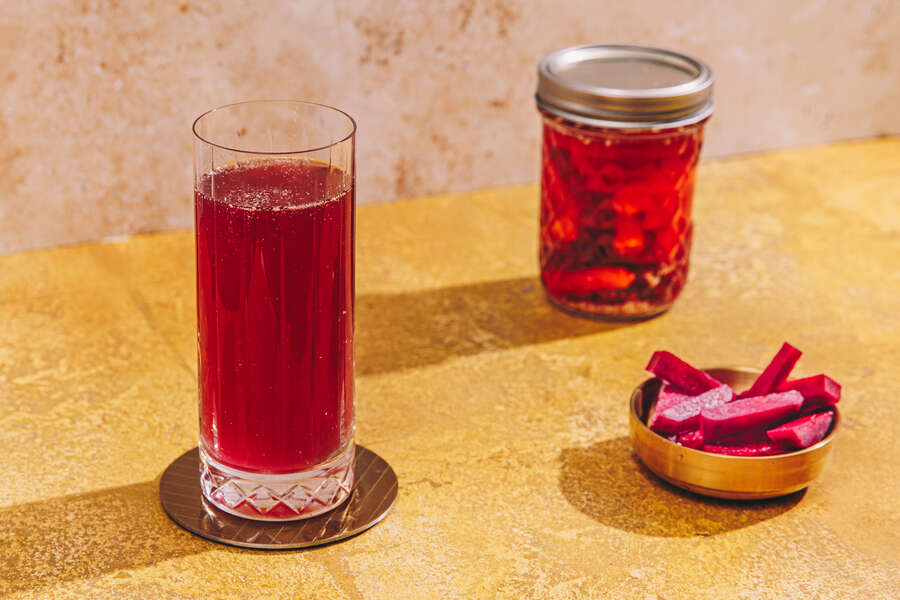
The Best Recipe for Kanji, a Probiotic Drink

The Best Recipe for Kanji, a Probiotic Drink

In an alternate universe, I’m walking the beaches of Santa Monica following a yoga course, chugging a glass bottle of lemon-mint earl gray kombucha as the solar sets in excess of the Pacific. In fact, I’m in Mumbai right now, the yoga mat is below, and I’m pretty invested in building this winter’s initially batch of kanji.

A refreshing drink built from fermented root greens, kanji is considerably similar to Japanese European kvass. Both have exclusive sourness and are thought to have probiotic advantages.

Kanji gives all the positive aspects of “roots, sunshine and spices,” says Raksha Lulla, a scientific and sports nutritionist at The Locavore, a wellness internet site that encourages ancient Indian techniques of feeding on. In trying to keep with Ayurvedic traditions, she suggests, every single batch of kanji incorporates the electricity of the earth and sun to aid digestive wellbeing through the wintertime. She thinks it improves bacterial well being in your intestine, “thereby empowering immunity, slicing any digestive concerns like bloating and constipation.”

For lots of in India, kanji marks the onset of winter season. It originated in the north of the state, which has a cooler local weather than southern India. The gentle winter daylight carefully ferments the vegetables in the kanji.

Vanika Choudhary, a fermentation specialist and chef at Noon restaurant in Mumbai, is a kanji devotee. Elevated in Jammu, in India’s Kashmir area, she estimates she was two decades old when she initial tasted it. “My grandmother would pick the freshest black carrots, indigenous to Kashmir, to make black carrot kanji,” Choudhary says. “She would ferment the kanji in an earthen pot with black salt, dried kashmiri chili, and wild mustard, and hold it in the sun for a 7 days or 10 times.” Now, she serves it to her very own a few-yr-previous son, who enjoys its sour tang.

Lulla likens kanji to “the Indian kombucha,” and claims that its “anthocyanins do the job as anti-oxidants for blocking totally free radical hurt from our pressured out way of residing. They get the job done with our body’s defense mechanisms.” Its nutritional vitamins and minerals can support eyesight, coronary heart and skin health, and collagen manufacturing, she adds.

Choudhary presents her kanji a kick with wild mustard moreover sun-dried Kashmiri chilies from her mothers and fathers garden in Jammu, although numerous use mustard only. No make a difference which degree of spice you desire, help save the pickled carrots at the bottom of the jar to take in with millet rotis, eco-friendly salads, or nevertheless you serve pickles so as to not waste anything at all.

Here’s my no-fall short information to building kanji from scratch. Just like kombucha, be absolutely sure your devices is sterilized and maintain the consume covered with a thoroughly clean fabric. Discard if you see any irregularities or mildew.

Kanji

Generate: 6 cups

Substances:
• 250 grams (about 1 cup) dim-coloured carrots, peeled and lower into two-inch segments (or orange carrots plus one particular medium beet)
• 6 cups water
• 2 tablespoons yellow mustard seeds
• 2 tablespoons black salt

Instructions:
1. Pound the yellow mustard into a coarse powder and maintain aside.
2. Boil water, lined, and then make it possible for it to amazing to space temperature. Continue to keep its lid on in the course of.
3. At the time cooled, transfer h2o to a clear, huge-mouthed ceramic or glass jar. Insert all the other components and stir with a dry spoon to incorporate.
4. Address the jar lightly with a muslin fabric and permit it to sit in delicate winter sunlight, both outdoors or indoors at room temperature, for 2-3 days. Stir each morning. Within just 48 several hours, the consume need to convert a little sour and commence to ferment.
5. Transfer jar of fermented kanji to the fridge. To serve, pour into a glass, reserving the carrots to try to eat as pickles with a food or in a sandwich.