
Shortage “failure” due to “weird supermarket culture” says Dimbleby

Shortage “failure” due to “weird supermarket culture” says Dimbleby

Government advisor Henry Dimbleby has blamed the recent fruit and vegetable shortages in supermarkets on a “weird supermarket culture”.
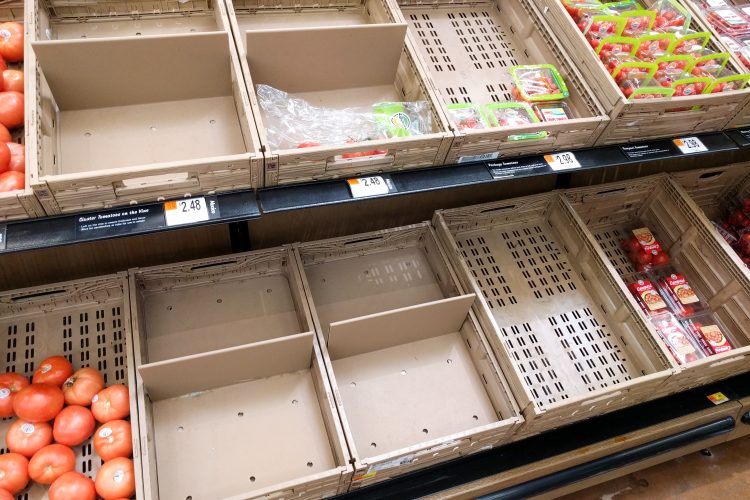
empty supermarket shelves

In a recent statement given to The Guardian, Henry Dimbleby, co-founder of restaurant chain Leon and food strategy advisor for the UK Government, branded recent fruit and vegetable shortages as a “market failure”, blaming Britain’s “weird supermarket culture”.

New Food recently reported that numerous supermarkets have been limiting their sales of various fruit and vegetables as a result of import shortages from Spain and North Africa.

Now, Dimbleby has told The Guardian that other countries in Europe are not having to face the same problems as the UK as they do not have the same “cultural problems”.

“There’s just this weird supermarket culture. A weird competitive dynamic that’s emerged in the UK, and nowhere else in the world has it, and I don’t know why that is,” Dimbleby told The Guardian.

While the shortages themselves caused a stir on social media, the UK’s Environment Secretary, Thérèse Coffey, also generated widespread conversation with a comment about consumers turning to home-grown produce, such as turnips, to navigate empty supermarket shelves.

However, the turnip comments have been labelled “frustrating” by Dimbleby, as he thinks that Brits are concerned about Coffey’s words instead of “structural issues in the food system”.

Dimbleby told The Guardian: “I find it quite frustrating that everyone is suddenly worried about a gap of vegetables in February, when there are much bigger structural issues that need to resolve, and definitely the government on health has very explicitly gone backwards.”

UK committee chair express concern over fertiliser shortages

Predicting that the “market failure” is “going to get worse”, Dimbleby also defined the UK food system as “unique”, explaining that he doesn’t know “another system where the supermarkets have these fixed-price contracts with suppliers”.

“So, basically, you have no effective market. It’s a very difficult one for the government to solve, but it does need to be resolved,” said Dimbleby.

The fruit and vegetable shortages in supermarkets are currently on-going, however, in a statement, Coffey predicted that they “will be a temporary issue that should be resolved in two to four weeks”. However, with Dimbleby stating that the shortages are part of a wider “market failure”, it could take numerous adjustments to get shelves reliably restocked.

Commenting on Dimbleby’s statement, Chris Elliott, Professor of Food Safety and Microbiology at Queen’s University Belfast, noted that “we have come to rely very heavily on supermarkets to secure our food in the UK.

“While the pandemic showed us how well they could do this the stresses and strains continue to mount on the global food system and we need to take a much more holistic view of food security in the UK going forward.

“We need all actors in the food supply system (both private sector and government) to come together and really start to generate a policy fit for purpose,” concluded Elliott.

Food tsar blames shortages on UK’s ‘weird supermarket culture’ | Farming

Food tsar blames shortages on UK’s ‘weird supermarket culture’ | Farming

The government’s food tsar has blamed Britain’s “weird supermarket culture” for recent food shortages, calling it a “market failure”.

Experts have criticised ministers for “leaving food policy to Tesco”, and meeting large food chains rather than suppliers, who have been struggling with rising costs while locked into contracts with supermarkets.

Henry Dimbleby, the co-founder of the restaurant chain Leon, who advises ministers on a food strategy for England, said Europe was not facing such issues because they did not have the same cultural problems.

He said: “There’s just this weird supermarket culture. A weird competitive dynamic that’s emerged in the UK, and nowhere else in the world has it, and I don’t know why that is.”

Dimbleby earlier criticised the government’s response to his recommendations, saying it was “not a strategy”.

He said he found the current situation “frustrating” as people were focusing on remarks about turnips, rather than structural issues with the food system. “I find it quite frustrating that everyone is suddenly worried about a gap of vegetables in February, when there are much bigger structural issues that need to resolve, and definitely the government on health has very explicitly gone backwards,” he said.

Dimbleby disagreed with the environment secretary, Thérèse Coffey, who denied that the recent shortages of eggs and vegetables was a “market failure”. He said: “This is a problem of market failure in the specifically British food system. It’s going to get worse. The UK food system is, I think, unique – I don’t know another system where the supermarkets have these fixed-price contracts with suppliers. So, basically, you have no effective market. It’s a very difficult one for the government to solve, but it does need to be resolved.”

Dimbleby said that in the UK lettuce prices in supermarkets were kept stable, whether there was a shortage or a glut, meaning farmers could not sell all their crop when they had too much, or get incentives to produce more during a shortage. He added: “If there’s bad weather across Europe, because there’s a scarcity supermarkets put their prices up – but not in the UK. And therefore at the margin, the suppliers will supply to France, Germany, Ukraine.”

This week, the farming minister, Mark Spencer, held a summit with large food chains but did not invite farming groups.

Timothy Lang, an emeritus professor of food policy at the University of London, said he was “absolutely not in the least” surprised by the recent food shortages. “It’s utterly regrettable,” he said. “This government did nothing because it was ideologically not prepared to consider nuances and difficulties. They’re locked into a minimalist, don’t intervene, leave-it-to-Tesco approach to food policy.”

He accused the government of ignoring Dimbleby’s food strategy, saying: “His final report of our plan dealt very well with household food insecurity and other things like the junk food cycle, advertising marketing, because he thought those were winnable things from this government. And he was ignored.”

Dimbleby believes the problem will get worse, and said he had foreseen this for some time, urging the government to “sort it out”.

He said: “In 2004 there was a particularly bad frost and we had the same issue then. And it will continue to get worse due to climate change. These periods of freak events that used to be not very often, because of climate change are going to happen more and more often. These problems won’t be resolved until we look at what I outlined in my food strategy – we need to fix the problems of climate change, and health, and the way the food markets in the UK are structured leave us vulnerable to this, so we’d better sort it out.”

skip past newsletter promotion

The National Farmers’ Union (NFU) is asking the government to support its call for more workers to pick crops, more affordable and sustainable energy, and fairness in food supply chains. UK growers have been saying since well before the recent shortages in fresh produce became visible that they were facing a string of challenges, some intensified by the pandemic and Brexit.

The NFU estimated fresh produce worth £60m was left to rot in fields last year, as growers could not get enough workers to pick their fruit and vegetables at the right time.

The NFU president, Minette Batters, said: “The consequences of undervaluing growers can be seen on supermarket shelves right now. Shelves are empty. This is a reality we’ve been warning government about for many months. Without urgent action there are real risks that empty shelves may become more commonplace.” She was also critical of the government meeting supermarkets rather than producers.

The Department for Environment, Food and Rural Affairs said: “We agree that the domestic horticulture sector is crucial to the resilience of our food system as well as an important part of our wider economy. We know that farmers and growers are facing global pressures, including from the invasion of Ukraine.

“Our new farming schemes will support farmers to produce food profitably and sustainably, including £600m in grants for equipment to help farmers become more productive. This is part of the significant action we have taken to support the sector so far, alongside allocating 45,000 seasonal workers and wider government support on energy bills through the energy bills relief scheme.

“Although there are currently some issues with the supply of fresh vegetables, caused by the poor weather in Spain and north Africa, the UK has a highly resilient food chain and is well equipped to deal with disruption.”