
‘Top Chef’ Byron Gomez on cuisine, culture and bringing Costa Rica to Colorado with Pollo Tico

‘Top Chef’ Byron Gomez on cuisine, culture and bringing Costa Rica to Colorado with Pollo Tico

Byron Gomez has prepared haute cuisine in some of this country’s finest restaurants. But on a recent day, in his food-hall stall on Pearl Street in Boulder, he is savoring something less high-brow, but oh-so-delicious. 

He calls it the “chicken oyster.” It’s a moist bit of meat hidden in a crevice behind the backbone of a rotisserie chicken that has rested overnight in Costa Rican spices before being slathered in a taste-bud-shaking secret sauce called Salsa Lizano.

That bit of food that brings him such joy serves as a symbol for a wildly unusual culinary career that has taken Gomez on a full-circle foodie journey in his 34 years.

It began in a modest family kitchen in Costa Rica where, as a toddler, he savored his native country’s foods so much that he would sneak out of his bed to sleep on the kitchen floor. 

Hop from there to a Burger King in Long Island where his family had immigrated when he was nine. Gomez was too shy to be good at the counter, but he was moved into food prep because he was an excellent tomato slicer. 

Move on to constructing delicate dishes at Michelin-starred fine-dining restaurants owned by a world-famous chef in New York City. Throw in a stint on the culinary competition Top Chef.

 All that winds finally to Pollo Tico, Gomez’s fast-casual, self-described “chicken joint” in the Avanti Boulder food hall.

“This introduces my culture and who I am,” Gomez told Colorado Matters host Ryan Warner during a visit to Gomez’s tiny Lizano-bottle-lined kitchen. 

The chicken is served up with Costa Rica’s most recognizable dishes — arroz con pollo (chicken and rice), gallo pinto (beans and rice), maduros (fried green plantains), and chayote escabeche (pickled squash). Salsa Lizano goes on everything.

Chef Byron Gomez Pollo TicoRyan Warner/CPR News
Salsa Lizano is an ingredient staple at Pollo Tico in Boulder.

Gomez’s time on Top Chef

These were not the foods that Gomez toiled over when he was a finalist on Season 18 of Top Chef, a brutal competition where the chefs spent 18 hours a day sweating over food challenges and the rest of the time totally closed away from a world in the thick of a pandemic. 

As a Top Chef finalist, Gomez showed off his culinary chops learned in top-culinary-world restaurants, including Cafe Boulad and Eleven Madison Park. He prepared a crab dish, a surf and turf entre, a pasta dish seasoned with coffee. 

The closest he got to his native cuisine was a Peruvian chicken dish. He is still kicking himself for those choices.

“I was watching the show at home with my bowl of ice cream and yelling at the TV, asking ‘Why did you do that?’”

It was that anger about not highlighting his ethnicity that led him back to his roots.

“I had the most Michelin stars of anyone in the cast,” he said. “But I realized I was cooking other people’s cuisines. Everyone else was rooted in ethnicity, but I was left asking, ‘Well, what am I?’”

Chef Byron Gomez Pollo TicoRyan Warner/CPR News
Byron Gomez owns Pollo Tico in Boulder, featuring Costa Rican-styled rotisserie chicken.

Sunday dinners with family

That answer lay in his memories of the big Sunday dinners his family would have in Costa Rica. His mother was well-known for her cooking skills, and friends and relatives would gather at the Gomez home for meals. 

The women would be cooking up a feast in the kitchen. The men would be watching soccer as they waited for the meal. And Gomez would be gravitating to the kitchen.

When his family migrated to Long Island, the Sunday feasts continued in an altered form. His family couldn’t get all their native foods, and what they could get didn’t taste the same. Still, other Costa Ricans would gravitate to the Gomez house and pack in for Sunday gatherings.

Gomez’s eventual mentor, Daniel Boulad, the Michelin-starred chef he still calls “papa,” helped him to realize those gatherings were where his culinary dreams might lay. He had instilled in him the idea that he should always continue to test the limits of his skill and creativity.

Gomez landed a job at Café Boulad by highlighting his work ethic and desire to learn. He had no formal culinary training, unless prepping burgers and cooking ethnic dishes at a mom-and-pop café counted. But he had the drive and talent and, after stewing over submitting an application for a month, he was rewarded.

He spent five years working under Boulad. He describes it as a pressure-cooker existence similar to the Hulu culinary drama “The Bear,” or to the late Anthony Bourdain’s portrayal of sometimes hellish working conditions in the book “Kitchen Confidential.”
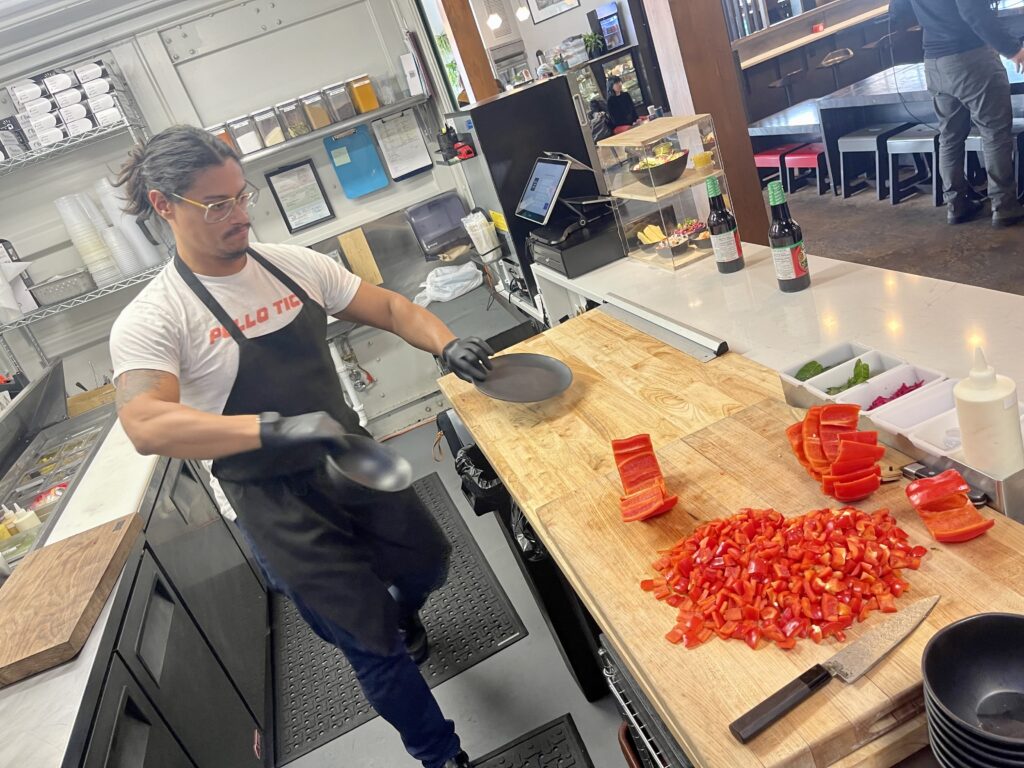
Chef Byron Gomez Pollo TicoRyan Warner/CPR News
Chef Byron Gomez working on food prep in Pollo Tico.

The next Shake Shack?

As his own boss now, Gomez still works hard, but can take time to hit the gym every day and to appear on the circuit of food festivals. 

He will be at Food & Wine festivals in Aspen and Charleston, South Carolina, this summer. He hopes to secure another slot on Top Chef.

Also on tap in Gomez’ journey is a fine-dining mobile dining room concept that he brainstormed about during the COVID-19 pandemic lockdown. It’s a concept that he said will “flip the rood truck thing on its head.”

He also has plans to open more Pollo Ticos. In fact, he is thinking big about that, too. He believes Pollo Tico could become the next Shake Shack — as soon as patrons figure out that his restaurant is not Pollo Taco, and that Costa Rican food is quite different from omnipresent Mexican cuisine.

“My duty is to bring the beauty of who we are to this country,” he said.

Gallo Pinto

Bringing Black Culture to the Table

Bringing Black Culture to the Table

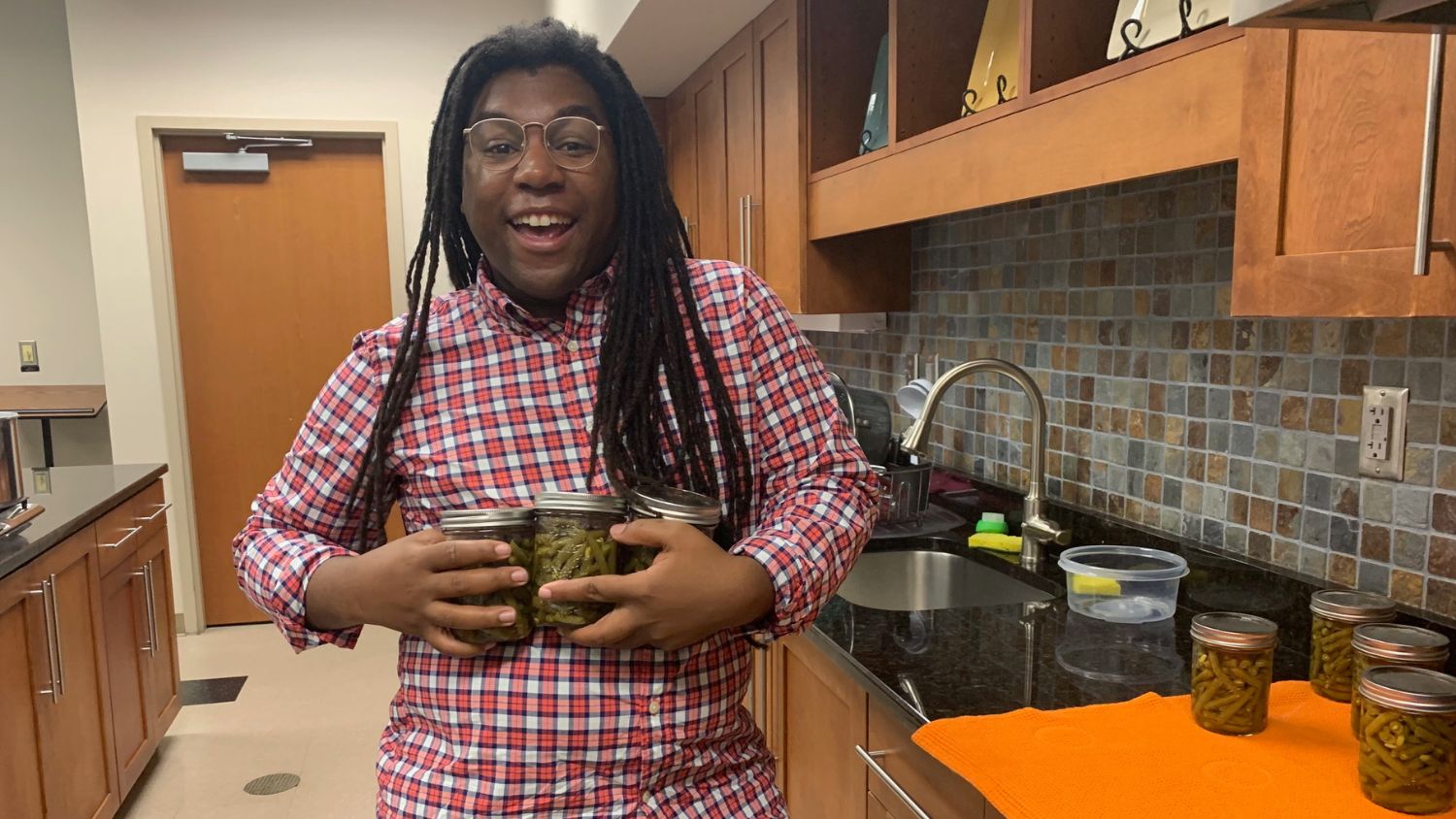
Marcus McFarland is familiar with and shares the historical past of the Black professionals who preceded him as agents with NC State Cooperative Extension. He’s pursuing their guide as the initially Black man to provide as a family and client science (FCS) agent in Union County, training children and older people about healthful cooking and behavior, food items basic safety and food items preservation. McFarland delivers his personalized and cultural connections to foods and health and fitness to the table.

A Charlotte, North Carolina, indigenous, McFarland grew up in the vicinity of Union County, found just southeast of Charlotte.

“I’m from a southern Black loved ones,” McFarland suggests. “A lot of what I bear in mind and imagine about when it comes to foods is the recollections of family members dinners, and I nevertheless have an appreciation for the meals.”

One of his beloved dishes that his grandmother and mother would make is homemade yeast rolls, but his loved ones also ate a lot of fruit and veggies.

“Everybody thinks in the South, it is nothing at all but biscuits and all the things fried,” points out McFarland. “But actually, I come from a household of smaller, sustainable sustenance farmers and sharecroppers. Most of the time what was economical was escalating fruits and vegetables.”

Joining NC State Extension

McFarland has often loved aiding other people and his community, and he volunteered normally for businesses like Habitat for Humanity. He was also fascinated in science and considered he preferred to go into well being treatment to mix his passions, but he immediately uncovered a really like for nutrition and dietetics at Appalachian State College.

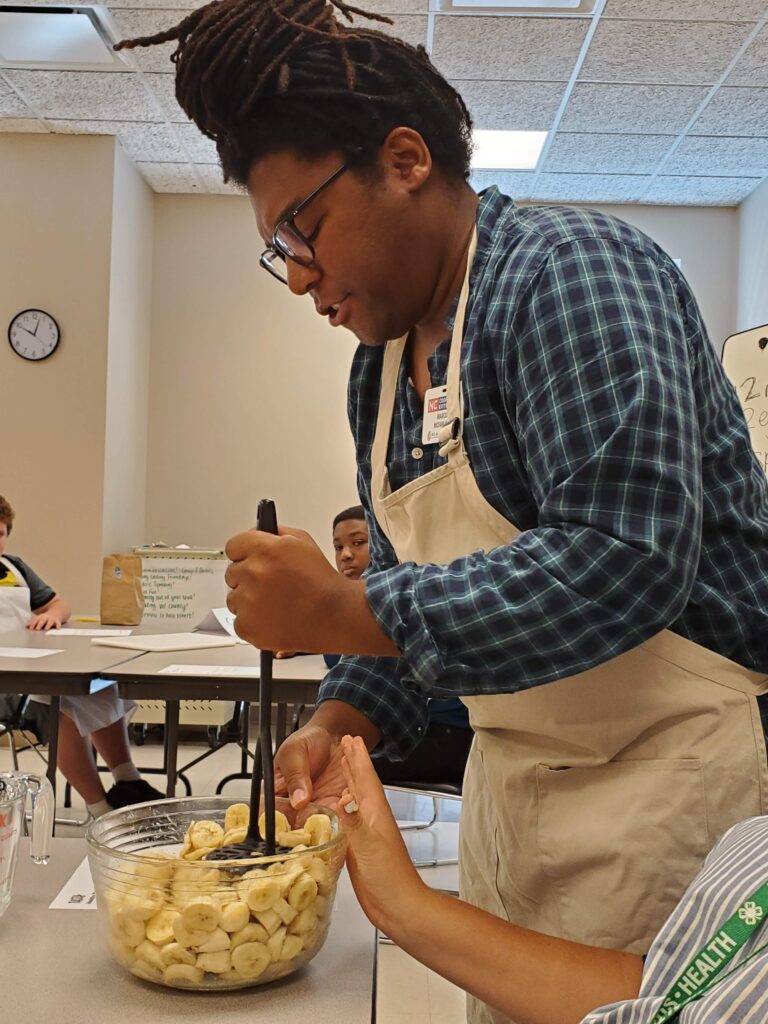
Marcus McFarland mashing bananas
Marcus McFarland teaching a course.

Soon after graduation, McFarland joined the AmeriCorps’ FoodCorps plan, in which he experienced the chance to educate children in the Charlotte-Mecklenburg college program about nutritious having, developing their personal foods and how to cook dinner. Although in that system, 1 of the leaders, Elizabeth Driscoll, stated an open up placement as an FCS agent in Union County.

“I don’t forget her telling us, ‘This is a excellent chance to keep on that enthusiasm for teaching our group about nourishment, health and wellness,” states McFarland.

Right after two years in FoodCorps, he started as an FCS agent, a purpose he has held given that 2018.

“I educate a simplistic search at nutrition,” McFarland claims. “It’s just ingesting far more fruits and veggies, thinking about what and how significantly you place into your overall body, and emphasizing it’s not about getting absent points you delight in.”

Generating a Difference 

As the to start with Black male agent in the county, McFarland is familiar with the impression he can have.

“I want to make confident that I am that representation for Black folks, so that they see, ‘Wow, there is this Black man who appears like me, who talks like me, who shares pretty equivalent cultural distinctions as me.’”

“I believe cultural link and nutrition can exist at the exact time.”

For McFarland and lots of other families, food items has generally been at the forefront of their society. However some of his childhood meals are not viewed as the healthiest possibilities, McFarland doesn’t sense he has to prevent ingesting them. Alternatively, he has realized how to make some of them more healthy or to balance the fewer wholesome foods with healthier ones, these types of as taking in a lot more fruits and greens with his grandmother’s yeast rolls.

“I assume cultural link and nourishment can exist at the similar time,” McFarland states. “When they exist at the similar time, you are in a position to preserve and honor your lifestyle. I feel like in a good deal of communities of color, they may perhaps see what they are having as not nutritious or nutritious, but which is not the situation a ton of moments.

“We can make improved, more healthy impacts on ourselves even though even now getting to get pleasure from the meals that we have relished for a long time.”

Celebrating Black Historical past

McFarland also teaches other people about those who have appear ahead of him. He revealed Celebrating Black Record in Extension in honor of Black Background Thirty day period, a write-up highlighting the contributions of African Individuals in agriculture, relatives and client sciences, and 4-H in North Carolina.

“I needed to know a lot more about the history powering our Black Extension agents, alongside with their contributions and the problems they might have faced in regards to what it was like doing the job in the course of segregation.”

Though doing the job with NC State Extension seems various now, there is a great deal of get the job done continue to to be finished with equal representation, and McFarland hopes to carry on growing nutrition equality between underserved communities.

“One day, with any luck ,, there will be a lot more Black adult men in diet and family members and consumer sciences who are equipped to educate about health and effect their specific populations so we all can have a chance to raise our top quality of daily life.”

Op-Ed: How social media is bringing healthy food options into South LA

Op-Ed: How social media is bringing healthy food options into South LA

There is no question that South LA is considered a foodstuff desert. Nestled inside an international metropolis, the bulk of the people in my neighborhood have had very little to no accessibility to refreshing fruits and vegetables and our feeding on habits have adjusted primarily based on these situation.

Obviously, when I initial experienced the idea of opening a salad organization in South LA, I was fulfilled with a lot of skepticism. I was told that folks in South LA “don’t consume salads” and for that reason, my small business would not be effective. I know now with encounter, that this is considerably from the truth. I would defy the naysayers, turning into the initially black-owned salad firm in Los Angeles.

Toss It Up started out as just an notion to make a adjust in the group when I was doing the job complete-time as a bus driver. I advised my coworkers that I was setting up a salad enterprise, and one particular of them prompt I convey my salads to do the job. “We’ll help you!” they stated. As it tends to do, phrase unfold, and before long, I was offering salads not just to co-staff but also to group associates willing to fulfill me all through my bus routes. When the demand got too higher to deal with, I commenced to seem for pop-up situations using social media to aid grow the new small business.

Toss It Up is on a mission to modify the ingesting practices of South LA residents minimal by tiny. Our purpose is to make South LA balanced again, and we are carrying out this by catering to everyday locals and meeting them wherever they are: on social media.

My COO, Matthew N. Crawford, recognized that traditional media outlets are not typically exactly where people today from my local community go to master about what’s happening in their possess backyard. As an alternative, we go on Fb and are active on Group web pages with hundreds of other South LA locals to study from each and every other in true-time.

Fb Teams, for case in point, offer us with a system to link with local community customers. We have been ready to share the Toss it Up story with above 12,000 Black and immigrant households living south of the I-10 freeway through the Invest in And Provide Stuff In Los Angeles group. I told them that there was balanced eating all around the corner, shared occasion information for our community pop-ups, and most importantly, images of the salads. This system was equally affordable and successful.

We’ve grown a subsequent for this salad small business in South LA and now have around 5,000 people today seeing our items when they open up social media, and we did that with small to no funds employing digital applications that each business enterprise has at their disposal.

Currently, about 30{d2b09b03d44633acb673e8080360919f91e60962656af8ade0305d5d8b7e4889} of my sales occur in via our Instagram web site in addition to customers reaching out on immediate messenger to request the purchasing url. For me, social media promoting is about tests what sticks and making use of what will work to keep getting more substantial. From tagging the ‘South Los Angeles’ location in just about every put up, and employing as many hashtags as achievable (28-30) to make it possible for new customers to locate us on the Instagram Discover Website page, I am accomplishing almost everything I can to turn into a firm you, and everybody can be happy of though supplying far more healthful options in South LA.

I hope the story of Toss it Up evokes other Black business owners to embrace electronic instruments to improve their brands. Social media has been a game changer for my business, and it can be for yours too.

Javonne Sanders
CEO/Founder of Toss It Up

Toss It Up is operating to start our to start with brick-and-mortar positioned in South LA by the conclude of this Summer months. In the meantime, we serve the community at community farmer’s marketplaces like the just one taking place the initial and 3rd Saturdays of just about every thirty day period in Compton, and ‘Saladbowl Sunday” each and every Sunday at the Wellington Farmers Market place in Midtown.