Marcus Samuelsson bridges the gap between food and culture

Marcus Samuelsson bridges the gap between food and culture

“I might be the only Swede-iopian that you’ve met.”

This opening sentence of chef, author and Food Network personality Marcus Samuelsson’s keynote speech “A Night with Marcus Samuelsson: A Career of Chasing Flavors” succinctly summed up the following hour. Samuelsson took the stage at Miami University’s Harry T. Wilks Theater in Armstrong Student Center on Wednesday, March 29.

Samuelsson, who has been a mainstay on Food Network shows like “Chopped” and “Iron Chef,” framed his talk around the intersection between food and culture. He went through his own life and career, highlighting the challenges he overcame to reach his current successes.

Born in Ethiopia, Samuelsson lost his mother to illness when he was around 2 years old. He and his sister, age 5 at the time, were almost orphaned, but the two were rescued by a nurse at the hospital.

“The nurse that took care of us, she broke the law in order to save us,” Samuelsson said. “She took us in. I’m not suggesting they should break the law, but there’s actually two times in my journey where someone broke the law for the better.”

The two were adopted three months later and moved to Sweden, where they  joined a culturally diverse family that included people from all walks of life. There, Samuelsson was exposed to different foods and styles of cooking.

Samuelsson used the example of Swedish meatballs to illustrate this point.

“I know Swedish meatballs from three different places,” Samuelsson said. “School lunches — tastes like a furniture store. My mom, who did the fast Swedish meatballs … or my grandmother’s, that were actually rolled, they were in different shapes, but they were delicious.”

For the remainder of his speech, Samuelsson described his journey as a chef across several different countries, from Japan to Switzerland to France and eventually to New York City, where he currently resides. Throughout, he peppered in pieces of advice and wisdom he picked up on his travels.

One such observation came when he was discussing collaboration.

“I always get confused when people say, ‘I’m self taught, I did this on my own,’” Samuelsson said. “What? Who did anything on their own? Very few people. And also, that doesn’t sound like fun.”

Samuelsson also highlighted how his time in New York, specifically Harlem, has impacted the way he perceives and enjoys food. 

Enjoy what you’re reading?
Signup for our newsletter

“If I wanted the best cornbread, it was at an after-church program and had nothing to do with a restaurant,” Samuelsson said. “If I wanted to find the best jerk chicken, I’d go to certain parks post-basketball game, and that’s where they were blasting Jamaican music … and that’s where they serve the best jerk chicken.”

Samuelsson ended his prepared remarks with a story about his experience of simultaneously competing on the competition show “Top Chef” while also creating the menu for former President Barack Obama’s first White House State Dinner.

He left the audience with an encouraging sentiment.

“I think all of you guys will have your own moments,” Samuelsson said. “It might not involve a president, or it might. But it’s gonna be your moment.”

The lecture portion of the evening closed with an audience Q&A. Samuelsson answered questions about the late Anthony Bourdain, advice for living in New York and what sets him apart from other chefs.

Following the talk, a reception was held in the Armstrong atrium where Samuelsson signed copies of and took pictures with his newest book “The Rise: Black Cooks and the Soul of American Food.”

Samuelsson’s was the final lecture of the academic year for Miami University’s Presidential and Career Leadership Series. Sponsored by the Center for Career Exploration and Success, the guest lectures are intended to offer students exposure to a variety of different careers and experiences.
At the intersection of food and culture

At the intersection of food and culture

No matter how different we are as individuals, we can all bond over a good meal. 

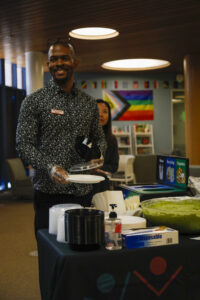
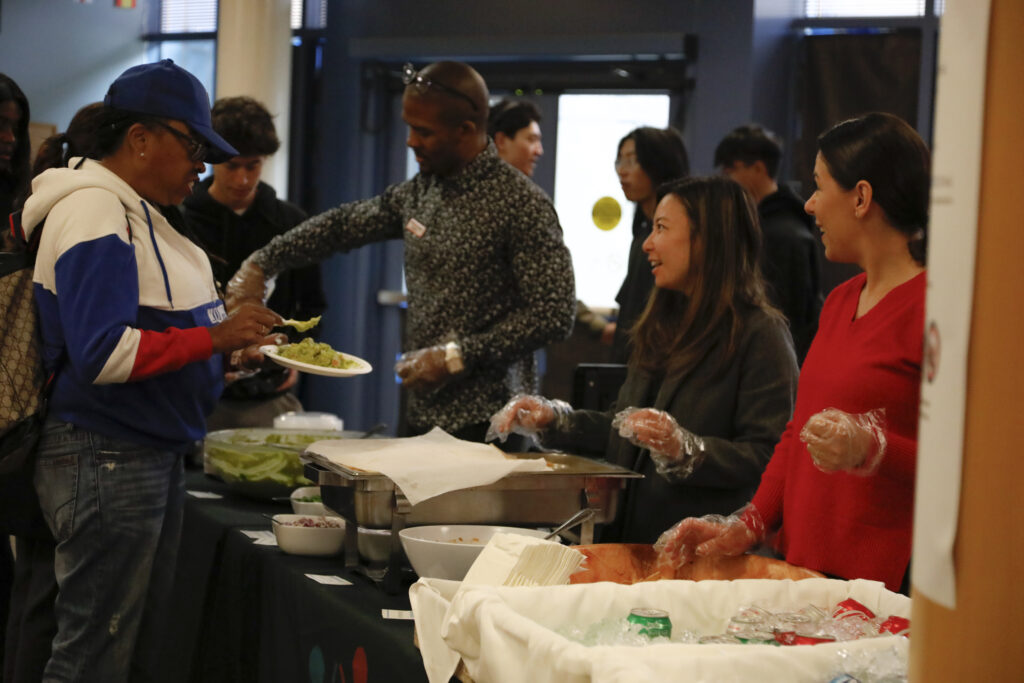
Coordinator of the Brahma Bodega Geremy Mason helps students assemble guacamole bowls in the Multicultural Center at Pierce College in Woodland Hills, Calif., on April 17, 2023. Photo by Rachael Rosenberg

“Food and Culture: Exploring the Intersection” was the first event of its kind at Pierce College. Held at the Multicultural Center on Monday, the event was a collaboration between the Brahma Bodega and the Multicultural Center that brought students and faculty together. 

The event provided an opportunity for people to learn about food and culture while making a dish.

Multicultural Center Coordinator Tatevik Melkumyan came up with the idea of the event while sharing food with her colleagues. Different dishes reminded them of foods from their own culture. 

“We think we’re very different, but really, we’re the same and we’re connected in a lot more ways than we actually know of,” Melkumyan said. “Being able to learn about food from different cultures and learning through food that we’re actually very much connected and very similar. So that’s what sparked the idea for the event.” 

A lot of people can relate to the feeling of having their own comfort foods, so this gives students the opportunity to experience comfort foods associated with various cultures. 

Brahma Bodega Coordinator Geremy Mason spoke about the significance of students exploring different aspects of themselves through traditions and food. 

Geremy Mason gets ready to assemble a guacamole bowl in the Multicultural Center at Pierce College in Woodland Hills, Calif., on April 17, 2023. Photo by Rachael Rosenberg
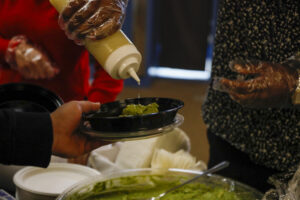
A student assembles a guacamole bowl in the Multicultural Center at Pierce College in Woodland Hills, Calif., on April 17, 2023. Photo by Rachael Rosenberg
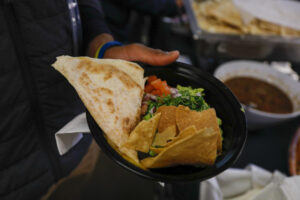
A student’s assembled guacamole bowl in the Multicultural Center at Pierce College in Woodland Hills, Calif., on April 17, 2023. Photo by Rachael Rosenberg

“I think it’s really important that students can explore all aspects of multiculturalism,” Mason said. “Food preparation, as we were talking about in the presentation, is a big part of cultural identity and tradition. We wanted to have some kind of collaboration where we got to discuss that and have an engaging activity.” 

After discussing the importance of food and culture, and the way they are interwoven, the main dish for the event was based on traditional Mexican cuisine. With the use of avocados in many different forms and cultures, students and faculty were able to create their own guacamole. 

Ingredients and materials were prepared at the food station for people to assemble their plates. From tomatoes, avocados, and red onions, to cilantro, salsa, and quesadillas. There was a wide variety of choices, as well as chips and refreshments. 

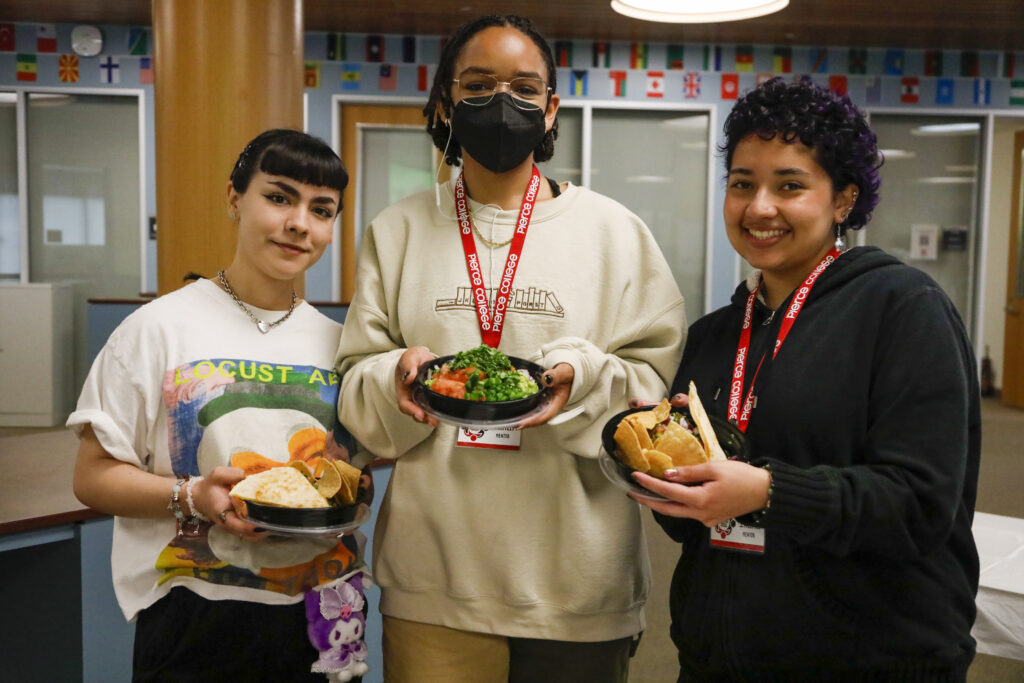
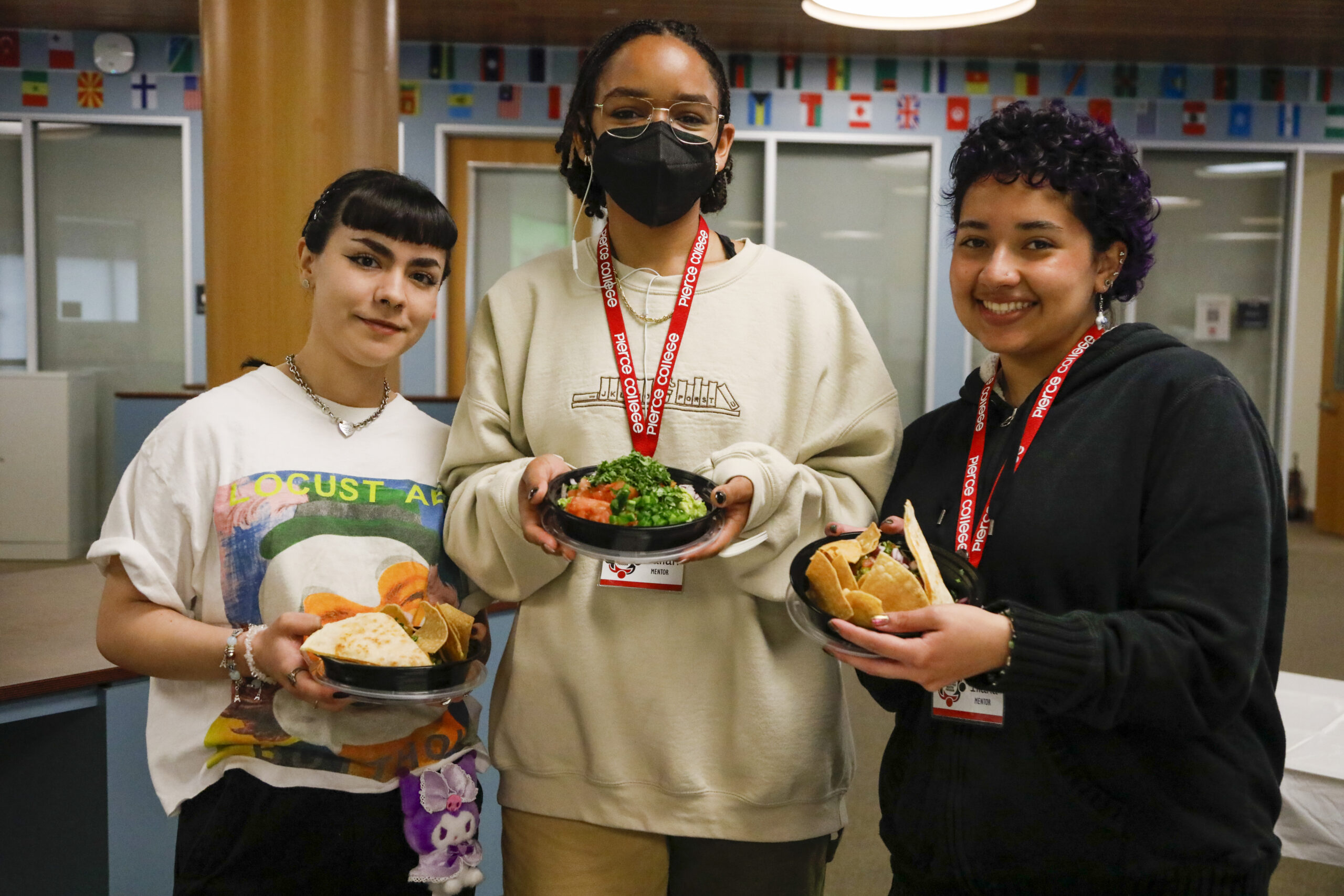
(Left-right) Pierce Students Isabella Vieyra, Nailah Babatunde-Bey, and Lliana Pride hold their guacamole bowls in the Multicultural Center at Pierce College in Woodland Hills, Calif., on April 17, 2023. Photo by Rachael Rosenberg

Pierce student Isabella Vieyra enjoyed the presentation and the making of guacamole. 

“I am Mexican, so it does feel like it hits a little close to home,” Vieyra said. “I think it’s fun and interactive and the presentation was a good explanation of its significance in Mexican culture.”

Dean of Student Engagement Juan Carlos Astorga expressed his connection to family traditions, and why it’s important for students to engage in the food of their culture. 

“It’s an amazing opportunity because as we talk about food and culture and the connection to that, it’s also about a connection to our elders and how we pass on traditions,” Astorga said. “It’s engaging our connection to culture, but also introducing how food does those intersectional connections to each other.” 

New Restaurant Will Link Himalayan Food, Culture, Art, Religion

New Restaurant Will Link Himalayan Food, Culture, Art, Religion

New Restaurant Will Link Himalayan Food, Culture, Art, Religion

By ELIZABETH COOPER
COOPERSTOWN

It has been more than a year since Alex’s World Bistro on Main Street closed its doors, but the spring sunshine has awoken more than the flowers this year.

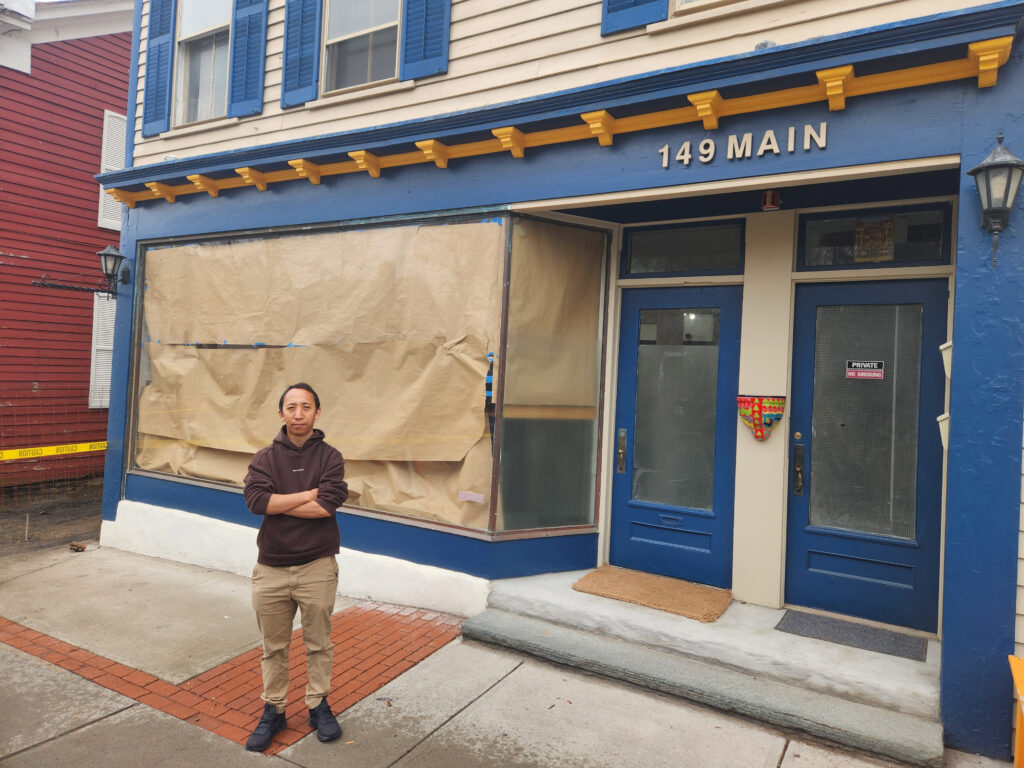
The long empty storefront is suddenly a hive of activity. Contractors, an attorney and even a small child could be seen there on a recent Wednesday.

It’s all part of the next segment in the life journey of a Nepalese man who started out as a shepherd boy in a remote village without electricity or cars.

Nawang Gurung will be opening his restaurant, Norbu, in May. It will feature Nepalese and Indian food and he hopes it will also be a place where people can learn about Himalayan culture, art and religion.

He and his partner, Diki Bista, have two young daughters and they want them to grow up in a beautiful, natural surrounding like this one.

“I feel like it’s a home away from home,” he said of Cooperstown and his Himalayan homeland. “It’s like moving back to the mountains, compared to New York City.”

Norbu means jewel in Tibetan.

“For us, Cooperstown is a jewel and precious,” he said.

To Gurung, food, culture and art are linked and he wants to share it all. Norbu will be decorated with photographs of his homeland, and he is particularly excited to serve momo, a form of Nepalese dumpling.

“It is kind of like a Japanese gyoza,” he said. “In Tibet it has become a very popular food in the mountain areas.”

Cooperstown Chamber of Commerce Executive Director Tara Burke said residents and business owners were eagerly awaiting the restaurant’s opening.

“Alex’s was a beloved spot for locals,” she said. “I think there is a lot of excitement and questions about who is going into that space and what they will offer. It’s going to be a great, diverse option.”

As for Alex Webster, former owner of Alex’s, he said he “could not be happier” to see Gurung taking over the space.

“They seem like wonderful people and I am thrilled with the plans for the restaurant,” he said. “I am excited that in many ways they will continue in my effort to bring exciting, fun, quality food to the area.”

Alex’s old bar, made from sections of a bowling alley, remains in place and Gurung is in the process of getting a liquor license.

Here Because of Chocolate

Gurung’s unlikely trajectory from the mountains of Nepal has taken him through Dallas, Boston, New Haven, and New York, with time logged in some of America’s greatest universities, and the dining rooms of a number of Indian restaurants. He has worked for scholars and non-profits, but also waited tables to support himself and his family members back home.

It all began with the hope for a piece of chocolate.

“Chocolate was the only English word I knew,” said Gurung, now 37. “I am here because of that chocolate today.”

His village in the Mustang region of Nepal had been closed to tourists because of its holy connection to Buddhism, but that changed in the early 1990s when he was still quite young. Gurung and the other local children loved the chocolate that some of the outside visitors gave them and would ask for it whenever they could.

One day when 8-year-old Gurung was tending his flock of about 200 goats and sheep, he spotted a European man who seemed a likely prospect. The man didn’t have any chocolate, but he offered something that turned out to be far better. Charles Ramble was a professor of Tibetan culture at Oxford University. He spoke Nepalese and took a shine to little Gurung. He soon met Gurung’s parents and offered to take the boy to Kathmandu to get an education. They declined, but when Ramble returned a year later they accepted.

Gurung did well at the school and became interested in the study of culture and religion. After graduating he worked as an assistant for an American Fulbright scholar in Kathmandu. He then worked for an organization helping people with tuberculosis while searching for the next opportunity.

Because of his interest in religion, Gurung applied to a Baptist university in Dallas, Texas, but when they required him to be baptized in order to continue his scholarship he declined and had to leave.

Next, he went to Boston, because he had heard of Harvard University there. He couldn’t afford it and instead went to a community college nearby while working at an Indian restaurant frequented by Harvard students. They liked him and soon they were helping him sneak into classes so he could learn there.

Later he did the same in New Haven at Yale. Along the way, Ramble introduced Gurung to a Dartmouth professor, whom he briefly worked for doing research. He finally applied and was admitted to Columbia University, where he planned to major in cultural anthropology, but soon realized his small scholarship would not be enough to live on if he was to continue sending money home.

Instead of attending, he started his own project, Voices of the Himalayas, which seeks to document cultural change in Nepal, Tibet and other parts of the region. That work was funded by Dartmouth and other foundations. Later, he started working with young people from the Himalayas who live in New York, teaching them about their heritage. He is also working to document the experience of Himalayan people during the pandemic.

To Cooperstown

Gurung learned of Cooperstown from Daniel Kaufman, a linguist at Queens College whose family owns property near Fly Creek.

The two were good friends and Kaufman had mentioned Cooperstown to Gurung several times.

Gurung said it wasn’t until fall of 2022 that he considered coming up to see the place for himself after a dinner with Kaufman in Brooklyn. Starting fresh seemed more appealing to Gurung, because he had invested much of his savings in a childcare center Bista was hoping to operate, but COVID-19 had struck and the business was having difficulties.

So he and Bista hired an Uber and came up to have a look. He then spotted the empty Alex’s space and in short order put in a bid.

“It was one of the most impulsive acts I have ever seen in my life,” Kaufman said. “He wasn’t looking to move here, but he visited Alex’s and he bid on it. It was extremely spontaneous.”

Gurung, however, says there were many hints that Fate was at work.

“Always things [about Cooperstown] kept coming up,” Gurung said of the time after the Brooklyn dinner. “It was a karmic connection.”

It didn’t hurt that baseball is full of numbers that have significance in Buddhism. Nine innings, three strikes, four balls, 108 stitches on the ball.

“One hundred and eight is a very precious, holy number,” he said.

Kaufman said he had even suggested Gurung make a momo in the form of a baseball.

“I regularly come up with absurd ideas like that and usually people brush them off,” Kaufman said. “He decided he would give it a try!”

Gurung said it might be harder than he thought.

“It might be challenging,” he said. “I tried to do research on that.”

Whatever their form, Gurung will make sure they are delicious, he said.

National Cannabis Festival features 2 Chainz, policy, food and culture

National Cannabis Festival features 2 Chainz, policy, food and culture

The National Cannabis Festival, which returns to the RFK Stadium grounds for the seventh time this weekend, is known for its mix of activism and hip-hop, with past musical headliners including De La Soul, Ghostface Killah and Ludacris. This year, 2 Chainz, Juicy J and Free Nationals are topping the bill for a day-long show expected to attract thousands on Saturday, but festival founder Caroline Phillips is trying to create something much bigger than a concert.

“We hope that the National Cannabis Festival can become sort of like a South by Southwest for cannabis lovers,” she says, “where people are coming here for a full week of policy programing, cultural events and opportunities to network, all capstoned by the festival that takes place over the weekend.”

Organizers planned a whole slate of events in D.C., including policy forums, restaurant specials, DJ nights and a 4/20 fun run. The festival itself is introducing an LGBTQ lounge and will also hold pavilions focused on entrepreneurship, wellness and culture. (And, to answer the big question, no, smoking pot is not legal at the festival, but we’re betting the scent will still be in the air.)

Here’s what you need to know about the festival’s expanding activities.

You can have the munchies for a whole week

Food has always played a role at the festival — the Munchies Zone includes a mix of food trucks and chefs serving special dishes. This year, though, the deals have been extended outside of the gates, with nine days of wink-wink food and drink specials at local restaurants, running through Sunday. Among the highlights: Dolcezza’s “Munchies” adds peanut butter cups and chocolate-covered pretzels and potato chips to milk chocolate gelato. All Purpose Shaw’s Italian 420 cocktail spikes gin, prosecco, cassis and lemon with a CBD-infused rose syrup. Jerk at Nite offers the choice of its Jamaican-style Yardie platter with a patty or jerk chicken and mac. The full menu is on the festival website.

Bring your running shoes — or your dancing shoes

420 Week, with three days of events leading up to the festival, brings a mix of activities, including a mushroom cultivation workshop and a networking social sponsored by the National Association of Black Cannabis Lawyers. Among the highlights: A 4.2-mile 4/20 run, starting at Meridian Hill Park on Thursday morning; a 4/20 Kickback social event at Songbyrd on Thursday night, with music and video; and a free Friday night party at Wild Days, the Eaton hotel’s rooftop bar.

The music goes beyond the headliners

2 Chainz and Juicy J are “so revered in the cannabis community,” Phillips says, but there’s local representation at the concert, thanks to Backyard Band — “our house go-go band” — and a first-time performance by D.C.’s Cumbia Heights. “As the festival has grown, we have had to expand the music offerings to make sure that we are bringing a music experience together that appeals to our very diverse audience,” she says. “This year, we’re really excited to be bringing Cumbia Heights to the festival to make sure that we have some music that represents the Latin American community in D.C.”

Grow your own? Learn from the best.

While D.C., Maryland and Virginia all have different rules about purchasing or accessing marijuana, each jurisdiction does (or will) allow residents to possess their own plants. New this year at the festival itself is a Grower’s World, where festivalgoers can meet participants and judges from the National Cannabis Championship — a celebration of homegrown cannabis flowers. “Folks can talk to them about the methods they’ve used to grow such great plants,” Phillips says, or ask, “This is my setup at home — what should I be doing differently?” There will also be vendors selling equipment for those inspired to upgrade.

Wondering about the future of weed? You might find it at CannaTank.

Since the beginning of the festival, it has hosted a “Shark Tank”-style competition that allows budding entrepreneurs to pitch a cannabis-related business venture to win cash and face time with PR teams, among other prizes. This year’s participants are Upling, a dispensary delivery app billed as “DoorDash for weed”; Natural Elevation Snacks, a line of organic oat and honey snacks; Herban Holistic Healthcare, which offers wellness and cannabis coaching; and “The Phytos,” a “pot edutainment comic about a team of terpenes and cannabinoids.” The finalists offer their final pitches at 4 p.m. Saturday.

Even Official Washington participates in 420 Week

While marijuana legalization and reform movements evolve across the country, “there are still many challenges ahead,” Phillips says. The National Cannabis Policy Summit, first held in 2018, brings together lawmakers, business leaders, lobbyists and advocates at the U.S. Capitol Visitor Center on Thursday to discuss the current landscape. Senate Majority Leader Charles E. Schumer (D-N.Y.) will deliver the keynote speech; the event is free for the public to attend. Even Phillips is sometimes stunned by how far public sentiment about cannabis has come in recent years: “I think if you’d asked me eight years ago if our event would be invited into the United States Capitol, let alone having the Senate majority leader deliver the keynote address, I would have told you, ‘I don’t know if that’s going to happen.’”

National Cannabis Festival

Festival Grounds at RFK Stadium, 2400 East Capitol St. SE. nationalcannabisfestival.com.

Date: Saturday from noon to 10 p.m.

Admission: $85; $306 for a group of four. VIP tickets $425.

BSI puts focus on food safety culture with new guidance

BSI puts focus on food safety culture with new guidance

Relevant to anyone from manufacturers and factory workers to restauranteurs and baristas, the guidance has been published by the British Standards Institution (BSI) following extensive sector discussion on food safety culture, including what it is, how to measure it and how to ensure continuous improvements.

Food industry majors – including Walmart, McDonald’s, PepsiCo, HelloFresh, Kerry Foods and 3M – have all been involved in drafting the guidance.

Positive food safety culture

The document – named PAS 320 – includes steps on identifying gaps and then implementing a plan for change. It makes recommendations related to leadership; the organization’s vision, mission, values and policy; organizational structure; responsibilities, accountabilities and authorities; guiding coalition team; interested parties; change champions; influencers; and food safety documentation.

In particular, the guidance also includes advice on how prioritizing people in the sector not only supports improved food safety, but also brings other benefits including investment return, business performance improvement, reduction of the costs associated with poor quality, and enhanced efficiency. For example, the guidance notes that creating and maintaining a strong culture that preserves quality and reduces risk requires management commitment and a mindset that safety is the responsibility of everyone at every stage of the food supply chain.

The guidance is published at a time when packaging and labelling regulations is being led by the Food Standards Agency following the UK’s exit from the European Union through Brexit. New allergen labelling laws that came into force in the UK last year also require businesses to label all food that is pre-packed for direct sale with a full list of ingredients, with the 14 major allergens including milk emphasised in the list.

What 5 ridiculous “woke food” boycotts can tell us about the GOP’s culture war

What 5 ridiculous “woke food” boycotts can tell us about the GOP’s culture war

These days, it feels like at least once a week a mainstream company comes out with a new product or campaign that — because of how it’s packaged or advertised or has been modified — throws prominent conservative public figures into a tailspin because yet another American company has gone “woke.” 

As Salon’s Amanda Marcotte pointed out in March, the GOP is “obsessed with ‘woke,’ but can’t define it.” 

“That was hilariously demonstrated in a viral video clip of conservative author Bethany Mandel falling completely apart when asked in an interview to define ‘woke,’ a concept she wrote an entire book denouncing. Mandel couldn’t do it,” Marcotte wrote. “‘So, I mean, woke is sort of the idea that, um…’ she stammered before admitting it ‘is something that’s very hard to define,’ and then failing utterly to get close.” 

But, as Marcotte wrote, this is a “feature, not a bug.” It can mean whatever Republicans want it to mean in the moment, which has led to some objectively ridiculous boycotts that didn’t really pan out as planned for the participants — especially in the world of food and drink. 

For instance, remember in 2017 when fans of Sean Hannity destroyed their Keurig coffee machines after the company pulled its ads from Hannity’s Fox News program? As Zachary Petrizzo wrote for Salon, “Hannity tried to save the advertiser (and the valuable ad dollars) by giving away 500 Keurig machines, but it was too late. By the end of the boycott, an unknown number of Fox News viewers were just left with expensive coffee machines they had tossed off balconies or otherwise obliterated.” 

Just a year prior, angry Breitbart readers flushed Kellogg’s cereal down toilets because the cereal company didn’t want to associate their brands with Breitbart News, whose former executive chairman was Steve Bannon. 

But as silly and cyclical as conservatives’ constant declarations of a “culture war” feel (and they certainly are both silly and cyclical) these boycotts are most often driven by hateful rhetoric surrounding marginalized people and communities, as is the case with the latest call for a boycott against Bud Light beer, which is still simmering this week. 

Here’s a breakdown of five recent conservative boycotts that tell us a lot about the ways in which members of the Republican party rely on fanning fears of ambiguous “wokeness” to make their constituents feel like they are under attack. 

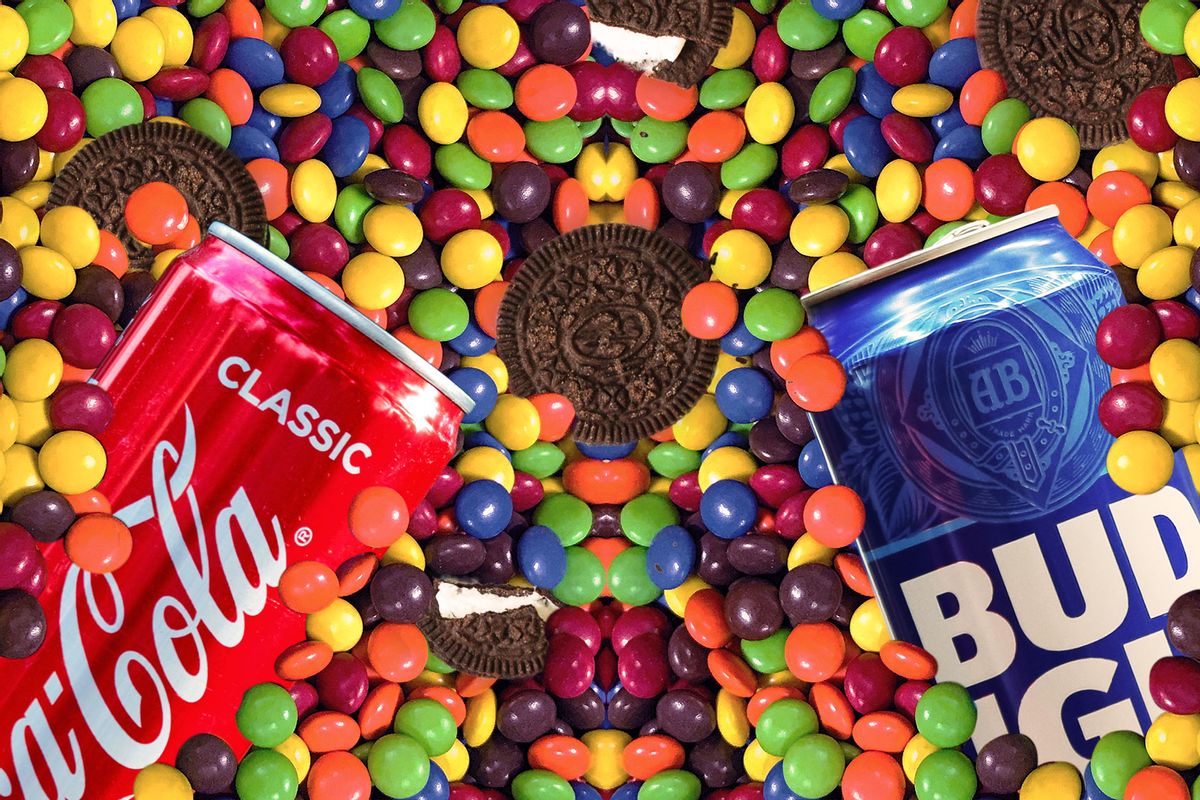
You’ve probably seen the video of Kid Rock tearfully shooting cases of Bud Light off a folding table in a field — but what you may not know is why exactly he punctuates said video with the sign-off, “F**k Bud Light and f**k Anheuser-Busch.” 


While Rock doesn’t explain in the video, as Salon Food reported last week, the musician released the clip on Twitter after other other conservative public figures said the beer brand had become”woke” because of an Instagram partnership between the Bud Light and trans actress and activist Dylan Mulvaney.


The partnership itself was pretty minimal: Mulvaney posted a single photo in her Instagram grid featuring herself with a few cans of the beer, then in her Instagram stories, shared a photo of a can of Bud Light branded with her face. 


It was a one-off promotional can sent to Mulvaney to celebrate the 365th day of her viral TikTok series “Days of Girlhood.” As reporter Miles Klee noted for Rolling Stone, this was a single can of beer featuring Mulvaney’s likeness “and it didn’t even appear on the grid: You had to look at her Instagram stories to see it.” 


However, its existence prompted some vitriolic statements from prominent conservative figures. Fox News published an article describing how “many people mocked Bud Light over the partnership.” 


In it, Fox shared statements made by conservative commentators, including John Cardillo, who wrote on Twitter, “Who the hell at @budlight thought it was a good idea to make a grown man who dresses like little girls their new spokesperson? Brands have to stop listening to their woke creative teams and get in touch with their consumer demographics.”


“Might genuinely be the weirdest thing I’ve ever seen in my life,” The Spectator contributing editor Stephen Miller remarked. Townhall.com columnist Derek Hunter wrote: “@budlight: the groomer of beers.”


Along with Kid Rock, country musicians like Travis Tritt have decided to boycott Bud Light and its parent company, as well. As Salon Food reported, Country singer Travis Tritt announced that he would be banning Anheuser-Busch products from his tour hospitality rider, referring to the list of requests — including food and drink items — an artist provides to concert venues.  


“I was on a tour sponsored by Budweiser in the 90’s. That was when Anheuser-Busch was American owned,” he wrote on Twitter. “A great American company that later sold out to the Europeans and became unrecognizable to the American consumer. Such a shame … Other artists who are deleting Anheuser-Busch products from their hospitality rider might not say so in public for fear of being ridiculed and cancelled. I have no such fear.”


However, for some Republicans, the boycott just isn’t really working out. For example, look at Rep. Dan Crenshaw, R-Texas, attempted to boycott Bud Light — by filling his fridge with one of its parent company’s beers, a move that Instagram commenters classified as a “tremendous self-own.” 


In January, less than two weeks into the New Year, Fox host Tucker Carlson gloomily announced that “woke M&M’s” had returned. You may remember that in January 2022 — a full year prior to Carlson’s most recent candy rant — he had dedicated an entire segment on his program to picking apart the revamped looks of the anthropomorphized M&M’s mascots. 


As Brett Bachman wrote for Salon, the company released new packaging in which the brown M&M swapped out her signature stilettos for kitten heels, while the Green M&M’s go-go boots were replaced with white sneakers.The relatively benign changes were meant to promote “inclusivity” and bring the female-presenting characters in line with “current” trends that are more “representative of our consumer,” Anton Vincent, the company’s president, said.

That didn’t fly with Carlson, though, who attempted to connect “Mars’ decision to make its cartoons ‘less sexy’ to the decline of American society.”


“M&M’s will not be satisfied until every last cartoon character is deeply unappealing and totally androgynous, until the moment you wouldn’t want to have a drink with any one of them,” the Fox News said. “That’s the goal… When you’re totally turned off, we’ve achieved equity.” 


A year later, M&M’s unveiled a new promotional wrapper featuring the three “female” candy characters, including the classic green and brown characters and the new purple peanut M&M. This is, again, where things start to feel cyclical because of course Carlson managed to find something threatening about the campaign. 


“The green M&M got her boots back, but apparently is now a lesbian, maybe?” Carlson said in a “Tucker Carlson Tonight” segment, a reference to a viral 2015 tweet depicting the green and brown M&M holding hands that he’d ostensibly dug up for the occasion. 


The caption on said tweet read: “It’s rare Ms. Brown and I get to spend time together without some colorful characters barging in.”


Carlson then turned his attention to the newest M&M character.”And there’s also a plus-sized, obese purple M&M,” he said. “So, we’re gonna cover that, of course.”


As Forbes reported, this prompted conservative influencer Nick Adams Adams to release “a weird video in which he emphasizes how disturbing the feminist M&Ms are, and calls for ‘a complete and total boycott of all things Mars.’ He also called for the same thing a few days ago for pregnant Joker, so these sternly-worded boycotts don’t seem to have much commitment behind them.”

“COOKIE!” Newsmax host Greg Kelly wrote on Twitter above a photo of Sesame Street’s Cookie Monster in April 2022. “I love COOKIES. C is for COOKIE. COOKIE IS FOR ME.  I do NOT like GAY COOKIES.  ‘Sexuality’ has NOTHING TO DO with the Cookie experience.  Cookies are for ALL!  Basically Cookies are ‘asexual’—why is the WOKE LEFT messing around with OREOS?!?!  STOP THE INSANITY.” 


This … statement was prompted by a video that had been released by Oreo a few days prior.


“The Note,” which was directed by Alice Wu (“Saving Face” and “The Half of It”), depicts a young Chinese-American man practicing a coming-out speech before a few close family members. Before the young man shares his truth with his grandmother, his mom slips him a note. “She might be my mother,” it reads, “but you are my son.”


The video ends with a message for viewers to pay it forward. “Coming out doesn’t happen just once,” it says. “Be a lifelong ally.”


It’s honestly a beautiful short film about an important part of the queer experience (and one that was refreshingly not released during Pride Month), but it prompted conservative public figures, including Kelly and Ben Shapiro, to call for a boycott against the cookie brand. At the time, Lila Rose, the founder of a movement dedicated to ending abortion, told Oreo to “stop sexualizing children.”

In August 2022, Cracker Barrel Old Country Store accidentally joined the culture war when they decided to add plant-based sausages to their menu. The company wrote in a Facebook post: “Discover new meat frontiers. Experience the out of this world flavor of Impossible™ Sausage Made From Plants next time you Build Your Own Breakfast.” 


Note that I said “add” — the Impossible Sausage was not replacing the pork sausage on the menu, but its customers saw the change as a sign that the restaurant was caving to the whims of liberal vegans. 


“We don’t eat in an old country store for woke burgers,” one commenter wrote, while someone else added: “I just lost respect for a once great Tennessee company.” 


“Not going to happen!” another customer vowed. “Cracker Barrel use[d] to be so good, we looked forward to eating in them but not anymore.” 

In April 2021, Donald Trump’s former legal advisor Jenna Ellis, distributed a statement from the former president on Twitter. It read: “It is finally time for Republicans and Conservatives to fight back—we have more people than they do—by far! Don’t go back to their products until they relent. We can play the game better than them.”


The tweet came after Georgia-based companies, including Delta Airlines, ViaComCBS and Coca Cola, spoke out against new restrictive voting legislation that would, among other things, criminalize bringing food and water to voters as they are waiting to cast ballots. At the time, prominent Republicans, including Sen. Minority Leader Mitch McConnell, R-Ky., characterized the situation as corporations allowing themselves to be bullied while “join[ing] in the bullying themselves.” 


“From election law to environmentalism to radical social agendas to the Second Amendment, parts of the private sector keep dabbling in behaving like a woke parallel government,” McConnell said in a statement.


This resulted in calls from conservatives, including Trump, to boycott the companies that had “gone woke” — though, as Salon Food reported back then, Trump’s own boycott was relatively short-lived. Within just a few days of making his public statement urging his constituents to not “go back to their products until they relent,” online sleuths spotted a Coca-Cola bottle on the president’s desk. 


Two years later, he would reportedly be found drinking “non-stop Diet Cokes” in that same office “to avoid filming [the] video announcing he’d leave the White House.” 

Read more

about this topic