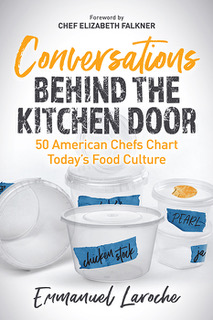
Have you ever wondered what chefs discuss behind closed doors? A new book dropping today has some answers.
“Conversations Behind the Kitchen Door: 50 American Chefs Chart Today’s Food Culture” by Emmanuel Laroche offers insights from leading chefs and readers will walk away with advice and inspiration from noted chefs, restaurant owners, bartenders, and industry leaders, all of whom have shared their stories in their own words. Subjects include where they got their start, what they learned from mentors, how they mastered proper techniques, and trends to expand their culinary horizons.
Born and raised in France, Laroche is vice president of marketing with Symrise North America a global manufacturer of flavors for the food and beverage industry. In 2015, Emmanuel developed an exclusive partnership with StarChefs for Symrise and began moderating panel discussions with successful culinary professionals. In 2018, he launched the podcast, Flavors Unknown, featuring a series of conversations with acclaimed and award-winning chefs, pastry chefs, and mixologists from around the United States.
Modern Restaurant Management (MRM) magazine caught up with Laroche to learn more about why he wrote this book, the state of restaurant culture and more.
Why write this book and why now?
My passion for food started when I was a kid in France. When I was six or seven years old, my mother taught me how to cook a Quiche Lorraine from scratch. I grew up in a family where food was ubiquitous at home and while traveling and in a country with a strong culinary heritage.
When I came to the United States, my French family and friends consistently teased me about the absence of culinary traditions in America. Twenty years ago, I was not able to properly answer them. Today, after four seasons of my podcast, ‘Flavors Unknown,” where I interview acclaimed American chefs, pastry chefs, and mixologists, and many tasting adventures across the country, I felt I had enough knowledge and content to write a book to formulate an answer.
“Conversations Behind the Kitchen Door” is also a way to bring more people to listen my podcast. They are personal projects linked to my passion for food and the desire to understand people who produce it, transform it, celebrate it, and share their passion for food with others. I am in charge of marketing for a global food ingredient company and travel often for my day job. The pandemic gave me the time to write the book.
How has the pandemic affected restaurant culture?
A lot has been already written on the topic. During the pandemic, I had the chance to host two podcast episodes featuring panel discussions with several chefs from different part of the country and representing distinct restaurant profiles. After these episodes, my conversations with culinary leaders continue to highlight that a of people left the hospitality business for good. Chefs from various horizons mention first that skilled workforce is difficult to find and that there is a labor shortage and a short food supply.
Since the pandemic, many chefs created fast-casual concepts and we see more and more tasting and prix-fix menus. I am very pleased to have witnessed a lot more community spirit and support between restaurants and with farmers and purveyors.
What traits or characteristics are necessary for a good restaurant leader?
In the last chapter of the book called “The Kitchen as a Metaphor for Life”, I relate something that chef David Burke told me. He said four things are important in this business: having an open mind, a good work ethic, a hunger for success, and enthusiasm. From all the other conversations, I highlight, in the same chapter, many advice about leadership. I picked a few of them; be present and accessible, create a positive environment, promote respect, implement standards, and keep in mind that great feedback is earned.
A good restaurant leader needs to understand how to balance discipline, creativity, and consistency.
A good restaurant leader needs to understand how to balance discipline, creativity, and consistency. Discipline as a mean to deliver results, creativity as in finding creative solutions to achieve something, and consistency as in having a common purpose and that is expected from everyone to deliver food every day to the highest standards.
What lessons did you learn in the process of writing the book?
I learned many lessons while writing this book, about leadership, about food, and about me as an individual. I previously mentioned some learning about leadership. About food, I should cook local and buy more in season as produce taste better and is cheaper. My time spent with chef Drew Adams in the woods alongside the Potomac River in D.C. convinced me that I should explore more about foraging. I now make everything possible to access higher quality ingredients and support farmers’ markets and local businesses.
The objective of this book is to demonstrate that people shouldn’t be afraid of experimenting in the kitchen, and only use recipes as guidelines. Not everybody has the same ingredients that restaurants have, and everybody has different markets and different seasons.
For me as an individual, I learned that the future is about collaboration. I should always look for opportunities and anticipate and prepare for the unexpected. I shouldn’t be afraid of failing. And finally, resilience is the secret ingredient to success. I love traveling and go on culinary adventure. All culinary leaders I had on the podcast challenge the new generation of cooks to travel to broader their horizons. They suggest tasting everything, take pictures, write notes, and bring ingredient back. In the chapter “The Flavor-Memory Database”, I give a list of twenty travel tips for setting up a tasting tour.
What do you hope readers take away from the book?
People who are emotionally connected with the food and drinks they like, will enjoy learning about the journeys and stories of the chefs that prepare it. This book will help readers know how to choose quality ingredients, develop relationships with famers at farmer’s markets, and find inspiration while traveling. People interested in the state of the food industry today and how it has shaped eating habits, with advice from chefs on how to be more creative in the kitchen. Food enthusiasts will learn about how America eats today and understand how chefs think. Culinary students will learn the importance of establishing short term and long-term goals and finding a mentor to guide and challenge them. Cooks will find new sources of inspiration and tips on how to evolve in the industry. And finally, chefs will find out what their peers are doing.
The pandemic has fundamentally changed the restaurant industry and despite food business closures, bankruptcies, and uncertainty, the hospitality industry has proven to be more resilient than expected.
“Go and Travel” is probably the main recommendation I took away from my conversation with culinary leaders. It is a great source of inspiration. It resonates with my DNA. I identified seven common paths when it comes to chef’s creative process (that can be use on their own or in combination). I share them in the chapter called “Creative Decisions.”
A lot of the culinary leaders I talked to were also mentors. I share in the book eight key pieces of advice most of them learned from their mentors and passed on to others.
What do you see as key challenges facing restaurants in 2023?
There is still a cost-of-living crisis, and the restaurant industry remains very competitive, and we will continue to see chefs using their creative thinking and collaboration approach with farmers and purveyors to find way to keep cost down. One thing I learned from all my conversations is that chefs are resilient. The pandemic has fundamentally changed the restaurant industry and despite food business closures, bankruptcies, and uncertainty, the hospitality industry has proven to be more resilient than expected.
Food trucks and ghost kitchens are here to stay and with the behavioral and attitude shifts towards food for the new generations, new opportunities for food and beverage innovation will emerge. More people are working from home which will offer opportunities for breakfast and lunch fast casual ideas. More creative packaging will come into play as convenience will continue to drive innovation. Plant-based food is here to stay as well as more people are adopting the flexitarian diet. How can chefs make plant-based food more desirable?
What keeps you passionate about restaurants and the industry?//
The passion I have for food since my childhood in France never needed away. I still want to explore. I have the chance to participate to more than sixty tastings a year. Do I experience FOMO (Fear Of Missing Out), a syndrome so many times mentioned when referring to Millennials? Probably I do. When I travel I always prepare my trip searching the web for unique restaurants, coffee roasters, breweries, and local bakeries. When I interview culinary leaders, I am curious about their innovation and their creative process. Chef Elizabeth Falkner says in the foreword she wrote for my book, “Emmanuel genuinely seems like he is trying to solve a puzzle, which is why this book is an important piece of writing.”
What advice would you give to someone starting out in the industry?
I give eight advice from chefs and their mentors in the chapter “The Kitchen as a Metaphor for Life”. Here are four of them: lose the ego!, set-up goals early in your career, find amazing mentors who can guide and challenge you, and respect everyone and everything. And to be successful, focus on making the local customers happy, as you need to attract the neighborhood. They will be the ones helping to pay the bills.
What is your favorite or the most colorful anecdotes in the book?
From the chefs:
There are lot of small anecdotes like when chef Shamil Velazquez mentioned that he applied to the CIA when he was in 9th grade, or when chef Brother Luck shared that he went into working at restaurants as an opportunity to eat at the end of the night.
One colorful story is about the moment when chef Fiore Tedesco decided to stop playing drums in a band and go into cooking.
One emotional story is when chef Bonnie Morales mentioned that the name of her restaurant Kachka is connected with the hard story of her grand-mother escaping a ghetto in Belarus during WWII.
What are a few of the most surprising things you learned from the chefs you interviewed for Conversations Behind the Kitchen Door?
Only a few of the people I talked to consider themselves as artists. It was an idealistic mental image I had of them. During my conversations, I learned that the creative side of their job becomes less and less of a focal point. As they progress in their career, execution, techniques, process, leadership, and simplicity take over.