Cambridge students gets cooking with Chef in the Classroom

Cambridge students gets cooking with Chef in the Classroom

Elementary students in the Cambridge School District are shown how to make recipes by a chef, and then they turn around and become the chefs as high school freshmen.

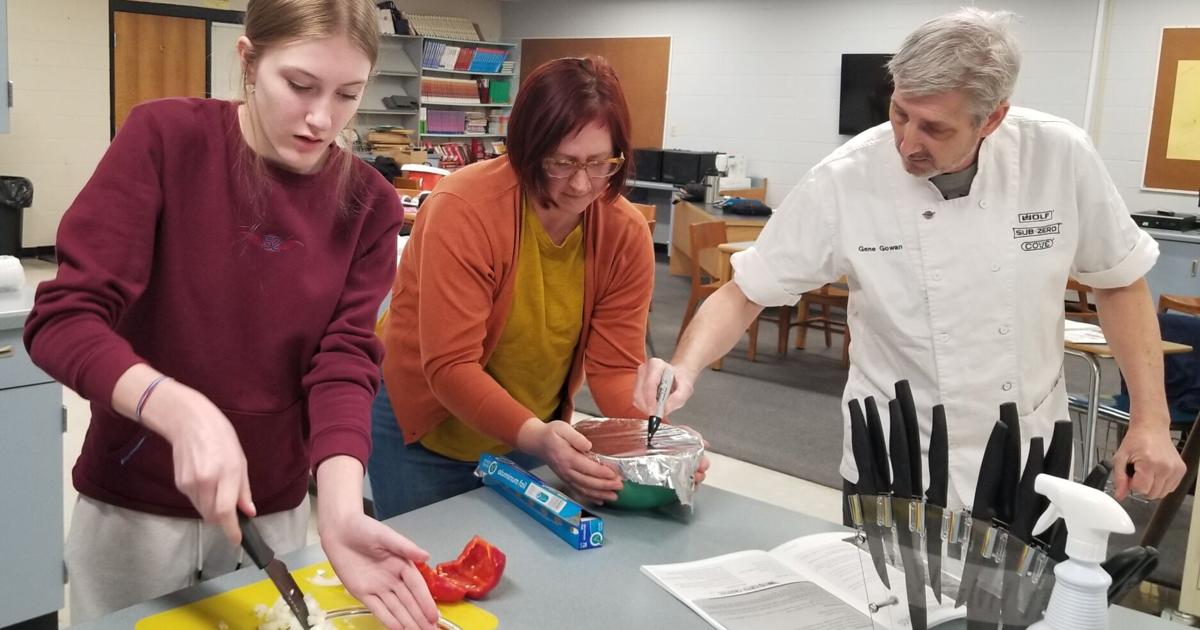
The Chef in the Classroom program brings in a chef to demonstrate for the young students how to make foods that are mostly tied to other lessons they are learning. Then in high school, the chef comes back to again teach students to make those same recipes and others. The students also learn knife skills and other cooking tips.

“It is kind of a full circle kind of thing,” said Gene Gowan, who serves as the chef.

The Chef in the Classroom is one of the programs organized by Cambridge Farm to School, a volunteer-run organization that assists with programming and facilitates hands-on education in the Cambridge School District and the community. Chef in the Classroom takes place once a year for each grade for elementary students, and for four days during freshman health classes. Elementary students receive a copy of the recipe they learned, and each high school student receives a booklet with recipes and cooking tips.

People are also reading…

“I’m learning a lot of new things in the first day,” freshman Maggie Porter said about Chef in the Classroom.

Freshman Josie Punsel said she was learning new recipes and knife safety and was being exposed to different foods.

“The class is pretty interesting,” she said.

Teacher Antione Gray, whose freshman health classes took part in Chef in the Classroom last month, said he sees several benefits to the program.

“The biggest thing is not a lot of families expose kids to cooking,” he said.

While his students might do some food preparation at home, Gray said, it tends to be more simple fare. Not only is the cooking in Chef in the Classroom more elaborate, it also introduces students to different foods, he said.

“The last thing, though, is it gets them out of the classroom,” Gray said.

Instead of sitting in their normal classroom, the students head down to the school’s food lab for hands-on lessons.

Elementary students get to taste what Gowan makes, and the recipes are usually tied into what they are studying. For example, fourth-graders do a Native American unit, so Gowan made a traditional recipe called “Three Sisters Succotash.” Gowan also shows students how math, science and reading tie in to the kitchen, and where particular food items come from and how they are grown.

Gowan runs a small catering business called Canella Culinary and is a chef in the sales training department at Sub-Zero, which has a farm on its property for growing the produce it uses. He said he gets satisfaction from seeing students try new things and exert a little bit of peer pressure to get others to do so.

“I like interacting with the kids,” Gowan said. “I really enjoy helping them learn where their food comes from and the stories behind it.”

The Cambridge Farm to School program started small and has evolved over the years while its leadership changed. In 2017, new co-chairs Jacy Eckerman and Ben Timp formed a new Farm to School Advisory Committee and partnered with the Cambridge-based Rural Schools Collaborative with the goal of becoming a non-profit organization, which was realized in 2019. There are still three of the founding advisory board members on the current board: Eckerman, Timp and Erica Lien.

In 2012, local parents Robin Kantzler and Grace Leonard became the co-chairs and began to focus on Farm to School programs at the elementary school level. Kantzler and Leonard began Farm to School education and enrichment programs, including Chef in the Classroom, which is modeled after Fort Atkinson’s program. Since 2017, Eckerman has worked with teachers in the elementary school to incorporate the chef program with what students are learning in their classrooms. Eckerman and Gowan expanded the program into the high school health class in 2020.

Currently the farm to school program has three prongs: Chef in the Classroom, maintaining its Perennial Edible & Exploration Garden, and environmental projects such as composting and recycling. Efforts to grow produce to use in school lunches include Project Tomato and the raspberry patch.

The garden also is a community educational space used to host collaborative projects focusing on reuse and sustainable materials, and students can use it to work on independent projects. Eckerman made the garden sign by using plastic bottle caps to create the lettering and design. Using an old billboard and poles, a shelter was built out of reused materials, and pallets were reused for a fence around the pumpkins. Future plans call for a table and benches to be built out of reused materials.

Plans for this year include getting all the structures built for the raspberry growing operation, irrigation systems built and installed, and planting and maintaining the garden to grow a variety of pumpkins to be used as decoration for a fall festival, in addition to herbs and perennial plants that help deter pests. Other plans include maintaining and caring for what was planted last year — lavender, bamboo and perennial flower beds. Future plans include building a tool shed using only reused materials.

Cambridge Farm to School holds community work days one Saturday a month starting in May and is always looking for volunteers for its gardening projects and other programs, Eckerman said. But the fall festival has helped get the organization recognition.

After some false starts due to the COVID-19 pandemic, last fall the organization launched the Cambridge Farm to School Fall Festival, which includes a chili cook-off, 5K run, family games, live music and beer tent, and information about the organization. This year it will take place on Oct. 14 at Westside Park. The festival is a community celebration and raises money to support all the Farm to School programs.

“We’ve worked really hard in the last two years to really get our name out there,” Eckerman said.

“I like interacting with the kids. I really enjoy helping them learn where their food comes from and the stories behind it.”

Gene Gowan, chef, Canella Culinary
Global affair: OSU students return home with food, culture at International Bazaar | Entertainment

Global affair: OSU students return home with food, culture at International Bazaar | Entertainment

Saani Mohammed stands below a connected banner of international flags in traditional Ghanaian attire and basks in the exposure for his country.

Finally, he feels seen, he said.

Not just a statistic or body walking across Oklahoma State University’s campus.

Mohammed finally acted as if he was home. He was. Kinda.

OSU’s International Student Organization hosted its annual International Bazaar, a three-hour fun fest filled with dozens of global foods, strong flavor and music, on Saturday afternoon in the Wes Watkins Center.

“This is big exposure for us,” Mohammed said. “Mostly Africa is not portrayed in the positive light. But we have our food here. Some of us have our national cultural dresses. People seem them and they’re like, ‘Who are these people?’ Then we talk about it. It makes us feel included.”

More than 200 students and Stillwater residents bounced from 12 booths and sampled deserts and entrees from more than 12 countries or regions.

It’s times like Saturday that show food and community can bring folks together.

“The purpose of today is to show Stillwater community the diversity of international students that we have here on campus,” Salome Suarez, International Student Organization president said. “Each area club has prepared different dishes from their own country. We want everybody to see how the dishes are from other parts of the world.”

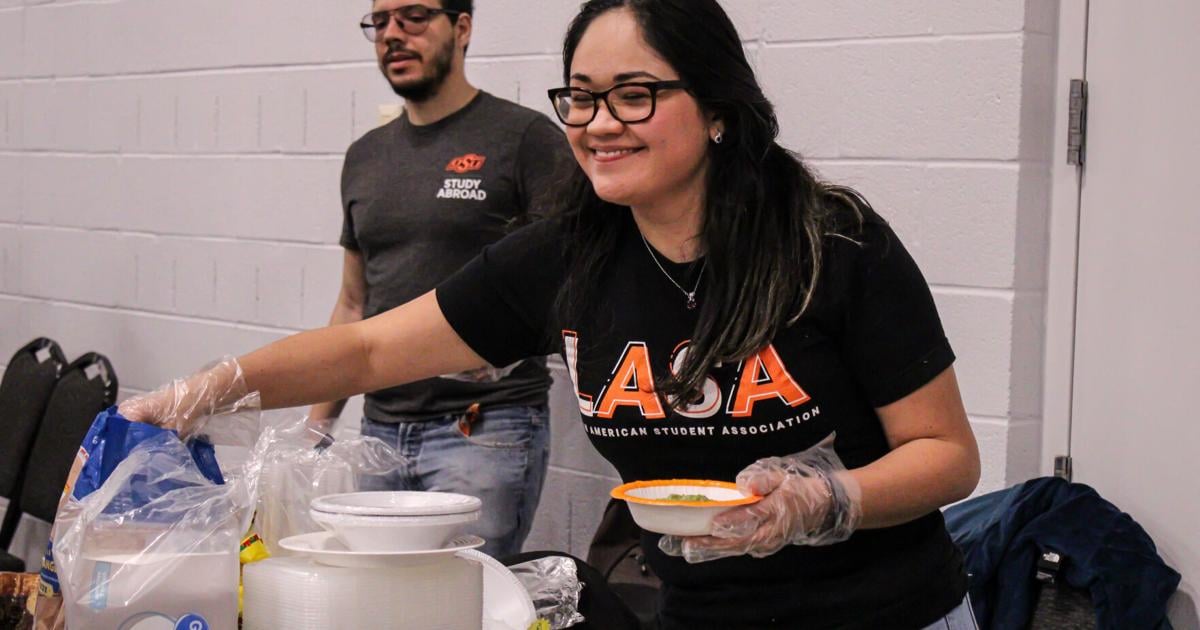
Foods ranged from the Bangladeshi students’ tandoori chicken to the Latino American students’ cheese empanadas. Lots of desert, too.

Within hours, the exhibit hall transformed into a multicultural kitchen.

Tim Huff, ISO’s adviser, said the event began more than three decades ago. It’s one of ISO’s five annual events and the purpose remains.

“It gives all these students a home,” Huff said. “They feel like they belong when they’re here. You can see them just relax and get into it. It’s very important to see the true nature and culture of these kids because they settle in here.”

Many of the foods appeared similar. Lots of chicken and different meats. But cultural differences appeared in the bite and the food’s preparation.

The Nepalese Student Organization sold about 750 momos, steamed dumplings filled with chicken and vegetables.

Niranjan Pokhrel, a horticulture master’s student from Nepal said the group started making the food at 6 p.m. Friday night. The job wasn’t finished until 3:30 a.m.

It’s no easy task.

“It takes a lot of effort to make that,” he said. “It’s also a skill thing. Not everyone can make it. We had some people’s friends and seniors were really good at making it.”

In Persian culture, kitchens are the realm of women, Yaser Shamsi, Iran native and doctorate student in OSU’s English department, said. Men perform tasks of manual labor such as moving large pots. But women make the food.

“Even looking at the way people celebrate things and the way people cook (are different),” Shamsi said. “You can cook the same ingredient when you just buy it from a shop like Walmart. But when it goes home and it goes through the process that happens in the kitchen, it is the culture, the background and the people that makes the final dish that you see here.”

His wife made most of the Iranian items, such as falafel.

“Having a community of Iranian people just makes me feel as if it’s not that far away from family,” Shamsi said. “OSU is really international friendly. This is one of the events that I really appreciate.”

OSU boasted 1,519 international students in fall 2022, according to OSU international student statistics provided to The O’Colly.

Mayank Talreja, a master’s student from India, represents OSU’s largest international community. The country’s 418 students make it OSU’s biggest international population.

The Indian Student Association also won the event’s best desert content with its kalakand, an Indian milk cake.

“That is what encourages us and gives me a motivation to do something for students,” Talreja said. “We help students transition their life from India to a new country here. It’s been great that a lot of friends are here from our country.”

ISO will also host its Culture Night on April 8 in the Seretean Center for the Performing Arts, another opportunity for OSU’s international students.

Taste of OSU returns, giving students opportunity to try international foods and watch cultural performances

Taste of OSU returns, giving students opportunity to try international foods and watch cultural performances

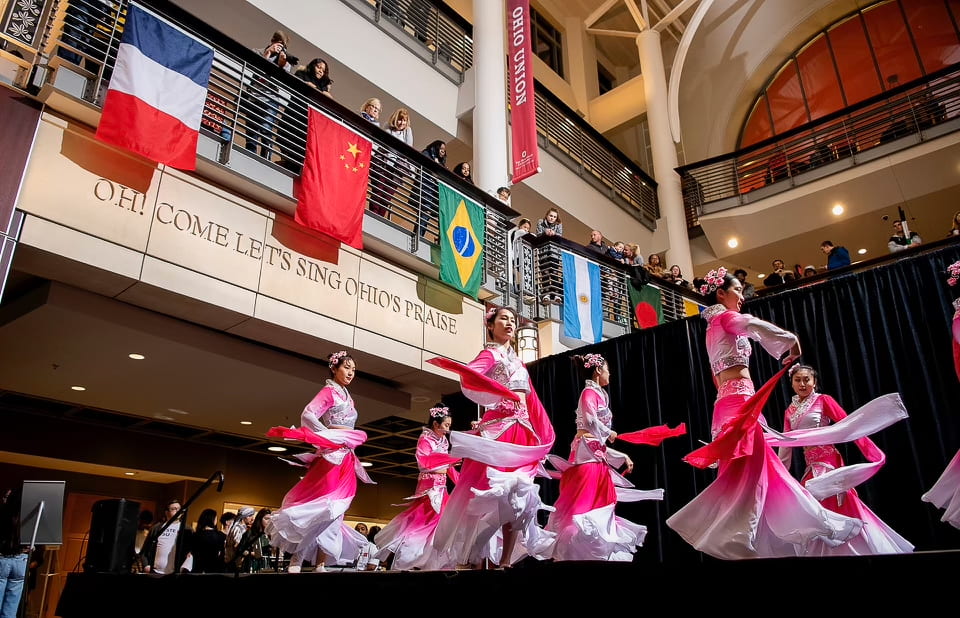
The Oriental Dance team performs inside the Ohio Union. Courtesy of Maureen Mille

Savor the flavor and spice up the weekend by participating in Taste of OSU Feb. 17. 

The revival of Taste of OSU, an event founded in 1997, since the start of the COVID-19 pandemic will give students the opportunity to celebrate their culture and experience others through international foods and cultural performances. The Office of International Affairs will host the event in the  Archie M. Griffin Ballroom within the Ohio Union from 5-8:30 p.m., according to the Taste of OSU website. 

The event is free and open to the public, but attendees must buy a $1 food ticket in order to try the food at different booths, according to its website.

When attendees enter the event, they will be greeted with a variety of uniquely decorated cultural booths, Maureen Miller, director of communications for the Office of Internal Affairs, said.

“They might decorate it with posters or flags. Some of them wear T-shirts and clothing representative of their home countries,” Miller said. “Some groups do interactive kinds of things. Some people will do henna, some groups will write your name in their language.”

Each booth typically has two different foods for attendees to try, Mia Miller, student chair of Taste of OSU 2023 and a fourth-year in international studies, said. These would include a type of “rice and then some dessert or whatever they’ve chosen that they think represents their culture.” 

Students can expect to see food and cultural booths from organizations — including the Korean Student Association, Brazilian Students Association and Lebanese Student Organization —will host food and cultural booths. There will be performances by the Aloha Dance Club, Indian Students Association, Salsa Club and more, according to its website.

Since many current students and organizations were unaware of the event, Maureen Miller said she hoped to start reintroducing Taste of OSU slowly by having fewer organizations involved and by only hosting the event in the ballroom.

“Many of the students who have participated in Taste of OSU before had graduated, so we thought we’d bring it back a little bit slowly,” Maureen Miller said. “So, this year, we have 15 international student organizations cooking food, and we have about 20 cultural performances.”

The event is open to anyone, not just Ohio State students, Mia Miller, who attended Taste of OSU before enrolling, said. 

“​​I got to see the celebration and all of the events and everything in its full glory, you could say, because back then there were about 4,000, 3,000 people coming.” Mia Miller said. “It opened to the whole [Columbus] community with 30 student groups.” 

Maureen Miller said before its absence, Taste of OSU had become a popular attraction on campus.

“Right before the pandemic hit, and at that moment in time, Taste of OSU really took over the Ohio Union,” Maureen Miller said. “We had the food and the performance hall and in the ballroom, and then a stage was set up in the atrium area, so everyone could watch the performances right there on the first floor and then all around the balcony on the second floor.

Alison Lee, a fourth-year in biology, participated in the event in 2020 as a volunteer photographer. She’ll now experience Taste of OSU as the president of the Taiwanese American Student Association. 

“I think I’ll get a different perspective because I will be training, cooking and serving food the day of, so I’ll be the one that’s more interacting with a guest,” Lee said. 

Lee said Taste of OSU brings the diversity on Ohio State’s campus together and celebrates it, which is why she decided to participate again in the revival. 

“I’m really passionate about culture and diversity and try to promote that on campus,” Lee said. “So, I think Taste of OSU does that perfectly to showcase the diverse culture that exists on OSU’s campus.”

Food tickets can be purchased ahead of time beginning  Feb. 14, or the day of the event. 

Food in Sicily students explore Sicilian culture, experience tasting and making local foods

Food in Sicily students explore Sicilian culture, experience tasting and making local foods

Learners interested in the Meals in Sicily study away program, scheduled for May possibly 10-31, 2023, are invited to go to an approaching info session on Microsoft Groups.

Members in the analyze abroad expertise can generate 6 Ohio College credits, study about the lifestyle of food stuff in Sicily, and get arms-on practical experience tasting and creating Sicilian dishes.

“Like ice product, cheesecake, and chocolate? What about marzipan, cannoli, and sumptuous pasta? Then, come practical experience the cultural and historic foods methods of Sicily, the Mediterranean’s largest island. We are going to travel Sicily’s jap ‘Greek’ coast to see and taste this special island’s abundant record of food items traditions. You may perhaps even meet the Chef’s Desk star even though browsing Caffè Sicilia in Noto, Sicily,” explained Meals in Sicily Director David Bell, Ph.D., chair and associate professor of linguistics in the College or university of Arts and Sciences.

Intrigued students are invited to join an details session by using Teams at just one of the adhering to dates and times:

  • Wednesday, Jan. 18, at 7:30 p.m.
  • Tuesday, Jan. 24, at 7:30 p.m.
  • Thursday, Feb. 2, at 7:30 p.m.
  • Monday, Feb. 6, at 7:30 p.m.
  • Wednesday, Feb. 16, at 7:30 p.m.
  • Tuesday, Feb. 21, at 7:30 p.m.
  • Monday, Feb. 27, at 7:30 p.m.

Learners Master How to Make Sicilian Dishes

In addition to understanding about wine, olive oil, chocolate, and cheese, a person of the a lot of activities on the Meals in Sicily program is cooking. Learners in will understand how to make two regular Italian dishes: cavateddi al ragù and arancini.

Generating Cavateddi al Ragù


Enjoying their work making cavateddi al ragù, from bottom left: Theresa Moran, Susi Kimbell (director of the Exedra Center), Emily Jones, Sidnie Kiligour, Sefi Monterosso (Exedra Center staff), Jackie Augustine, Lauren Hates, Marco Messina (Exedra Center staff), David Bell, Faith McLaughlin, Maya Roth-Wadsworth, and Emily McCarty.
Making the most of their perform earning cavateddi al ragù, from base left: Theresa Moran, Susi Kimbell (director of the Exedra Heart), Emily Jones, Sidnie Kiligour, Sefi Monterosso (Exedra Middle staff members), Jackie Augustine, Lauren Hates, Marco Messina (Exedra Center team), David Bell, Faith McLaughlin, Maya Roth-Wadsworth, and Emily McCarty.

Cavateddi al ragù is made from cavati, or cavateddi in Sicilian, and tomato sauce. During a new Foods in Sicily software, students gathered at the Exedra Heart in the heart of Ortigia to make the pasta.

“The position is to clearly show how the most straightforward of substances — flour and h2o — can be turned into some thing delicious and healthy. This is the essence of cucina povera, the delicacies of the poor,” mentioned Theresa Moran, a Foods in Sicily college member.

The students had been led in the pasta producing practical experience by Exedra workers member Sefi Monterosso, who showed the students how to make a mound of flour and with even handed drops of water, switch it into a dough, then start to roll and knead it. College students watched Monterosso expertly get up a ball of dough in her arms and then slam it down onto the kitchen area table.

“This a great way to get rid of all your frustrations and anxieties,” Monterosso explained as she pounded the ball of pasta onto the desk, kneading it with the heel of her hand, lifting it, and then hurling it back again down on the table. “This is also essential to establish up the gluten so the pasta isn’t flabby,” she mentioned.

Immediately after loads of kneading, when the dough was sleek, tender and very a little puffy, the learners started rolling out the pasta. They very first slice the dough and then rolled pieces of it out into worms or snakes. Then, they slice the dough snake into shorter parts, utilizing the knuckle on their thumb as a rough measure. Getting a fork, the students swiftly rolled the compact parts a single by a single down the the tines on the again of the fork, collecting them into awaiting platters. The brief parts of dough stop up generating a condition vaguely resembling a pill, roly-poly, or potato bug.

For Monterosso and the other Sicilian staff members, who have been making this pasta for many years, each individual minimal piece of dough is lightly, immediately and efficiently pressed down the back again of the fork and with a flick of the wrist, sent on to the platters. College students usually push the dough as well challenging, and the pasta then does not curl and gets too deeply grooved.

After the college students concluded building the cavateddi, they tossed the pasta briefly with flour to preserve the individual items from sticking. The pasta was then dropped into a big cauldron of boiling water and boiled briefly.

When the pasta pops up to the area of the h2o, it’s time to drain and dress the pasta. First, the pasta is tossed with a minor extra virgin olive oil and then the dish is dressed with a basic crimson sauce created from community tomatoes. Listed here is wherever the grooves from the fork tines are important—the sauce clings to the individual grooves in each and every piece of pasta. Matching the suitable pasta shape to the correct variety of sauce is an critical component of Italian cooking, and the cavateddi go perfectly with the easy sauce of regional tomatoes, garlic, parsley, and chilies, Moran pointed out.

For the remaining contact, the students sprinkled the pasta with grated cheese. Commonly ricotta salata, a usual really hard Sicilian cheese, created from fresh ricotta cheese that is pressed, salted, dried, and aged for 30 times or more, is utilised, Moran included.

Producing Arancini

On the left, Faith Laughlin, Emily McCarty, Liza Gildemeister, Lauren Hayes, Jackie Augustine, and Sefi Monterrosso. On the right, Jackie Augustine and Sefi Monterosso roll the arancini in breadcrumbs while Liza Gildemeister watches with Lauren Hayes in the near foreground.
On the remaining, Faith Laughlin, Emily McCarty, Liza Gildemeister, Lauren Hayes, Jackie Augustine, and Sefi Monterrosso. On the proper, Jackie Augustine and Sefi Monterosso roll the arancini in breadcrumbs while Liza Gildemeister watches with Lauren Hayes in the around foreground.


Arancini are rice balls, just one of the most prevalent Sicilian street food items treats eaten at any time of the working day.  The singular kind is arancino, a diminutive of the term arancia, which indicates “orange,” derived from the classical Arabic word for orange, naranj. Arancini, also identified in Rome as supplì, is a dish that can be traced back again to the Arab conquest of Sicily. These rice balls can be filled with cheese, meat and peas in pink sauce, ham, mushrooms, zucchini, and even with a sweet filling this kind of as a pistachio product.

Arancini also signify an crucial cultural rivalry amongst the western Arab influenced element of the island and the japanese Greek motivated aspect. In Palermo, in western Italy, the rice balls are normally formed like oranges and are termed arancine, applying the feminine plural marker (arancina or arancinu in the singular). In Catania, in jap Italy, normally the rice balls are shaped into triangles like the Sicilian volcano Mount Etna, and their grammatical gender is masculine.

As with all cooking days at the Exedra Centre, pupils in a modern Food items in Sicily working experience commenced by scrubbing their arms and forearms. Then large platters of steaming rice were being brought out, and the learners yet again acquired from Monterosso and the other Exedra staff members, for whom building these rice balls is component of their usual practical experience developing up in Sicily.

To make arancini, first make a little half dome ball in 1 palm and then cautiously insert the filling of choice in the middle of this ball. Fillings can be cubes of ham or cheese or a tablespoon of meat in red sauce. The plan is not to incorporate far too much filling — and not to have also much rice. Then put rice on major of the filling.

The college students practiced cupping their hands collectively and pressing firmly to compact and condition the rice to the perfect shape.

After the rice ball is designed, it is rapidly rolled in a slim flour slurry and then rolled in pretty good breadcrumbs made from Sicilian bread. The arancini are then taken to the kitchen the place they are deep-fried in a vat of olive oil. As quickly as they are browned all around, they are eradicated and put out on towels to soak up the excessive oil — and then eagerly grabbed as a scrumptious rapid lunch or sizzling snack.

“The trick to taking in arancini,” Moran mentioned, “is waiting right up until they are just at the correct temperature so that you can bite via the thin crispy rice shell into the delightful heat handle in the heart.”

Food in Sicily Analyze Absent Program

Food items in Sicily is a college-led software for Ohio College credit. In OHIO study absent courses, college students gain OHIO credit history, choose programs with other OHIO college students and are taught by OHIO school. A student’s fiscal help package deal applies the very same as it would for on-campus courses.

Foodstuff in Sicily is open up to undergraduate and graduate pupils, and learners can earn 6 credit hrs whilst studying how to make mozzarella, training Italian with a “Table and Market” conference with neighborhood social enterprises, supporting with dinners at a neighborhood soup kitchen area, having cooking classes, and going to farms, breweries and wineries. (For further facts see the articles on Singing, Dancing and Churning the Cheese in Sicily in the course of the 2019 excursion, and Foodstuff in Sicily students experience how support modifications people’s lives and  Foods in Sicily pupils explore the ability of community resilience in the course of the 2022 vacation).

Visits to marketplaces and web sites in Ortigia, Italy, include the Catacombs of San Giovanni, the medieval Jewish quarter and Castello Maniace. Day excursions are planned to Catania, Italy, in which college students will stop by the fish current market, historic town middle, Benedictine Monastery, Greek Theater and Cathedral. Students also will hike on Mt. Etna and get pleasure from time on Sicilian beach locations, as perfectly as tour the historic towns of Noto and Taormina

For a lot more details, stop by the Foodstuff in Sicily webpage or contact Bell at belld@ohio.edu.

Study away badge
See additional about Experiential Learning at OHIO.

College of Ag Sciences students taste Greek cuisine and culture on trip

College of Ag Sciences students taste Greek cuisine and culture on trip

College PARK, Pa. — Students in Penn State’s University of Agricultural Sciences explored Greece’s rich culture — and its meals — whilst finding out abroad in Thessaloniki, Greece, this summertime.

Furnishing this chance to Penn Point out learners was essential to Chris Sigler, assistant training professor and educational adviser in the Department of Meals Science. His goal was to aid his food items science students grow their experiences outside the classroom and produce networking options.

“I consider that when students seem again on their college occupations, they should really come to feel that people courses broadened their encounter and understanding of what they are studying,” Sigler claimed.

With aid from the college’s Undergraduate Schooling and Ag Sciences Worldwide places of work, Sigler worked with Helen Yarenis, review overseas coordinator of advertising and marketing and communications for Perrotis School — component of the American Farm College in Thessaloniki — to make it possible for Penn Point out college students to generate credit history when getting portion in a six-7 days research overseas plan hosted by Perrotis.

College students could take two classes — “Mediterranean Diet” or “Greek Wine Organization” — or participate in an internship or exploration. They also studied Greek tradition and language and visited historical sites, this kind of as Mount Olympus and the Parthenon, and regular web pages, which includes a mussel farm and a cherry competition. And, of study course, they acquired how to make common Greek food.

Lauren Wolf, a 2nd-year food items science major, opted for the Mediterranean Diet plan study course. She reported heading on excursions and subject visits throughout Greece authorized her to acquire palms-on experience.

A person of the most appealing points Wolf figured out for the duration of her excursion abroad, she mentioned, was how significant the agriculture marketplace is in Greece. Furthermore, she learned about the well being gains of seafood and its job in the Mediterranean diet plan.

She also discovered that her time overseas allowed her to hook up with fellow Penn Staters and fulfill students from other universities, which served her to be more open up to new experiences.

“Studying overseas assisted develop my independence as a result of touring to Greece,” Wolf stated. “Also, I truly feel it is aided me turn into extra outgoing and link with other folks.”

Catarina Rodrigues, a 3rd-calendar year food items science big, is intrigued in products development and selected to do investigate at Perrotis that focuses on the solution growth of gluten-absolutely free and dairy-free snacks. She and her spouse baked foodstuff and analyzed their water activity, colors, textures and other properties.

“People would come for taste tests and tell us their beloved samples,” Rodrigues reported. “I just remember sensation so thrilled at that second, just doing some thing that was meals science-relevant, which restored my assurance in picking my big.”

The expertise also enabled them to meet foods science majors from other universities, which includes Ohio State, Purdue, College of Illinois Urbana-Champaign, Texas A&M and Virginia Tech.

“They now get to learn what it is like to fulfill other foodstuff scientists — simply because foodstuff science is a really little field — and they have the option to get started networking and collaborating with other pupils from diverse universities, who could possibly be pupils they end up doing the job with in the industry in the upcoming,” mentioned Sigler.

Sigler ideas to operate with Perrotis University to increase the software. He also plans to direct a modest group of learners again to Perrotis as component of an embedded spring system, Food stuff Science 460: Worldwide Food stuff Output.

“Global engagement is crucial to reinforce interpersonal capabilities and broaden international viewpoint,” claimed Ketja Lingenfelter, assistant director for university student global engagement for Ag Sciences Worldwide. “International immersion and palms-on activities not only enable college students to obtain skills not ordinarily made in a classroom but also to discover facets of their prospective occupations on a international degree.”

This training course supports the college’s Sustainable and Obtainable Examine Abroad initiative, which encourages learners to incorporate sustainable techniques into their analyze abroad encounters and can make finding out overseas available to all college students.

Even further details about review overseas opportunities via the University of Agricultural Sciences is readily available by making contact with Lingenfelter at ketja@psu.edu or by checking out agsci.psu.edu/students/research-overseas.


8 recipes for helping college students learn to cook

8 recipes for helping college students learn to cook

I lived in a dorm all 4 decades of college, relying on a meal strategy to feed me in concerning all my classes, researching and several hours put in toiling in the basement office of the college newspaper. I just didn’t have time to cook dinner, and the messy absolutely free-for-all that was the shared dorm kitchen did not enable.

In retrospect, I would like I’d been a tiny more motivated to cook dinner in school, especially once I graduated and realized I experienced some catching up to do. For pupils who stay off campus or determine they don’t want dining corridor food items, that requirement comes substantially sooner.

How to get young ones to eat a healthy lunch? Give them some command.

That is not to say they have to be geared up to make multicourse, elaborate foods. But if you or a cherished one are getting ready to head off to college, contemplate generating an exertion to master a handful of effortless, versatile back-pocket recipes that are just the issue to make cooking self-confidence. Right here are examples from our Recipe Finder that I endorse.

One-Pan Roast Rooster and Potatoes, over. This is one particular of the quite very first recipes I shared on Voraciously, and it’s rookie-welcoming. All you will need is a sheet pan, a several ingredients and tolerance to make a fulfilling, homey meal that will fill your house with wonderful aromas. Bonus: Any extra rooster can be spun off into a large wide variety of toss-alongside one another foods.

Basic Folded Omelet. Omelets are thrifty, rapid, customizable and suitable food stuff for any time of working day. This cross involving French and diner designs is quick to fill with regardless of what you want.

How to make great scrambled eggs, just the way you like them

Superior Than Takeout Fried Rice. School pupils operate on takeout, among other matters, so be absolutely sure all that extra rice is put to excellent use. You can even freeze leftovers until you have sufficient for a new meal. Frozen veggies and other pantry staples make this a prepared-when-you-are recipe.

Gochujang Skirt Steak. Skirt steak “has all the items going for it that we look for for a midweek dinner: minimum prep, lightning-rapidly cooking, major flavor and a reasonable rate tag,” recipe developer Ali Slagle writes. All those issues are perfect for pupils. Other than salt and pepper, all you require for this recipe are the steak, honey, oil and gochujang, a Korean fermented chile paste that will past a though in the fridge and is uncovered at a lot of supermarkets these days.

The essential to weeknight steak evening meal is fast-cooking skirt

Rapid Blender Tomato Soup With Cheese Crisps. All right, so possibly there is a blender in the kitchen area for frozen beverages. Give it even far more use with a uncomplicated, comforting soup which is just begging to be served with grilled cheese (feel absolutely free to skip the cheese crisps, which are just baked rounds of grated cheese).

How to make a much better grilled cheese: 7 ideas for a cheesier, crispier, far more flavorful sandwich

Spaghetti Carbonara. Guaranteed, you can pour a retail store-purchased sauce over pasta, no judgment below. But if you want to take your pasta to the upcoming degree — or maybe present off for another person — consider this typical Italian dish that is generally just tacky spaghetti with crisped meat. You get a great wow factor devoid of a great deal of effort or time.

No Food items Processor Hummus. Tubs of keep-purchased hummus in all probability lurk in a lot of scholar fridges. Even if you don’t have a food items processor or want to cook dinner the beans from scratch, you can however make this multipurpose dip. (But if you want to find out how to make a pot of beans, we can help with that, far too.) In this article, a rolling pin — or wine bottle! — and whisk assist pull it alongside one another.

How to make the greatest, easiest hummus, beginning with a can of chickpeas

All-Function Muffins. If there’s a risk of expending way too significantly cash at the campus espresso shop on meh pastries, take into consideration investing in an economical muffin tin for this recipe by yourself. You only want just one bowl for these tender, fluffy muffins that are ideal for breakfast on the go or an afternoon snack. Really feel cost-free to use whichever combine-ins you want and enjoy about with unique flours.