Gretchen’s table: Chilaquiles verde is a magical Mexican breakfast
Updated

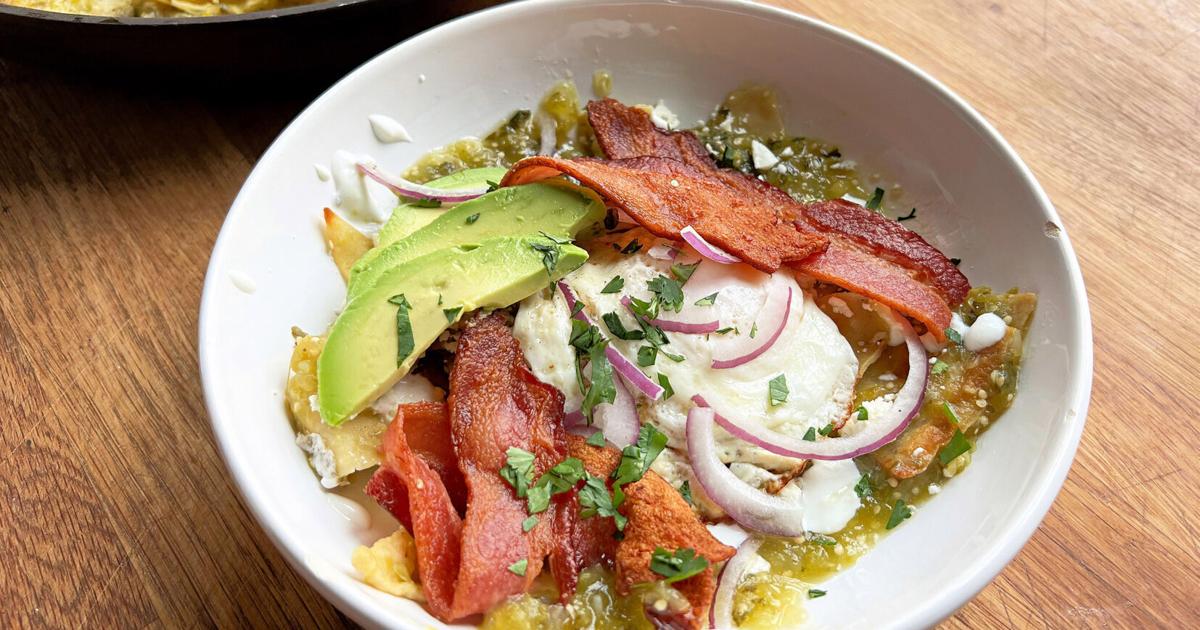
Chilaquiles verde topped with bacon and avocado at Provisions Local Kitchen in Driggs, Idaho. (Gretchen McKay/Pittsburgh Post-Gazette/TNS)
For a food writer, one of the best things about going on vacation is not having to cook every day, all day. Then again, because your world revolves around testing recipes, vacation also can mean work because if you go somewhere new and exciting, you’re bound to eat a dish or two you’ll want to re-create when you get home.
At least that’s what happened to me on a recent trip to Jackson Hole, Wyoming. Midweek during our trip, my husband and I braved the snowy Teton Pass into Idaho in my sister’s SUV so we could spend a few hours snowshoeing at the Grand Targhee Resort. Famished after clomping atop the (very deep and very packed!) snow, we stopped at The Provision Kitchen in the tiny town of Driggs for a little well-earned apres ski before heading back up the pass to Wyoming. I love anything with salsa verde, so the restaurant’s chilaquiles immediately caught my eye.
If you’ve never had it, chilaquiles is a traditional Mexican breakfast offering in which totopos — corn tortillas that have been cut into quarters and fried — are smothered in green or red salsa, then topped with garnishes such as queso fresco, black or refried beans, onion, fried or scrambled eggs and sliced avocado. It’s hearty, incredibly flavorful, pretty to look at and for the cook, super easy to make.
A cross between nachos and enchiladas, the dish is thought to date back to the time of the Aztecs, though an actual recipe didn’t appear until 1898, in Encarnacion Pinedo’s “The Spanish Cook.” It’s a great way to use up leftover tortillas or tortilla chips that would otherwise go to waste.
Served at The Provision Kitchen as a breakfast dish, mine came with a couple crispy pieces of bacon and an over-easy egg. Chorizo or pulled chicken or pork or beef barbacoa are other common toppings.
If you prefer red sauce, substitute about 1 1/2 pounds of tomatoes for the tomatillos, and add 1 1/2 cups chicken or vegetable broth after they’ve been boiled and pureed/ Then fry it in a couple tablespoons of oil for a few minutes to thicken.
CHILAQUILES VERDE

Chilaquiles verde topped with bacon and avocado at Provisions Local Kitchen in Driggs, Idaho. (Gretchen McKay/Pittsburgh Post-Gazette/TNS)
PG tested
For sauce
- 1 pound tomatillos, husked and rinsed (about 10 medium-large)
- 2 or 3 jalapeños, stemmed and seeded
- 1/2 medium white onion
- Large handful fresh cilantro, coarsely chopped
- 2 cloves garlic
- Juice 1/2 lime
- Kosher salt
For bowl
- 12 corn tortillas
- 4 tablespoons vegetable oil, for frying
- For serving
- 1/2 cup canned black beans, drained and rinsed
- 1/4 cup sour cream, thinned with a little lime juice
- 1/2 cup queso fresco
- 4 fried or sunny-side up eggs
- 1/2 red onion, thinly sliced
- 8 sliced crispy fried bacon
- 1 avocado, seeded and thinly sliced
Make sauce: Place tomatillos, jalapeños and onion in a large saucepan or Dutch oven and add enough water to completely cover. Bring to a boil over medium-high heat, then reduce heat to low and simmer until vegetables are cooked through and soft, around 8-10 minutes. (Tomatillos will change color from bright to pale green.)
Transfer tomatillos, jalapeños and onion to a blender using a slotted spoon. Add cilantro, garlic, lime juice, and a generous pinch of salt and blend until smooth. Taste and add more salt or lime juice if desired. Set aside.
Stack tortillas on top of each other and cut into eighths. Heat oil in a large frying pan, then fry wedges until brown and crispy. Drain on a paper towel-lined plate, then place back into the pan.
Pour salsa verde on top, and toss gently to combine.
Portion tortillas into four bowls and top each with equal amounts of black beans. Drizzle sour cream on top, followed by equal amounts of queso fresco. Garnish each bowl with a fried or sunny-side up egg, sliced onion, 2 slices bacon and sliced avocado.
Serve immediately.
Serves 4.
— Gretchen McKay, Post-Gazette
EatingWell: Hearty breakfast skillet comes together in one pan
Updated

Boost your veggie count for the day.
One skillet is all you need to create this satisfying, veggie-loaded breakfast (or dinner) dish. This skillet is packed with mushrooms, bell pepper and chard to help up your veggie count for the day and is topped with bacon, eggs, cheese, pico de gallo and fresh cilantro.
Southwest Breakfast Skillet
Serves 4
Active Time: 35 minutes
Total Time: 35 minutes
- 4 strips center-cut low-sodium bacon (4 ounces)
- 12 ounces Yukon Gold or red potatoes, scrubbed and cut into 1/2-inch pieces
- 1/4 cup water, plus more if needed
- 8 ounces white button mushrooms, diced
- 1 medium red, orange or yellow bell pepper, diced
- 1/2 small red onion, diced
- 1/4 teaspoon salt, divided
- 1/4 teaspoon ground pepper, divided
- 4 cups Swiss chard, stemmed and thinly sliced (from 1 bunch)
- 1 clove garlic, minced
- 4 large eggs
- 1/2 cup shredded cheddar cheese
- 1/4 cup chopped fresh cilantro
- 1/4 cup prepared salsa or pico de gallo
1. Cook bacon in a large nonstick skillet over medium heat, flipping once, until crispy, 5 to 7 minutes. Transfer the bacon to a paper-towel-lined plate. Pour off all but 2 teaspoons of the bacon fat.
2. Return the pan to medium heat. Add potatoes and cook, stirring often, for 2 minutes. Add water; cover and steam for 5 minutes, stirring once halfway through. Add mushrooms, bell pepper, onion, and 1/8 teaspoon each salt and pepper; cook, stirring occasionally, until the vegetables are tender, about 5 minutes. Stir in chard and garlic; cook until the chard is tender and wilted, about 2 minutes more. Crumble the bacon and stir into the mixture.
3. Spread the mixture evenly in the pan. Using the back of a wooden spoon, make 4 indentations. Crack 1 egg into each indentation. Season with the remaining 1/8 teaspoon each salt and pepper. Cover and cook until the egg whites are set, about 5 minutes.
4. Remove from heat and top with cheese, cilantro and salsa (or pico de gallo).
Tasty tip: Cracking each egg into a small bowl before adding to the skillet makes it easier to remove any unwanted shell.
Recipe nutrition per serving: 341 Calories, Total Fat: 20 g, Saturated Fat: 4 g, Cholesterol: 200 mg, Carbohydrates: 23 g, Fiber: 3 g, Total Sugars: 4 g, Protein: 17 g, Sodium: 602 mg, Vitamin A: 3721 IU.
(EatingWell is a magazine and website devoted to healthy eating as a way of life. Online at www.eatingwell.com.)
The Kitchn: Brown sugar cornmeal waffles transport me back to my grandmother’s kitchen
Updated

Homemade waffles get an upgrade with light brown sugar and yellow cornmeal.
Over the years, there have been varying stories about the origins of chicken and waffles. Many believe that the infamous duo made its debut in the 1930s at the Harlem-based restaurant Wells Supper Club. For me, however, my love for the dish began in the late ’90s, and it is one that has made a lasting impact on the way I view food.
I can still remember my first time tasting a cornmeal waffle covered in a blanket of butter and syrup. I was sitting at the end of my grandmother’s kitchen table, enjoying the soulful noise coming through her record player, when she introduced the distinct blend of sweet and savory flavors married into a delicious waffle. At that moment, I’d found a dish that I knew I’d find comfort in for years to come.
I was born and raised in Georgia, where I could find a Waffle House on just about any corner. With its cheap prices and easy accessibility, one can understand how such strong affinity has been built up for the brand. I myself am a person who enjoys their fair share of Waffle House on any given day of the week, but sometimes, making waffles at home just feels and tastes so much better.
Whether I’m enjoying them for breakfast, brunch, or, in some cases, dinner, waffles have been a favorite recipe of mine to play around with. As of late, these brown sugar cornmeal waffles have become my favorite version of the classic dish because they remind me of time I spent with my grandmother when I was a kid. Brown sugar provides the waffles with a caramel-like sweetness that reduces the amount of syrup you’ll need to drizzle on top. And the cornmeal gives it both a nice crunch and toasty flavor. But the best part? They’re easy to make and are perfect for any occasion.
Brown Sugar Cornmeal Waffles Recipe
Makes 7 to 8 (about 7-inch) thin waffles
- 8 tablespoons (1 stick) unsalted butter
- 1 1/4 cups all-purpose flour
- 3/4 cup finely ground yellow cornmeal
- 1/2 cup whole buttermilk
- 2 large eggs
- 2 tablespoons packed light brown sugar
- 2 teaspoons vanilla extract
- 2 teaspoons baking soda
- 1 teaspoon baking powder
- 3/4 teaspoon kosher salt
- Cooking spray
- Fresh berries, for serving (optional)
1. Cut 1 stick unsalted butter into a few pieces, place in a small microwave-safe bowl, and microwave on high until melted, 40 to 60 seconds. (Alternatively, melt on the stovetop over low heat.) Set aside to cool slightly while you heat a waffle iron for medium heat.
2. Place the melted butter, 1 1/4 cups all-purpose flour, 3/4 cup finely ground yellow cornmeal, 1/2 cup whole buttermilk, 2 large eggs, 2 tablespoons packed light brown sugar, 2 teaspoons vanilla extract, 2 teaspoons baking soda, 1 teaspoon baking powder, and 3/4 teaspoon kosher salt in a large bowl and whisk until combined; the batter will be quite thick.
3. When the waffle iron is ready, coat with cooking spray, then pour in the amount of batter recommended by the manufacturer, about 1/2 cup for a (7-inch) thin round waffle. Close the lid and cook until the waffle is golden-brown. When the waffle is ready, remove from the iron to a wire rack.
4. If not serving immediately as they are made, place directly on a rack in a 200 F oven to keep warm. Repeat making waffles with the remaining batter. Serve with fresh berries.
Recipe notes: The waffles can be refrigerated in an airtight container for up to five days or frozen for up to two months. Reheat directly on a rack in a 350 F oven until heated through, 4 to 6 minutes if refrigerated, or 10 to 12 minutes if frozen.
(Choya Johnson is a contributor to TheKitchn.com, a nationally known blog for people who love food and home cooking. Submit any comments or questions to editorial@thekitchn.com.)
EatingWell: Enjoy this potato ‘pancake’ at breakfast, lunch or dinner
Updated

Cut into wedges to serve.
Preshredded potatoes for the rösti are the key to making this crisp pancake quickly. Top with fried eggs and a salad and it becomes a meal.
Asparagus & Potato Rösti
Serves 4
Active Time: 10 minutes
Total Time: 30 minutes
- 3 tablespoons extra-virgin olive oil, divided
- 8 ounces asparagus, trimmed and cut into 2-inch pieces
- 1/2 teaspoon salt, divided
- 1 tablespoon butter
- 1 pound frozen shredded potatoes
1. Heat 1 tablespoon oil in a medium nonstick skillet over medium heat. Add asparagus and 1/4 teaspoon salt. Cook, stirring, until tender, about 3 minutes. Add butter and potatoes; stir to combine. Press the mixture gently into a single layer. Cook until crispy on one side, about 10 minutes.
2. Slide the rösti onto a clean plate. Drizzle the top with the remaining 2 tablespoons oil, then invert into the pan so the crispy side is up. Cook until crispy on the other side, 8 to 10 minutes more. Slide onto a serving plate and sprinkle with the remaining 1/4 teaspoon salt. Cut into 6 wedges.
Recipe nutrition per serving: 206 Calories, Total Fat: 13 g, Saturated Fat: 3 g, Cholesterol: 8 mg, Carbohydrates: 19 g, Fiber: 2 g, Total Sugars: 1 g, Protein: 3 g, Sodium: 305 mg, Potassium: 62 mg, Iron: 2 mg, Folate: 16 mcg, Calcium: 8 mg, Vitamin A: 316 IU, Vitamin C: 14 mg.
(EatingWell is a magazine and website devoted to healthy eating as a way of life. Online at www.eatingwell.com.)
Seriously Simple: Surprise your mom with these light and fruity ricotta pancakes
Updated

Whether you call these flapjacks, hot cakes or griddle cakes, they are part of a sunny meal on a special day.
Brunch is my favorite meal on Mother’s Day. It’s the day we can leisurely sit around the table, relax and just enjoy the moment. This year I’m making these delectable pancakes for my daughter, husband and our new grandson. I can’t wait to see his face when he tries them.
Whether you call these flapjacks, hot cakes or griddle cakes, they are part of a sunny meal on a special day. These heavenly fluffy hot cakes are lightened up by incorporating ricotta cheese and whipped egg whites into the batter. I enjoyed making all sorts of pancakes when my daughter was young. And now I can make them for the next generation.
These sophisticated pancakes include creamy ricotta that creates an airy sweetness, while the addition of whipped egg whites folded into the batter produces a moist and light result. I like the addition of orange zest for a touch of citrus. Some crisp bacon or sausage is all you need to make this an unforgettable Mother’s Day. For brunch, accompany these pancakes with a crisp, fruity Johannesburg riesling, a spicy gewürztraminer or Champagne.
Pancakes skills that will make you a pro
- Combine the dry ingredients with the wet ingredients until they are just blended. Working the batter for too long will cause the pancakes to be tough.
- Use a large non-stick skillet or flat griddle.
- Heat the pan and then add the butter to it. Make sure there is not too much butter, or the pancakes will be oily.
- Use a measuring cup with a spout or a ladle to avoid spilling.
- Pour the batter slowly, as it will spread.
- Cook the first side until tiny bubbles appear across the pancake. Flip the pancakes and cook until golden brown on both sides.
Ricotta Pancakes with Roasted Blueberry Sauce
Serves 4
For the blueberry compote:
- 18 ounces fresh blueberries, cleaned
- 2 tablespoons brown sugar
- 2 tablespoons unsalted butter, cut into small pieces
- 1 teaspoon orange zest
- 1/4 teaspoon ground cloves
- 1/4 teaspoon cinnamon
For the pancakes:
- 4 large eggs, separated
- 1 cup low-fat ricotta cheese
- 2 tablespoons sugar
- 1 tablespoon finely chopped orange zest
- 1/2 cup all-purpose flour
- Pinch of salt
- 4 tablespoons unsalted butter (for cooking the pancakes)
For the blueberry topping:
1. Preheat the oven to 375 F.
2 Place the blueberries in a medium baking dish. Sprinkle the brown sugar, butter, orange zest and spices over the blueberries and mix to combine. Roast until the blueberries begin to burst, and the juice is syrupy, about 20 minutes. If they overcook, they will break down and turn into syrup with little texture so be careful.
3. Let cool for about 10 minutes. Meanwhile make the pancakes.
For the pancakes:
1. Combine the egg yolks, ricotta, sugar, orange zest and flour in a medium bowl and whisk until well combined.
2. In a large bowl with an electric mixer combine the egg whites and a pinch of salt and beat on medium speed until the egg whites are stiff but not dry.
3. Add one third of the egg whites to the pancake mixture and fold them in gently. Fold in the remaining egg whites, making sure no white streaks are left in the batter.
To cook and serve the pancakes:
1. Heat 2 tablespoons of the butter in a large griddle or saute pan over medium heat. Pour in about 1/4 cup batter for each pancake and cook for about 2 to 3 minutes on each side or until lightly browned. Add more butter as necessary.
2. Serve the pancakes immediately with a large spoonful of roasted blueberry topping. You can also serve these with some warm maple syrup if you like.
Make ahead: Make the blueberry topping up to one day ahead, cover and refrigerate. Reheat gently before serving.
(Diane Rossen Worthington is an authority on new American cooking. She is the author of 18 cookbooks, including “Seriously Simple Parties,” and a James Beard Award-winning radio show host. You can contact her at www.seriouslysimple.com.)
5 recipes to usher in spring brunch season
Updated
After a winter of heavy dishes, it’s time to lighten things up with herb-filled quiches, frittatas and citrus.
Since Mother Nature missed the memo that spring has arrived, it’s time to take matters into our own hands. And there’s no better place to usher in a new season than the kitchen.
Bid a fond farewell to the heavy stews and sauce-laden comfort food that got us through a trying winter. We need to lighten up.
Easter was just the first occasion of a spring filled with special occasions — bridal showers, Mother’s Day, graduations — and brunch is one of our favorite ways to celebrate. While we always have our go-to dishes (is it even a brunch without ham?), we’re also ready to try something new.
Fresh herbs take center stage in frittatas and quiches, while peas and asparagus remain a match made in culinary heaven. Both kids and adults will enjoy vegetable-filled egg bites, which you can and should tailor to your own tastes, and adding bacon to deviled eggs will make them fly off the plate even faster than usual. Because we’re not quite ready to entirely do away with comfort food, start the morning out with orange-kissed sweet rolls that appeal to our nostalgic side, but without the stress of working with yeast dough. We’re feeling better already.
Add bright-colored napkins and a bouquet of tulips, daffodils or daisies, and it’s officially spring. If not outside, at least in your kitchen.
CRAB AND BOURSIN CHEESE QUICHE
Serves 6.
In “For the Love of Seafood” (Countryman, 2023), author Karista Bennett writes: “Over the years, I’ve developed a lot of quiche recipes. My preferred ratio for a creamy quiche custard is four eggs to 1 3/4 cups heavy cream, using a deep-dish pie plate (about 2 inches deep). If the pie plate is a standard pie plate (1 1/2 inches deep), reduce the heavy cream to 1 1/2 cups. It’ll still be delicious!” Feel free to substitute your own pie crust recipe, or a store-bought one if time is of the essence.
For the pie crust:
- 1 1/2 cups all-purpose flour, plus more for dusting
- 1 teaspoon salt
- 6 tablespoons unsalted butter, cold, cut into cubes
- 1/3 cup ice-cold water
For the quiche filling:
- 6 ounces crabmeat
- 1 (5.2-ounce) pkg. garlic and fine herb boursin cheese
- 1 tablespoons chopped fresh chives, plus more for garnish
- 4 large eggs
- 1 3/4 cups heavy cream
- 1 teaspoon salt
- 1/2 teaspoon freshly ground black pepper
Directions
To prepare the pie crust: Combine the flour, salt and butter in a food processor and pulse until it forms crumbles. Then, while pulsing, add the cold water and pulse until the dough comes together. It’ll be a bit shaggy. Roll out the dough on a floured surface and form a 10- to 11-inch disk. Cover with plastic wrap and refrigerate for at least an hour.
Preheat the oven to 350 degrees Fahrenheit.
Roll out the chilled dough on a floured surface, to about a 12-inch round that is 1/8 inch thick. Fold the dough in half and place it in a 9-inch deep-dish pie plate, placing the fold in the center and then unfolding the dough. Press the dough down into the pie plate, trim the edges, and then pinch to form a pretty edge.
To prepare the quiche filling: Squeeze out all the excess liquid from the crab and dry with a paper towel. Then, layer into the bottom of the pie crust. Next, layer the boursin cheese over the crab and sprinkle with the chopped chives.
In a medium bowl, whisk together the eggs, heavy cream, salt and pepper and then pour it over the crab and cheese. Put the pie plate on a baking sheet and place it in the oven. Bake for about 45 minutes, or until the center is set. If needed, place a piece of parchment over the quiche to keep the crust from getting too brown.
Once the quiche is done, remove from the oven, garnish with additional chives and let sit for about 10 minutes. Serve warm or at room temperature.
HERB FRITTATA
Serves 8.
The basic difference between an omelet and a frittata is the latter is cooked slowly over low heat — sometimes even baked in the oven — while an omelet is cooked quickly over medium or medium-high heat. Omelets are usually served immediately so they retain their heat, while frittatas are often served at room temperature. This is a great dish to make ahead for brunch. From “Italy on a Plate,” by Susan Gravely (Vietri Publishing, 2023).
- 4 small red potatoes
- 10 eggs
- 1 1/4 cups mixed finely chopped herbs, such as dandelion greens, thyme, basil, oregano or Italian parsley, plus more for garnish
- 1/4 cup grated Parmigiano-Reggiano cheese
- 1/4 cup finely chopped onion
- 1/2 teaspoon salt
- 1/4 teaspoon black pepper
- 1/4 cup olive oil, or more as needed to cover the bottom of the pan
- Seasonal edible flowers, for optional garnish
Directions
Place the potatoes in a small pot and cover with water. Bring to a boil over medium-high heat and cook for 10 minutes until fork-tender. Drain and set aside to cool.
In a medium bowl, beat the eggs with a fork. Add the chopped herbs, cheese, onion, salt and pepper and stir to combine.
Cut the cooled potatoes into 1-inch chunks. Add to eggs and stir gently to combine.
Heat the oil in a large skillet over medium heat, making sure there is enough oil to just cover the entire bottom of the pan. Add the egg mixture and cook 4 to 5 minutes until the frittata thickens. Use a spatula to loosen around the edge. If you are good at flipping frittatas, turn the frittata over onto the other side and let cook for another 3 to 4 minutes until set. If not, you can finish using the oven broiler, cooking 3 to 4 minutes until the eggs are set.
Place the frittata on a serving plate or wooden cutting board and cut into wedges. Garnish the center with a bunch of herbs and seasonal flowers.
MASALA EGG BITES
Serves 6.
These fluffy mini frittatas or egg muffins are spiced with a simple combination of ginger, green chile and turmeric to take the ubiquitous coffee-chain egg bites up a notch and are a fun addition to any brunch spread (or breakfast on the go). Mix up the toppings as you like — use spinach, roasted red pepper, goat cheese, or any other veggies or cheeses you like. If you don’t have a mini-muffin pan, use a regular muffin pan and increase the baking time by 5 minutes. From “The Vegetarian Reset,” by Vasudha Viswanath (Collective, 2023).
- 4 eggs
- 1/2 cup full-fat cottage cheese
- 1/2 cup shredded Cheddar cheese
- 1/2 cup diced red bell pepper
- 2 tablespoons diced onion
- 2 tablespoons chopped cilantro
- 1 jalapeño pepper or Thai chile, chopped
- 1 teaspoon grated ginger
- 1/2 teaspoon ground turmeric
- 1/4 teaspoon salt
Directions
Preheat the oven to 350 degrees. Lightly grease a 24-cup mini-muffin pan with nonstick spray.
Combine the eggs, cottage cheese and Cheddar cheese in a blender or food processor and blend until smooth. The mixture will be the consistency of heavy cream. Add the red pepper, onion, cilantro, chiles, ginger, turmeric and salt to the blender and pulse a couple of times until evenly distributed (don’t blend the toppings smooth, just distribute them evenly throughout the mixture).
Pour the mixture into the prepared mini-muffin pan, filling each muffin cup no more than two-thirds full. Bake for 15 minutes, or until golden brown on top. Let cool in the pan (they will deflate a bit). Remove from the pan and serve.
To make ahead: Bake as directed and store in an airtight container in the refrigerator for up to 4 days. Reheat for 20 seconds in the microwave. To freeze, wrap them individually in plastic wrap to prevent them from sticking together, and freeze for up to 1 month.
WHIPPED RICOTTA WITH PEAS AND ASPARAGUS
Serves 4.
This pretty salad works beautifully as a starter, arranged on individual plates, but is equally stunning on a platter served family-style. Whipping the ricotta gives it a smoother, lighter and creamier texture. You can also use half feta or rindless goat cheese if you prefer a bolder, saltier flavor. From “LEON Big Salads,” by Rebecca Seal (Conran, 2023).
- 1 1/4 cups ricotta
- 2 tablespoons extra-virgin olive oil, plus more for serving
- 1 tablespoon milk
- Pinch of salt and freshly ground black pepper, plus extra for serving
- 2 teaspoons finely chopped flat-leaf parsley
- 2 tablespoons finely chopped chives
- Olive oil, for cooking
- 20 asparagus spears, trimmed
- 1/2 cup frozen peas
- Handful of pea shoots or arugula
- Parmesan cheese, grated, for garnish
- Leaves from a sprig of fresh mint, torn if large
- Freshly squeezed lemon juice, to serve
Directions
Place the ricotta, extra-virgin olive oil and milk into the bowl of a blender or small food processor and blitz until smooth and creamy. (You can also whisk by hand.) Stir in the salt, pepper, parsley and chives.
Heat a little olive oil in a large frying pan over medium heat and add the asparagus and the peas. Sauté for a couple of minutes until the asparagus just begins to brown, shuffling it all around in the pan. Remove from the heat.
Divide the whipped ricotta mixture between four starter plates and use the back of a spoon to spread it out over the plate. Arrange the asparagus on top and scatter over the peas, then finish with the pea shoots or arugula, plus the Parmesan, mint, a generous squeeze of lemon juice, a drizzle of extra-virgin olive oil and final twist of salt and pepper. Serve.
ORANGE ROLLS
Makes 8 rolls.
Inspired by orange roll recipes from the 1910s and ’20s, these citrusy cinnamon rolls have an old-fashioned feel. Perfumed with fresh orange zest in the base, filling and glaze, they come together in less than an hour, thanks to a fluffy, tender dough that doesn’t require yeast. To help the biscuit-dough base end up as soft as any yeasted treat, cream cheese and extra milk are mixed into the dry ingredients. But the most important part of these rolls is the fresh orange zest, plump with fragrant, flavorful citrus oils. From the New York Times’ Genevieve Ko.
For the dough:
- 1/3 cup packed light brown sugar
- 1 orange
- 1 2/3 cups all-purpose flour, plus more for rolling
- 1 3/4 teaspoons baking powder
- 1/4 teaspoon fine salt
- 3 tablespoons cold unsalted butter, cut into small pieces, plus softened butter for the pan
- 2 tablespoons cold cream cheese
- 2/3 cup whole milk or half-and-half
For the filling:
- 1/2 teaspoon ground cinnamon or a combination of cinnamon and cardamom
- 2 tablespoons unsalted butter, very soft
- For the (optional) glaze:
- 1/4 cup cream cheese, room temperature
- 3 tablespoons powdered sugar, or to taste
- 1 orange
Directions
To prepare the dough: Preheat oven to 375 degrees. Place the brown sugar in a small bowl and zest the orange directly over it. Gently rub the zest into the sugar and transfer 2 tablespoons to a large bowl to use for the dough. Save the rest of the orange sugar for the filling.
Add the flour, baking powder and salt to the large bowl and whisk well. Add the butter and cream cheese, and smash and rub them into the dry ingredients with your fingertips until they’re fully incorporated and the mixture resembles crumbs.
Add the milk all at once and stir gently with a fork until the dough comes together and no dry bits remain. Freeze while you prepare the pan and filling. Very generously butter the bottom and sides of an 8-inch round cake pan or ovenproof skillet.
To prepare the filling: Mix the cinnamon (and cardamom, if using) into the reserved orange sugar.
Scrape the dough onto a well-floured work surface. Use a floured rolling pin to roll the dough or flour your hands to pat the dough into a 12-by-5-inch rectangle. It may be sticky, but that’s OK. Just flour the dough enough to be able to shape it.
To fill the dough, spread the very soft butter evenly over the surface, then sprinkle the orange sugar on top. Starting with one long side of the dough, roll it up into a 12-inch-long log. If it’s stuck to the surface, scrape it up as you roll it, using a bench scraper or stiff spatula.
Use a serrated knife to cut the log with a sawing motion into 8 (1 1/2-inch-thick) slices. Place a slice in the center of the pan, then space the remaining slices 1/2-inch apart around it. At this point, the rolls can be covered and chilled for up to 2 days before baking directly from the refrigerator.
Bake until golden on top, 23 to 25 minutes. You don’t want to overbake, but also want the dough to be cooked through. When you press the top, the roll shouldn’t sink but spring back just a little.
To prepare the glaze: While the rolls are baking, place the cream cheese and the powdered sugar in a bowl. Zest the orange directly over the sugar, then mix and smush together until smooth. Squeeze in 2 tablespoons orange juice and mix well. The glaze should be a bit thick because it will loosen when it hits the hot rolls. Taste and add more powdered sugar if you’d like. Stir in more juice if it’s too stiff.
Let the rolls cool for 5 minutes in the pan, then spread the glaze all over them. Cool a bit longer to serve hot or warm.