Make This No-Bake Fall Dessert If You Suck at Decorating

Make This No-Bake Fall Dessert If You Suck at Decorating

Image for article titled Make This No-Bake Fall Dessert If You Suck at Decorating

Photo: Allie Chanthorn Reinmann

Tricky dessert recipes can spell trouble, and frankly, my oven is busy enough already during the holidays. Instead of making finicky desserts, let’s make one that’s impressive and yet which still allows us to revel in its shapelessness. A dessert that doesn’t need any heat, requires zero decorating skills, and can be made in advance–nay, should be made in advance. You’re cordially invited to produce this pumpkin cheesecake trifle. If crumbling cookies with your fists, and spooning heaps of whipped pumpkin filling sound like your jam, follow me.

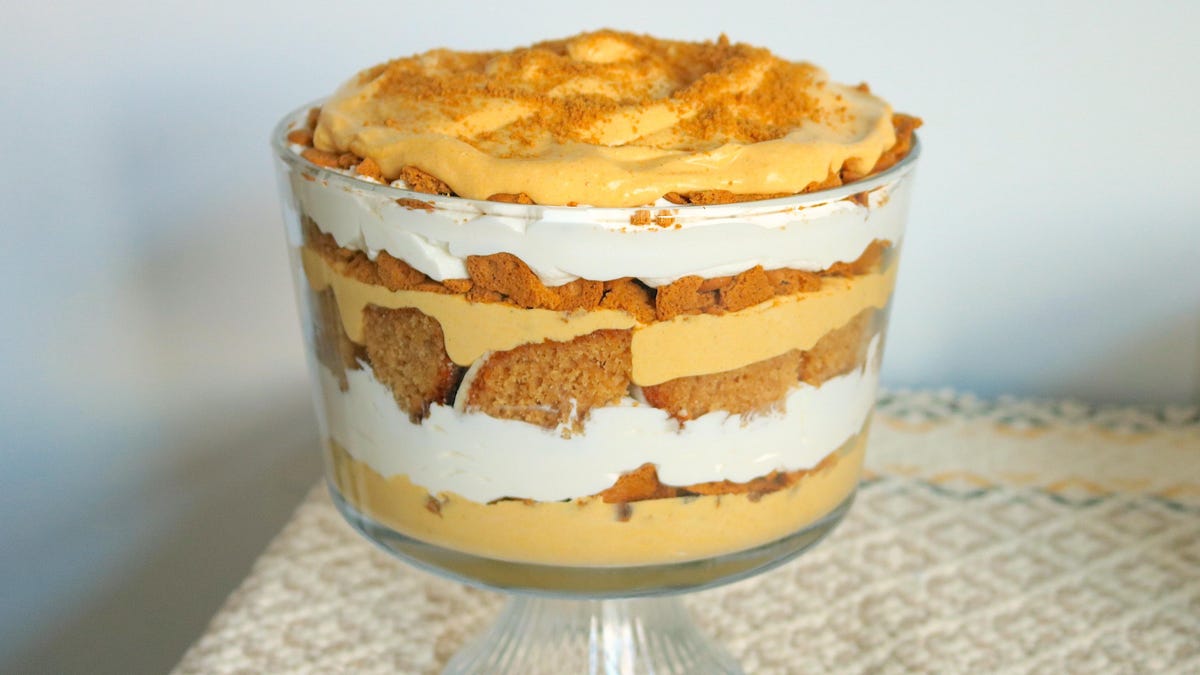
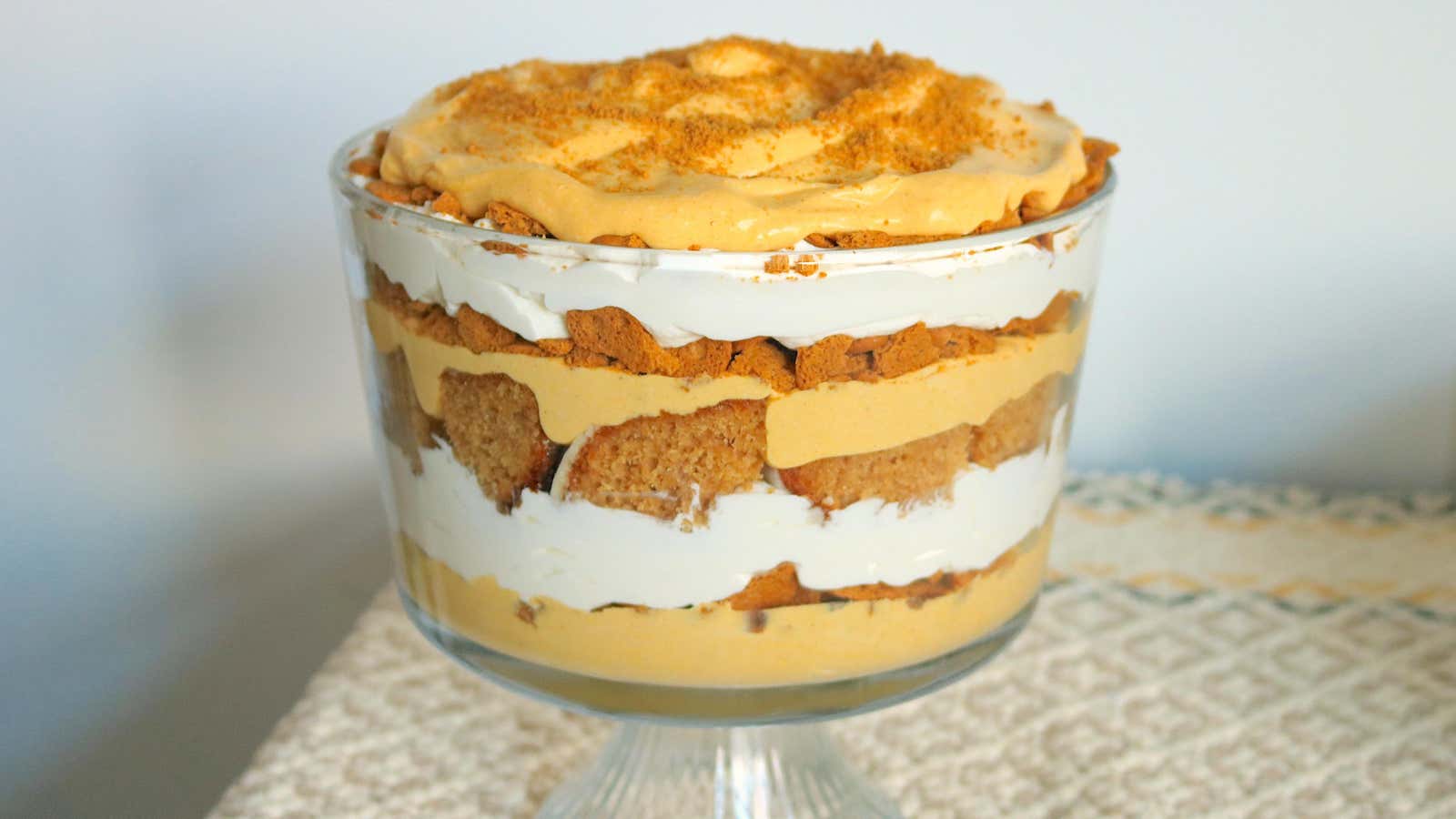
If you can make an icebox cake, you can make a trifle. The biggest difference between the two is an icebox cake is built and a trifle is dumped. Besides tasting great, this style of dessert makes a great example for other simple desserts: All you need is whipped cream and a dry component to soak up some moisture, and you have a damn classy treat. Since the trifle takes the icebox idea and piles it all into a container, the only decorating tool you need is a presentable vessel. You can use a giant bowl, a large mason jar, or even make dainty individual servings in champagne glasses. Choosing a clear container will let you show off the layers swirling around inside. These layers are the decoration. No piping bags or frosting necessary; the way you plopped things in the bowl is decoration enough.

To make this gargantuan dessert, I layered a pumpkin cream, whipped cream, cookies, and leftover cake (my apple cider bundt cake is the gift that keeps on giving), but you can use any cake, or lose the cake completely, and just do an extra layer of cookies. For the cookies, I used Anna’s Swedish Thins in the ginger flavor, but you can use any dry, brittle cookie. It’ll get crumbled anyway.

Image for article titled Make This No-Bake Fall Dessert If You Suck at Decorating

Photo: Allie Chanthorn Reinmann

Add a sweetened whipped cream and the pumpkin “cheesecake” layer. This latter, fluffy layer summons all the right flavors without actually requiring you to bake said cheesecake. I like to remove some of the moisture from the pumpkin puree before adding it to the mix. Line a bowl with a few layers of paper towel and put the puree on top. Cover it with more paper towels until it’s soaked with moisture—you can go after it with more paper towels if you want, but usually one round is enough. Discard the paper and the pumpkin will be ready to go. Warm one and a half packages of cream cheese in the microwave until it’s soft and spreadable, and mix in the sugar, salt, spices, lemon juice, and the pumpkin puree. In a separate bowl, whip the cream to stiff peaks and gently fold two or three cups of the whipped cream into the pumpkin mixture to lighten it.

Image for article titled Make This No-Bake Fall Dessert If You Suck at Decorating

Photo: Allie Chanthorn Reinmann

In a bowl or clear container of your choosing, spread a third of the pumpkin mixture on the bottom. Crush some cookies in your hands and sprinkle them on top. Use as many cookies as you need to cover the creamy layer with about a half inch of cookie crumbles, making sure to crumble all the way to the walls of the container so you can see it from the outside. You’re already decorating, well done!

Layer a third of your whipped cream onto the cookie layer, and top that with more cookies. Repeat this, alternating pumpkin cream with cookies (or cake), and whipped cream, in a pattern that pleases you. Periodically take a peek from the outside to see how your decoration is going; this your moment for dessert self-expression, and trifle is your artistic medium. Make as many layers as you have space and materials for, and top it all off with any leftover cookie dust.

Image for article titled Make This No-Bake Fall Dessert If You Suck at Decorating

Photo: Allie Chanthorn Reinmann

This recipe will make a rather large dessert, about 12-20 servings, but it will work equally as well if cut in half. To ensure the cookie layers soak up enough moisture from the cream layers, you need to make it at least five hours before serving, but I suggest doing so the night before. Store in the fridge when not being eaten. It will keep, covered, in the cold for up to four days.

Pumpkin Cheesecake Trifle

Ingredients:

Pumpkin Cream Cheese Base

  • 12 ounces cream cheese, microwaved until soft and melty
  • ¼ teaspoon salt
  • ¾ cup sugar
  • ½ teaspoon cinnamon
  • ½ teaspoon ground cardamom
  • ¼ teaspoon ground clove
  • 1 can pumpkin (15 ounces), drained of excess water with paper towels
  • 1 tablespoon lemon juice

Whipped Cream

  • 1 quart heavy cream
  • ¼ cup granulated sugar
  • 1 teaspoon vanilla extract
  • Cookies or cake for layering (I used 2.5 boxes of Anna’s Swedish thins, and some cake.)

In a large mixing bowl, whisk the warm cream cheese with the salt and sugar until smooth. Add all of the remaining ingredients in the cream cheese base, and whisk until smooth.

In a separate mixing bowl, whip the heavy cream and sugar on medium high speed for about 10 minutes, or until firm peaks have been reached. Add the vanilla extract and stir in. Gently fold about 3 cups of the whipped cream into the pumpkin mixture. It should appear light and fluffy and you will have nearly equal quantities of both creamy mixtures in their separate bowls.

In your trifle vessel of choice, layer the pumpkin cream, crumbled cookies, and whipped cream. Each cookie layer should be about a half inch thick. It doesn’t matter much what order the creams are added, but the cookies should be between each layer to provide maximum material for soaking up moisture. Finish the trifle with a layer of either cream you have left and store in the fridge to set for 5-24 hours before serving. 
    

A Bourbon Cocktail Recipe For Ringing In The Holiday Season

A Bourbon Cocktail Recipe For Ringing In The Holiday Season

Ahh, a warming, cold-weather cocktail. Whether you’re whipping one up to celebrate Thanksgiving, Christmas, or just the annual first use of your fireplace, you can’t go wrong with a bourbon cocktail recipe for the holiday season. We love all manner of seasonal drinks, but bourbon is arguably the most beloved seasonal spirit to mix into your boozy bevvie come November and December. This concoction, however, also throws butterscotch into the mix, so it’s officially our go-to bourbon cocktail choice for the season. Keep reading for a Butterscotch Milk Punch bourbon cocktail recipe that will change your holiday drink repertoire forever.

bourbon cocktail


Butterscotch Bourbon Milk Punch

Ingredients

For The Cocktail:

  • 4 ounces bourbon
  • 1 cup whole milk or cream
  • 2 teaspoons powdered sugar
  • 1/2 teaspoon vanilla extract
  • Ground nutmeg, for garnish
  • Vanilla bean, split, for garnish
  • Homemade butterscotch syrup, for the rim

For The Homemade Butterscotch Syrup:

  • 4 tablespoons unsalted butter
  • 1 cup packed brown sugar
  • 1/2 teaspoon kosher or pink salt
  • 3/4 cup heavy whipping cream
  • 2 teaspoons vanilla extract
bourbon cocktail recipe

Directions

To Make The Syrup:

  1. In a 2 quart sauce pot, melt the butter over medium-low heat. Add in the brown sugar and stir until the brown sugar resembles wet sand. Stir in the half teaspoon of salt.
  2. Increase the heat to medium and stir occasionally until the mixture is bubbling up, about 3 to 5 minutes.
  3. Add in the cream, lower the heat slightly, and whisk it all together until it is uniform and any lumps dissolve.
  4. Keep cooking the syrup for another 5 to 7 minutes until it reaches the temperature of 225 degrees F. Use a digital or candy thermometer, and if you don’t have one, stop simmering after a few minutes to ensure it doesn’t burn..
  5. Remove the pot from the burner, then add in the vanilla extract. Let the butterscotch syrup cool slightly and adjust the vanilla extract and salt amounts as needed after trying it. It will thicken up as it cools. This makes a large batch, so use it with cocktails, cookies, cakes, and ice cream!
  6. Once the syrup is cooled completely, store it in a glass jar with a lid and refrigerate it for up to a month.

To Assemble The Cocktail:

  1. Add bourbon, milk or cream, powdered sugar, and vanilla extract to a large shaker with a few pieces of ice. Shake the ingredients together.
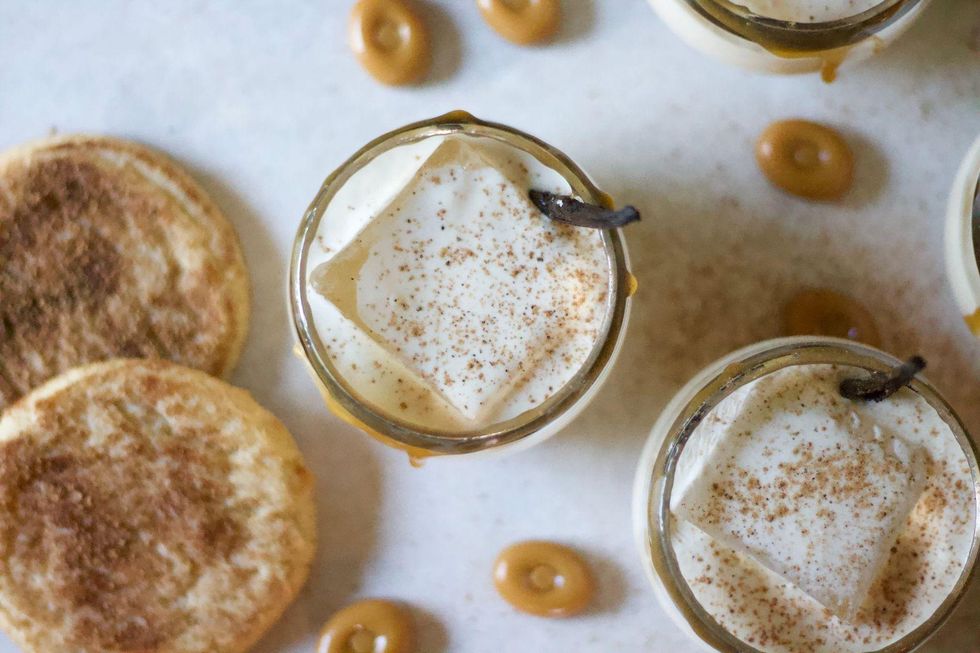
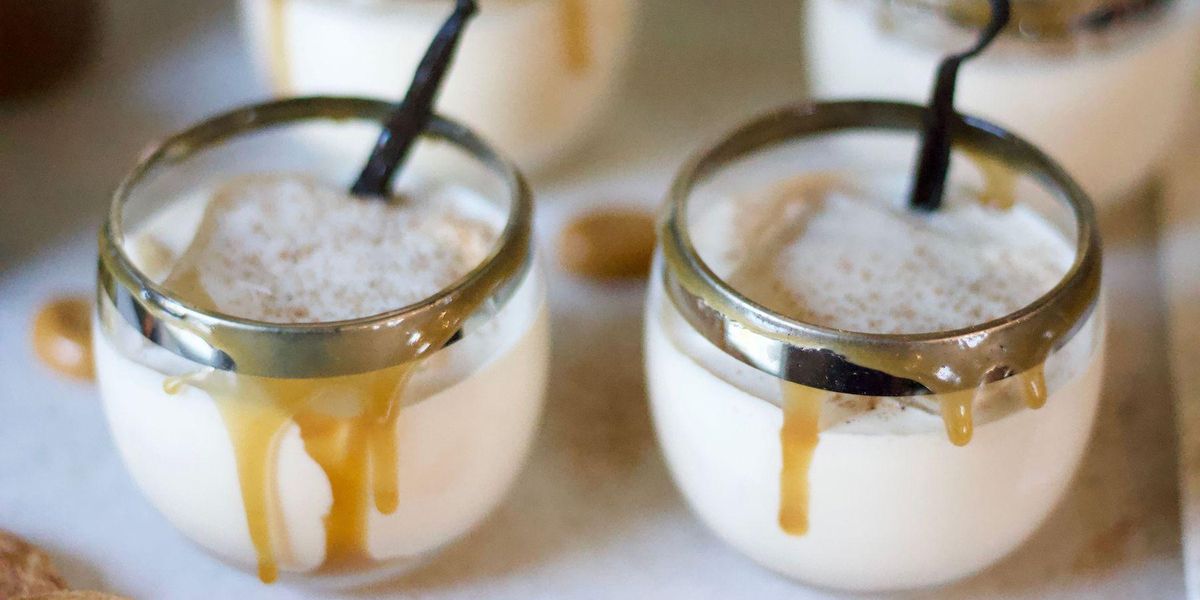
  2. Dip the rim of each glass into the homemade butterscotch syrup, then add a large ice cube or several smaller ice cubes into the glass, topping with the milk punch. Garnish each drink with a sprinkle of ground nutmeg, and a split vanilla bean. Serve immediately and with cookies!

Love this fall bourbon cocktail recipe? Be sure to subscribe to our newsletter for more recs and inspo!

Recipe and photos by Sarah Anderson.

Delicious meals for $20 a week: June Xie on changing the way you cook | Food

Delicious meals for  a week: June Xie on changing the way you cook | Food

When June Xie was in the third grade, her teacher announced that they were going to compile a classroom cookbook, with each student bringing in a family recipe. It made Xie’s stomach sink.

“That’s such an American tradition, written down recipes with exact amounts,” Xie says, in the living room of her apartment in Woodside, Queens. “I grew up with Chinese immigrant parents: home cooking was just chop your vegetables, throw them in a wok with oil, season it with salt and maybe some kind of spice and serve it alongside rice. There was no sauteeing onions for seven minutes exactly. When it’s done, it’s done.”

Still, Xie and her mom did their best. They had moved to New York from Beijing when Xie was seven years old, so they were both still learning English. They tried to write down a recipe for something they cooked often (“probably tomato and eggs”, she remembers) and then translated it into English as best they could. The teacher was not impressed. “She said she couldn’t use the recipe because not only was the English not clear enough but all the amounts were in grams and kilos – and she wanted cups and ounces. Everything was wrong, basically. I just remember crying.”

The ability to cook anything, any time without referring to instructions might not have helped Xie in school, but it has made her one of New York’s greatest food resources, maybe the last person in the city who can find a way to eat something delicious for less than a dollar. She is a jazz cook, improvising with her ingredients, constantly turning yesterday’s dinner experiments into tomorrow’s breakfast – but many of the meals she comes up with are restaurant quality, full of unexpected flavour combinations and fresh produce. And most impressive is the way she can transform a $1 bag of vegetables that are close to going rancid into gourmet-looking ingredients that can be used all week.

She demonstrates these skills in a YouTube series called Budget Eats: a show where she shops on an unimaginably small allowance in one of the world’s most expensive cities for groceries.

June Xie reaches for produce outside a grocery store in Queens.
June Xie, the producer of Budget Eats, grocery shopping in Queens. Her No 1 tip is to go to the store and keep your eye open for whatever is on sale.

The show feels like a kind of alchemy. There are no bright lights, slick editing or planned recipes to follow. Episodes last as long as they need to, often over an hour, with Xie baring her soul as well as her culinary skills.

Budget Eats has been running for two years and has millions of viewers. What makes it unlike other food content is that the savings come not from coupons or hacks, but from adopting a different mindset.

“A lot of people have written to me saying: ‘You’ve changed the way that I cook.’ I think food media has this effect of making people feel inadequate and it actually intimidates them away from cooking. People are shocked to find out that you can substitute things and the world won’t end. Every ingredient can be treated every which way if you’re open to the possibility of experimentation. You can blend up celery, you can blend up rice, you can blend up wheat, you can blend up eggs. There is no best way.”

Close up images of Chinese eggplant and Italian grapes on sale
Chinese eggplant and Italian grapes at the Woodside, Queens, Dollar & Up fruit and vegetable market.

But the first time Xie pitched Budget Eats to her employers at the recipe and food website Delish, they weren’t that interested. Xie’s job was to develop recipes for professionally styled food videos shot in fancy test kitchens. A show about spending as little as possible, bags of half-rotten vegetables and making food that tasted good but might look ugly, shot in a tiny and unremarkable home kitchen: it didn’t really align with the brand’s values, they thought.

But then the pandemic hit, all other production was halted, and they told her to give it a go. She shot the first episode, “I lived on a $5 a day budget for a week in New York City”, on her Google Pixel phone. A mix of reality show (Xie feeds her dog, Tom, and thinks out loud in her kitchen) and incredibly cheap cooking (from a $35 weekly she manages to make a Lebanese mujaddara, a sweet potato gnocchi, split-pea soup with brown rice crackers, spicy potato and rice pancakes and a ton of other meals), it quickly became one of the most popular videos in Delish’s history, so she kept making more.

“When I was looking for inspiration for those early episodes, the only YouTube videos about money-saving cooking I could find were mommies who go to Walmart and I was like, ‘They’re buying a gallon of milk for 87 cents.’ But that doesn’t make sense in New York, where you can easily spend $4 for the saddest gallon of milk. So I knew I’d have to find a different way to make things work. I couldn’t be so prescriptive – even if your store does have sales, the sales change every week. Oatmeal can be $4 one week and $6 the next.”

Because the Guardian is an international operation, a little note on food prices in New York City: they are a lot. If you’re coming here from Milwaukee, you’ll be shocked. If you’re coming from Scunthorpe, you’ll be horrified. Right now on FreshDirect, a big online supermarket known for decent prices, a regular box of Kellogg’s Corn Flakes costs $7, a 5-pack of everything bagels costs $8, 12 organic eggs cost $8, a 1-litre carton of Oatly costs $4.79, and a single navel orange is $2. That’s before you even get into eating out: a ham and cheese baguette from Pret is $12.50.

But Xie finds tiny loopholes in the blanket ruling that New York is expensive and exploits them for all they’re worth.

She says the first rule of budget cooking is always to look for the sales. “Just keep your eye open for whatever is on sale and buy as much of it as you can afford. You’ll find ways of using those sale items and if you don’t know how to use it, you’ll learn. It’s all just food and it’s interchangeable.”

Red Dragon Fruits and Chinese bitter melon
Red dragon fruits and Chinese bitter melons are among the vast selection on sale at the Dollar & Up fruit and vegetable market.

“It’s also the little things,” she says, gesturing around her kitchen. “The one thing people get wrong is always buying the same stuff. If you know rice, potatoes and beans are always cheap, you might keep getting them. But you can burn out. I would invite you to buy different ingredients in the same price range and just try them out.”

On one episode of Budget Eats, for example, Xie discovered a strange grain on sale at her local store. “I had no idea what it was. It kind of looked like farro – and you know I made rice pudding with it, I made a stir-fried grain with it, I blended some into flour and made pasta with it – and it was fun! I think that’s the trick.”

But, she says, the easiest way for me to learn how to buy on a budget is for her to show me. So we head out of the apartment and into Queens to shop at one of her favorite grocery stores: HF Dollar & Up Fruit and Vegetable. It is a heaven of produce, big boxes of tangerines and rambutans lined up outside, bags of peanuts, durians and fresh meat stacked high inside and then, for Xie, the star of the show: the $1 bags.

“If you go to Chinese grocery store, they will always have a discount bin like this. One dollar’s worth of things that have basically started to go rotten. And my mom always hated my dad buying those bags, but I loved buying those bags with my dad.”

Because everything is a bit cheaper here, there’s more freedom to experiment. To go grocery shopping with Xie is to go to the factory with Willy Wonka – we stop at a pile of Italian grapes, which I’ve never tried. “Oh, you’ve got to, they’re so good.” I fill up a bag, and another of rambutans. On Xie’s recommendation, I also get some ching yeh pork sung, a kind of dried pork candyfloss, some sweetcorn-flavoured chips and some dried prawns that are sugary and sweet.

As we walk through Jackson Heights, I eat my whole bag of Italian grapes. They taste rich and winey and my whole bag was only $1.35. I scoop a piece of porky candyfloss on to my finger and it melts in my mouth, a world of new taste and textures hitting my tongue.

June Xie walks through a grocery store aisle gazing at snacks.
Xie shops the snack aisle at the Dollar & Up.

Xie makes no bones about the fact that the way she does it, hunting down cheap ingredients and cooking everything from scratch, takes a huge amount of time and labor that most people don’t have. “Making Budget Eats is exhausting,” she says. “Trying to record a video for a huge media corporation that has to be polished, learning what the boundaries are between home life, self-presentation, identity, transparency. The first year was so taxing because I didn’t know how to do any of it. It’s a whole week of planning, shopping and gathering – then another week of shooting, 12- to 16-hour days.”

She was also unsure about how much of herself to give over – the weeks are often tiring and emotional and Xie talks honestly in her videos about how much she was affected by the death of her mother, the isolation of the pandemic and her own concerns about money.

“The fact that we value the idea so much of privacy is fascinating to me. I just let go of all my personal things as a way of freeing myself of being a commodity. It’s deprivatizing myself. It’s liberating. I am then free to just be, rather than curate. If I don’t curate my personality, no one can call me out for being a fake.”

June Xie peeks her head through black, white, and orange curtains.
Xie peeks through curtains that separate her bedroom from her apartment hallway and kitchen.

Xie’s extra tips for making food taste delicious and money go further:

  • Always store your flours in the freezer, especially in this city. There are bugs everywhere and they can quickly go rancid in the summer months. Nuts, too – they’re full of fat so if you leave them at room temperature they’ll start to smell like burnt gasoline.

  • More expensive isn’t always better. If it’s something that you taste right away – like butter and jam on toast – then it’s worth spending a little bit more on the butter. But if you’re buying butter to bake into cookies, then it’s just an ingredient; you can get the cheapest one.

  • Trader Joe’s umami seasoning is very underrated. The best cumin seeds come from Burlap and Barrel, and Sichuan peppercorns from 50Hertz are the best you can get in the US.

  • If I can’t see an ingredient, I won’t think about how it would taste and then I won’t use it. So have everything just out. Even stacked on the floor. If it’s tucked away, then I won’t think, “Ooh, maybe coconut goes with cumin.”

  • When I eat out with friends, I just make it clear with them if I’m on a budget. I can’t spend more than $20 today so where can we go for that? It avoids the awkwardness of splitting the bill and it makes it kind of fun.