A taste of home: Park woman shares French culture through food

A taste of home: Park woman shares French culture through food

Photos courtesy of Gerard and Belevender
Marie Wallace is in her happy place making crêpes at The French Cow, a fixture at Eastern Market.

The reason Marie Wallace came to the United States from France and a big reason she remains are about as far apart as her home country and current residence.
“I was 23 and a big Eminem fan,” Wallace recalled. “I loved hip-hop and Eminem. I wanted to write a screenplay; I’m a screenwriter. My dream was to come to Detroit, meet Eminem, give him my screenplay and he would produce it.”
Though she came close — she met Eminem’s manager, Paul Rosenberg, multiple times and, as a singer, worked with Luis Resto, who co-produced the rapper’s Oscar-winning “Lose Yourself,” from the film “Eight Mile” — she has yet to meet the man himself and her screenplay was turned down.
But the rejection turned out to be a blessing in disguise. Wallace at the time was starting a business that has since become a popular Eastern Market destination.
“I’m very passionate about French food, about food in general,” she explained. “I was disappointed when I tasted crêpes here. They’re not the quality I was used to (in France). I had crêpes all the time with my family; we made crêpes constantly.”
In 2008, Wallace mentioned to her husband she’d like to start a crêpe business, but the timing wasn’t right as she was busy raising their two sons.
“Then Good Girls Go to Paris Crêpes opened in Detroit,” she said. “It broke my heart. It was very popular and it got big. People were lining up for crêpes.
“… When I got my divorce, I took my kids there and they said, ‘You should make your own,’” she added.
That’s exactly what she did. Using her own crêpe recipe and with her mother’s help, Wallace set about creating The French Cow crêpes shop.
“I started at Coffee & … on Jefferson and Chalmers,” she said. “I was scared. I didn’t know if people would like it.”
She voiced her concerns to the cafe owner, who encouraged Wallace to give it a try.
“She kept saying, ‘Just do it,’” Wallace recalled. “So each month, I had a pop-up there.”
Though she had some success, the shop wasn’t enough to support her, so she landed a job at Selden Standard in Detroit, which helped her learn more about the industry.
“They hired me knowing I was starting my own company,” she said. “I studied a lot there. I learned about kitchen service. I learned the ropes through Selden. Two years later, I started at Eastern Market.”
Wallace said some customers were skeptical at first. Her savory crêpes, for instance, are made with buckwheat flour, so they come out darker.
“But that’s how we make them in France,” she explained. “Black is for savory, white is for sweet. Little by little, they began tasting them. They say, ‘This is how they’re done in France? OK, let’s try it.’
“Now people are there before we even open, every time,” she continued. “We sell 200 to 350 crêpes, which is a lot. Now I have employees, two to four during the season. I started with just my mother.”
The French Cow currently is a fixture at Eastern Market on Saturdays, though during summer months, hungry patrons can find the shop there three days a week. The French Cow also handles catering requests.
“Anything where we can sell crêpes we are doing,” Wallace said. “I also make baguette sandwiches and sell them at Milwaukee Cafe near New Center.”
Among The French Cow’s most popular savory crêpes are the Pigalle and the Big Mack.
“The Pigalle is inspired from the Red District of Paris,” Wallace said. “It’s delicious, but also a little bit dirty. It’s Swiss cheese, ham, caramelized onions, then I make a homemade cilantro-garlic sauce I put on top.
“The Big Mack has corned beef,” she added. “I named it after a customer who’s Irish, named Cormack. The crêpes have some very strange names because they’re named after things in my life, like The Wallace Boys — Nutella, bananas and walnuts — is named after my sons.”
Another popular sweet crêpe is Jessica’s Secret, featuring homemade rhubarb jam, strawberries and ricotta. But don’t expect to find this tasty treat at the shop during winter.
“I try to do everything seasonal and strawberries are not in season now,” Wallace said. “I use the freshest ingredients. The market is an amazing place to find fresh ingredients all year round. So many people don’t know that Eastern Market is open all year. It’s one of the only cities in the United States that has that.”
Wallace currently is compiling a cookbook, “with crêpes and other things, picturing the authentic French way of living,” she said.
“I feel like sometimes Americans are infatuated (with France) for the wrong reason,” Wallace said. “They fall in love with Paris because of the Eiffel Tower, because it’s so romantic. They don’t dig deep into what the culture really is, of what the feeling of sharing food really is. It’s not that they don’t want to, but now I’m forcing them to. If I ever open a shop, it will be a real culture shock for them, because I will keep it authentic.
“I would love to have my own place in Grosse Pointe Park,” she added. “I would love it to have a Parisian feel where people can walk to it.”

Grosse Pointe Park resident Marie Wallace brings an athentic Parisian food experience to Eastern Market with sweet and savory crêpes inspired by her hometown.

Wallace said making crêpes helps her express her creative side, which knows no limits.
“I’m also a trained actor and screenwriter and a singer,” she said. “I love to decorate. I feel like crêpes may seem odd, but I create a lot when I’m coming up with a menu or decorating the booth creatively at the market. I am a content creator and a constant creator.”
Wallace put her creativity to use during the pandemic by writing the screenplay, “13 Weeks,” for which she is trying to get representation.
“It’s about two people who start a conversation during the pandemic, apart from each other, in different cities,” she said of the romance.
When she’s not peddling crêpes, Wallace, who has lived in Grosse Pointe Park since 2016, enjoys spending time with her two boys, ages 12 and 14, both students at Pierce Middle School.
Learn more about The French Cow on Instagram @thefrenchcow, on Facebook at The French Cow crêpes, by visiting thefrenchcowcrepesshop.net or emailing thefrenchcowcrepes@gmail.com
Vegan Peppermint Chocolate Recipe – Brit + Co

Vegan Peppermint Chocolate Recipe – Brit + Co

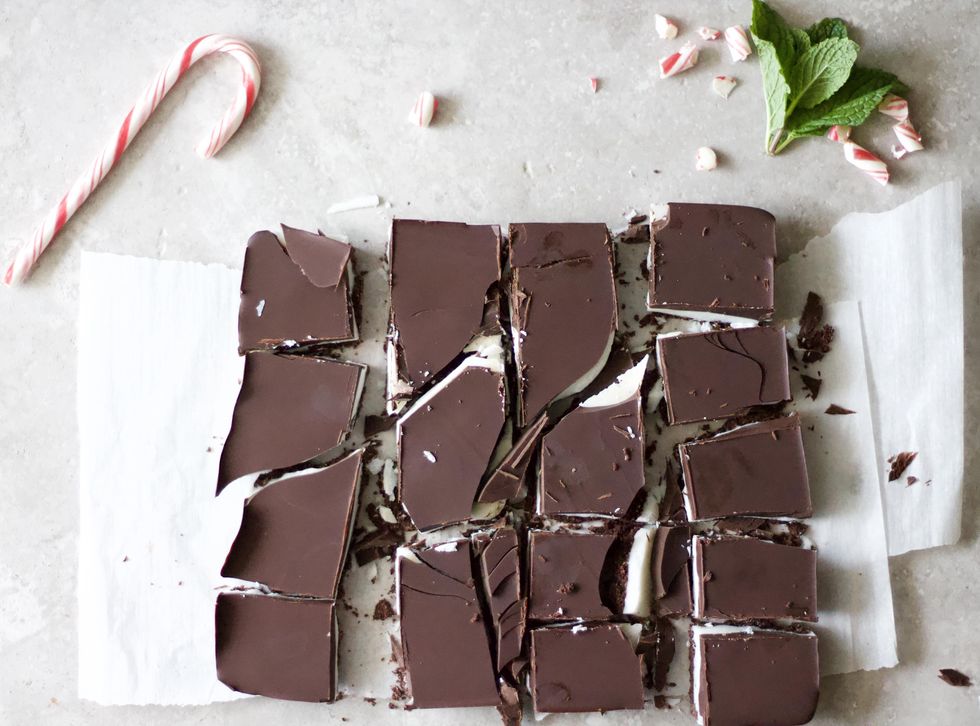
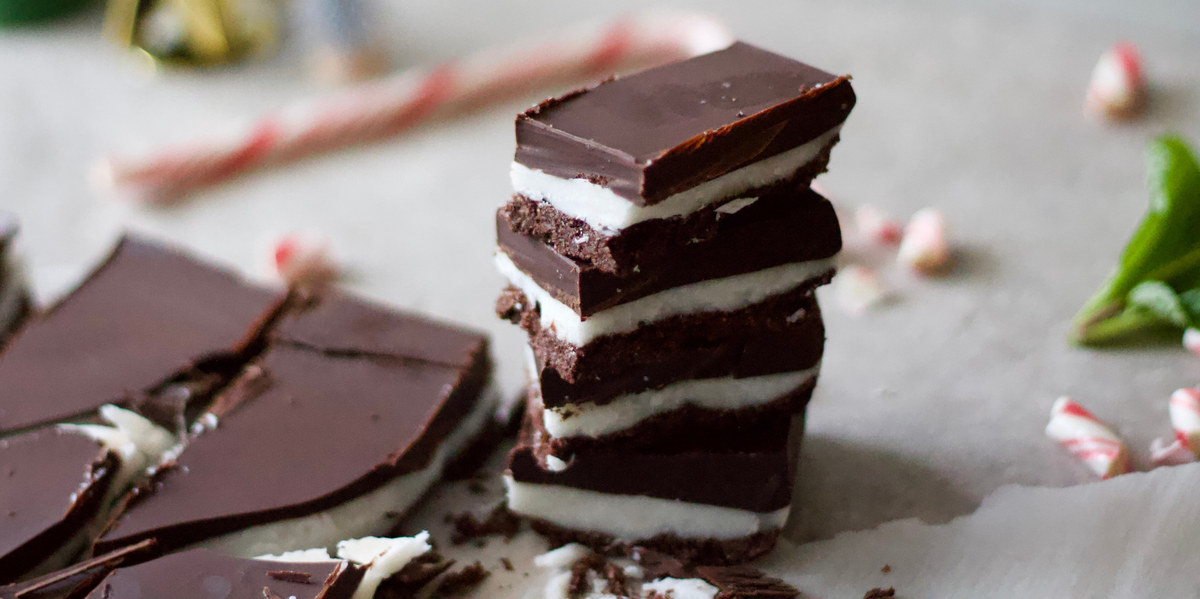
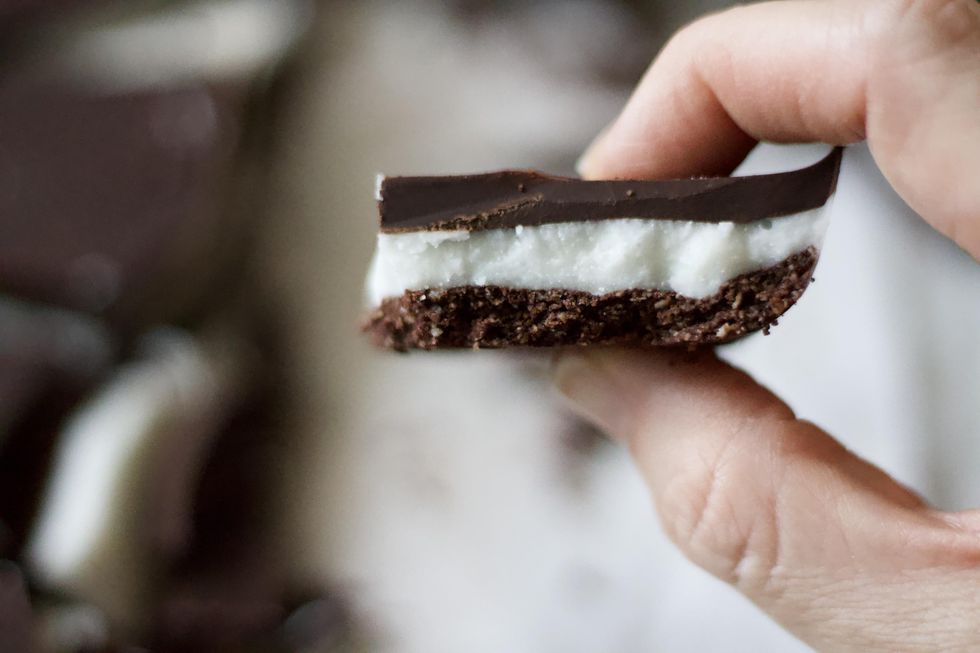
Peppermint and chocolate undoubtedly make the perfect pair for the holiday season. It’s the rich, sweet flavor found in our fave seasonal Starbucks mocha order, the sweet scents of Christmas candles and what completes this delicious peppermint dessert for the wintertime. This vegan peppermint chocolate recipe is a prime choice for homemade candy when celebrating with friends and family this time of year. A light crust with thick peppermint-infused filling topped with a decadent layer of dark vegan chocolate will keep everyone going back for more and more. It’s super quick to make and can be stored in the fridge for a while for easy access. Make this treat with a seasonal cocktail in hand, and let’s get to snacking!


What You Need To Make Vegan Peppermint Chocolate

Vegan Peppermint Chocolate recipe for the holidays and Christmas

For the crust:

  • 1 cup almond flour
  • 1/4 cup cocoa powder
  • 1/4 teaspoon pink salt
  • 2 tablespoons melted coconut oil
  • 2 tablespoons maple syrup

For the peppermint filling:

  • 1 cup coconut butter
  • 1 cup coconut oil
  • 1/4 cup maple syrup
  • 1 teaspoon peppermint extract

For the dark chocolate topping:

  • 9 ounces vegan dark chocolate chips (about 2 cups)
  • 1 tablespoon coconut oil

How To Make Vegan Peppermint Chocolate

Vegan peppermint chocolate recipe for the holidays and christmas

  1. Preheat the oven to 350 degrees F. Line an 8×8 inch baking dish with parchment paper and set aside.
  2. Start with the crust. In a small mixing bowl, add in the almond flour, cocoa powder, and salt and mix until it looks uniform. Stir in the melted coconut oil and maple syrup until the batter comes together. Using your hands, gently spread the crust over the top of the parchment paper in the baking dish, going all the way to the edges. If the crust is sticking, use a bit of water on your hands to help spread it evenly. Bake the crust in the oven for 15 minutes. Remove it from the oven and let it cool completely.
  3. While the crust is baking, mix together the peppermint filling ingredients in a separate mixing bowl. If the coconut butter is hard and flaky, melt it gently over low heat in a small saucepan until just melted, then combine it with the remaining ingredients. It should come together easily but not be overly drippy or with too many lumps in it. Pour the peppermint filling over the completely cooled crust, then place the entire dish in the freezer to set (about 10-15 minutes).
  4. Next, melt the chocolate chips and coconut oil in a saucepan or pot over low heat until just melted. Remove the dish from the freezer and top the peppermint filling with the dark chocolate, then place back in the freezer to set the topping, for about 20 minutes.
  5. Cut the bars into 16 pieces and serve immediately. They should be stored in the freezer or refrigerator for the best results. If the bars are very hard, run sharp knife under hot water for 30 seconds, dry it off, then cut the bars.

Recipe development and photography by Sarah Anderson.

Sign up for our newsletter for more spectacular holiday recipe ideas!

Tips for overcoming age-related cooking challenges

Tips for overcoming age-related cooking challenges

Cooking at home is a mood-booster, exercises muscles and the mind, and can help us maintain a healthy diet, especially as we age.

But with age-related medical conditions come new challenges in the kitchen. People with dementia or memory loss may worry about forgetting the roast they put in the oven.

Perhaps the meals you used to prepare for a family of five no longer make sense for a solo diner.

Arthritis, lost muscle mass, decreased height, and vision problems can all affect how you cook.Here are some tips to get the most out of home cooking.

Consider what you’re cooking

Research shows that people who cook for themselves eat out less often and consume less fast food, said Julia Wolfson, an associate professor at Johns Hopkins Bloomberg School of Public Health who studies food systems and food policy.

That can be especially important for older adults, whose metabolism has slowed and who may be at risk for type 2 diabetes, high blood pressure, or high cholesterol — all medical conditions that are influenced by diet.

But, Wolfson said, “Just purely the act of cooking itself does not equal healthy eating.”

Get the most out of home cooking by planning meals that balance protein and high-fiber vegetables with fat and carbs. Think about portion sizes, and the amount of salt and sugar you use.

For instance, packaged spice blends often contain lots of salt. Making your own spice blend may be one way to cut down on salt and amp up flavor.

Stock the freezer

In a 2020 study, Wolfson and her former colleagues at the University of Michigan found that older adults were more likely than the general adult population to cook for themselves at home.

But people’s relationship with food can change as they go through different life stages, such as children moving out or the death of a spouse.

Preparing and eating a favorite meal associated with fond memories can be comforting. Make the meal you love, then freeze leftovers in individual-serving packages, rather than in one large container. You’ll have dinner for the future and reduce the amount of time you have to spend cooking.

Load the slow cooker

Slow cooker meals are perfect for people who may have balance or strength issues that limit their ability to cook on the stove. Bending and lifting to use the oven can also become challenging with age.

Slow cookers sit on the counter, are designed to be left on all day and are a good way to prepare larger meals that can be frozen, said Heath Jones, an occupational therapist with Wesley Enhanced Living Main Line, a senior living center in Media, Delaware County.

Eliminate access issues

Put everything you use most frequently in easy-to-reach spots, Jones suggested.Plates and cups don’t have to live in high-up cabinets. Leave them on the counter.

Reorganize the refrigerator so that the items you need are within easy reach, without needing to bend down or dig to the back of the fridge. And when it’s time to replace your fridge, consider one with the freezer on the bottom or side, rather than on top.

Simplify cleanup

Disposable kitchen items, such as paper plates and aluminum pans, can make the difference between eating a healthy home-cooked meal or turning to processed foods.

Too environmentally conscious to stock up on foil baking pans, paper plates and plastic utensils? Line baking sheets with aluminum foil to avoid baked-on food that’s hard to scrub off.

Try single-pan meals to at least reduce the number of dirty dishes.

5 Longevity-Boosting Blue Zones Recipes

5 Longevity-Boosting Blue Zones Recipes
The wait is finally over, and the one item your holiday wishlist has been missing has finally hit the (book) shelves. Dan Buettner, the New York Times bestselling author of titles like The Blue Zones Kitchen and The Blue Zones and a National Geographic Fellow, has released his latest (and potentially greatest) book yet, The Blue Zones American Kitchen: 100 Recipes to Live to 100. And we couldn’t be more excited to share the news.

Buettner, who has closely studied the hotspots that are home to the longest-living people in the world, focuses on reconstructing a largely-forgotten American diet that closely resembles the dietary patterns found in the Blue Zones in this new release. “For the book, I’ve exhumed more than 60 oral histories, scientific reports, and academic papers to reconstruct four traditional American diets from the early 20th century,” Buettner says. “The scope of the work is ethnically and racially diverse—it precisely captures the diets of Mexican Americans, Asian Americans, African Americans, as well as Native Americans.”

The book is comprised of more than 100 plant-based recipes that, according to Buettner, “showcase the ingenuity of our Indigenous people and our immigrants who brought their time-honored cooking techniques from the Old World and blended New World ingredients to produce ingenious food that just may help you live to 100.” He also notes that the data-driven representation of what Americans were really eating a century ago closely represented what was found in his original Blue Zones research.

To get an inside glimpse into the book, Buettner kindly has shared a few of his favorite five-ingredient (or less) recipes so you can get cooking right away. And they’re filled with longevity-boosting ingredients to nourish your body with the same type of nutrient-rich foods found in the Blue Zones, where people live well into their 100s.

5 longevity-boosting recipes from The Blue Zones American Kitchen

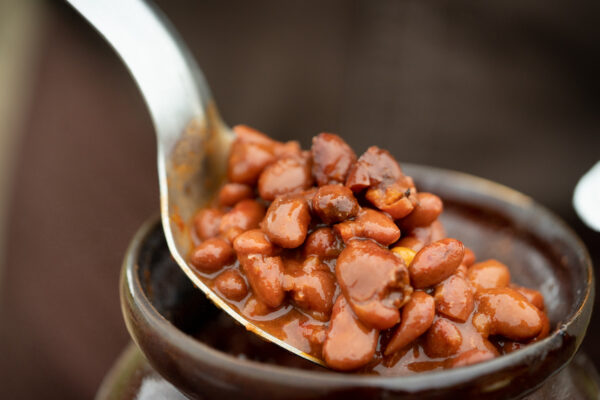
blue zones American kitchen beans
Photo: David McLain

Mohawk Baked Beans

Recipe by Dave Smoke McCluskey
Yields 6-8 servings

Ingredients
2 pounds dried cranberry beans
1 large onion, diced
1/4 cup darkest maple syrup
2 Tsp tomato paste
2 Tbsp yellow mustard
Salt
Freshly ground black pepper

1. Place the beans in a large pot and cover them with cold water. Soak them overnight. Drain.

2. Put the beans in a Dutch oven or oven-safe pot and cover them with water. Bring them to a boil over medium-high heat, then reduce the heat to low and simmer for 1 to 1 1/2 hours, until the beans are al dente.

3. Once the beans are al dente, add the onion, maple syrup, tomato paste, and mustard. Put them in the oven and set the oven to 225°F. Let the beans cook 8 hours or overnight, checking occasionally and adding water if needed. Season with salt and pepper to taste. Serve hot.

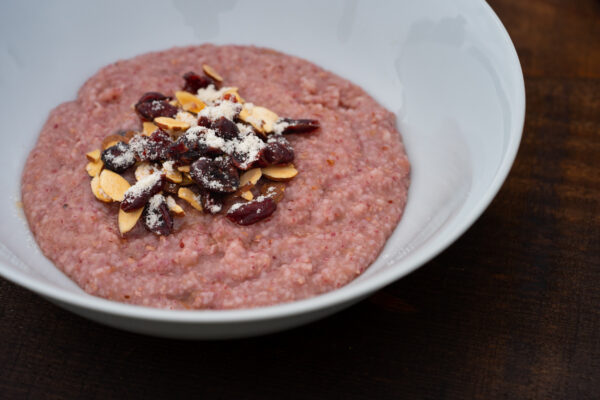
blue zones American kitchen mash
Photo: David McLain

Warriors of the Rainbow Cranberry Mush

Recipe by Dave Smoke McCluskey
Yields 6 servings

Ingredients
4 cups water
4 cups almond milk
1 pound fresh cranberries or 1/2 pound dried cranberries
3 cups hominy grits
1 cup maple syrup, or to taste
Optional toppings: pumpkin seeds, pecans, dried cherries, or maple sugar

1. In a large pot, combine the water, almond milk, and cranberries and bring to a boil over high heat.

2. Reduce the heat to medium-low, stir in the grits, and let simmer for 45 to 60 minutes, stirring occasionally, until the grits have absorbed the liquid and are very tender.

3. Stir in the maple syrup and serve hot with desired toppings, if using.

blue zones American kitchen coconut rice
Photo: David McLain

Coconut Rice

Recipe by Nicole Marquis
Yields 6 servings

Ingredients
2 Tbsp dried coconut shreds
3 cups long-grain rice
2 cans unsweetened coconut milk
2 1/2 cups water
2 Tsp cane sugar

1. In a small sauté pan over medium-low heat, sauté the dried coconut until golden brown throughout. Set aside.

2. In a rice cooker, combine the rice, coconut milk, water, and sugar. Cover and turn on the rice cooker. (Alternatively, cook the rice in a covered pot.)

3. Once the rice is cooked, fold in the toasted coconut.

blue zones American kitchen corn
Photo: David McLain

Cambodian Coconut Corn

Recipe by Chad Phuong
Yields 3 servings

Ingredients
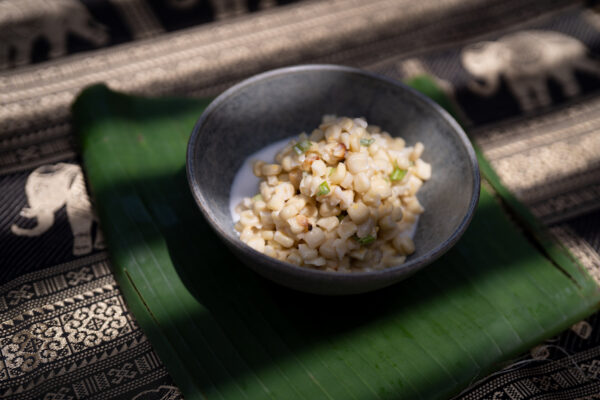
2 cups fresh corn kernels
1/2 cup unsweetened coconut milk
1/3 cup sugar
1/2 Tsp salt
1/4 cup chives, chopped

1. Preheat the oven to 350°F. Spread the corn kernels in a baking dish in an even layer and roast them in the oven for 10 minutes.

2. Meanwhile, in a small saucepan, bring the coconut milk to a boil.

3. Add the sugar and salt and reduce the heat to low. Simmer for 5 minutes.

4. Add the chives and simmer for 1 minute more.

5. Pour the coconut milk mixture over the corn kernels and return the dish to the oven to bake for about 5 minutes, until lightly brown on top.

blue zones American kitchen succotash
Photo: David McLain

1620s Plymouth Succotash

Recipe by Paula Marcoux
Yields 5 servings

Ingredients
2 pounds cooked, hulled corn (or reconstituted dry whole hominy, frozen hominy, or pozole)
8 ounces dried cranberry beans (or Jacob’s cattle beans or other similar beans), soaked and cooked until just tender
Salt

Optional add-ins:
2 turnips, peeled and chopped
2 carrots, peeled and chopped
1 acorn squash or other winter squash, seeded and sliced
Few handfuls of chopped cabbage, collards, or turnip greens
2 leeks or onions, sliced
Few handfuls of chopped lettuce, spinach, endive, chicory, or arugula (or a combination)
Tender strawberry or violet leaves
1 cup ground walnuts, chestnuts, or hazelnuts
Freshly ground black pepper
Few chives or scallions, chopped
Calendula petals
Fresh mint or parsley

1. In a large soup pot, stir together the corn, beans, and salt.

2. Add the optional turnips, carrots, squash, cabbage or other winter greens, and leeks or onions, and simmer until they are almost tender, about 10 minutes. (Add oil, if needed.)

3. When the above are nearing tenderness, add the leafy greens (lettuce, spinach, endive, chicory, or arugula), strawberry or violet leaves, ground nuts, and pepper, and simmer for a few minutes more.

4. Stir in the chives or scallions, calendula petals, and mint or parsley.

An herbalist shares her brain-boosting herbal shot for longevity:


Our editors independently select these products. Making a purchase through our links may earn Well+Good a commission.

All Boba Tea recipes in Disney Dreamlight Valley: Coconut, Raspberry & more

All Boba Tea recipes in Disney Dreamlight Valley: Coconut, Raspberry & more

Published: 2022-12-14T14:16:09

Updated: 2022-12-14T14:16:24

Disney Dreamlight Valley is filled with delicious recipes for players to make. One such recipe is Boba Tea, a recent addition during the Toy Story update. So, we’ve compiled all the Boba Tea recipes in Disney Dreamlight Valley including how to make Coconut Boba Tea and Raspberry Boba Tea.

Disney Dreamlight Valley is a fantastic game for budding chefs. It includes over 170 unique recipes where you’re tasked with finding the ingredients and creating your favorite foods. While it’s exciting to create new ideas, finding out the ingredients for these recipes can be a little frustrating.

We’ve compiled all the Boba Tea recipes in Disney Dreamlight Valley so you can get back to drinking your favorite drink without needing to hunt around for the ingredients or the recipe.

Article continues after ad

If you’re looking for more recipes in Disney Dreamlight Valley we have a guide detailing all the ingredients you need.

How to make Boba Tea in Disney Dreamlight Valley

Disney Dreamligt Valley how to make Boba teaDisney / Gameloft

You’ll need Milk, Sugarcane and a flavoring to make a three-star Boba Tea.

The base ingredients surrounding Boba Tea in Disney Dreamlight Valley are thankfully relatively easy to get hold of. You’ll only need two ingredients to make the base Boba Tea then the respective additional flavoring for the three-star drinks. For example, a Dreamlight Valley Raspberry Boba tea will need the normal ingredients with one raspberry added in.

To make a normal Boba Tea you’ll need:

You can find Milk in Chez Remy and it’ll cost you 230 Star Coins each. Then the Sugarcane can be brought at Dazzle Beach. The Sugarcane itself is 29 Star Coins while the seeds are only 5 Star Coins. Due to the growth time being only seven minutes, we recommend buying the seeds and growing them.

Article continues after ad

All Boba Tea recipes in Disney Dreamlight Valley

We’ve compiled all five of the current Boba Tea recipes in Disney Dreamlight Valley so you can get to drinking your tea as soon as possible. The recipes, their ingredients, and how much they sell for are below:

That’s all the Boba Tea recipes in Disney Dreamlight Valley along with how you can make this delicious drink. While waiting for your Sugarcane to grow, take a look at some of our other handy Disney Dreamlight Valley guides:

Lost Diaries locations in Disney Dreamlight Valley | How to upgrade your house in Disney Dreamlight Valley | All flowers in Disney Dreamlight Valley | All Realms in Disney Dreamlight Valley | How to unlock all characters in Disney Dreamlight Valley | Disney Dreamlight Valley Emeralds guide | Is Disney Dreamlight Valley multiplayer? | How to feed animals in Disney Dreamlight Valley | How to redeem the Golden Potato code | All Disney Dreamlight Valley recipes | Current Disney Dreamlight Valley Star Path | When is the next Disney Dreamlight Valley update? | Disney Dreamlight Valley crop growth times

Article continues after ad

The best gifts for home cooks in Oakland and Berkeley

The best gifts for home cooks in Oakland and Berkeley

For thoughtfully designed gifts that blend both practicality and style, look no further than kitchen tools and accessories. These are the gifts that they’ll reach for again and again throughout the year, truly relying on essential cookbooks and sharp knives, and taking pleasure in speckled ceramics and soft linens. 

Sure, it’s easy to stock up at Williams-Sonoma, a Bay Area tastemaker since 1956. But there are so many small and independent shops that are actually local to the East Bay, places where you can find gifts that go way beyond the same-day-shipped.

Here are the highlights this holiday season, whether you’re shopping for your best food friend, or craving something for your own wishlist.  

For someone who eats everything in bowls

Oakland ceramicist Sarah Kersten’s basin collection. Courtsey: Sarah Kersten

Listen, eating food in bowls is no longer a trend, it’s officially a lifestyle. And local ceramicist Sarah Kersten’s new basin bowl collection is breathtakingly pretty: wide and shallow bowls, speckled as naturally as quail eggs or Appaloosa ponies. 

She handshapes them all in her studio in Oakland, and supplies many cool restaurants across the Bay, from Sister and Jo’s Modern Thai in Oakland to Octavia in SF and Valley Bar + Bottle in Sonoma. And they come in a range of colors and sizes, from the tidiest olive dish to the broadest pasta bowl. 

Sarah Kersten, 2725 Magnolia St. (near 28th Street), Oakland. Check website for in-person shopping hours most Saturdays in December, or order online.

For someone who’s into sustainability with style

These Palm + Perkins napkins embrace the mismatch. Courtesy: Palm + Perkins

This local general store carries a wide range of clothing, homewares, and other gifts, and they love featuring sustainability this season. But it doesn’t feel like a lecture with these handsome napkins, mismatched in blues and grays, and sporting jaunty stripes and checks. 

The fabric just happens to be made from 100 percent recycled materials (80 percent cotton from clothing and 20 percent poly yarn from plastic bottles, to be precise). Plus, it’s a festive time of year to set out cloth napkins, and inspiration to avoid tossing so many paper towels. 

Palm + Perkins, 2950 College Ave. (near Ashby Avenue), Berkeley. Shop in person 11 a.m.-5 p.m. daily, or purchase online.

For the cocktail connoisseur living that highball life

Even tap water tastes better when it’s from a cool glass, like this one from Aderia. Credit: Umami Mart

The highball craze keeps high rolling across cocktail menus in the East Bay. And they do go down easy, don’t they? Thanks to good whisky, lots of ice and bubbly mix-ins, which help lower the ABV. Everyone’s favorite Japanese market has several cool sets of tall glasses, so you can keep chilling and sipping at home. 

They’re made by Aderia, a collectible glass maker in Japan, whose whimsical and retro designs date back more than 200 years. Umami Mart carries several of their patterns, including this “slash” design, with cuts fanning around the base of the drink. Of course, Umami Mart also stocks excellent Japanese whiskies, if you want to pair with a bottle.  

Umami Mart, 4027 Broadway (near 40th Street), Oakland. Open 12-6 p.m. Tuesday-Thursday and Sunday, 12-7 p.m. Saturday, also available online.

For the gastro-traveler who won’t shut up about their trip to Portugal

This little terracotta pig does double duty as a cute centerpiece and as a showy assador. Credit: The Spanish Table

May we present the real party animal of this holiday season: A little terracotta pig who serves as an assador — a mini tabletop grill for sausages. Set him out with drinks and snacks, pour alcohol into his belly and strike a match. Then throw chourico or linguica sausage onto his back, and let it roast in the flame. 

Is he a one-trick pig? Maybe, but look, that’s never stopped anyone from gifting a Swiss fondue set. So for the friend who keeps going on about the anchovies they ate in Lisbon, this could be a fun party trick. Plus, how cute!  

The Spanish Table, 1814 San Pablo Ave. (near Hearst Avenue), Berkeley. Open 10 a.m. – 6 p.m. Monday-Saturday, 11-5 Sunday, or order online.

For the dedicated diner who still misses Brown Sugar Kitchen

The cover of Oakland chef Tanya Holland’s latest book, California Soul. Credit: Ten Speed Press

Chef Tanya Holland closed iconic soul food restaurant Brown Sugar Kitchen in January 2022, serving her last fried chicken and waffles. The Oakland chef remains front-and-center, however, with her latest cookbook, California Soul.

Holland’s book features Black farmers and foodmakers from across California, while serving fresh interpretations of Dungeness crab gumbo, collard green tabbouleh and lavender buttermilk pie, among 80 recipes. It’s available wherever good cookbooks are sold, but if you pick up a copy at local Marcus Books, you’ll be supporting another Black-owned business in the East Bay. 

Marcus Books, 3900 Martin L King Jr Way (near 39th Street), Oakland, open 10 a.m.-6 p.m. Monday-Saturday, 12-4 Sunday, also available online.

For the serious cook who deserves a Japanese knife

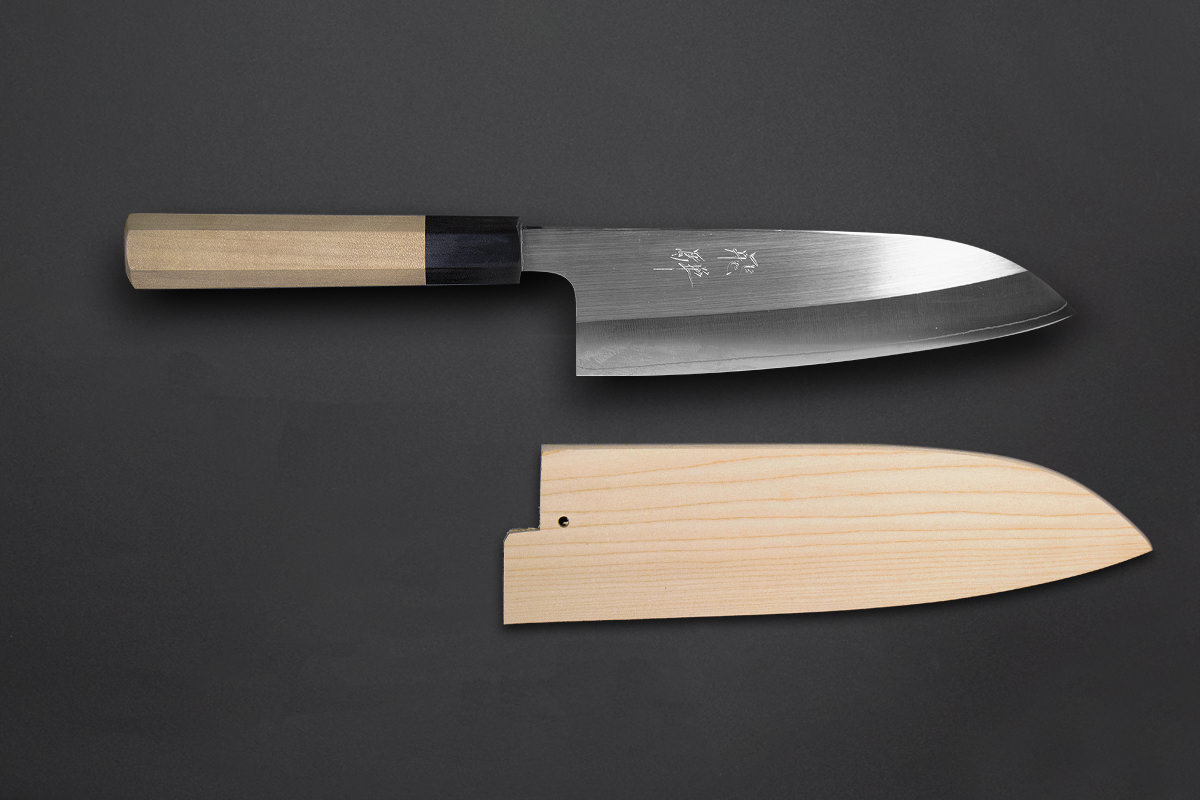
The Hida Santoku at Hida Tool is serious knife business. Credit: Hida Tool

Berkeley cooks get their knives sharpened at Hida Tool, a hardware store that sources the finest kitchen, woodworking, and gardening tools from Japan. For serious cooks, they carry an array of chef’s knives, from straight to western handles, and with different lengths and curves of blade. 

The Hida Santoku is their own original creation, crafted in collaboration with knifemaker Sakai Kikumori. It features modern and durable stainless steel, but finely sharpened to a Japanese bevel, and fitted with a traditional octagonal handle made of lightweight magnolia. Your minced herbs may never be the same. 

Hida Tool, 1333 San Pablo Ave. (near Gilman Avenue), Berkeley. Open 10 a.m.-5 p.m. Monday-Saturday, or purchase online.

For the neat freak who lives for pantry organization

Hard to imagine a spice rack more Instagrammable than this one from Sweet July. Credit: Sweet July

For anyone who thinks heaven must resemble the Container Store, here’s a sweet little slice of organization. At Sweet July, Ayesha Curry’s airy retail shop in Oakland, the television star and domestic polymath stocks a variety of different ceramics, linens and other home goods. Including this simply perfect spice rack, made of blonde acacia wood, petite enough to slide into most cabinets, and offering a triplet of tiered steps. 

So you can easily spy what’s inside every bottle! No more rummaging around in the spice cabinet up to your armpit. Either place existing bottles on the rack, or invest in the matching glass set with acacia stoppers (sold separately). At only twenty-something bucks for the rack, you could even throw in a bottle of Jamaican curry or jerk seasoning from Oaktown.  

Sweet July, 455 23rd St. (near Valley Street), Oakland. Open Monday, and Wednesday-Saturday from 8 a.m.-6 p.m., Sunday 11-6 (closed Tuesday), or order online.

For the farmer’s market rat who stalks seasonal produce

If time must pass, a calendar from Maria Schoettler makes it do so more deliciously. Credit: Maria Schoettler

She’s an icon. She’s a legend. She is the iconic vegetable calendar from Oakland illustrator Maria Schoettler. If you’ve ever stood in a kitchen, scrutinizing the brushstrokes of a lovingly hand-painted red kabocha or leaf of dino kale, perhaps you already understand. 

Schoettler has been making these kitchen calendars since 2008, and she paints them fresh every single year. “Fresh produce for a fresh year, baby,” as she writes on Instagram. They’re printed on thick and textured art stock and hang on a sturdy wire hook, so you can flip through the months and get excited for every microseason. There is no greater gift for hyperlocal produce obsessives in the East Bay. 

Maria Schoettler, stocked at shops across the Bay Area (and beyond) or available online.


Featured image: the blueberry, cornmeal and candied lemon teacakes with olive oil from California Soul. Credit: Aubrie Pick