At the intersection of food and culture

At the intersection of food and culture

No matter how different we are as individuals, we can all bond over a good meal. 

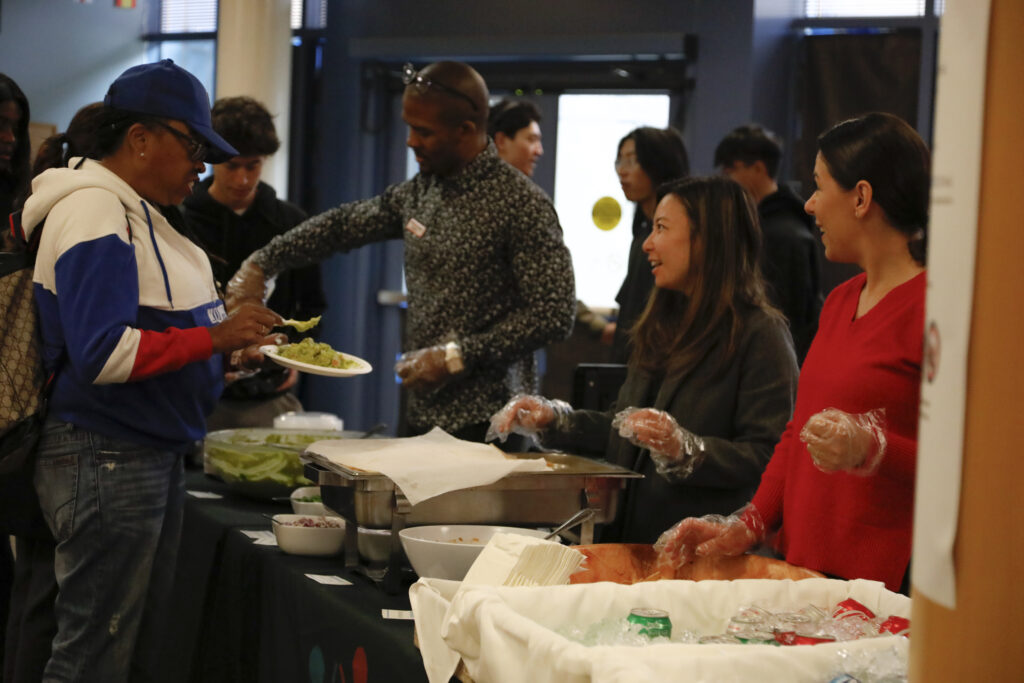
Coordinator of the Brahma Bodega Geremy Mason helps students assemble guacamole bowls in the Multicultural Center at Pierce College in Woodland Hills, Calif., on April 17, 2023. Photo by Rachael Rosenberg

“Food and Culture: Exploring the Intersection” was the first event of its kind at Pierce College. Held at the Multicultural Center on Monday, the event was a collaboration between the Brahma Bodega and the Multicultural Center that brought students and faculty together. 

The event provided an opportunity for people to learn about food and culture while making a dish.

Multicultural Center Coordinator Tatevik Melkumyan came up with the idea of the event while sharing food with her colleagues. Different dishes reminded them of foods from their own culture. 

“We think we’re very different, but really, we’re the same and we’re connected in a lot more ways than we actually know of,” Melkumyan said. “Being able to learn about food from different cultures and learning through food that we’re actually very much connected and very similar. So that’s what sparked the idea for the event.” 

A lot of people can relate to the feeling of having their own comfort foods, so this gives students the opportunity to experience comfort foods associated with various cultures. 

Brahma Bodega Coordinator Geremy Mason spoke about the significance of students exploring different aspects of themselves through traditions and food. 

Geremy Mason gets ready to assemble a guacamole bowl in the Multicultural Center at Pierce College in Woodland Hills, Calif., on April 17, 2023. Photo by Rachael Rosenberg
A student assembles a guacamole bowl in the Multicultural Center at Pierce College in Woodland Hills, Calif., on April 17, 2023. Photo by Rachael Rosenberg
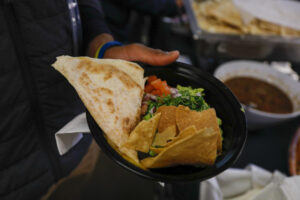
A student’s assembled guacamole bowl in the Multicultural Center at Pierce College in Woodland Hills, Calif., on April 17, 2023. Photo by Rachael Rosenberg

“I think it’s really important that students can explore all aspects of multiculturalism,” Mason said. “Food preparation, as we were talking about in the presentation, is a big part of cultural identity and tradition. We wanted to have some kind of collaboration where we got to discuss that and have an engaging activity.” 

After discussing the importance of food and culture, and the way they are interwoven, the main dish for the event was based on traditional Mexican cuisine. With the use of avocados in many different forms and cultures, students and faculty were able to create their own guacamole. 

Ingredients and materials were prepared at the food station for people to assemble their plates. From tomatoes, avocados, and red onions, to cilantro, salsa, and quesadillas. There was a wide variety of choices, as well as chips and refreshments. 

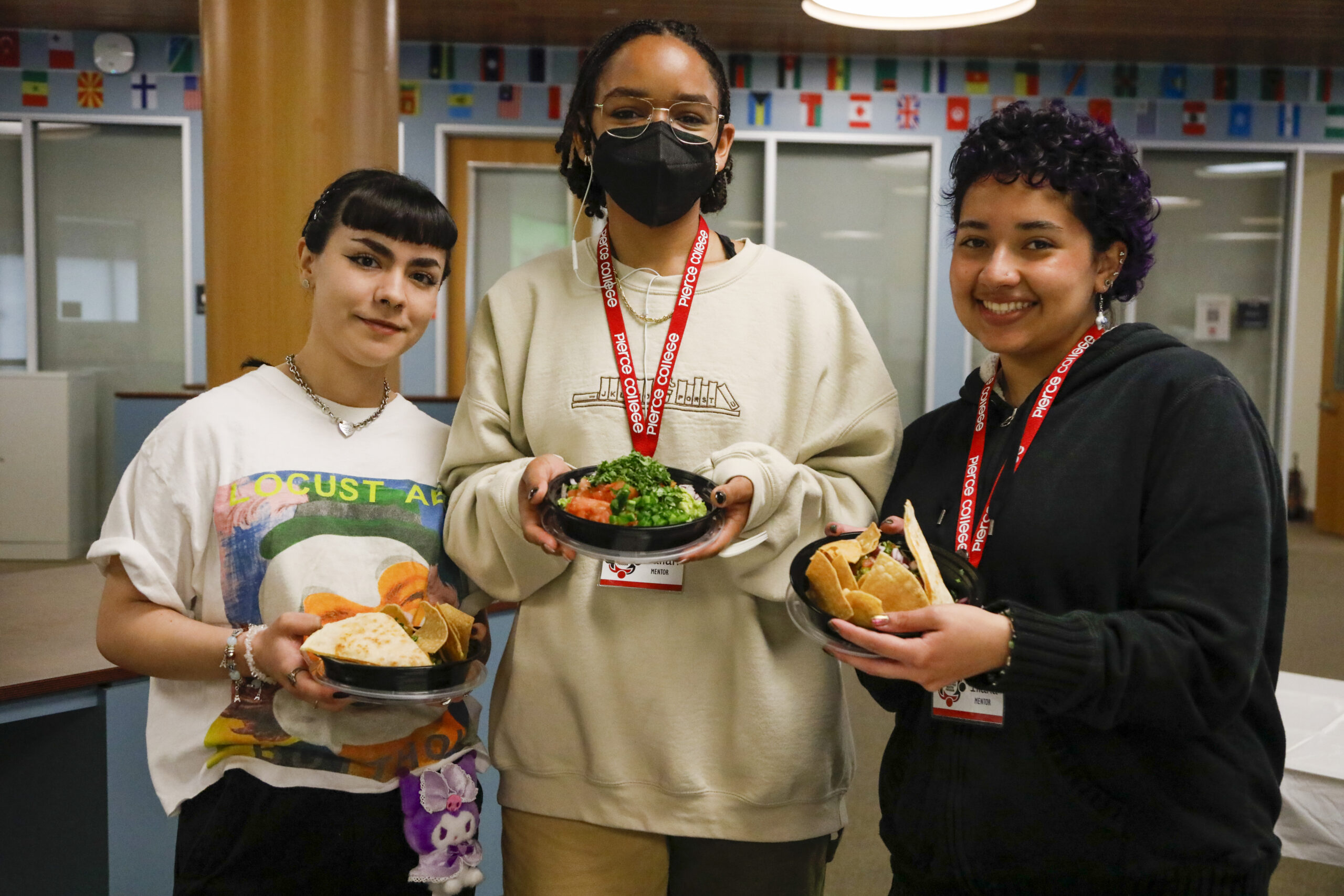
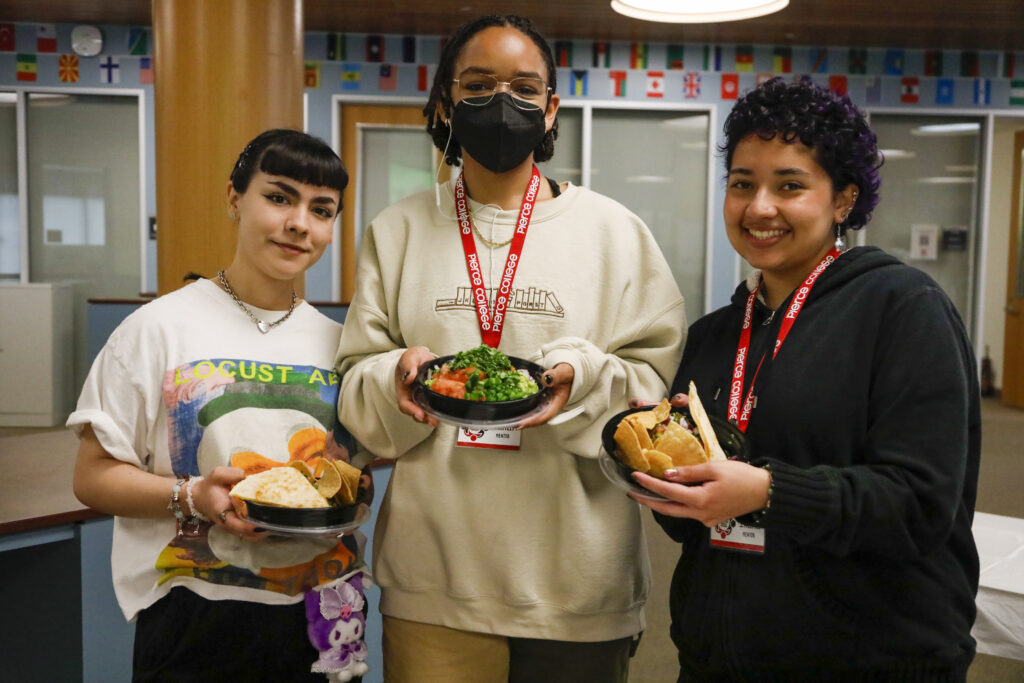
(Left-right) Pierce Students Isabella Vieyra, Nailah Babatunde-Bey, and Lliana Pride hold their guacamole bowls in the Multicultural Center at Pierce College in Woodland Hills, Calif., on April 17, 2023. Photo by Rachael Rosenberg

Pierce student Isabella Vieyra enjoyed the presentation and the making of guacamole. 

“I am Mexican, so it does feel like it hits a little close to home,” Vieyra said. “I think it’s fun and interactive and the presentation was a good explanation of its significance in Mexican culture.”

Dean of Student Engagement Juan Carlos Astorga expressed his connection to family traditions, and why it’s important for students to engage in the food of their culture. 

“It’s an amazing opportunity because as we talk about food and culture and the connection to that, it’s also about a connection to our elders and how we pass on traditions,” Astorga said. “It’s engaging our connection to culture, but also introducing how food does those intersectional connections to each other.” 

Freezer Meals: How Long Does Food Actually Keep?

Freezer Meals: How Long Does Food Actually Keep?

The drive to prepare a meal can come in waves. You braise short ribs for hours on Sunday and struggle to gather the will to make ramen on Thursday. On those nights, it helps to have a freezer full of, well, braised short ribs. It’s cheaper than takeout, requires nearly no energy to reheat and feels like an act of care, past you taking care of present you.

The freezer is the best source of fully cooked dishes, homemade meals that need only to be heated through and, of course, desserts for sweet cravings. (It also remains a smart place to store many ingredients.)

And it’s as simple to stack up dishes in your freezer as it is to understand what keeps best and when to eat it.

You can freeze anything, though some foods are better suited and all start to diminish in taste, texture and scent over time. So it’s not exactly a matter of can, but should.

How water turns into ice largely determines what freezes best. As fresh ingredients with a lot of water freeze, their cell walls break, altering their texture. Cooking does something similar, which is why, with their broken cell walls, fully and partly prepared dishes maintain their integrity in the freezer.

The short answer is a year, maximum — not because the food will spoil, but because it’ll taste sad. (The Centers for Disease Control and Prevention has a cold food storage chart, for more precise timelines.) Two to six months is better for ensuring quality. So is wrapping the food tightly. Exposure to freezing air causes food to dehydrate, making it tougher and more bland (commonly known as freezer burn). The oxygen in that air can also cause food to oxidize, causing fats to taste rancid. Follow these tips for ideal food storage and be sure to label and date every item using masking or painter’s tape and a permanent marker, so you’re never left wondering what you have.

As long as your freezer is at or below zero degrees, bacteria can’t grow. The best way to tell if something seems fine to eat is to smell and touch it after it defrosts. If it smells rotten or rancid, and doesn’t feel the way it should — think mushy, mealy fish — trash it. If you’re not sure, take a little nibble. If it tastes good, enjoy.

But remember: The freezer is not a time machine. If leftover stew close to turning in the refrigerator is thrown in the freezer, it won’t thaw into impeccably fresh stew. Once thawed, it’ll return to its iffy state.

Soups, Stews and Braises: Anything liquid, soft or stored in sauce stays intact in the freezer. Stocks, soups (creamy, chunky or brothy) and stews of all kinds (from curries to chilies) can be ladled into sturdy airtight containers with at least an inch of room at the top. Braised meat or vegetables like collards should be smothered evenly in their sauce. Meatballs hold up especially well if stored in gravy, and from-scratch beans like these oven-braised ones keep their creamy, tender texture when packed with their starchy simmering liquid.

Ideally, thawing would occur overnight in the refrigerator, but these dishes can be quickly defrosted straight from the freezer. Run the sealed container under hot water until the ice block releases, then slide it into a saucepan. Add a scant inch of water, set over medium-high heat, cover, and simmer, occasionally breaking up the ice, until everything bubbles evenly for a few minutes.

Casseroles and Sweet or Savory Pies: Lasagna and anything like it — meat, vegetables or starch layered with sauce — are freezer heroes. Fully cooked casseroles can be wrapped tightly in their dishes, then unwrapped, covered with foil and heated in the oven. Leftovers can be portioned and sealed into smaller containers, then popped out and zapped in the microwave or baked until bubbling. A casserole with cooked components, such as tomato-meat sauce or creamed broccoli and rice, can be assembled in the dish, wrapped and frozen, then cooked through in the oven.

Double-crust pies should be assembled with raw dough and chilled filling. The whole thing should be frozen uncovered until rock hard, then wrapped tightly until it’s baked from its frozen state. Quiche should be fully baked, then frozen whole or in wedges. Thaw in the refrigerator, then heat in the oven.

All Manner of Dumplings: Any two-bite treat wrapped in dough — potstickers, samosas, mandu, pierogies, lumpia, phyllo rolls and the like — falls into a special freezer-friendly category. All can be fully assembled with cooked or raw fillings, then frozen uncovered on a tray until hard before being transferred to airtight containers. Then, boil, pan-fry, steam, deep-fry or bake them straight from their frozen state.

Dessert: Homemade sweets should complement your ice cream stash. Meringue, gelatin, cream desserts like trifles, and delicate baked goods like sponge cake or tuiles don’t hold up well, but nearly every other sweet does. Cookies can be frozen as dough or fully baked. Dough balls and slices should be baked from frozen; ready-to-eat cookies taste fresh when heated in a toaster oven. Cakes and breads can be kept whole or wrapped in slices, and those with a very fine-textured crumb, like this marble cake, keep especially well.

Cupcakes, brownies and other bars, waffles, unfilled cream puffs (and their savory gougères cousins) keep well in airtight containers and thaw quickly at room temperature. For goods meant to be eaten hot, a quick blast in the toaster oven refreshes their crispness.

Stocking a freezer may seem like a task for vigilant planners, but it’s especially helpful for those who don’t plot out a weekly meal plan. Anytime you’ve made too much of a dish that freezes well, wrap leftovers well and throw them in. And anytime you’re just too exhausted to cook, heat them up and be delighted with the meal you so lovingly made.

New Restaurant Will Link Himalayan Food, Culture, Art, Religion

New Restaurant Will Link Himalayan Food, Culture, Art, Religion

New Restaurant Will Link Himalayan Food, Culture, Art, Religion

By ELIZABETH COOPER
COOPERSTOWN

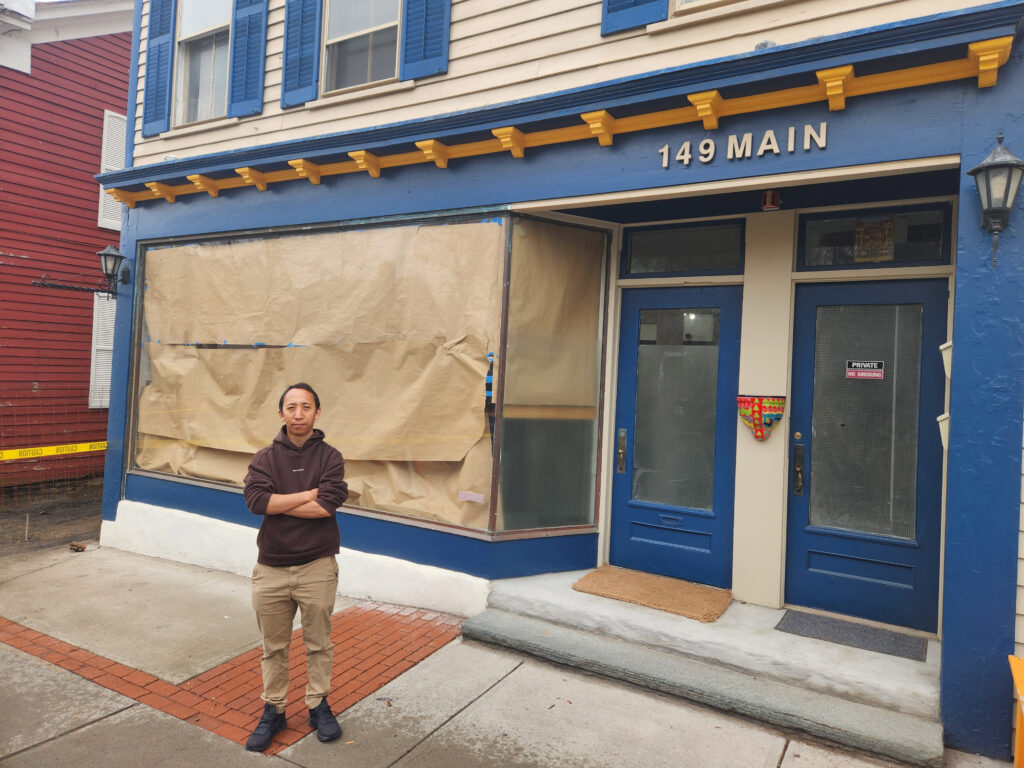
It has been more than a year since Alex’s World Bistro on Main Street closed its doors, but the spring sunshine has awoken more than the flowers this year.

The long empty storefront is suddenly a hive of activity. Contractors, an attorney and even a small child could be seen there on a recent Wednesday.

It’s all part of the next segment in the life journey of a Nepalese man who started out as a shepherd boy in a remote village without electricity or cars.

Nawang Gurung will be opening his restaurant, Norbu, in May. It will feature Nepalese and Indian food and he hopes it will also be a place where people can learn about Himalayan culture, art and religion.

He and his partner, Diki Bista, have two young daughters and they want them to grow up in a beautiful, natural surrounding like this one.

“I feel like it’s a home away from home,” he said of Cooperstown and his Himalayan homeland. “It’s like moving back to the mountains, compared to New York City.”

Norbu means jewel in Tibetan.

“For us, Cooperstown is a jewel and precious,” he said.

To Gurung, food, culture and art are linked and he wants to share it all. Norbu will be decorated with photographs of his homeland, and he is particularly excited to serve momo, a form of Nepalese dumpling.

“It is kind of like a Japanese gyoza,” he said. “In Tibet it has become a very popular food in the mountain areas.”

Cooperstown Chamber of Commerce Executive Director Tara Burke said residents and business owners were eagerly awaiting the restaurant’s opening.

“Alex’s was a beloved spot for locals,” she said. “I think there is a lot of excitement and questions about who is going into that space and what they will offer. It’s going to be a great, diverse option.”

As for Alex Webster, former owner of Alex’s, he said he “could not be happier” to see Gurung taking over the space.

“They seem like wonderful people and I am thrilled with the plans for the restaurant,” he said. “I am excited that in many ways they will continue in my effort to bring exciting, fun, quality food to the area.”

Alex’s old bar, made from sections of a bowling alley, remains in place and Gurung is in the process of getting a liquor license.

Here Because of Chocolate

Gurung’s unlikely trajectory from the mountains of Nepal has taken him through Dallas, Boston, New Haven, and New York, with time logged in some of America’s greatest universities, and the dining rooms of a number of Indian restaurants. He has worked for scholars and non-profits, but also waited tables to support himself and his family members back home.

It all began with the hope for a piece of chocolate.

“Chocolate was the only English word I knew,” said Gurung, now 37. “I am here because of that chocolate today.”

His village in the Mustang region of Nepal had been closed to tourists because of its holy connection to Buddhism, but that changed in the early 1990s when he was still quite young. Gurung and the other local children loved the chocolate that some of the outside visitors gave them and would ask for it whenever they could.

One day when 8-year-old Gurung was tending his flock of about 200 goats and sheep, he spotted a European man who seemed a likely prospect. The man didn’t have any chocolate, but he offered something that turned out to be far better. Charles Ramble was a professor of Tibetan culture at Oxford University. He spoke Nepalese and took a shine to little Gurung. He soon met Gurung’s parents and offered to take the boy to Kathmandu to get an education. They declined, but when Ramble returned a year later they accepted.

Gurung did well at the school and became interested in the study of culture and religion. After graduating he worked as an assistant for an American Fulbright scholar in Kathmandu. He then worked for an organization helping people with tuberculosis while searching for the next opportunity.

Because of his interest in religion, Gurung applied to a Baptist university in Dallas, Texas, but when they required him to be baptized in order to continue his scholarship he declined and had to leave.

Next, he went to Boston, because he had heard of Harvard University there. He couldn’t afford it and instead went to a community college nearby while working at an Indian restaurant frequented by Harvard students. They liked him and soon they were helping him sneak into classes so he could learn there.

Later he did the same in New Haven at Yale. Along the way, Ramble introduced Gurung to a Dartmouth professor, whom he briefly worked for doing research. He finally applied and was admitted to Columbia University, where he planned to major in cultural anthropology, but soon realized his small scholarship would not be enough to live on if he was to continue sending money home.

Instead of attending, he started his own project, Voices of the Himalayas, which seeks to document cultural change in Nepal, Tibet and other parts of the region. That work was funded by Dartmouth and other foundations. Later, he started working with young people from the Himalayas who live in New York, teaching them about their heritage. He is also working to document the experience of Himalayan people during the pandemic.

To Cooperstown

Gurung learned of Cooperstown from Daniel Kaufman, a linguist at Queens College whose family owns property near Fly Creek.

The two were good friends and Kaufman had mentioned Cooperstown to Gurung several times.

Gurung said it wasn’t until fall of 2022 that he considered coming up to see the place for himself after a dinner with Kaufman in Brooklyn. Starting fresh seemed more appealing to Gurung, because he had invested much of his savings in a childcare center Bista was hoping to operate, but COVID-19 had struck and the business was having difficulties.

So he and Bista hired an Uber and came up to have a look. He then spotted the empty Alex’s space and in short order put in a bid.

“It was one of the most impulsive acts I have ever seen in my life,” Kaufman said. “He wasn’t looking to move here, but he visited Alex’s and he bid on it. It was extremely spontaneous.”

Gurung, however, says there were many hints that Fate was at work.

“Always things [about Cooperstown] kept coming up,” Gurung said of the time after the Brooklyn dinner. “It was a karmic connection.”

It didn’t hurt that baseball is full of numbers that have significance in Buddhism. Nine innings, three strikes, four balls, 108 stitches on the ball.

“One hundred and eight is a very precious, holy number,” he said.

Kaufman said he had even suggested Gurung make a momo in the form of a baseball.

“I regularly come up with absurd ideas like that and usually people brush them off,” Kaufman said. “He decided he would give it a try!”

Gurung said it might be harder than he thought.

“It might be challenging,” he said. “I tried to do research on that.”

Whatever their form, Gurung will make sure they are delicious, he said.
National Cannabis Festival features 2 Chainz, policy, food and culture

National Cannabis Festival features 2 Chainz, policy, food and culture

The National Cannabis Festival, which returns to the RFK Stadium grounds for the seventh time this weekend, is known for its mix of activism and hip-hop, with past musical headliners including De La Soul, Ghostface Killah and Ludacris. This year, 2 Chainz, Juicy J and Free Nationals are topping the bill for a day-long show expected to attract thousands on Saturday, but festival founder Caroline Phillips is trying to create something much bigger than a concert.

“We hope that the National Cannabis Festival can become sort of like a South by Southwest for cannabis lovers,” she says, “where people are coming here for a full week of policy programing, cultural events and opportunities to network, all capstoned by the festival that takes place over the weekend.”

Organizers planned a whole slate of events in D.C., including policy forums, restaurant specials, DJ nights and a 4/20 fun run. The festival itself is introducing an LGBTQ lounge and will also hold pavilions focused on entrepreneurship, wellness and culture. (And, to answer the big question, no, smoking pot is not legal at the festival, but we’re betting the scent will still be in the air.)

Here’s what you need to know about the festival’s expanding activities.

You can have the munchies for a whole week

Food has always played a role at the festival — the Munchies Zone includes a mix of food trucks and chefs serving special dishes. This year, though, the deals have been extended outside of the gates, with nine days of wink-wink food and drink specials at local restaurants, running through Sunday. Among the highlights: Dolcezza’s “Munchies” adds peanut butter cups and chocolate-covered pretzels and potato chips to milk chocolate gelato. All Purpose Shaw’s Italian 420 cocktail spikes gin, prosecco, cassis and lemon with a CBD-infused rose syrup. Jerk at Nite offers the choice of its Jamaican-style Yardie platter with a patty or jerk chicken and mac. The full menu is on the festival website.

Bring your running shoes — or your dancing shoes

420 Week, with three days of events leading up to the festival, brings a mix of activities, including a mushroom cultivation workshop and a networking social sponsored by the National Association of Black Cannabis Lawyers. Among the highlights: A 4.2-mile 4/20 run, starting at Meridian Hill Park on Thursday morning; a 4/20 Kickback social event at Songbyrd on Thursday night, with music and video; and a free Friday night party at Wild Days, the Eaton hotel’s rooftop bar.

The music goes beyond the headliners

2 Chainz and Juicy J are “so revered in the cannabis community,” Phillips says, but there’s local representation at the concert, thanks to Backyard Band — “our house go-go band” — and a first-time performance by D.C.’s Cumbia Heights. “As the festival has grown, we have had to expand the music offerings to make sure that we are bringing a music experience together that appeals to our very diverse audience,” she says. “This year, we’re really excited to be bringing Cumbia Heights to the festival to make sure that we have some music that represents the Latin American community in D.C.”

Grow your own? Learn from the best.

While D.C., Maryland and Virginia all have different rules about purchasing or accessing marijuana, each jurisdiction does (or will) allow residents to possess their own plants. New this year at the festival itself is a Grower’s World, where festivalgoers can meet participants and judges from the National Cannabis Championship — a celebration of homegrown cannabis flowers. “Folks can talk to them about the methods they’ve used to grow such great plants,” Phillips says, or ask, “This is my setup at home — what should I be doing differently?” There will also be vendors selling equipment for those inspired to upgrade.

Wondering about the future of weed? You might find it at CannaTank.

Since the beginning of the festival, it has hosted a “Shark Tank”-style competition that allows budding entrepreneurs to pitch a cannabis-related business venture to win cash and face time with PR teams, among other prizes. This year’s participants are Upling, a dispensary delivery app billed as “DoorDash for weed”; Natural Elevation Snacks, a line of organic oat and honey snacks; Herban Holistic Healthcare, which offers wellness and cannabis coaching; and “The Phytos,” a “pot edutainment comic about a team of terpenes and cannabinoids.” The finalists offer their final pitches at 4 p.m. Saturday.

Even Official Washington participates in 420 Week

While marijuana legalization and reform movements evolve across the country, “there are still many challenges ahead,” Phillips says. The National Cannabis Policy Summit, first held in 2018, brings together lawmakers, business leaders, lobbyists and advocates at the U.S. Capitol Visitor Center on Thursday to discuss the current landscape. Senate Majority Leader Charles E. Schumer (D-N.Y.) will deliver the keynote speech; the event is free for the public to attend. Even Phillips is sometimes stunned by how far public sentiment about cannabis has come in recent years: “I think if you’d asked me eight years ago if our event would be invited into the United States Capitol, let alone having the Senate majority leader deliver the keynote address, I would have told you, ‘I don’t know if that’s going to happen.’”

National Cannabis Festival

Festival Grounds at RFK Stadium, 2400 East Capitol St. SE. nationalcannabisfestival.com.

Date: Saturday from noon to 10 p.m.

Admission: $85; $306 for a group of four. VIP tickets $425.

How can we make our brains prefer healthy food? – study

How can we make our brains prefer healthy food? – study

Frequent sugary food consumption can create the same bodily response as drug addiction, which can be passed down from mother to baby during breastfeeding, a new study has found. 

The peer-reviewed study, published in the journal Cell Metabolism, has found that what someone eats alters their brain’s reaction to food. 

The study explains that the brain can begin associating neutral signs with cravings, similar to Pavlov’s theory of association. Seeing the sign for a favorite patisserie can cause hunger and/or the drive to consume without the presence of hunger. 

The association between the stimuli, in this case the patisserie, and the resulting feeling of hunger or desire for food is subliminally through the central nervous system. In response, the body will release dopamine that will entice future actions.

WHY IS sugar addictive? (credit: DAVID DEWITT/THECOZYCOFFEE)

Sugar creates a strong dopamine response in the brain’s pathways that connect frontal lobe regions and the desire to eat sugar is further fueled by the body’s cells using the glucose for energy consumption.

How does a high-fat diet impact food cravings?

Scientists provided rats with a high-fat diet (HFD) and found that not only did the rats gain weight, but their dopamine signaling and functioning were also altered. The rats’ food preferences also changed.

When the scientists stopped the HFD, the rats showed a decreased desire for food.

The same experiment was carried out on mice and provided similar results. 

Is the same true for humans?

It was previously not tested whether the diet results shown in animals translate to humans. 

The study notes that this is an important question because it extends current models of obesity, which argue that genetic or trait-like factors predispose individuals for weight gain in an environment that is not conducive to weight loss. Furthermore, researchers theorize that if exposure to an HFD rewires brain circuits to impact preference and associative learning, then the cycle of overeating may begin with environmental exposure instead of (or in addition to) a predisposition.

To assess this, healthy, normal-weight participants underwent baseline assessment. Next, the participants were randomly assigned to dietary intervention with a high-fat, high-sugar (HF/HS) or a low-fat, low-sugar (LF/LS) yogurt 2 times a day, in addition to their normal diet, for 8 weeks. Subsequently, all subjects were reassessed (post-intervention session).

Participants were tested on designated days after an overnight fast.

Testing looked at BMI, hunger rating, and a blood draw. Subsequently, the participants received a granola bar for breakfast and performed a fat and sugar concentration preference test and a stop signal task, which tests inhibition responses by asking participants to respond as quickly as possible to a predetermined stimulus but to cease any response when a subsequently presented stop signal is displayed.

After a second blood draw examining glucose level, participants underwent fMRI acquisition during which they carried out a food anticipation and consumption task on a milkshake, showing that when faced with a choice of food products, either for immediate or later consumption, our brain anticipates the likely affect the food will have on us. 

Next participants underwent an associative learning task, learning about the relationship between two seemingly unrelated stimuli becoming connected. 

Results indicated that indeed the results on animals remained true for humans as well. Repeated exposure to energy-dense, HF/HS food, in the absence of body weight or metabolic change, can rewire brain circuits and shift dopamine-dependent associative learning and preference for particular foods. 

BSI puts focus on food safety culture with new guidance

BSI puts focus on food safety culture with new guidance

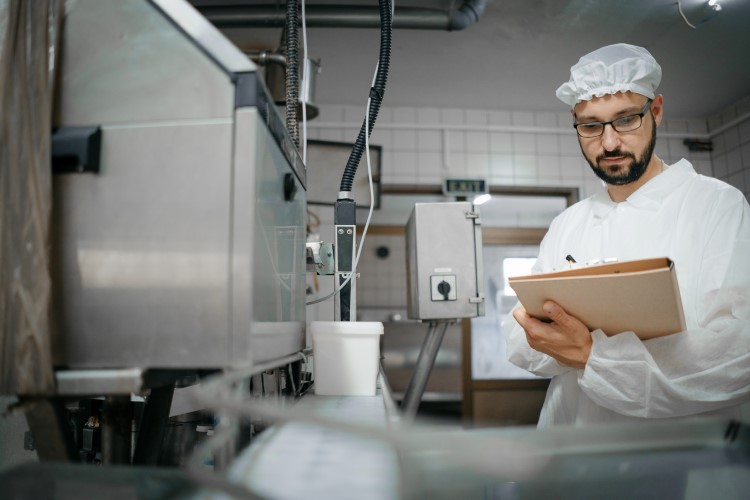
Relevant to anyone from manufacturers and factory workers to restauranteurs and baristas, the guidance has been published by the British Standards Institution (BSI) following extensive sector discussion on food safety culture, including what it is, how to measure it and how to ensure continuous improvements.

Food industry majors – including Walmart, McDonald’s, PepsiCo, HelloFresh, Kerry Foods and 3M – have all been involved in drafting the guidance.

Positive food safety culture

The document – named PAS 320 – includes steps on identifying gaps and then implementing a plan for change. It makes recommendations related to leadership; the organization’s vision, mission, values and policy; organizational structure; responsibilities, accountabilities and authorities; guiding coalition team; interested parties; change champions; influencers; and food safety documentation.

In particular, the guidance also includes advice on how prioritizing people in the sector not only supports improved food safety, but also brings other benefits including investment return, business performance improvement, reduction of the costs associated with poor quality, and enhanced efficiency. For example, the guidance notes that creating and maintaining a strong culture that preserves quality and reduces risk requires management commitment and a mindset that safety is the responsibility of everyone at every stage of the food supply chain.

The guidance is published at a time when packaging and labelling regulations is being led by the Food Standards Agency following the UK’s exit from the European Union through Brexit. New allergen labelling laws that came into force in the UK last year also require businesses to label all food that is pre-packed for direct sale with a full list of ingredients, with the 14 major allergens including milk emphasised in the list.