
Thanksgiving leftover recipes: Stuffing cakes, turkey pasta & more

Thanksgiving leftover recipes: Stuffing cakes, turkey pasta & more

Too much turkey and stuffing overload isn’t a problem for those who like Thanksgiving leftovers. Chef Eric LeVine, partner at 317 Main restaurant in Farmingdale, has these recipes for a fresh twist: 

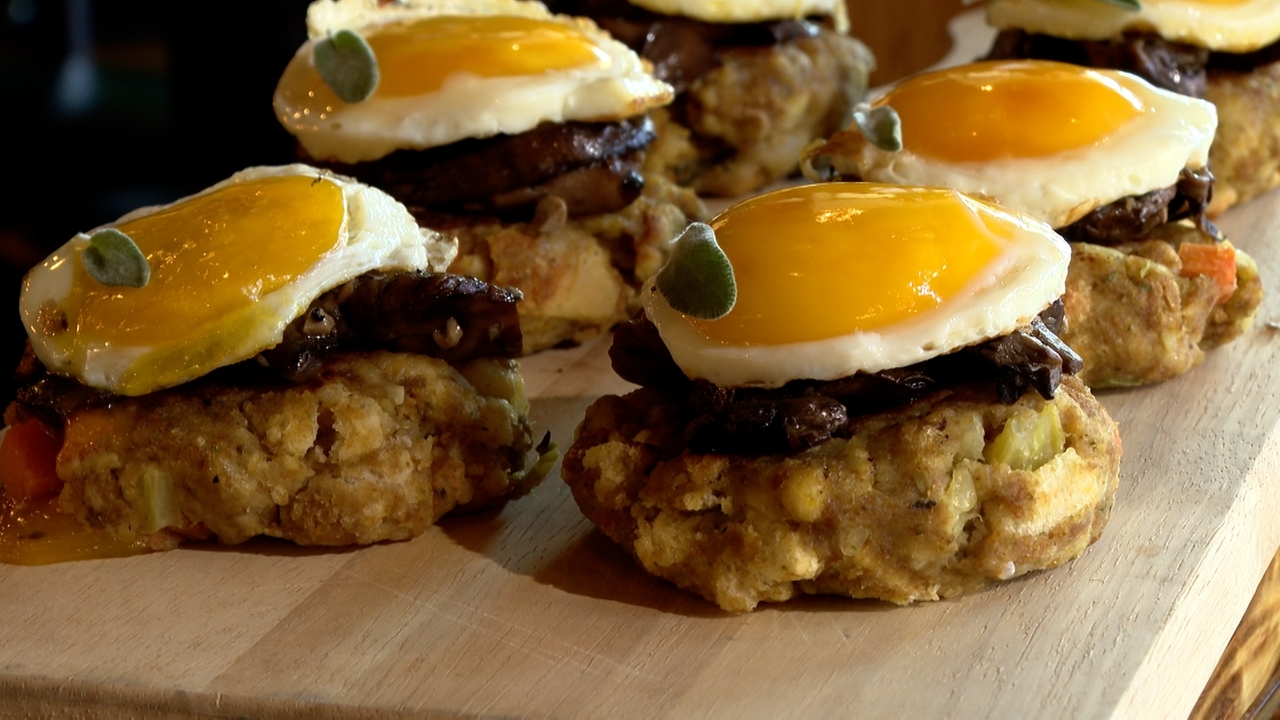
Stuffing Cakes with Roasted Mushrooms

For stuffing cakes:

2 cups leftover stuffing

2 eggs 

1/2 cup Italian breadcrumbs 

2 tablespoons olive oil 

12 thin slices pancetta

1 tablespoon fresh lemon juice 

1 tablespoon kosher salt 

6 eggs, at room temperature 

1. Place the stuffing in a large bowl, breaking up any large clumps. Add the eggs and breadcrumbs and stir to combine, making sure all of the stuffing is evenly coated with the eggs.

2. Scoop 1/3 cup of the stuffing into your hands and shape into a patty, about 3-inches wide and 1/2-inch thick. Repeat to make 6 stuffing cakes.

3. Heat the oil in a medium skillet over medium-high heat and cook the cakes, two at a time until golden brown, 2 to 3 minutes per side. Transfer to a paper-towel-lined plate and repeat with the remaining cakes. Loosely cover with foil to keep the cakes warm.

Roasted mushrooms:

1 1/2 pounds cremini mushrooms

4 cloves garlic

3 tablespoons olive oil

1 1/4 teaspoons kosher salt

1/4 teaspoon freshly ground black pepper

1 tablespoon 

balsamic vinegar

Chopped fresh chives or parsley, for serving (optional)

1. Arrange a rack in the middle of the oven and heat the oven to 450°F.

2. Trim and quarter 1 1/2 pounds cremini mushrooms and place on a rimmed baking sheet. Smash and peel 4 garlic cloves and add them to the baking sheet. Drizzle with 3 tablespoons olive oil and season with 1 1/4 teaspoon kosher salt and 1/4 teaspoon black pepper. Toss to coat and spread out in a single layer.

3. Roast, tossing halfway through, until the mushrooms are tender and caramelized, 18 to 20 minutes total. Remove from the oven, drizzle with 1 tablespoon balsamic vinegar, and toss to coat. Garnish with chopped fresh chives or parsley

Add roasted mushrooms on top of stuffing cake and top with a fried egg.

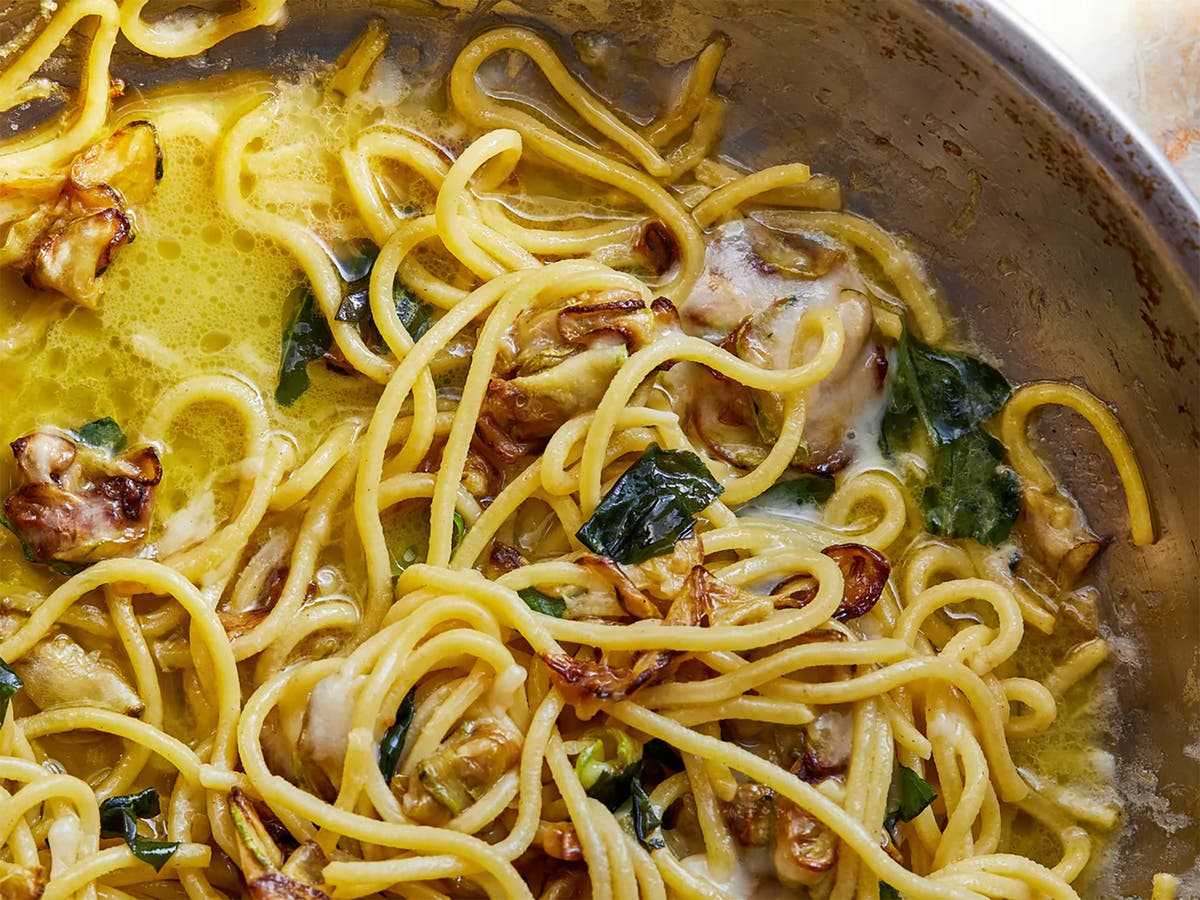
Turkey bucatini pasta

2½ teaspoons kosher salt

¾ pound bucatini or gluten-free noodles

½ cup (1 stick) + 2 tablespoons salted butter

½ cup slivered almonds

½ cup panko or gluten-free panko

2 garlic cloves, minced

¾ teaspoons garlic powder

¼ teaspoons ground nutmeg

½ teaspoons freshly cracked black pepper

1½ cups heavy whipping cream, room temperature

2 cups freshly grated Grana Padano or Parmesan cheese

2 cups cubed leftover turkey

¼ cup minced flat-leaf parsley, for serving

1. Fill a large pot with 4 quarts of water and add 2 teaspoons of the salt. Bring to a boil over high heat. Add the bucatini and cook until al dente according to the package instructions. Drain.

2. Meanwhile, heat a small dry skillet over medium-high heat. Add the almonds and toast, about 4-5 minutes. Transfer the almonds to a small bowl. In the same skillet, melt 2 tablespoons of the butter over medium-high heat until sizzling. Add the panko and cook, stirring, until golden brown, 3-4 minutes. Transfer the panko to a separate small bowl.

3. Melt the remaining ½ cup of butter in a large skillet over medium-high heat. When the butter begins to sizzle, add the garlic, garlic powder, nutmeg, remaining ½ teaspoon salt, and pepper, stirring, until the garlic is fragrant, about 1 minute.

4. Gradually stir in the heavy cream and bring to a simmer. Add the Grana Padano and stir until fully incorporated, about 2 minutes. Reduce the heat to low and cook until thickened, about 5 minutes. Stir in the turkey and continue cooking until warmed through.

5. Remove the pan from heat. Add the bucatini and toss to coat.

To serve, divide the pasta among 4 bowls, sprinkle with toasted panko, almonds, and parsley.

Ham croquet recipe

4 tablespoons unsalted butter room temperature

1 tablespoon finely chopped onion

1 cup whole milk room temperature

1 cup all-purpose flour divided

1/4 teaspoon nutmeg

Salt and pepper to taste

1 tablespoon dry cooking wine (vino seco)

1 pound ground ham* (see note)

2 large eggs room temperature

1 cup bread crumbs (or finely ground saltine crackers)

Vegetable oil for frying

1. In a saucepan, melt butter at medium-low heat. Add onion and cook for 1 minute.

2. Slowly whisk in milk, 1/3 cup of flour, nutmeg, salt and pepper. Continue to whisk until it becomes a very thick sauce (a roux).

3. Add in the cooking wine and ground ham to the sauce. Mix together slowly until combined. Reduce heat to low and let simmer for 5 minutes.

4. Transfer the filling to a bowl. Let it rest at room temperature then refrigerate for 2 hours or overnight (the longer the better). The mixture has to harden in order to form into logs and coat evenly. If this step is skipped, it will be very hard to form logs, coat with the breading, and fry.

5. Remove the filling from the refrigerator. Form logs from the mixture straight from the fridge. It’s OK if they are cold, it will be easier to form the logs this way. You want the logs to be approximately 3″ long and 1″ wide. If the mixture is sticky as you’re making the logs, add bread crumbs, 1 tablespoon at a time, to the mixture until it’s no longer sticky.

6. Continue forming the logs until you have all the croquette logs done then place them back in the fridge to firm up once again, about 30 minutes.**

7. To bread the croquette logs, you want to set up a breading station. In one bowl, whisk eggs and set aside. In another bowl, mix the remaining flour and bread crumbs.

8. Remove the logs from the fridge. Dip each croquette log in the egg wash and then coat in breadcrumb/flour mixture. Repeat with each one until they are all breaded. Let the croquettes rest at room temperature for 5 minutes before frying.

9. In a large pot or pan, heat enough vegetable oil to cover the croquettes completely. Fry each croquette until golden brown, approximately 3-4 minutes. Don’t crowd the pot too much as you are frying. This will help them all get evenly cooked.

Sweet potato risotto

2 tablespoons olive oil

1 large onion, finely chopped

Kosher salt and black pepper

2 small sweet potatoes (about 1 pound), cut into 1/4-inch pieces

2 cloves garlic, chopped

1 cup Arborio rice

1 cup dry white wine

½ cup grated Parmesan (2 ounces)

2 teaspoons chopped fresh oregano

1. Heat the oil in a large saucepan over medium heat. Add the onion, ½ teaspoon salt and ¼ teaspoon pepper. Cook, stirring occasionally, until soft, 3 to 5 minutes.

2. Add the sweet potatoes and garlic and cook, stirring occasionally, for 1 minute.

3. Add the rice and cook, stirring, for 2 minutes. Add the wine and cook, stirring frequently, until absorbed.

4. Measure 3½ cups of water. Add ¾ cup at a time and cook, stirring occasionally and waiting until each addition is absorbed before adding the next. It should take 25 to 30 minutes for all the water to be absorbed.

5. Stir in the Parmesan and oregano.

Broccoli casserole frittata

2 tablespoons olive oil

1 garlic clove (thinly sliced)

3 ½ cups broccoli florets

¼ teaspoon crushed red pepper

Salt

Pepper

8 large eggs

½ cup grated Parmigiano-Reggiano cheese (1 1/2 ounces)

1. Preheat the oven to 350°. In a 10-inch ovenproof nonstick skillet, heat 1 tablespoon of the olive oil. Add the garlic and cook over moderately high heat for 30 seconds. Add the broccoli and crushed red pepper and cook for 1 minute. Stir in 2 tablespoons of water, season with salt and pepper and cover. Cook over moderate heat until the broccoli is crisp-tender, 2 minutes; let cool.

2. In a bowl, whisk the eggs with 1/4 teaspoon each of salt and black pepper. Stir in the broccoli. Return the skillet to the stovetop and heat the remaining 1 tablespoon of oil. Pour in the eggs and cook over moderately low heat until set around the edge, 3 minutes. Sprinkle the frittata with the cheese. Transfer the skillet to the oven and bake the frittata until the center is just set, about 12 minutes. Serve warm or at room temperature.

3 no-cook pasta sauce recipes for weeknight easy dinners

3 no-cook pasta sauce recipes for weeknight easy dinners

Pepper, Harissa and Tomato Pasta Sauce

Total time:20 mins

Servings:4 to 6

Total time:20 mins

Servings:4 to 6

You know that little tingle of excitement you feel when Netflix is about to drop a new season of your favorite show? I get that feeling when I find out Sabrina Ghayour is about to release a new cookbook.

Recently, I ripped open a thick envelope and found an advance copy of her “Persiana Everyday.” The book is due out in October.

I’m a fan because Ghayour writes for the harried home cook who wants big flavor.

“I cook every day. I’ve cooked every day since I was a kid — every meal in the house,” she said in a phone call from home in the United Kingdom. The Iranian British chef has written about growing up an only child in a house with parents who did not cook. She credits that with freeing her from being hidebound by tradition and giving her room to experiment.

When I asked Ghayour about the deftness of her tightly written recipes, the author of six cookbooks said: “I’m phenomenally lazy. I don’t like washing things if I don’t have to.”

She often refers to herself as “stubborn,” saying she respects classic cooking techniques, but in her day-to-day life as a working stepmom, she leans into efficiency and away from what she calls “mama cooking,” cooking it the way it has always been done, following specific rules and a firm ingredient list, and using multiple bowls, pots and pans.

7 no-cook recipes for tacos, soup, dessert and more

“I wanted to be a commercially available Middle Eastern girl,” she said of her food writing and recipe development. “I want people to cook from my books — not do one amazing feast that took 15 hours to prepare and then put the book back on the shelf.

“If you really want to be truthful, there is really not that much authenticity in this book, because I made this up.

“My whole ethos and style is stripping things back from the perspective of what we don’t need. If, as Persians, we have certain ingredients that you have to hunt down, I’m like, don’t use that.”

Make this Sabrina Ghayour recipe: Walnut, Spinach and Herb With Zucchini Pasta Sauce

Case in point: Several simple recipes feature rose harissa, the Tunisian chili paste with rose petals or water for a more floral note.

I told her I struggled to choose a recipe from her latest cookbook because I’m tempted by so many, including her Harissa and Lemon Roasted Chicken Thighs, in which the chicken is slathered with a mixture of harissa, yogurt, lemon juice and zest and baked until slightly charred.

“I’m making them right now,” she said. “I really make them all the time. They’re just like a two-minute no-brainer. I can have the chicken with wraps or rice and tomorrow it will go into a curry.”

When I mentioned how often she uses harissa in her recipes, Ghayour said: “I live in a village with no grocery store, no shops, so I use the same things over and over again.”

Harissa brings the heat in these 5 recipes

Harissa is one of the condiments she urges home cooks to keep on hand because it is so versatile. (If you buy a jar, you also can use it to make the Harissa Chicken Noodle Lettuce Cups from her “Simply: Easy Everyday Dishes” cookbook.)

“It’s great stirred into pasta sauces. It’s great in stir-fries to make it spicy. It’s great in salad dressing. It’s great in butter compounds. It’s just that completely giving ingredient that you cannot stop using.” Still, she said, if you don’t have it, substitute your favorite chili paste.

Make this Sabrina Ghayour recipe: Yogurt, Tarragon and Pistachio Pasta Sauce

“In terms of food, [the pandemic] has been an education that I didn’t expect,” she said. “It made us realize that, as cooking professionals, we’re lucky our pantries are stocked a little better with somewhat [hard-to-find] ingredients.”

The recipe I eventually settled on is a 10-minute, no-cook Pepper, Harissa and Tomato Pasta Sauce, which has multiple uses.

Ghayour encouraged me to imagine quickly pan-frying bone-in chicken thighs, then baking them with this sauce and a handful of salty black olives. The pepper sauce also is great with cubed potatoes for a patatas bravas-style dish or tossed with lamb meatballs.

Staff picks: 8 condiments we swear by and how to use them

She included recipes for two other no-cook pasta sauces on the same page, and I tried those as well.

She also recommends serving the Walnut, Spinach and Herb With Zucchini Pasta Sauce over thin, breaded chicken cutlets with a squeeze of lemon, while the Yogurt, Tarragon and Pistachio Pasta Sauce pairs well with lamb or kefta kebabs.

All three of these sauces freeze beautifully. I know because I made them all in one night and sampled each, then froze the leftovers.

And, if Ghayour writes another cookbook, which I hope and think she will, I’ll probably write about that one, too. Keep on being stubborn, Ms. Ghayour.

Pepper, Harissa and Tomato Pasta Sauce

This spicy red no-cook sauce comes together in about 10 minutes in a blender. It’s so easy to make, it might be done before your pasta has finished boiling. The dish can be a fast and easy weeknight meal, but it also works well as a side dish with simply cooked proteins, such as steak, grilled chicken, lamb or tofu.

Storage Notes: Refrigerate leftover sauce for up to 3 days; freeze for up to 1 month.

Where to Buy: Make your own rose harissa, or find it in international markets or online.

Want to save this recipe? Click the bookmark icon below the serving size at the top of this page, then go to My Reading List in your washingtonpost.com user profile.

Scale this recipe and get a printer-friendly, desktop version here.

  • 1 pound your favorite pasta shape
  • Fine salt
  • 2 large red, orange or yellow bell peppers (14 ounces total), cored, seeded and coarsely chopped
  • 6 ounces oil-packed sun-dried tomatoes
  • 2 large cloves garlic, coarsely chopped
  • 2 tablespoons rose harissa
  • Freshly ground black pepper
  • Grated Parmesan cheese (optional)

Fill a large pot with water, place over high heat and bring to a boil. Season lightly with salt, add the pasta and cook according to the package instructions, stirring occasionally, until al dente.

While the pasta is cooking, place the bell peppers, sun-dried tomatoes, garlic and harissa in a blender and process until smooth. Taste, and season with salt and pepper, as needed.

Once the pasta is cooked, drain and add it to a large bowl. Pour the sauce over it and, using tongs or two big forks, toss to coat. Serve family-style, with Parmesan cheese, if desired.

Per serving (1 1/3 cups pasta, 1/3 cup sauce), based on 6

Calories: 364; Total Fat: 6 g; Saturated Fat: 1 g; Cholesterol: 0 mg; Sodium: 168 mg; Carbohydrates: 67 g; Dietary Fiber: 5 g; Sugar: 5 g; Protein: 12 g

This analysis is an estimate based on available ingredients and this preparation. It should not substitute for a dietitian’s or nutritionist’s advice.

From “Persiana Everyday” by Sabrina Ghayour (Hachette, 2022).

Tested by Ann Maloney; email questions to voraciously@washpost.com.

Scale this recipe and get a printer-friendly, desktop version here.

Browse our Recipe Finder for more than 9,900 Post-tested recipes.

Did you make this recipe? Take a photo and tag us on Instagram with #eatvoraciously.

Steamed bream, herby pasta: Yotam Ottolenghi’s recipes for 30-minute meals | Food

Steamed bream, herby pasta: Yotam Ottolenghi’s recipes for 30-minute meals | Food

For some, a 30-minute meal is a super-quick fix. For others, it’s a longer than they usually spend making dinner. For me, however, whether it’s midweek or when we have friends over at the weekend, it’s pretty much where I’m at. On the one hand, 30 minutes is no time at all – it’s an episode of something quick on TV, a podcast listen or a catch-up with a buddy on the phone – but it’s also enough time to make something special. And, if I’m feeling really organised, I’ll call a friend or listen to a podcast while I’m cooking, so I’m smashing it, or at least feel as if I am, before supper’s even served.

Steamed bream, red bulgur and spicy pine nuts (pictured top)

A well-stocked pantry will mean you’ll have to buy only minimal ingredients for this. That said, if you don’t have what’s listed below, you can sub them with alternatives: almonds or walnuts, say, instead of the pine nuts, cherry tomatoes instead of baby plums, and so on.

Prep 5 min
Cook 25 min
Serves 4

2 tbsp olive oil
1 onion
, peeled and finely chopped (180g)
150g baby plum tomatoes
Fine sea salt
¼ tsp chipotle flakes
250g coarse bulgur wheat
250ml light coconut milk
½ vegetable stock cube
, crumbled (or 1½ tsp bouillon powder)
2 tbsp tomato paste
4 sustainably sourced sea bream fillets
, skinned
3 tbsp (10g) picked coriander leaves, roughly chopped

For the quick-pickled shallots
1 large banana shallot, peeled and cut into thin rounds (50g)
2 tsp lime juice
⅛ tsp caster sugar

For the spicy pine nuts
1 tbsp pine nuts
2 garlic cloves
, peeled and thinly sliced
1 tbsp oil
½ tsp chipotle flakes

Put a large, nonstick frying pan for which you have a lid on a medium-high heat. Add the oil, onion, tomatoes and a half-teaspoon of salt, and fry, stirring occasionally, for five minutes, until the onions turn translucent and the tomatoes start to break down.

Stir in the chipotle, fry for two minutes, then add the bulgur and toast for two minutes. Pour in the coconut milk, then stir in the stock cube, tomato paste and 200ml water, turn down the heat to medium, cover and cook for 10 minutes.

Meanwhile, put a small frying pan on a medium-high heat, add all the spicy pine nut ingredients and fry gently, stirring often, for four to six minutes, until the garlic turns golden. Tip into a small, heatproof bowl and set aside to cool slightly (make the nuts well in advance, if you like).

Sprinkle an eighth of a teaspoon of salt in total over the flesh side of the fish fillets. Take the lid off the bulgur pot, give it a good stir, then lay the fillets skinned side up on top. Cover again, leave to cook for five minutes, then take off the heat and leave to rest, still covered, for two minutes. Finish with a heavy grind of pepper.

While the fish is cooking, mix all the quick pickle ingredients in a small bowl and set aside for five minutes.

Scatter the shallots on top of the fish, spoon over the pine nuts and their oil, sprinkle with the coriander and serve.

Olive salsa verde and golden raisin pasta

Yotam Ottolenghi’s salsa verde golden raisin and olive pasta.
Yotam Ottolenghi’s olive salsa verde and golden raisin pasta.

Inspired by Sicilian pastas, which contrast the sweet and the savoury, this is quick, easy and very versatile. A fridge and cupboard raid will make for countless variations – the addition of some tinned fish would be very welcome, for example.

Prep 10 min
Cook 20 min
Serves 4

360g trofie, or any other short, dry pasta such as penne
⅛ tsp saffron
3 tbsp golden raisins
1 tbsp lemon juice

For the almond pangrattato
30g blanched almonds, roughly chopped
4 tsp olive oil
45g panko breadcrumbs
1 tsp finely grated lemon zest
Fine sea salt and black pepper

For the salsa verde
20g mint leaves
20g parsley leaves
20g basil leaves
2 garlic cloves
, peeled and crushed
2 tbsp capers
80g pitted green olives
, roughly torn into quarters
1 tbsp good white-wine vinegar
75ml olive oil

For the pangrattato, put a large frying pan on a medium-high heat, add the almonds and a teaspoon of olive oil, and toast, stirring frequently, for three minutes, until golden brown. Add the breadcrumbs, the remaining tablespoon of oil and a good grind of pepper, and toast, stirring constantly, for four minutes more, until a deep, golden colour. Tip into a medium bowl, stir in the lemon zest and an eighth of a teaspoon of salt, and leave to cool for 10 minutes.

For the salsa verde, put all the herbs on a board and chop finely. Add the garlic and capers, and repeat until very finely chopped. Scrape into a large bowl, add the olives, vinegar, oil, an eighth of a teaspoon of salt and a good grind of pepper, and mix well.

Bring a large pot of salted water to a boil, add the pasta and saffron, and cook for six minutes (or four minutes less than the packet instructions say for al dente). Drop in the raisins, cook for two minutes more, until plump, then drain and reserve 50ml of the cooking water.

Return the pasta to the dry pan, put it on a low heat and stir in the salsa, reserved pasta water and lemon juice. Divide between four shallow bowls and serve scattered with the pangrattato.

Brothy beans with roast mushrooms and chive salsa

Yotam Ottolenghi’s brothy beans with roasted mushrooms and chive salsa.
Yotam Ottolenghi’s brothy beans with roast mushrooms and chive salsa.

This is a great weekday lunch or dinner. If you like, swap the butter beans for any tinned beans you have to hand. Serve as it is, or with plenty of crusty bread or fluffy rice.

Prep 10 min
Cook 20 min
Serves 6

10g dried porcini
500g mixed mushrooms
, cut in half – I used king oyster, oyster, chestnut and shiitake
150g shallots, peeled and cut in half (150g)
5 sprigs fresh thyme
3 tbsp olive oil
Salt and black pepper

For the beans
2 tbsp olive oil
5 garlic cloves
, peeled and crushed
2 x 400g tins butter beans, drained (470-480g net)
1½ tbsp lemon juice
2 tsp wholegrain mustard

For the salsa
40g chives, roughly chopped
25g parsley, hard stems discarded, soft stems and leaves roughly chopped
1½ tsp cumin seeds, toasted
2 garlic cloves, peeled and crushed
90ml olive oil
2 tbsp lemon juice

Heat the oven to 240C (220C fan)/475F/gas 9. Put the porcini in a heatproof jug, cover with 300ml just-boiled water and leave to soak for five minutes.

Meanwhile, put the fresh mushrooms, shallots and thyme on a large oven tray lined with greaseproof paper, add three tablespoons of olive oil, three-quarters of a teaspoon of salt and a good grind of pepper, and toss to coat. Bake for 20 minutes, stirring once halfway, until golden and slightly charred.

While the mushrooms are roasting, get on with the beans. Put a small saute pan on a medium-high heat, add two tablespoons of olive oil and the garlic and saute for a minute, until fragrant. Carefully spoon in the soaked porcini, taking care not to add any sediment at the bottom of the jug, and cook, stirring occasionally, for two minutes. Using a fine sieve, strain in the porcini liquid and leave to cook for another seven minutes. Stir in the butter beans and a quarter-teaspoon of salt, cook for another three minutes, then take off the heat and stir in a tablespoon and a half of lemon juice and the mustard.

To make the salsa, put the chives, parsley, cumin seeds, garlic and olive oil in the small bowl of a food processor, blitz until almost smooth, then scrape into a small bowl. Stir in the lemon juice and a quarter-teaspoon of salt, and set aside.

To assemble the dish, spoon the beans on to a large platter with a lip. Scatter a third of the salsa on top, swirling it in slightly, then arrange the roast mushroom and shallot mixture on top. Spoon over another third of the salsa and serve with the remaining salsa on the side.

Pasta Evangelists: Our favourite dishes from the recipe box

Pasta Evangelists: Our favourite dishes from the recipe box

If you’ve seen Stanley Tucci’s Searching for Italy series, you might’ve caught the man himself waxing lyrical about a seemingly humble dish of spaghetti with courgettes – or zucchini to the Italians. In a picture-postcard scene, Stanley samples the dish at a cliffside restaurant with views of the sea, before confidently claiming it’s “one of the best things he’s ever eaten”. The dish in question? That’d be spaghetti alla Nerano.

Spaghetti alla Nerano is a dish of pasta, fried courgettes and cheese that hails from the southern Italian region of Campania. More specifically, the dish’s origins can be traced back to one woman and one Campanian village. That woman is Maria Grazia, who created the dish at her namesake restaurant, Mariagrazia, in 1952. Hidden away in the picturesque fishing village of Nerano, on the sun-kissed Amalfi coast, the restaurant (and the recipe) have been passed down the generations – and both are still going strong today.

The dish itself is a lesson in how to make simple ingredients sing; the original recipe involves little more than pasta, courgettes, Provolone del Monaco cheese and basil. Provolone del Monaco is a buttery, somewhat spicy cow’s milk cheese that’s typical of the Sorrento region, but it’s much harder to find than regular Provolone in the UK. If you can’t find either, a mix of Pecorino and Parmigiano Reggiano cheese works well.

Serves: 4

Prep time: 10 minutes | Cook time: 30 minutes

Ingredients:

400g spaghetti

6 medium courgettes (roughly 1kg), sliced into thin rounds

Handful of fresh basil leaves, torn

200g Provolone (or 100g each of Pecorino and Parmigiano Reggiano), grated.

500ml sunflower oil, for frying the courgettes

50g butter

Salt and pepper, to taste

Method:

Heat the sunflower oil in a large, high sided frying pan. You want the oil to be hot, so test it by dropping in a single disc of courgette and checking if it sizzles.

Once the oil is suitably hot, add your sliced courgettes and deep-fry until golden (you might need to do this in batches depending on the size of your pan).

Remove your courgette rounds with a slotted spoon and drain on kitchen paper, then put them in a bowl and leave to cool to room temperature.

Next, bring a pan of well salted water to the boil and start cooking your pasta – aim for a couple of minutes less than the packet instructions.

While the pasta is cooking, put a frying pan on medium and heat your cooled courgette, stirring occasionally and adding a couple of ladles of pasta water.

Once the courgettes start to soften, add the butter and stir until it melts, breaking the courgettes up with the back of a wooden spoon as you go.

Once your pasta is al dente, drain it (reserving some more pasta water) and add to your pan of courgettes, along with most of the cheese.

Remove your pan from the heat and toss to combine, adding more pasta water if you need (you’re looking for a silky sauce that coats your pasta).

Season to taste, then serve sprinkled with more cheese and some torn basil leaves.

Looking for comfort? Reach for layers

(Pasta Evangelists)

Looking for comfort? Reach for layers. Only today, they’re not in the form of a worn-in jumper or fluffy fleece, but layers of golden fried aubergine, melting mozzarella and smooth tomato sauce. Aubergine parmigiana – or parmigiana di melanzane to the Italians – is a true comfort classic, and for good reason.

From just a handful of ingredients, some gentle frying and a healthy hit of Italian cheese, comes a warming dish rich in savoury flavour. In contrast to many other comfort foods, aubergine parmigiana is also low-carb (and no less delicious for it). It’s very easy to make too, with the only real effort coming from frying the aubergine slices in batches (a crucial step, so don’t rush it).

Like many classic Italian dishes, the origins of parmigiana di melanzane are contested. The regions of Campania and Sicily both claim to have birthed it, but we like to think of aubergine parmigiana as a collaborative effort; it was likely that it did first emerge from the island of Sicily, where Arab colonisers first introduced the aubergine to Italy. The dish was then improved on in Naples with the addition of milky mozzarella.

Serves: 4-6

Prep time: 20 minutes | Cook time: 1 hour

Ingredients:

4 large aubergines

100ml olive oil, for frying and drizzling

300ml homemade tomato sauce or shop-bought passata

300g mozzarella (two balls)

150g parmesan, grated

15g fresh basil leaves, torn

50g breadcrumbs, fresh or dried

Chef’s tip: If you want to make this dish vegetarian, just swap out the parmesan for a vegetarian alternative.

Method:

Prep and fry the aubergines.

Drain the mozzarella and cut into thin slices.

Slice the aubergines into 5mm rounds.

In a deep frying pan, heat two inches of oil until hot.

Fry your aubergines in batches until golden on both sides.

Remove from the pan and drain on a baking tray lined with kitchen roll.

Assemble your parmigiana: in a large rectangular baking dish (pyrex is perfect), make a layer of aubergine slices, overlapping them as you go.

Cover your aubergine base with a thin layer of passata, then top with a quarter of the mozzarella, parmesan and basil.

Repeat the layers in this pattern (aubergine, sauce, cheese) until you’ve used it all up, (don’t worry if you end on a layer of aubergine).

Top with a final dusting of parmesan, a scattering of breadcrumbs and a drizzle of olive oil.

Bake your parmigiana: preheat your oven to 180C (160C fan/gas mark 4).

Once hot, bake your parmigiana for 30 minutes, or until golden.

Remove your parmigiana from the oven and leave to rest, before serving warm.

Chef’s tip: If you have time to get ahead, your parmigiana will benefit from being left to sit for 4-12 hours after the first bake. This intensifies the flavours and helps the parmigiana layers to firm up. When you’re ready to eat, simply reheat at 180C (160C fan/gas mark 4) for 10-15 minutes, then slide under a hot grill for a few minutes until the top is a riot of golden bubbles.

Spaghetti alla chitarra translates to ‘guitar spagehtti’

(Pasta Evangelists)

Spaghetti alla chitarra – which translates to “guitar spaghetti” – is so named because it’s made by pushing a sheet of pasta dough onto a wooden pasta cutter lined with guitar-like wire strings. The chitarra cuts the dough into long strands that resemble a thicker, squarer spaghetti – qualities that make this pasta shape an ideal partner for creamy sauces and chunky meat ragú.

Traditionally made from a fresh flour and water dough, spaghetti alla chitarra is a typical shape of the central Italian region of Abruzzo, as well as its neighbour Lazio (where it’s instead known as tonnarelli). In Lazio, you’ll often find this shape paired with cacio e pepe, but in Abruzzo it’s more commonly served alongside the region’s famous lamb ragú.

Abruzzo’s rocky, mountainous interior is prime sheep-rearing country, and you won’t go far without spotting a flock of hardy sheep roaming the craggy hillsides. It’s no surprise then, that the Abruzzese love to eat lamb. Arrosticini – skewers of lamb roasted over an open fire – are a big favourite, but this lamb ragú with red peppers is the area’s signature pasta sauce. The sweet peppers cut through the rich lamb perfectly, creating a sauce that’s good all year round.

Serves: 4

Prep time: 15 minutes | Cook time: 2 hours

Ingredients:

400g spaghetti alla chitarra, fresh or dried

400g lamb shoulder, cut into small cubes

2 large red peppers, deseeded and cut into thin strips

3 cloves of garlic, thinly sliced

1 tin of peeled plum tomatoes

500ml lamb or chicken stock

125ml dry white wine

2 tbsp olive oil

3 bay leaves

Salt and pepper, to taste

50g grated pecorino, to finish

Method:

Put a large saucepan over a medium heat and add the olive oil. Once hot, add the lamb and fry until evenly browned.

Add the garlic, bay leaves and a pinch of salt, then fry until the garlic is golden (be careful not to let it burn). Pour in the wine and let it reduce by about half.

Add the tomatoes and red peppers, breaking the tomatoes up with the back of a spoon. Pour in half of the stock, stir and bring to a simmer.

Cover and reduce the heat to low, then let everything bubble away for 1½ – 2 hours, until the lamb is tender. Add more stock if it starts to look dry.

Boil a large pan of water. Salt well, add the pasta, stir, then cook until al dente (3-4 minutes for fresh, 2 minutes less than the packet instructions for dried).

Drain the pasta, reserving some cooking water. Transfer the pasta to your pan of ragú and toss until well coated, adding a splash of pasta water to loosen.

Divide between bowls, season with salt and pepper and top with a generous handful of pecorino. Buon appetito!

Pasta alla gricia is one of Rome’s most quintessential pasta dishes

(Pasta Evangelists)

Pasta alla gricia is one of Rome’s most quintessential pasta dishes. Combining guanciale (cured pork cheek), pecorino romano cheese, black pepper and a swish of pasta water into a silky sauce, pasta alla gricia packs a rich, porky punch despite its deceptively simple ingredients list.

Guanciale is the heart and soul of this dish. Across Rome, salumerie counters are piled high with thick slabs of this fat-marbled marvel, which is made from salt-cured pig cheek. Fattier than its famous cousin, pancetta, guanciale releases this deeply flavoured fat when fried – enriching pasta alla gricia with its seriously savoury flavour.

Although it’s less well known than the three other classic Roman pastas: carbonara, amatriciana and cacio e pepe, pasta alla gricia has actually been around for a lot longer. Indeed, pasta alla gricia is commonly thought of as the foundation on which these dishes were built (add egg and you have a carbonara, add tomatoes and you have amatriciana).

As a dish that relies on very few ingredients, using the best quality you can lay your hands on is important – for Romans, it’s not pasta alla gricia unless you use guanciale and pecorino romano. When it comes to picking the right pasta shape, we’d lean towards the sauce-catching ridges of rigatoni, but spaghetti is also a traditional pairing in Rome’s trattorie.

Serves: 4

Prep time: 5 minutes | Cook time: 15 minutes

Ingredients:

400g rigatoni (spaghetti, bucatini or penne would also work well)

250g guanciale, cut into thin batons

120g pecorino romano, grated

2 tbsp olive oil

Salt and freshly ground black pepper, to taste

Chef’s tip: If you’re struggling to find guanciale, replace it with the same amount of good quality, unsmoked pancetta – we promise not to tell any Romans.

Method:

Bring a large pan of water to the boil, salt generously, add the pasta, stir, then cook until al dente (typically 2 minutes less than the packet instructions).

While the pasta cooks, add the oil and guanciale to a large frying pan and put on a medium heat.

Fry gently, until the fat has rendered and the guanciale pieces are starting to turn golden.

Add a ladle of your pasta water to the pan of guanciale, turn the heat down and let it bubble away until the pasta is ready.

Once the pasta is ready, drain, reserving some of the pasta water. Add the pasta to the frying pan along with two-thirds of the cheese and toss well.

Continue adding splashes of the reserved pasta water and tossing everything together until you have a glossy sauce.

Remove from the heat, top with the remaining cheese and a healthy grind of black pepper, then serve immediately. Buon appetito!

In Puglia, one pasta shape dominates

(Pasta Evangelists)

In Puglia, the sun-soaked heel of Italy’s boot, one pasta shape dominates. Named after the ‘little ears’ that each shape is said to resemble, orecchiette (pronounced oh-reck-ee-ET-tay) are a prime example of the region’s simple, rustic cuisine. From a vegan pasta dough of flour, water and salt, Pugliese nonne have been hand-rolling orecchiette since the 12th century. Even today, in the cobbled old town of the region’s capital, Bari, women craft orecchiette on tables along la strada delle orecchiette (an unofficial, but fitting moniker).

Puglia’s classic and most authentic orecchiette dish is orecchiette con cime di rapa – which sees the shape paired with a sauce of garlic, anchovies and cime di rapa. Known in the UK as turnip tops or rapini, cime di rapa has a mustardy, slightly-bitter flavour profile. Once boiled, its bitter-sweetness comes to the fore – making it a perfect match for this salty, savoury sauce.

Although it’s popping up more and more in greengrocers and farmers markets, cime di rapa can sometimes be hard to find in the UK. If you’re struggling to source it, chard, kale and spring greens are all good substitutes.

Serves: 4

Prep time: 10 minutes (plus 1 hour to make the fresh pasta) | Cook time: 20 minutes

Ingredients:

500g turnip tops, tough stalks trimmed and cut into 4cm lengths

8 anchovies

3 garlic cloves, sliced

½ teaspoon red chilli flakes

100ml extra virgin olive oil

50g pecorino cheese, grated (optional)

Salt and black pepper, to taste

400g dried orecchiette

Chef’s tip: If you want to keep this dish vegan, you can leave out the pecorino cheese and anchovies

Method:

Put a large pan of water on to boil for your pasta.

Put half of the olive oil in a wide frying pan with the anchovies and garlic, then put on a low heat.

Warm gently for 6 minutes, or until the anchovies dissolve. Add the chilli flakes, then take the pan off the heat.

Once the pan of water boils, add salt, then throw in the turnip tops and stir.

If you’re using fresh pasta, let the turnip tops boil for 5 minutes, then add the orecchiette and cook for another 3 minutes.

If you’re using dried pasta, add it at the same time as the turnip tops and cook for 2 minutes less than the packet instructions.

Drain your pasta and turnip tops, saving some pasta water, then add them to the anchovy and garlic pan and place over a medium heat.

Toss everything together with a ladle or two of pasta water, until the pasta is well coated.

Serve drizzled with the remaining olive oil and a dusting of grated cheese, if using.

For more delicious recipes and essential guides to right your pasta wrongs, head to the Pasta Evangelists blog, or sign up to receive their authentic fresh pasta recipe boxes on their website, pastaevangelists.com.