The Restaurants Eater Became Regulars at in 2022

The Restaurants Eater Became Regulars at in 2022

Welcome to Year in Eater 2022, Eater’s annual ritual of eulogizing the past 12 months through input from the city’s top food writers and New York figures. For 2022’s final week, Eater NY will be posting questions daily about New York City’s restaurant scene in the past year, with answers from those who know it best: Eater editors and friends of Eater. Now: What were your regular go-to destinations in 2022? What newcomer on the scene excited you this year?


Mohamed Attia, managing director, the Street Vendor Project: Our office is located at 40 Rector Street, and we are lucky to have incredible street food options just a few blocks away at Zuccotti Park. Biryani House and Sam’s Falafel have consistently good and unique flavor, healthy, affordable halal food, and they are good people!

Mahira Rivers, food journalist: It seems like every borough is in its “best new restaurant” era, but I went to Quang Nguyen and Dina Fan’s residency at People’s Wine Bar earlier this year and I still think about the grilled lobster with sauce au poivre…so I was very excited to visit Cool World in Greenpoint, where Nguyen is cooking these days. The sauces are still brilliant and the crab chip tostada is 10/10, highly recommend!

Deanna Ting, New York editor, Resy: Going to Ming’s Caffe on Canal Street for Hong Kong-style breakfasts before heading to the office. I wound up at Gage & Tollner for a few celebrations this year, and it was always so much fun. At night, I’d find myself at Double Chicken Please for drinks (I really love that Japanese cold noodle cocktail, and it’s great that you can get a non-alcoholic version of it, too). There were so many great new spots that I loved going to this year, but a few standouts were Dept. of Culture, Wenwen, El Quijote, and 53. The storytelling behind the menu at Dept of Culture made the entire meal for me. At Wenwen, I loved how you could just tell how much fun they were having there. I missed the old El Quijote and was worried it might lose its charm with this reboot, but it didn’t at all. 53 was a pleasant surprise; the food is really exceptional.

Robert Sietsema, senior food critic, Eater NY: I must have gone to Zaab Zaab a half-dozen times, with its combination of heat, unique dishes from the Isan region, organ meats in a cuisine where they’ve rarely been seen here before, and, yes, the casual and joyous vibe of the place.

Korsha Wilson, food journalist: Dept of Culture in Brooklyn is a game changer for sure. The specificity with which chef Ayo Balogun is exploring ingredients and dishes from the region in Nigeria he grew up in is a welcome addition to the city’s African restaurant scene. It’s refreshing to see because so many restaurants lump all of the African Diaspora (Africa, the Caribbean, and South America) together when there are so many regional differences. Otherwise my go-to was Shukette. I could sit at that bar, dipping pita and lafa into whipped, fluffy garlic, listening to ’90s/2000’s hip hop, and drinking sparkling rose, all evening.

Jaeki Cho, host, Righteous Eats: Trinciti Roti Shop in Ozone Park. I go there for the doubles, the bake and shark on weekends (when I have time to wait in line), and I always get my sea moss. In terms of newcomers, Zaab Zaab comes to mind. We don’t normally highlight restaurant openings on Righteous Eats, but Zaab Zaab is on the same block where I grew up, and it’s fascinating to see how Woodside Avenue has changed, and become a destination for Thai food. Zaab Zaab is the first place I tried Isan-style Thai, and had a proper larb. All the accolades coming their way are well-deserved, shouts out to the team over there.

Stephanie Wu, editor-in-chief, Eater: I’m rarely a regular, but the places I’ve been to at least three times each this year — which says a lot! — include Mala House, a new Sichuan restaurant near me that has become my favorite takeout spot; Wenwen, Eric Sze’s new Taiwanese place in Greenpoint, which is now serving brunch; and Jerrell’s Betr Brgr, which serves vegan smash burgers in Soho.

Pat Kiernan, news anchor, NY1: Pastis. It’s consistently excellent. It’s fun. It’s three minutes from my office. And it’s open early for breakfast and lunch. Newcomer: We were really excited to learn that the buzziest addition to Williamsburg this year is only two blocks away from my house. We were less excited to learn that it’s almost impossible to get a reservation. But our one visit to Laser Wolf did not disappoint. We had a spectacular view of the sunset.

Moonlynn Tsai, co-founder, Heart of Dinner: More than likely you’ll find me over at Wu’s Wonton for a bowl of the tri-colored wontons with a side of roast duck, and then as a mid-day treat, Yin and I love taking a walk to Lady Wong, which has been our favorite new eateries to have opened last year for their delicious kuihs, before making it over to La Cabra for an afternoon cortado, and another pastry from Librae Bakery!

Scott Lynch, contributor, Hell Gate and Brooklyn Magazine: Yellow Rose, Golden Diner, Mama’s Too, and Malai ice cream always make me happy. During the summer I either go for a Rockaway Bakery — Tacoway Beach twofer, or hit the peerless Brothers concession stand at Beach 106. If I lived a different life, newcomers like Syko, Oma Grassa, Zaab Zaab, Cruz de Sur, Baby Blues Luncheonette, Fish With You, and Rodo Foods would definitely be in the regular rotation.

Nicolas Heller, New York Nico: Go to: Anthony and Son’s Panini Shop, La Bonbonniere, Casa Adela, Punjabi Deli, the Tyger, Thai Diner, Greenberg’s Bagels, Cuts & Slices, Saigon Social, Veselka, Lemon Ice King of Corona. Newcomer: Ensenada, Nura, and S&P.

Mike Diago, writer, the Bittman Project: I live in the Hudson Valley, but whenever I head to the city, I try somewhere new to me and then head to Little Spain, usually to Spanish Diner or La Barra for tapas and claras, the beer and lemon soda mix that’s served in a porron.

Carina Kaufman-Gutierrez, deputy director, the Street Vendor Project: Chalupas Poblanas El Tlecuile, run by Cleotilde Juarez and her family, opened out of necessity in the height of the pandemic, and this year her business really took off thanks, in large part, to Righteous Eats highlighting her, now gaining a reputation in Corona and beyond. A must-visit at 37-47 Junction Boulevard on weekend evenings.

Sara, Madison, and Carly Shapiro, Sister Snacking: We have been really into neighborhood spots and staying close to home while finding places we can come back to that are not fussy. Madison lives in the West Village and loves Malatesta for its pink sauce ravioli and grilled calamari. Claud was truly spectacular — we will dream about their escargot croquettes. and Lord’s from the team behind Dame. Lord’s is where we want to spend every cold night this winter. Nura also really impressed us with its brunch and dinner.

Caroline Shin, contributor, Eater NY: I visit my lovely neighborhood spots the most often: Aliada (seafood set for two), Kondo (fried squid legs and daily handwritten specials), any of the Brazilian “kilo” places like Point Brazil, Copacabana, Villa Brazil (salt-crusted short ribs and collard greens salad), Los Parceros (massive Colombian yuca bread), Meet Fresh (Taiwanese grass jelly shaved ices), and my milk tea joints like Moge Tee, Teazzi, and Gongcha. I was super excited about Seoul Ttukbaegi, a small, no-frills spot filled with Korean locals, particularly seniors. I’m so into bubbling vats of soups and stews.

Jutharat Pinyodoonyachet, photographer: Playground in Jackson Heights. This place is always my go-to destination for Thai food whether only for myself or with friends.

Christopher Robbins, editor, Hell Gate: B&H Dairy for weekend lunches, Málà Project for weeknight dinners, Streecha for stuffed cabbage and donuts, C&B for veggie sandwiches. Eastwood for the best crispy chicken sandwich and fries in NYC.

Ryan Sutton, chief food critic, Eater NY: Pastis for an easygoing dinner after the Whitney, Guantanamera for a mojito after teaching at CUNY for three hours, Cosme for an occasional splurge, Spanish Diner for an all-purpose “we need to eat somewhere really good and not too expensive,” and Urban Hawker will soon be on that list as well, for Lady Wong sweets after spending a few hours at my “satellite office” at MoMA. Newcomer: Ensenada. Chef Luis Herrera has some serious talent and I think the Williamsburg restaurant’s skate wing mole tacos with XO sauce and branzino al pastor are two of the sleeper hits of the year.

Empanada Lady combines Black and Puerto Rican culture for new food experiences

Empanada Lady combines Black and Puerto Rican culture for new food experiences

The colder temperature months, which she affectionately refers to as “coquito period,” are Elisa Milan’s preferred time of 12 months for small business.

The culinary entrepreneur known as the ”Empanada Lady” has captivated a substantial adhering to in Baltimore with her spins on Puerto Rican staples this sort of as empanadas and coquito, a creamy coconut consume ordinarily served chilly in the course of the winter season months. She has some 11,800 followers on Instagram, and her food stuff nearly normally sells out at situations.

“It’s surely occupied,” Milan stated from the kitchen area of her eatery at Motor Property, a blended-use space that combines food ideas, arts and celebration areas on the border of the Station North and Outdated Goucher neighborhoods. “People are celebrating and congregating. I sell bottles of coquito by the gallons.”

Milan, an American who has a Puerto Rican mom and a Black father, has tapped into her blended heritage and designed a burgeoning culinary empire that displays both of those cultures with an undeniable Baltimore aptitude for dishes and drinks. The final result is that she has captivated a massive Black clientele through the mid-Atlantic region. Many have hardly ever had versions of these dishes mainly because Baltimore has not had a significant Puerto Rican local community.

Cooking also can help Milan, 31, bridge the cultural disconnect that she has felt throughout lifetime as a man or woman of Black and Latina heritage.

Born in California, she lived in the Bronx till she was 6 several years aged and then grew up in Baltimore.

“I didn’t mature up with a large amount of Puerto Rican friends. I had Latin homegirls. But not a lot of Puerto Ricans. My Puerto Rican practical experience was from my Puerto Rican spouse and children. My father, who is Black, was not around. There was a disconnect. My Black pals crammed that,” she reported. “Now, I’m equipped to provide them each [Black and Puerto Rican people] with each other. I’m proud. I’m joyful. It feels aligned with my journey. It feels like it is so much far more than the foods. It’s the society, the neighborhood.”

Jessica van Dop DeJesus, author of the 2019 book “The Eating Traveler Guideline to Puerto Rico,” loves what Milan is carrying out in Baltimore.

“This is a fantastic way to expose Puerto Rican delicacies to Maryland,” mentioned van Dop DeJesus, who is primarily based in Brussels. “I never think in the word genuine since I think every single cuisine adapts to its environment and ingredients that are accessible in that sector. I enjoy when cooks play with common substances and flavors to generate a thing new and exciting.”

American Black and Puerto Rican cultures are ripe for cultural fusion because of their shared ancestry and historical past in the United States, exactly where they have historically labored collectively in metropolitan areas these as New York, Chicago and Philadelphia.

“It’s honest to say that in the Northeast, these teams gravitated towards just about every other due to the fact back again then — in the course of the ‘50s and ‘60s — you had to,” reported van Dop DeJesus, who grew up in Puerto Rico and Rochester, New York.

Sign Up for Alerts

Get notified of need to have-to-know
information from The Banner

She recalled that her mom went to Rochester in her early teenagers and labored with the Black group in the ‘60s. That shut doing the job marriage resulted in friendships that led to an incorporation of lifestyle. For illustration, her mother’s dish of neck bones with macaroni and sofrito seasoning arose from the mixing of cultures.

Milan suspects that if she weren’t cooking, she would however be in the health-related field she previously worked with licensing out-of-condition nurses through the Maryland Board of Nursing.

“They did not renew my agreement in 2019 and that’s when I went total time as the Empanada Lady,” she described.

Milan began the company as a dare in 2016, while she was performing as an assistant at a now-defunct yoga studio in downtown Baltimore.

“The owner bet me I couldn’t make revenue cooking foodstuff at a perform event. I brought my grandmother’s empanadas. I offered out, but I broke even. I knew I was in it just after that.”

Milan initially began her business enterprise as Elisa’s Empanadas, but she changed the name to The Empanada Lady just after a few decades.

“No one particular ever called it that,” she recalled. “They would just say, ‘The Empanada Girl.’ I just leaned in and acknowledged it.”

Milan produced enthusiasts out of her generally Black buyers, numerous of whom experienced by no means experienced empanadas ahead of.

Sheri Andrews, 37, has been taking in Milan’s empanadas considering that 2015. Milan’s empanadas are distinct from the types that Andrews utilised to consume from corner suppliers in her indigenous New Jersey.

“It’s pretty nostalgic. But hers are unique. The dough is different, and the filling is distinctive. She does not skimp on the filling at all. She’s supplying you your money’s worth for guaranteed,” claimed the Owings Mills resident. “You can taste the diverse cultures through the spices. Every single tradition has an empanada, but her spices set it apart. It’s just delightful to me.”

Morgan Bryson, 32, has been a longtime close friend of Milan’s considering the fact that substantial college. She was 1st launched to empanadas when Milan’s mother had to be nudged to make the dish for the then-adolescents.

“It would make my day when she would make it. It was a thing you did not arrive across normally,” she recalled.

Milan has taken the empanadas to the future level, in accordance to Bryson, who life in Randallstown.

“She does not complain about making them,” Bryson reported with a chuckle.

And Bryson can promptly place the distinctions involving Milan’s empanadas and all those she has eaten elsewhere.

“I certainly style the big difference. Elisa’s empanadas never taste like a pastry. I have gotten accustomed to her empanadas so a lot that if I had someone else’s, I would say, ‘They’re not accomplishing it right.’”

Milan altered the measurement of her grandmother’s empanadas, which have been lesser. She also stuffed hers with additional meat filling and chunkier pieces of veggies, and gave them a a bit spicier flavor profile. Her mother and grandmother only produced traditional beef empanadas, but she can make these as nicely as empanadas with hen, pork, salmon or shrimp.

“When I very first started out, no one understood anything at all about empanadas,” she recalled, including that she at first started cooking out of the kitchen of her then-Cockeysville apartment. “Being in Baltimore, I’m a large amount of people’s 1st knowledge with the meals and culture.”

Milan characteristics the bigger parts of her empanadas and other dishes to the Black tradition of serving large, elaborate meals.

“It’s the abundance,” she mentioned. “We are fruitful. It displays up in the generosity of our portion sizing. We feel about how we want to take in. If you shell out $40 to $50, you want to have some food for afterwards.”

Milan has also collaborated with Black chef Ericka Loyal to make a seafood salad that retains consumers stumped about what is in the distinctive seasoning mix that coats the hearty, cold dish composed of bounce lump crab meat, shrimp and pasta.

“It gets to be a pleasurable guessing game,” Milan mentioned. “We’re also generous with the part size — just like the empanada. You’re receiving a great deal for what you shell out for.”

Milan’s “nada sauce,” which she serves with her empanadas, is also a nod to mixing Black and Puerto Rican cuisines. Usually, empanadas are served with a mayo ketchup. But Milan amps up her sauce by adding chili powder and lime in addition to her holy trinity of Puerto Rican seasonings: sofrito, sazon and adobo.

“That’s a excellent case in point of the fusion,” Milan said. “Empanadas are not typically spicy. It is a way to increase the spice on the side.”

The nada sauce has gotten so popular, Milan now sells it by the bottle, in addition to serving it with her stuffed empanadas.

Coquito, coconut-based concoction that is similar to eggnog—without the egg by The Empanada Lady.

When it will come to coquito, the Puerto Rican equal of eggnog, Milan totally flips the script and adds alcohols and liquors that are well-known in Black Baltimore communities this sort of as Hennessy, a variety of makes of Cognac and Crown Royal vanilla. She also has nonalcoholic and vegan versions of the consume. Historically, coquito is made with white rum, she defined. National Coquito Day was on Wednesday.

Though Milan has place her blended spin on a lot of Puerto Rican foods, one detail that she will not do — at her family’s ask for — is provide coquito “out of time.” Most users of her relatives are even great with educating workforce how to use altered relatives recipes when cooking for the general public.

“They are satisfied for me. They are rooting for me. My grandmother is declaring, ‘You are sharing recipes.’ She’s happy of me, but she’s tight about it. But my grandmother [who lives in the Bronx] is nevertheless adapting,” Milan said with a giggle. “I explain to her: ‘Mama, they simply cannot do it like me. It’s mine.’ She’s coming all over.”

johnj.williams@thebaltimorebanner.com

Bar Moro, a celebration of Iberian and Mediterranean food culture, now open in Clayton

Bar Moro, a celebration of Iberian and Mediterranean food culture, now open in Clayton

Chef Ben Poremba’s latest highly-anticipated concept recently debuted in Clayton. Bar Moro opened in mid-October and has quickly become a popular destination for Spanish- and Mediterranean-inspired food and drink.


Bar Moro egg

Egg and caviar.


Bar Moro main seating

The dining area at Bar Moro.


As reported by Feast in October, Moro stands for “moor,” an homage to the cultural traditions of Islamic Spain, the Arabic Mediterranean and Poremba’s Moroccan heritage. Bar Moro falls under the Bengelina Hospitality Group brand (Elaia, Olio, Nixta, etc.) and fills the space previously occupied by Billie-Jean. The bar and restaurant celebrates Iberian and Mediterranean food culture, with offerings including tapas, regional classics and a robust beverage program.

“Bar Moro is an idea that Ben had to represent Spanish cuisine,” says Luciano Racca, who serves as the general manager of Bengelina Hospitality Group. “It’s food at its finest, but in a relaxed environment. While quality is above everything else, it still has a bar feel like you’re in Spain – it’s busy, it’s noisy, it’s alive. That’s the atmosphere we want to transmit. It’s very high-end food and a very cozy experience.”

People are also reading…


BarMoro bar kitchen

The bar and kitchen are integrated.


Bar Moro mar i muntanya

Mar i muntanya – Catalan-style roasted chicken with lobster sauce.


Bar Moro anchovy toast

Anchovy toast.


According to Racca, benchmarks of the food menu include traditional dishes such as pan con tomate – “the dish that really opened up the idea of building a Spanish menu.” High-end conservas, or tinned fish, are another highlight alongside hand-sliced jamon iberico and gambas – sustainably raised shrimp delivered fresh daily from Triple J Farm out of Foristell, Missouri.

A selection of vegetables and salads include options such as escalavida (Catalan roasted vegetables) with roasted peppers, eggplant, tapenade and anchovies, while large plates include mar i muntanya (Catalan-style roasted chicken with lobster sauce) and arroz negro cremoso – a squid ink rice porridge with chorizo, braised octopus and celery leaf. For dessert, the kitchen offers a basque cheesecake.

Wine selections include curated options from Spain and Portugal, with an emphasis on sherry informed by a winery research trip Racca took to Spain last summer, as well as vermouth. Five different gin and tonic options made with Spanish ingredients are available along with a selection of cocktails, spritzers, shrubs and sangria.

“It’s very exciting to have a Spanish place back in St. Louis,” Racca says. “As with all of his concepts, Ben really loves to put in place something that really speaks the language of what we try to represent, elevating the experience to a level that was very unexpected. That’s the main reason why people should come try it out.”

Bar Moro is open Tuesday through Saturday from 4 p.m. until close – final reservations are taken at 9:30 p.m.

Bar Moro, 7610 Wydown Blvd., Clayton, Missouri, 314-296-3000, bengelina.com/bar-moro

What is Ozark cuisine? Meet the people demystifying it

What is Ozark cuisine? Meet the people demystifying it

During a recent dinner at Bulrush in St. Louis, Missouri, diners looked on as a circle of chefs carefully plated vibrant dish after vibrant dish.

Bison and venison meatballs with mushroom marinara. An acorn-shaped bowl filled with grilled kohlrabi and hen of the wood mushrooms. Roasted sunchoke goat cheese cheesecake with pickled vegetables.

This is not the food most people would imagine when they think about the Ozarks — and for chef Rob Connoley, that’s the point.

“I’m always serving customers things that people don’t realize are out there,” Connoley says.

Connoley opened Bulrush in 2019 as a restaurant firmly, and proudly, rooted in “Ozark cuisine.” It made him a recent James Beard Award finalist for best chef in the Midwest.

But even Connoley has a hard time distilling exactly what “Ozark cuisine” even is.

“Ozark food is tapping into and manifesting the culture of the Ozarks — OK, that’s pretty loosey goosey,” says Connoley. “I’ll say, for me, that means living off the land, hunting, subsistence farming, using everything of the plant and of the animal, curing, pickling, you know storing through the winter, keeping your pickle cellar up — this is Ozark food.”

Roasted sunchoke goat cheese cheesecake, pickled vegetables, paddlefish vicar and tuile at Bulrush in St. Louis’ Grand Center neighborhood.

Brian Munoz

/

St. Louis Public Radio

Roasted sunchoke goat cheese cheesecake, pickled vegetables, paddlefish vicar and tuile at Bulrush in St. Louis’ Grand Center neighborhood.


Going deeper than stereotypes

The Ozarks — also referred to as the Ozark Mountains and Ozark Plateau — are a physiographic, geologic and cultural highland area of the United States covering the southern half of Missouri, northern Arkansas, northeast Oklahoma and the extreme southeast of Kansas.

It’s known for natural attractions like sparkling springs, lush forests, waterfalls and caves, while lots of tourists flock to the man-made Lake of the Ozarks and Silver Dollar City in Branson, Missouri.

Nobody knows for certain where the name “Ozarks” comes from. But one theory is that the word is derived from the French “aux arcs,” describing either the bowed geography of the mountainous region, or the hunting bows of the Quapaw tribe, an indigenous nation that lived in the area now known as Arkansas.

In addition to the Quapaw, many other indigenous tribes are connected to the area: the Osage, Caddo, Delaware, Cherokee and Kickapoo, just to name a few.

Eventually, all the Native tribes were displaced and pushed out of the area by European settlers, a process that sped up after the Louisiana purchase. Many of these newcomers were of Scotch-Irish descent who came out west from Appalachia. The area also attracted families with German and French roots.

Connoley finds that despite the region’s rich history, the mainstream is still quick to unfairly judge Ozark food and culture.

Pecan cake, hazelnut skin, vanilla tuile, cinnamon ice cream, candied pecan dust and caramel namalaka on Thursday, Dec. 15, 2022, at Bulrush in St. Louis’ Grand Center neighborhood.

Brian Munoz

/

St. Louis Public Radio

Pecan cake, hazelnut skin, vanilla tuile, cinnamon ice cream, candied pecan dust and caramel namalaka on Thursday, Dec. 15, 2022, at Bulrush in St. Louis’ Grand Center neighborhood.

There are few positive depictions of the region in pop culture, between media like “Winter’s Bone,” the Netflix show “Ozarks,” and “The Beverly Hillbillies” that sensationalize the “backwoods” nature of the area.

Connoley says that negative stereotyping of Ozark culture has roots in a book called “The Shepherd of the Hills,” written in the early 1900s and adapted into a 1941 film starring John Wayne.

“The author did not intend it to be a negative book,” Connoley says. “He was just telling his experiences of the people who were living off the land and doing these ‘weird customs,’ weird by his standards, and over time that’s never stopped.”

Cookbooks made for tourists would display images of a grandma in a rocking chair smoking a pipe, and include recipes for baked possum and raccoon.

Connoley wants people to know that the Ozarks goes much deeper. The cuisine at Bulrush incorporates influences from Ozark’s Native tribes, free and enslaved African Americans, early settlers, and the land that connected them all.

“At the restaurant, I’m retelling stories of people from the past,” Connoley says.

Chef Rob Connoley, James Beard Award semi-finalist at Bulrush in St. Louis.

Brian Munoz

/

St. Louis Public Radio

Chef Rob Connoley, James Beard Award semi-finalist at Bulrush in St. Louis.

Connoley says Ozark cuisine shares similarities to the food from Appalachia and other regions — but this land is unique in its isolation.

To develop his dishes, Connoley spends a lot of time in archives, looking at cookbooks and letters from Ozarkers from the late 18th to early 19th centuries.

“And then, based on what they’re saying in those letters and journals, I tell their story through a plate of food.” says Connoley.

While Connoley grew up in St. Louis, he’s the first to say that he is neither indigenous nor from the Ozarks. But Bulrush makes a point of making a space for chefs who are.

“It’s not my story to tell,” Connoley says. “The way we tell the story here at the restaurant is we bring in guest chefs who are indigenous.”

Connoley takes this work — his mission to explore the region through its history and the food growing here, and educate diners about the Ozarks — seriously, and with a lot of care.

“You’ve gotta represent the place and the people and the time,” Connoley says. “And you’ve gotta do it right.”


Making food accessible

 Michelle Bowden works as the food sovereignty director for the Quapaw Nation in Oklahoma, making healthy food accessible for everyone in her community.

Nicol Ragland

/

The Quapaw Nation

Michelle Bowden works as the food sovereignty director for the Quapaw Nation in Oklahoma, making healthy food accessible for everyone in her community.

Michelle Bowden, food sovereignty director for the Quapaw Nation, is both indigenous and an Ozark resident. Like Connoley, her work is about breaking down barriers and educating her community — but her eyes are looking toward the future, not just the past.

“It’s one of those things that when you’re secure in food, everything else will kind of fall into place,” Bowden says.

Quapaw, Oklahoma, is a lower-income community in the northeastern corner of the state, where the tribe was forcibly removed to in the early 1800s.

A few years ago, Bowden worked with her tribe to do a food sovereignty assessment, which found a lack of access to healthy, fresh foods — a problem made even more clear during the pandemic, which highlighted the fragility of the global supply chain.

“I think people didn’t realize the fact that we are in such a fragile state of food security,” Bowden says.

Bowden says “food sovereignty” means taking control of food systems so the community can live independently — feeding and taking care of itself, without relying on outside help or supplies, which were never dependable in the first place.

So they got to work,opening a farmers market, creating a year-round grocery hub, and building a large garden. The market teaches classes on seed saving, canning and dehydrating, and offers supplies for people to grow and preserve their own food.

The Quapaw Nation operates their own cattle company, raising hormone free beef and bison, which was once a staple of American Indian life and a huge part of their culture.

Recently, Bowden acquired seeds from another tribe’s seedbank, allowing them to grow traditional Quapaw red corn once again.

Michelle Bowden is bringing back Quapaw red corn. She recently acquired seeds from another tribe's seedbank.

Michelle Bowden is bringing back Quapaw red corn. She recently acquired seeds from another tribe’s seedbank.

In the works are efforts to expand their bee raising operation, plant orchards and berry bushes, and build more high tunnels to grow produce year-round.

“I’m kind of looking at the sky as the limit, personally,” Bowden says.


Reviving the Ozark Chinquapin

It’s this perseverance of spirit, and determination to not just survive but thrive, that defines Ozark cuisine as much as anything.

And few foods are as determined to persevere as the Ozark Chinquapin.

A cousin to the iconic American Chestnut tree, the Ozark Chinquapin (castanea ozarkensis) once covered the Ozark region — stretching to the east coast, south into Mississippi and Alabama, and west into Texas and Oklahoma.

It was once a staple for the region, a prized treat and resource for both humans and wildlife. The chinquapin nut is easy to crack open, packed with protein, delicious when eaten raw, and even tastier when roasted — sweet, with notes of almond and peanut.

“We would fill our pockets full of them on weekends and then go to school on Mondays and eat them all day long and pass some of them to friends to eat,” recalled Jerry M. from Missouri. “They was so thick on the ground they would just cover it.”

 The Ozark Chinquapin was once a vital part of Ozark life, an important food source for humans and animals, and it's rot resistant wood was ideal for foundations, fence posts and furniture.

Steve Bost

/

Ozark Chinquapin Foundation

The Ozark Chinquapin was once a vital part of Ozark life, an important food source for humans and animals, and it’s rot resistant wood was ideal for foundations, fence posts and furniture.

A Missouri outdoorsman named Harold remembered them from his own childhood: “Up on the hilltop, the nuts were so plentiful that we scooped them up with flat blade shovels and loaded them into wagons to be used as livestock feed, to eat for ourselves and to sell. Deer bears, turkeys, squirrels and a variety of other wildlife fattened up on the sweet crop of nuts that fell every year.”

But around the 1930s, the Ozark Chinquapin started to disappear — killed off by chestnut blight, a disease caused by a fungus introduced accidentally into the United States.

Over the decades, an estimated 4 billion American chestnut trees and millions of Ozark Chinquapins had died, and by 1970, most people thought the Ozark Chinquapins were extinct.

So Steve Bost, an avid wilderness man who was raised in the Missouri Bootheel, was surprised one camping trip when an old Ozark friend started telling him about “the sweetest nut you could ever imagine.”

 Steve Bost

Bost had never even heard of the Ozark Chinquapin. He became convinced that some of these trees had to be out there still, and started learning everything he could.

“I was a man on a mission to find this tree,” Bost says. “The tree experts told me, they said, ‘You are wasting your time and are on a ghost hunt. The tree you’re looking for no longer exists. All you’re going to find is a blighted stump sprout.’”

By the 1990s, Bost was working as a naturalist for Missouri State Parks. He spent years researching the Ozark Chinquapin in libraries and online, asking his wildlife connections, and searching the woods — to no avail.

“I burned up a lot of shoe leather and driven thousands of miles looking for these trees,” Bost says.

Until the winter of 2006, when Bost finally found a lead: a hunter who said he knew about some Ozark Chinquapin trees near the Arkansas-Missouri border.

They set out one cold, rainy day to hike into the mountains, and right before dark, they found it — an Ozark Chinquapin tree that had survived the blight.

“Sunlight was coming in, so some of them were blooming,” Bost recalls. “And he had found a tree that was about 8 inches diameter.”

At last, a specimen that had survived the blight. Bost says it was a beautiful moment, seeing this tree for the first time in real life.

Then he set out to find even more.

“Well, the next thing you know, Steve is aware of it, and he becomes Johnny Appleseed for the Ozark Chinquapin,” says AJ Hendershott.

 Ozark Chinquapin Foundation creator Steve Bost in 2012 with a 2 year old Ozark Chinquapin tree.

Steve Bost

/

Ozark Chinquapin Foundation

Ozark Chinquapin Foundation creator Steve Bost in 2012 with a 2 year old Ozark Chinquapin tree.

Hendershott is the vice president of the Ozark Chinquapin Foundation, an organization Steve Bost created. They’re dedicated to restoring this species through a comprehensive breeding program, working with various scientists, conservation groups, and citizen scientists.

“I like to look at ecology as a symphony,” Hendershott says. “The more instruments you have in the symphony, the sweeter the music. If you remove a particular instrument group, the music goes on. But that doesn’t mean it’s as sweet. So if we lose any particular species, whatever they contribute to the ecology of your system, whether you understand it or it’s so subtle that we don’t understand it, you’re still losing parts.

“When I look at any species, whether it’s Ozark Chinquapin, or some fish or a butterfly or, you know, a flower, it’s important.”

Thanks to those breeding efforts, the foundation now has about 100 large Ozark Chinquapin trees that are resistant to blight. They even send chinquapin seeds to members, so that more trees will be planted around the region.

There is still a long way to go before the Ozark Chinquapin returns its former glory. But Bost says each time a new person learns about this almost forgotten tree and how important it is to the Ozarks, it’s a step in the right direction.

“Trees can’t talk, so it’s up to us — you know people like me and AJ and the other people I work with — to keep attention on this,” Bost says.


Centering sustainability

One of the people who’s helping with the cause of the Ozark Chinquapin is Rob Connoley at Bulrush.

Connoley is an avid forager, and wild ingredients are a central part of Bulrush’s menu: acorns, mushrooms, ramps, elderberries, spicebush and mint bergamot.

“I can tell you there’s no restaurant who is as hardcore as us for not using purchased spices,” says Connoley.

Bulrush is also a zero-waste restaurant. Connoley challenges his staff to be creative with the elements they have — another principle of Ozark cuisine — like using boiled sweet potato water for cocktails.

Menu notes are scratched on a whiteboard as Kyle Swehla, 31, boxes chocolates on Thursday, Dec. 15, 2022, at Bulrush in St. Louis.

Brian Munoz

/

St. Louis Public Radio

Menu notes are scratched on a whiteboard as Kyle Swehla, 31, boxes chocolates on Thursday, Dec. 15, 2022, at Bulrush in St. Louis.

To make vinegar pies, a classic Ozark dessert “born out of poverty,” Bulrush creates its own vinegars infused with pawpaw, black walnut or sorghum.

A few weeks out of the year, when they’re in season, chinquapin nuts make their own appearance on the Bulrush menu — a chance to educate diners about this treat, the tree it comes from, and its importance to the region.

“Right now, on the menu I have a chinquapin chestnut moose. It’s served with acorn shortbread and sorghum cake along with candied sunflower seeds,” Connoley says. “And that’s the dessert that we end our meal with.”

By harvesting responsibly and sharing with intention, Bulrush is playing an important role in reviving the chinquapin nut.

“You gotta create a market for it,” Connoley says. “When people show interest, that’s when innovation happens and effort gets put into them to make them actually grow and be more in our kitchens.”

Sustainability in fine dining comes at a cost, of course: a seven-course meal at Bulrush costs $115 per person.

But that price tag, too, has a kind of purpose — demanding respect for Ozark cuisine.

Mary Otto, 54, of Concord, Mo., watches a video explaining the local sourcing of bison and venison at Bulrush in St. Louis’ Grand Center neighborhood.

Brian Munoz

/

St. Louis Public Radio

Mary Otto, 54, of Concord, Mo., watches a video explaining the local sourcing of bison and venison at Bulrush in St. Louis’ Grand Center neighborhood.

Connoley recalls an email he received, soon after Bulrush opened, from an Ozark man who attended a dinner there. The man wrote that he grew up going to school with packed lunches of canned and pickled goods prepared by his mom, while other kids ate pizza and hamburgers.

“To see you take those same ingredients that we were so embarrassed by and lift them up, not just to a meal, but to a tasting menu of a fine dining restaurant, he said, ‘I don’t know that you can fully appreciate what that means to someone like me and my family,’” Connoley recalls.

That’s what continues to motivate Connoley: seeing how Ozark food, even modernized in this way, can connect with people across generations.

Connoley shared another story of an elderly man who came into Bulrush for a meal with his grandson.

“He said, ‘I spent my entire life in the Ozarks,’” Connoley recalls. And he said, ‘I didn’t recognize a single thing you just served me. But every course reminded me of childhood.’”

“It didn’t matter that we made it like his wife made it or his grandmother made it. We gave him that sense of smell or that texture or that flavor that took him back 85 years,” Connoley continues. “These are the things that feed us.”

Hungry For MO is a production of KCUR Studios, with support from the Missouri Humanities Council. It’s hosted by Natasha Bailey and Jenny Vergara. This episode was written and produced by Suzanne Hogan with editing from Gabe Rosenberg and Mackenzie Martin. Sound design and mix by Suzanne Hogan and Paris Norvell. Music this episode from Blue Dot Sessions.

Special thanks this episode to Brian Munoz of St. Louis Public Radio for reporting and photos from Bulrush, and to the Quapaw Nation and Ozark Chinquapin Foundation for use of their photos.

Our 10 Recommended Food Reads of 2022

Our 10 Recommended Food Reads of 2022

That’s all, 2022. From the good (most popular recipes!) to the bad (least favorite food trends!), we’re spending December looking back. Head here for all the stories in BA’s year in review.

I always end the work week with too many tabs open, mostly because of my rampant ADHD but also because so many exciting stories are written about food culture across the internet. When I finally do read them, I often learn much about food and even more about the world beyond—how America’s obsession with omakase reveals how we see wealth, what candy flavors outside of the country show us about taste across borders, how an elusive Thai noodle dish represents the ways we crave connection. 

These stories—all from publications outside of Bon Appétit—are also just a lot of fun. This year, our staff’s Slack was buzzing with reading recommendations about Big Hot Sauce, poop, recipes written by A.I., and a wild investigation into which Santa Fe restaurant a Trump lawyer was dining at when the FBI seized his cell phone. We read these stories with delight and admiration (and not a bit of jealousy). In no particular order, please enjoy some of our staff’s favorite reads of 2022. —Karen Yuan, lifestyle editor

This Bloomberg Businessweek feature about spice giant McCormick’s entry into the hot sauce world is a fascinating look at how a big grocery company is attempting to innovate alongside modern food culture. The company, known for its red-capped spices, wanted to “evolve beyond ‘vanilla McCormick,’ a reference to the company’s formerly restrained approach as well as its extract business,” as Austin Carr writes. The joy in reading this are all the reported details. Sources told Carr that McCormick has helped other companies develop flavors, including Cool Ranch Doritos and Bud Light Lime. A “great turmeric crisis” at one point forced the company to hire trucks to do an overnight, 1,000-mile drive. I loved reading about how the sausage is made for condiments, spices, and so many other flavors that have become mainstays in our kitchens. —Serena Dai, editorial director

This New York Times feature explores how Black American Jews bring their identity to the foods on the Passover table. As an Asian American Jew, I am in constant search of ties between my two identities, above all through food. It’s a delight to read writer Kayla Stewart’s account of food people like Michael Twitty and the additions or changes they make to the traditional seder meal. Rather than serving maror, or bitter herbs, Twitty serves collard greens. Other Afro Judaic dishes on his table span from matzo-meal fried chicken to West African–inspired brisket. Stewart shares the voices of a wide range of Black Jewish figures who point to the evolving diversity of Jews in the US and the importance of bringing one’s culture into Judaism. The piece prompts reflection on what conversations can be had on Passover, a holiday so deeply connected to themes of history, freedom, and redemption. And I love how Stewart and the featured voices do so through food. —Kate Kassin, editorial operations associate

This Atlantic feature by staff writer Amanda Mull digs deep into why you, me, and everyone on TikTok is obsessed with imported candies: nutty-creamy Matcha Kit Kats from Japan, chewy Haribo gummies from Germany, and British Cadbury. The writing is playful and fun to read—Mull describes a Hi-Chew as “a Starburst that fights back”—but I most love that the reporting voyages beyond the obvious. Sure, the EU is way stricter with food additives than the US, which results in a totally different end product. But foreign candy’s success mostly comes down to taste: Imported treats lean hard into flavors (like melon, or spicy or savory notes) that domestic companies fear would alienate white Americans in particular. Luckily, it’s never been easier to stock up on international candies online. —Ali Francis, staff writer

This piece made me seethe with jealousy. The conceit is so good: New York Times food reporter (and BA contributor) Priya Krishna teams up with the tech desk to see if A.I. can write a personalized Thanksgiving menu, complete with recipes and “photos” of dishes that have never been cooked. Can I be replaced by a robot? On face value, yes. The recipes served up in response to Krishna’s prompt seem both creative and promising—pumpkin spice chaat, roast turkey with a soy-ginger glaze, naan stuffing. Krishna cooks her way through the meal, and the results—also documented in a 25-minute video—mimic the pleasure that you get when watching a particularly wicked technical challenge on The Great British Bake Off. —MacKenzie Chung Fegan, senior commerce editor

Longer than an article, shorter than a novel, Elegy for an Appetite is a rumination on cravings, craving for mastery, for food, for connection. Eclectically punctuated and sequenced, it is by far one of the more original reads on any subject I tackled all year.  Written by Shaina Loew-Banayan, a chef and co-owner of Cafe Mutton, one of Bon Appétit’s Best New Restaurants of the year, it covers her struggles with anorexia and bulimia and her early days as an aspiring chef. With humorous send ups of professional kitchens, this short, poignant and unorthodox story is not one I’ll soon forget. —Dawn Davis, editor in chief

When Jiro Dreams of Sushi came out in 2013, omakase became an aspirational meal for investment banking analysts everywhere. Nearly a decade later, Jaya Saxena sharply details how that came to be. “Jiro didn’t just introduce an unfamiliar cuisine to most Americans; it also redefined what kind of dining is worthy of occasion,” she writes. “Sushi counters became the new steakhouses.” Saxena explains how single pieces of raw fish served at 12-seat bars came to be synonymous with exclusivity and wealth, tracing Jiro’s legacy through America’s favorite $500 (or more!) courses. Then she looks forward to how new restaurants are divesting from pricey menus while maintaining “the thing Jiro Dreams of Sushi was really about—the suspense, joy, and transcendence that can happen when you put your trust into a visionary chef.” It’s a thoughtful, evocative read peppered with colorful tidbits, such as her own experience eating at Sushi Nakazawa amid loud, sake-chugging bros. Impeccable ambience. —Karen Yuan, lifestyle editor

I love the format of Grub Street Diet first and foremost because I am nosy. It brings me a perverse joy to know that someone is eating some kind of deranged lunch of five hard-boiled eggs or whatever. I love hearing that medium-famous people also eat toast in the morning—I do that too! I bet they would want to be my friend if we met! When Simpsons writer and prolific tweeter Broti Gupta recorded her week of eating, though, she transcended the medium. With classically relatable lines such as “I like to sit in one place and be given puréed fruits, much like a baby,” Broti manages to take readers through her week of eating while peppering in some absurd jokes. I let out several genuine LOLs while reading—a rarity in this day and age. Broti, if you’re reading this, I am as inspired by your love for tacos as I am by your determination to reveal intimate details about your boyfriend. —Sam Stone, staff writer

This touching Thrillist piece follows Kat Thompson’s journey as she searches for kanom jeen nam ngiao—Thai red cotton flower noodle soup—around the United States. This piece is tinged with nostalgia as it revisits the Thai-born author’s first taste of the dish and then transitions to her desire to get that same flavor stateside. Even though the restaurants serving this seemingly niche Northern Thai dish are hundreds of miles away from each other, each chef’s story echoes each other, with takeaways as distinctive as the noodle’s trademark red hue: family ties, cultural connection, and comfort. Perhaps the reason why I love this piece so much is that it is a strong instance of food being a way home without physically going there. —Jen Osaki, creative producer

Anna Merlan is a crackerjack investigative journalist; her coverage of conspiracy theorists and the alt-right is as well-researched (see her book Republic of Lies) as it is slightly masochistic (see her live tweets of Alex Jones’s Sandy Hook trials). What she is not, to my knowledge, is a food writer. That is at least until this past summer, when she turned the force of her journalistic powers to cracking a case of the utmost importance: Which Santa Fe restaurant was Trump lawyer John Eastman patronizing when the FBI seized his cell phone? With no time for FOIAs or Bureau spokespeople, Merlan turned to her on-the-ground sources—her aging punk friends from high school who have retained their encyclopedic knowledge of strip mall parking lots and late-night pho joints. I don’t know these friends, but it seems as if Merlan has assembled a New Mexican Ocean’s 11 of specialists, from Google Earth sleuths to a legman willing to shirk childcare responsibilities in order to race crosstown to a sushi restaurant. I would legitimately watch a show where they solve local mysteries of no consequence. —M.C.F.

Few things are better than a really satisfying shit, and JJ Goode argues we don’t talk about it enough. In one of my favorite stories of the year, Goode explores how the food world is obsessed with talking about what goes in, but afraid of acknowledging what comes out. “If you poop and I poop and Padma poops, why shouldn’t we talk about it?” He writes after Padma Lakshmi tells him about the euphoria she feels after a good dump. His potty talk journeys through our cultural aversion against the act, the biology and health effects of it, restaurant bathroom design, and foods that feature or recall poop across cultures. He also leads with an incredible anecdote featuring the restaurant Turkey and the Wolf’s bathroom. —K.Y.

How Instagram Changed Food Culture in 2022, With Dua Lipa’s Help

How Instagram Changed Food Culture in 2022, With Dua Lipa’s Help

ICYMI, there was a vibe shift this year. But that didn’t just happen in fashion — it was in food, too. Taste is always driving food culture — but it now goes beyond what we put in our mouths. Thanks to social media, we have a lens to look at what we eat, what it looks like, where we eat, and even how we eat. Here’s how that has evolved over the last twelve months.

The feed still feeds us

There’s a lot of chatter about how Instagram is dead, but one billion monthly users scroll the app every day — that’s 12.9 percent of the world’s population. Users still fall in line with aesthetic trends across the platform, and the London food scene is no less susceptible. In recent times, it felt like a meal didn’t happen unless it happened on Instagram.

Some venues have decor designed for a selfie backdrop — Gloria in Shoreditch, the Prada-owned Marchesi pasticceria — but the app also acts as a sort of word-of-mouth accelerator. Spots like Max’s Sandwich Shop, Berenjak, and Rita’s have grown, thanks to either a seal of approval from a supermodel, or a bounce in hype. Just like that, a waitlist becomes standard.

RIP the food post. Long live the food post

If Instagram is still where we see most images of food, the aesthetic of those images is changing. If, once, plates were viewed from above, perfectly tablescaped, and closer to a photo on a restaurant’s website than one of a much-enjoyed dinner, a more ‘real’ aesthetic spiked this summer, as the selfie has evolved from filtered perfection to a blurred end-of-the-night candid shot. The clumsy photos that would usually be deleted are now posted to main feeds, and a half-eaten, but mouthwatering meal is the way for a chef to promote a dish.

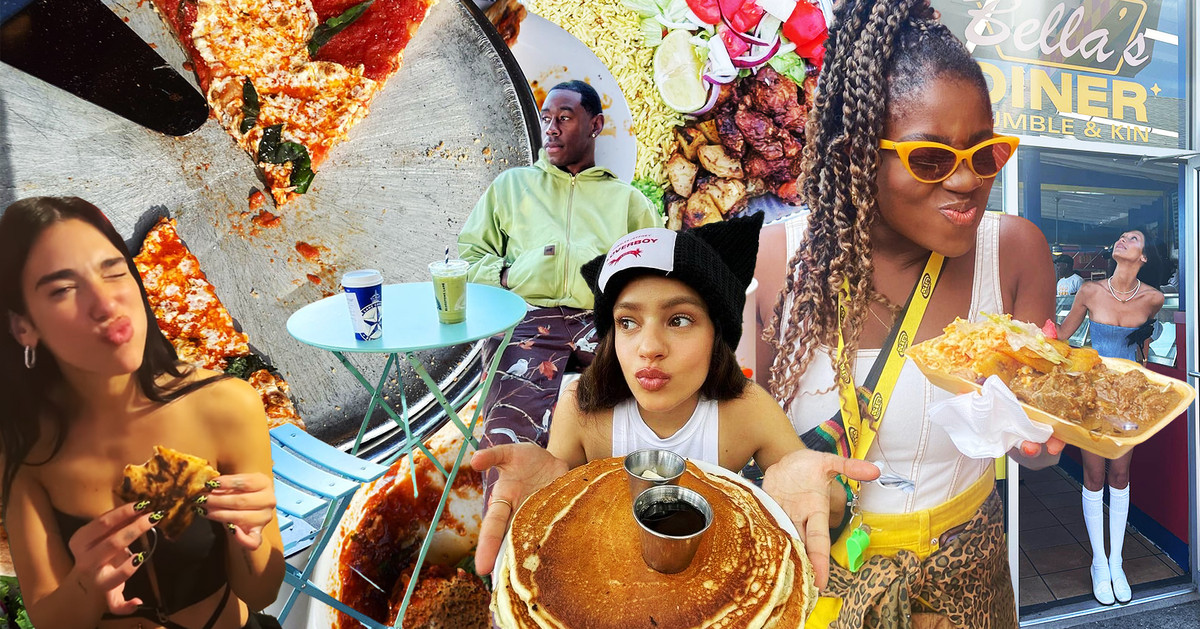
One Eater writer referred to this as “Instagram food’s laissez-faire era,” referencing Taylor Lorenz’s article which announced “The Instagram Aesthetic is Over” back in 2019 — referring to the glossy look. The photo dump (still on Instagram, of course) is its replacement. Tastemakers of a fashionable feed — from Dua Lipa to Bella Hadid and Tyler the Creator, Central Cee, Clara Amfo and Jeremy O. Harris — are now likely to post dumps (of a weekend, a festival, a month) with plates wiped clean, a close up of a distinctly non-glamorous takeaway container just one of the slides. The food shot is always part of the story. If, once, food was seen as something for the hoi polloi, celebrities and influencers are now as keen to show that they have been to a new hyped spot as they are to show off their latest garms.

Supermodel Bella Hadid with a hot dog at a Knicks game in NYC — an Instagram screen shot

Supermodel Bella Hadid with a hot dog at a Knicks game in NYC — on Instagram.
Bella Hadid/Instagram

Other apps flex their influence

TikTok has previously been seen as the relatable ying to Instagram’s yang, with the less glossy aesthetic arguably influencing more at-home videos. But it was BeReal that really made an impact.

Originally launching in 2020, it took off this year. It was the most downloaded app in August, and it was third in the Apple store’s social media category, between WhatsApp and Facebook, by October. A photo sharing app that includes both a selfie and a shot of where the user happens to be, this is a more ‘real’ idea of your day — because you have to post anywhere you are — whether that’s the office, Session House, or that crap Tesco Extra in Haggerston.

BeReal’s look, and vibe, has migrated to Instagram, with users screenshotting BeReals from hyped restaurant tables, or dining tables covered with wfh detritus, and posting them to Stories. BeReal memes, such as one from the pov of Ratatouille’s Remy the Rat, were also a thing. And even England footballers posted some BeReal-like food updates from Qatar in November — see John Stones, Kyle Walker and Dave the cat at a very standard looking restaurant.

Welcome to the chaos era

In a very prescient essay in February, newsletter Blackbird Spyplane hailed the “ungrammable hang zone,” i.e. cafes, restaurants and bars that have never thought about what they look like in a 6cm x 7cm rectangle, and are all the better for it.

“Right now, in year ~15 of the fetish for ‘clean lines’ and ‘understated elegance,’ I wanna hang for hours in a FRUMPY, MISSHAPEN, INVITINGLY INELEGANT place,” wrote one half of the Spy Plane team, Jonah Weiner, waxing lyrical about deeply unphotogenic items, like plastic-wrapped giant cookies.

This idea is now running riot in the gleeful fetishisation of mess on social media — with a crushed beer preferred can over, say, a perfect cocktail, or a crumpled takeaway bag from Tayyabs over any immaculate table setting, a candid shot over anything too posed, and a shaky video over something with the production values of a Hollywood worthy short. Expect more — never less — in 2023.