Living in a small space seems daunting, let alone cooking in one.
But Virginia Beach native A.J. Forget does both and has written his debut cookbook, “The Buslife Kitchen: Cuisine for the Modern Nomad.”
He, his girlfriend, Ayana Otteman, and their puggle live in a 2001 converted school bus (Sweet Bea) that gives them 90 square feet.
Forget worked as a wildland firefighter for the National Park Service in his 20s but his body couldn’t handle it anymore, he said.
In 2017, Forget started the next adventure: writing, cooking and building Sweet Bea with Otteman. He uses funds from the sale of his book, savings and odd jobs to make this dream a reality.
Forget grew up in a family where cooking was important to the menand he learned by watching his father. He also had a passion for writing and the desire to explore places he read about in novels. Forget attended the Virginia Beach Friends School and went to the College of William & Mary where he studied psychology and environmental science.
Ayana Otteman, A. J. Forget and a puggle (not pictured) live full-time and travel in a 2001 converted school bus named Sweet Bea. (Lisa Siciliano)
Since 2020, the bus lifers have wandered to places such as national parks where they set up camp for a week. Forget uses his three-burner propane cooktop to whip up pad thai and green chile, shrimp and corn chowder. He puts leftovers in the 70-liter refrigerator or shares them with other nomads.
Forget admits cooking in a bus is difficult.
“It makes you a better cook in the end because you have to be focused,” he said in a phone interviewfromStewarts Point campground in Lake Mead National Recreation Area in Nevada.
Forget suggests preplanning and organizing the cooking steps. Cooks need to consider the size of their workspace and how to utilize what’s in the kitchen already — a grocery store isn’t always nearby.
“Once you do this enough times,” he said,” it makes you a more efficient cook.”
Let’s Eat
Weekly
We’re serving up restaurant reviews and news about the local food scene every week.
He recommends recipes that don’t rely on equipment like a food processor or oven. Omit and modify recipes that have lots of ingredients and extra steps.
For example, “If there are 10 spices for a recipe, you probably don’t need them all,” he said. “I don’t think it impacts the quality of the food.”
He “bakes” on the stovetop but it takes practice and learning how heat works with different pans.
“We’ve got it pretty much down to a science,” he said, bragging about the pumpkin cookies Otteman made earlier in the day.
His cookbook features over 100 recipes from huli-huli chicken with Hawaiian mac salad, to Vietnamese pesto pasta with clay pot pork. He even has a stove-roasted turkey that looks appetizing.
Forget includes a salsa blanca recipe similar to the white sauce at Plaza Azteca — a Mexican restaurant chain — as an ode to living in Hampton Roads.
Rekaya Gibson, 757-295-8809, rekaya.gibson@virginiamedia.com; on Twitter @gibsonrekaya
Sweet Bea is a 2001 converted school bus driven by A.J. Forget, author of “The Buslife Kitchen: Cuisine for the Modern Nomad.” (A. J. Forget)
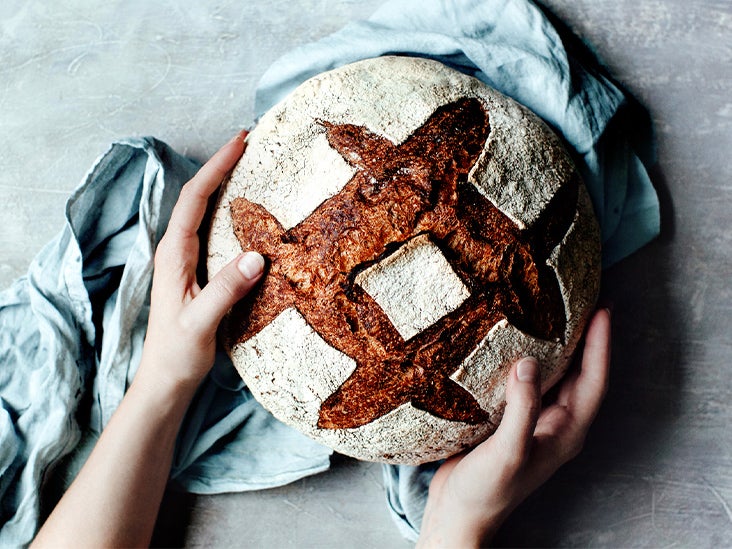
Share on PinterestExperts say whole grain breads are a simple way to improve your diet. Ellie Baygulov/Stocksy
Researchers say Americans are eating more whole grain foods but still not enough to meet daily dietary guidelines.
Experts say whole grain foods can improve overall health as well as help with weight loss.
They say you can increase the whole grain foods in your diet by grocery shopping more carefully and adding foods such as whole grain breads and pastas to family meals.
A new study published in the American Journal of Clinical Nutrition suggests people in the United States are eating more whole grains than ever.
However, researchers say it’s still not enough to meet minimum daily requirements.
The study reports the increase over the past two decades in whole-grain intake could be anywhere from 39{d2b09b03d44633acb673e8080360919f91e60962656af8ade0305d5d8b7e4889} to 61{d2b09b03d44633acb673e8080360919f91e60962656af8ade0305d5d8b7e4889}, depending on the exact definition of whole grain being used.
The wide-range estimate is due to the definition of whole grain being more strict across some studies than others. For example, some definitions include burritos, nachos, and tacos. Others do not.
The researchers applied varying definitions of whole grains to the dietary patterns of nearly 40,000 adults participating in the National Health and Nutrition Examination Survey (NHANES) between 2003 and 2018.
The research was supported by the National Institutes of Health’s National Institute on Minority Health and Health Disparities.
The study looked at definitions of whole grains from across major organizations, including:
Dietary Guidelines for Americans
Food and Drug Administration
American Heart Association
American Association of Cereal Chemists International
Whole Grains Council
The researchers reported that consumption of whole grain foods remained far below the recommended consumption of at least three ounces each day and varied considerably by each definition.
“We can’t say which is the best definition yet as we need to assess the nutrient profiles of each and how these different definitions are associated with health outcomes,” said Fang Fang Zhang, PhD, the senior study author and interim chair of the Division of Nutrition Epidemiology and Data Science at the Friedman School of Nutrition Science and Policy at Tufts University in Boston.
Amy Bragagnini, MS, RD, CSO, an oncology nutrition specialist at Trinity Health Lacks Cancer Center in Michigan and a spokesperson for the Academy of Nutrition and Dietetics, told Healthline that many clients ask her what exactly a “whole grain” is and why they are important for them to eat.
Simply put, whole grains contain all the important parts of the entire grain seed, says Bragagnini.
Amy Gorin, MS, RDN, an inclusive plant-based dietitian in Stamford, Connecticut, and owner of “Plant Based with Amy,” added that whole grains contain all essential and naturally occurring parts — the bran, germ, and endosperm— in their original proportions.
“This definition may include processed grains, but the processed product must deliver the same balance of nutrients present in the original grain seed,” she told Healthline.
“Once any of these components is stripped, it is no longer a ‘whole’ grain,” said Kristin Kirkpatrick, MS, RDN, the lead dietitian and manager of Wellness Nutrition Services at the Cleveland Clinic Wellness & Preventive Medicine in Ohio.
This depends, says Gorin.
As a general rule, she explained, “If a burrito has a flour tortilla made with whole grains as the first ingredient, then that would count.”
“If the nacho chips are made with whole cornmeal, then that would count as a whole grain,” she added.
There is one exception, though.
“While corn is considered a whole grain, it may be milled to the impact of taking out components of it which could render it more stripped based on how it is used,” Kirkpatrick told Healthline.
This is typically what you’d find in eateries, she said.
“A burrito made from a whole grain tortilla definitely counts as a whole grain in my view,” she told Healthline. “But even though some tortilla chips may be technically made with whole grains, that doesn’t necessarily make them a healthy choice.”
For example, she says, a food can be made from whole grains, but if it’s deep fried and loaded with calories (as chips are), then it’s not going to be healthy to consume that on a regular basis.
“The benefits of whole grains don’t outweigh the negatives of super high calorie, salty, addictive chips,” she added.
“Eating 2 to 3 servings of whole grains each day may lower the risk of diabetes, heart disease, and cancer,” says Cunningham, who points to research on the health benefits of whole grains.
Bragagnini agrees, adding that consistent intake of whole grain foods can help us:
Feel fuller longer
Feel more satisfied at each meal, which may help you to avoid overeating (which may lead to unwanted weight gain)
Lower risk of heart disease and high blood pressure
Lower blood sugar
Decrease the risk of developing type 2 diabetes
Decrease the risk of colorectal cancer
At the grocery store
First, look for the “100{d2b09b03d44633acb673e8080360919f91e60962656af8ade0305d5d8b7e4889} Whole Grain” stamp from the Whole Grains Council, which certifies that all the grain is whole and that a product contains at least 16 grams of whole grains per serving, says Bragagnini.
And if you don’t see this stamp, take a look at the ingredients.
“When you’re shopping for a whole grain product, such as bread, pasta, or crackers, look for the first ingredient to be a whole grain ingredient such as whole-grain flour or whole-wheat flour,” suggests Gorin.
“Many whole-grain products are made with whole grains but don’t contain them as a primary ingredient—and this makes things confusing,” she adds. “Also, aim for a variety of whole grains and experiment by trying different grains.”
Bragagnini says to look for whole grain keywords such as:
whole wheat
whole rye
wheat berries
brown rice
oats
quinoa
bulgur
Barley
buckwheat
wild rice
amaranth
At home
Next, slowly start to substitute whole grain products for the products you would typically serve at home, says Bragagnini.
“For example, if your family loves burritos, choose a tortilla wrap that is considered whole grain,” she suggests. “Then fill it with lean meat, beans, onions, tomatoes, garlic, peppers, etc., and you have a delicious whole grain/high fiber meal.”
Amy Reed, MS, RD, CSP, LD, is a pediatric dietitian and spokesperson for the Academy of Nutrition and Dietetics. She says to start with simple swaps such as changing white bread with whole wheat bread.
For example, “families are taught to slowly increase their intake of whole grains to work toward the goal of having at least 1/2 of their grains be from whole grains,” Reed told Healthline.
Bragagnini also suggests the following:
Skip the white rice and use brown rice for stir fry meals.
Use whole grain spaghetti noodles along with your favorite pasta sauce.
Top your favorite salad greens with quinoa to add a great texture to the side dish.
Combine quinoa with your favorite cut veggies, feta cheese, lemon, herbs and olive oil for a delicious main meal.
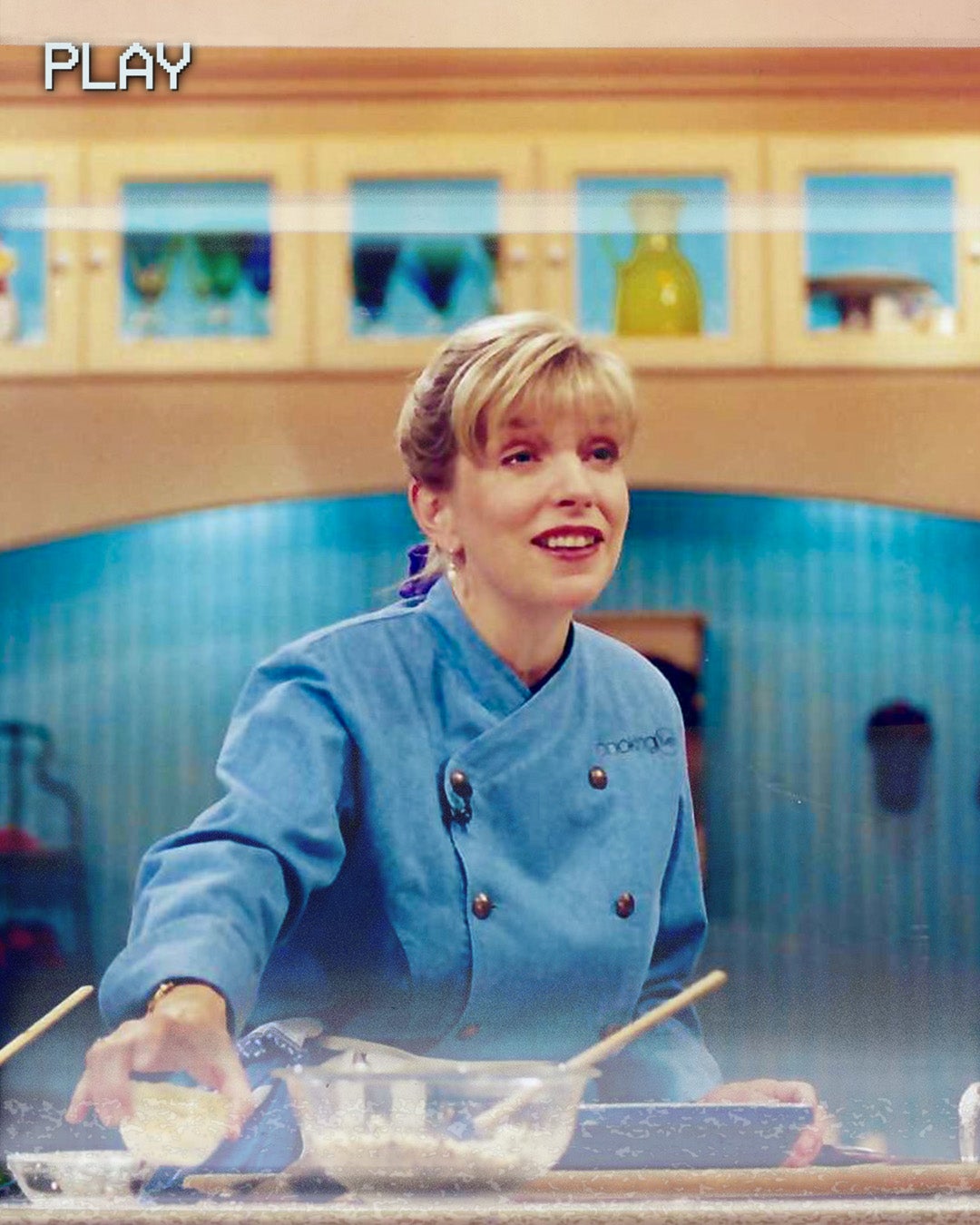
If you were a cooking show fan in the 1990s, you no doubt remember the characters. One hour, Emeril Lagasse was lighting a rum sauce on fire, while the next, Ming Tsai would be explaining the difference between spring rolls and egg rolls on East Meets West. But arguably the decade’s most skilled food TV star—the one whose show introduced the world to Michael Lomonaco, Aaron Sanchez, Anthony Bourdain, and umpteen other famous chefs—was Sara Moulton.
When I think about Moulton’s call-in show, Cooking Live, I remember the chef’s gentle demeanor, incisive cooking tips, and—of course—her signature blonde ponytail. Yet many viewers (myself included) didn’t realize that the Food Network gig was just another feather in Moulton’s already plumy cap. The chef graduated at the top of her class at the Culinary Institute of America, apprenticed at a Michelin-starred restaurant in France, worked the line at fine dining restaurants in Boston and New York City, and cooked professionally for Julia Child and Good Morning America. And decades before test kitchens were cool, she headed up the country’s most prestigious one, at the (defunct) Gourmet magazine. Translation? For more than half a century, Moulton has been a walking encyclopedia of cooking and food culture.
But you know what? I bet kids these days don’t know much about Moulton. Not that she isn’t busy—she hosts Sara’s Weeknight Mealson PBS, writes for various publications, and co-hosts a podcast on Milk Street Radio—she’s just not opening flashy restaurants or killing it on TikTok. Yet with ‘90s dishes suddenly trending in the form of Caesar salad wraps, pizza bagels, and espresso martinis, who better than Moulton, I thought, to weigh in on that decade’s food culture—and the lessons we might learn from it?
That’s how I found myself sitting across from the legend herself at a Manhattan cafe last month. We talked for two hours; she nursed a cappuccino while I typed. For the first time in my career, my interview subject showed up with more notes than I—pages and pages of bulleted anecdotes, which she flipped through as she spoke. Here are the highlights of our conversation.
Benjamin Kemper: When people say “‘90s food,” what comes to mind?
Sara Moulton: We learned so much in the ‘90s. That chiles have flavor and that chipotle is amazing. That there were many, many types of lettuces … Mesclun was king. There was both the rise of cilantro and the hatred of cilantro. Fruit salsas on fish. Lobster rolls. Penne alla vodka. And so many new cheeses. Until the ‘90s, most people knew only cheddar, brie, and boursin, but that changed with California cheesemakers like Laura Chenel. Avocados went mainstream, barbecue and grilling became more elevated, and finally some women were doing the grilling. Finally there were some women, period!
BK: What was new in the restaurant world?
SM: In the ‘80s, the hero of the food world was the writer, but in the ‘90s, it was solidly the chef. And they weren’t just cooking French food at New York restaurants—there were major players around the country. “Farm to table” was getting bigger. Alice [Waters] had done it from a French point of view, but people were finally celebrating American regional cuisine. We were also beginning to appreciate that everycuisine was regional through the work of people like Rick Bayless, Zarela Martínez, Josefina Howard, Mary Sue Milliken, and Diana Kennedy. We realized: There was no one French, Italian, or Thai cuisine.
BK: How did those trends translate into actual dishes?
SM: I wrote a few down. There was Anne Rosenzwieg and her chocolate bread pudding. Éric Ripert—his dishes were so fresh they popped—was putting warm vinaigrettes on fish. It was so unusual at the time! Nobu Matsuhisa made black cod trendy, and chiles had their moment in part thanks to Mark Miller and Stephan Pyles. Not many people know that George Germon and Johanne Killeen brought grilled pizza to the U.S. at their restaurant in Providence, Rhode Island. One thing I think about a lot is how Charlie Trotter was experimenting with and thinking about vegetables in ways that were way ahead of his time.
BK: How was cooking at home in the ‘90s different from today?
SM: This is obvious, but you couldn’t get ingredients on the internet yet, and that was a big handicap. When I was at Gourmet, if we listed an ingredient like sesame oil in a recipe, we had to add an asterisk to note that it was “available at specialty food shops.” But certain specialty ingredients were becoming mainstream, like balsamic vinegar, fresh fennel, and fresh herbs.
BK: What do you miss from that era? What has been lost?
SM: The idea that the ambiance is as important as the food. I don’t want to be jammed in, unable to hear a conversation, to be forced to eat standing up. That’s why I’m not a food truck person, even though I know they’re making some fantastic food. Wow, I just sounded old, didn’t I?
BK: Food Networkwas brand new in the ‘90s. What was it like working there?
SM: I came on board in ‘96. You have to remember, none of us had TV experience. We were petrified. Nervous wrecks. Even Emeril’s first tries were terrible. What I came to understand was, it’s one thing to be on TV with a host and another to be alone. This is going to sound strange, but to me it seemed vulgar, like too much attention on me. For my pilot I cooked fish meunière and asparagus—and never once smiled. When I held the asparagus up to the camera, it was shaking. But I limped along and got better over time. By 1999 I had two live shows on the network.
BK: What did you aim to achieve with your shows?
SM: At the time, more and more women were working, and it was hard to get dinner on the table. So I made it my mission to make people comfortable cooking during the workweek. Both my husband and I grew up with dinner on the table every night. It’s my religion. I trained at CIA, and when I graduated, I was a real snob and thought there was only one way to do things. Boy, was I wrong—I fell in love with home cooks taking their calls. Home cooks are no different from chefs, really: If you cook a recipe over and over again, you get to be damn good! A lot of times, callers taught me something.
BK: I remember there being a real gender divide. Emeril and Bobby Flay were doing their macho thing, grilling and lighting stuff on fire, and then there were shows like yours that were more geared toward busy moms.
SM: They didn’t really want women at Food Network. Every male chef had his own set, graphics, music, and tools. Not me. I had no oven, and the counter came up so high I had to stand on a riser. I remember recommending Michael Lomonaco for a show, and he got his own set.
Emeril and I were pretty good friends. He was a big talent. The next Jesus Christ. And it had to be a man—couldn’t be me. He had cars to drive him anywhere he wanted, while I had to get everywhere myself. I am grateful—I ended up on Food Network, and I did ultimately get my own set, but that’s how they were.
BK: There wasn’t much diversity, either, right? I’ve always wondered how many of the network’s higher-ups at the time were women and people of color.
SM: The executives were mostly men. And everybody was white.
BK: Wow. I guess that was the ‘90s.
SM: It was such a different time. Yesterday I was flipping through some ‘90s Gourmet magazines. I came across the word “Oriental” a few times—and I was like, really?
Another thing that makes me cringe is the whole fat police thing. It was a scam by the sugar lobby. It really impacted people. Everyone was looking at grams of fat and calories, and I created recipes with those things in mind.
BK: Can you leave us with a piece of advice?
SM: Nobody should ever stop learning, and if they do, they’re an idiot.
This interview was lightly edited for clarity and length.
The 1990s were pivotal in American food culture. The decade’s most influential dishes departed from rigid Continental cooking in favor of globally inspired fare: “Fusion” and “authentic” were the buzzwords of the era. Not that folks were giving up their deep-fried bar snacks or down-home cooking—there was simply more room on the table for hot sauces and spice blends, achaars and salsas, avocados and kiwis, and—of course—a glut of low-fat and processed foods.
The ‘90s seem like a century ago in restaurant years. Anthony Bourdain was still slinging steak frites at Les Halles, Marcus Samuelsson was a humble apprentice at Aquavit, and Thomas Keller had just become chef of a little-known restaurant in a former laundry, where he began creating flights of culinary fancy (think: Baskin-Robbins-inspired cones reimagined as silver cornets scooped with salmon tartare) and helped launch the careers of such crew members as Grant Achatz, René Redzepi, and Corey Lee.
Food was also becoming part of pop culture like never before. A group of Friends started hanging out in a fictional coffee shop called Central Perk, a testament to the second-wave coffee revolution, while the Soup Nazi—”No soup for you!”—had his memorable turn on Seinfeld. Around that time, a fictional sex columnist and her three besties sipped cosmos and appletinis in the City’s sleekest bars while, across the Hudson River, Jersey convenience store clerks overcooked coffee at the Quick Stop.
The decade that gave us Food Network, Emeril, and Iron Chef showed us there was more to food TV than stand-and-stir cooking shows. And food lovers (not “foodies” just yet) were devouring a new genre of food writing, too. Saveur debuted in the summer of 1994 with a 13-page cover story on the moles of Oaxaca, a culinary deep dive that set a new bar for reporting on food with its culture of origin front and center. The rest, as they say, is history.
So the next time you feel some nostalgia coming on (or want to party like it’s 1999), whip up one of these 14 quintessential ‘90s dishes.
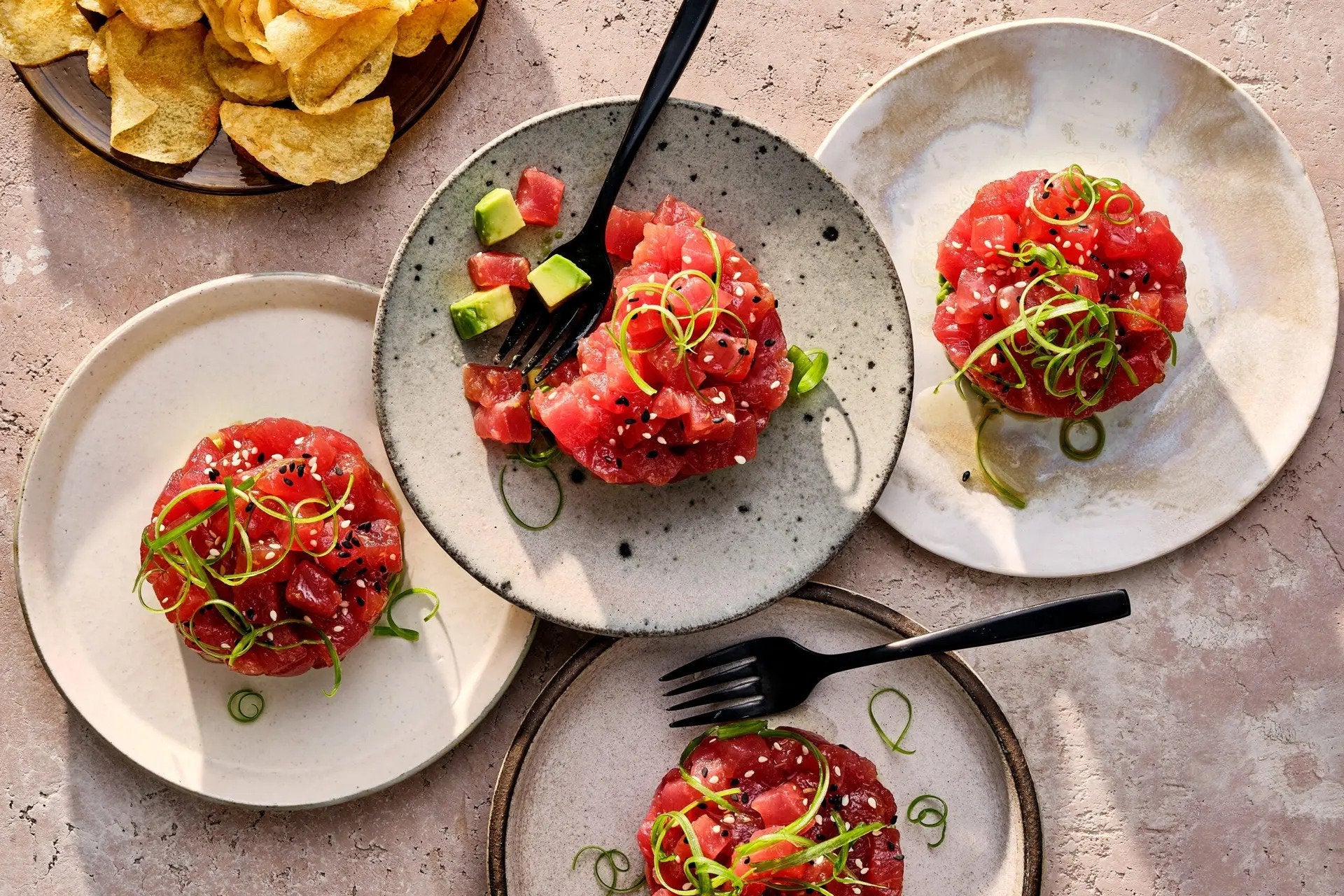
Invented by a French-trained Japanese chef in Beverly Hills, this dish epitomized American fine dining in the ‘90s. Sushi-grade tuna combined with ripe avocado (a novelty at the time) signaled the trendiness of “Asian fusion.” Get the recipe >
The chilled tomato soup native to the Iberian Peninsula became a summer dinner party staple, even if the chunky, crunchy American adaptation (inspired by a mid-century recipe from M.F.K. Fisher in How to Cook a Wolf) departed from the silky soup Spaniards were spooning up across the pond. Get the recipe >
The sauce that Ligurians have been making for centuries—combining sweet Genovese basil and the freshest-possible garlic (to avoid bitterness)—turned into a global hit in the ‘90s. Get the recipe >
The Aztecs called it āhuacamōlli. Traditional guacamole is still blended using a volcanic stone molcajete, which inspired the tableside preparations that swept Mexican American restaurants in the ‘90s. Add garlic at your own risk. Get the recipe >
Zany, unorthodox flatbreads inspired by experimental California chefs came into their own at the turn of the millennium. This recipe is a ‘90s twofer that combines pizza bianco and the garlicky romaine salad that was all the rage at the time. Get the recipe >
Once a go-to for ladies who lunched, this updated version of the Cobb à la Snoop Dogg adds homemade croutons and strips of chicken smothered in Sweet Baby Ray’s barbecue sauce. Get the recipe >
With the publication of her masterwork Essentials of Classic Italian Cooking in 1992, Marcella Hazan introduced a new generation of Americans to traditional Italian recipes such as this aromatic flatbread topped with lemon slices and rosemary sprigs. Get the recipe >
Every gumbo starts with a rich, dark roux and the blend of onion, celery, and bell peppers that Cajuns call the Holy Trinity. This version is thickened with herbaceous filé, the ground sassafras powder favored by TV cooking host Justin Wilson, who influenced a whole generation of Louisiana chefs. Get the recipe >
Oozing with spicy, cheesy filling, these crumb-coated, deep-fried peppers were a non-negotiable appetizer at ‘90s Super Bowl parties. Get the recipe >
Popularized by chef Jean-Georges Vongerichten, this distinctly ‘90s restaurant dessert, which is still ubiquitous today, has a runny chocolate core that erupts like a volcano upon digging in. Get the recipe >
This Chinese American fusion dish may have started at Madame Wu’s in Santa Monica, California, but it has evolved over time with the addition of instant ramen noodles and fried wonton wrappers. Get the recipe >
After Samantha ordered a sour, citrusy cosmo in the second season of Sex and the City, the whole country started sipping along. Get the recipe >
One part vodka, one part cultural phenom, this acid-green, apple-flavored “martini” was invented in 1996 at Lola’s West Hollywood. Get the recipe >
This recipe inspired by the Subcontinent pays respect to the battered-and-fried steakhouse side popularized by a certain Australian-themed fast-casual chain. Crikey, you really can make a bang-up version at home. Get the recipe >
When I was diagnosed with latent autoimmune diabetes in adults, the first thing a dietitian told me was that I wouldn’t be able to eat baked goods much anymore. I’m pretty stubborn, so it led me to find alternatives that would allow room for sweet treats.
Learning to bake with sugar substitutes has become a joy, and making delicious, blood sugar-friendly recipes such as my Jamaican Gizzada Cookie Bars has always been important to me. I know firsthand that living with diabetes doesn’t mean a life of bland foods.
13 holiday cookie recipes to bring color and joy to the season
I grew up eating gizzada, and it was one of the first dessert recipes my mother taught me to bake. When she passed away a few months ago, I was grateful to be working on this recipe — it gave me a way to remember our times in the kitchen making these little pastries.
The aromas of coconut, cinnamon, allspice, nutmeg and butter filled my kitchen and instantly unlocked some core memories — like my mom at the stove making the filling and me on pastry duty at our kitchen island with messy fingers and a tiny face dusted in flour. My mom and I didn’t bake together often, but making gizzada is one of those memories from my childhood that I’ll cherish forever now.
In Jamaica, gizzada is also called a “pinch-me-round” because this spice-forward pastry is usually made with the filling baked in a tiny crimped pastry shell. But even nostalgia deserves a twist sometimes.
For this recipe, I swapped out the pastry shell in favor of a shortbread crust made with almond flour and all-purpose flour. The extra fat in the almond flour helps slow blood sugar spikes, but also makes for a crumbly and nutty shortbread.
As for the filling, the traditional is too good to change, but I did swap regular brown sugar for Truvia Sweet Complete, a stevia-based alternative. It lowers the sugar content for those watching blood glucose.
Jamaican Gizzada Cookie Bars
While this recipe is designed to be a better option for those with diabetes, it does contain some added sugar and carbohydrates. We have included the nutrition data to help you decide how it might fit into your diet. Please consult a medical professional for guidance if you have questions or concerns.
These cookies are quite sweet, so we cut them into small pieces.
Be sure to use unsweetened coconut or your filling will be unpleasantly sweet and you’ll greatly increase the sugar content.
Because of the almond flour in the shortbread, it’s important to wait for the bars to cool completely before slicing into them. This shortbread is hearty, but when warm, it’s delicate and crumbly.
Storage: Refrigerate the bars in an airtight container between layers of parchment for up to 1 month, or freeze for up to 3 months.
Where to Buy: Truvia Sweet Complete sugars are available at some grocery stores and online.
Want to save this recipe? Click the bookmark icon below the serving size at the top of this page, then go to Saved Stories in My Post.
Scale this recipe and get a printer-friendly, desktop version here.
Nonstick cooking spray
3/4 cup (94 grams) all-purpose flour
1/4 cup plus 2 tablespoons (38 grams) confectioners’ sugar alternative, such as Truvia Sweet Complete or Swerve
1 1/2 cups (360 milliliters/430 grams) cream of coconut, such as Coco Real brand
1/2 cup (95 grams) packed brown sugar substitute, such as Truvia Sweet Complete or Swerve
2 tablespoons unsalted butter
1 tablespoon vanilla extract
1 teaspoon fine salt
1 teaspoon minced fresh ginger
1 teaspoon ground cinnamon
1/2 teaspoon ground allspice
1/2 teaspoon ground nutmeg
Make the shortbread: Position a rack in the middle of the oven and preheat to 350 degrees. Spray an 8-inch square baking dish or pan with nonstick cooking spray, then line it with two crisscrossed pieces of parchment paper long enough to have a generous overhang on all sides.
Set a mesh sieve over the bowl of a stand mixer or, if using a hand mixer, a large bowl. Into it, sift together the all-purpose flour, confectioners’ sugar alternative and salt to remove any lumps. Whisk in the almond flour or meal and break up any clumps. Add the butter and vanilla. Using the paddle attachment of the stand mixer or a hand mixer, beat on low until the ingredients start to come together and resemble sand in texture, then increase the speed to medium and beat until the dough comes together in larger clumps, about 3 minutes.
Transfer the dough to the baking dish and press it into an even layer, pushing it slightly up the sides of the pan at the edges. Using the tines of a fork, dock the dough all over to allow any steam to escape. Bake for 15 minutes, or until the dough is golden around the edges and mostly pale, but dry in the center.
Remove from the oven and let cool on a wire rack; keep the oven on.
Make the topping: While the shortbread bakes, in a wide skillet over medium heat, toast the shredded coconut, stirring often, until it turns a light golden color, 5 to 7 minutes. (Pay attention, as it can scorch quickly.) Remove from the heat and transfer to a bowl.
Return the skillet to medium heat and add the cream of coconut, brown sugar substitute, butter, vanilla, salt, ginger, cinnamon, allspice and nutmeg, stirring until the sugar substitute dissolves. Bring the mixture to a simmer and cook, stirring constantly, until it thickens, 5 to 7 minutes. Remove from the heat and stir in the toasted coconut.
Pour the topping over the shortbread, spreading it in an even layer with an offset spatula. Return the pan to the oven and bake for 18 to 20 minutes, or until the filling is bubbly all over and fragrant. The filling will be slightly wobbly in the center but will set as it cools — better to under- than overbake, to keep the bars soft.
Let cool on a wire rack for 30 minutes, then refrigerate for at least 2 hours so the slab can set. Remove the pan from the refrigerator and use the parchment overhang to transfer the square to a cutting board. Slice the bars into 16 to 20 pieces with a sharp knife and serve.
Who doesn’t love new kitchen toys? This year gift the chef, baker or foodie in your life a gadget that’ll transform their cooking game for the better. There’s nothing like having exactly what you need when you need it — especially when it comes to cooking! From larger gadgets that will impress even the most esteemed chef to smaller, yet extremely useful gadgets that will round out any kitchen, here’s a list to help you with your holiday shopping.
PURE Chef Package
PURE Juicer
PURE Juicer, PURE Chef Package
For your health conscious friend, check out this top-of-the-line juicer. PURE Juice features a sleek, minimalist design and a hydraulic two-stage juicing press, making it one of the most advanced on the market today. First, the 8-blade cutter extracts nutrients from the produce and fiber using its half-horse-powered motor. Next, the press applies 2.5 tons of pressure, ensuring every last drop of juice is squeezed out. Also worth noting is this juicer can offers multiple grids for produce, nut butter and baby food. This package includes a starter kit of all of all PURE’s juicing supplies for at least three to six months of juicing, as well as an apron, press cloth, press bag, and more.
The Barista Express is Breville’s newest and most innovative espresso machine to date. This state-of-the-art machine is perfect for the caffeine addict in your life thanks to it’s ability to go from bean to espresso in under a minute. With its special Impress Puck System, the perfect dose of beans; precise temperature and water pressure; and amount of microfoam milk for impressive latte art is just a touch away. Plus it even has a self-correcting dosage system that will remember how you liked your coffee last. Enjoy this professional cafe machine in the comfort of your own home.
Garlic Baker, Apple Slicer, White Marble Cheese Slicer
Harry & David
Harry & David
Harry & David have a number of kitchen gadgets that any chef would love to add to their repertoire. This Garlic Baker is made with terra cotta and features a top handle shaped like a clove of garlic and can be used in both convection and microwave ovens. This White Marble Cheese Slicer gives you perfectly uniform cheese slices, perfect for making charcuterie and cheese boards. This slicer comes with a white and gray marble board and two extra slicing wires. This Apple Slicer, Corer, and Peeler can do anything with apples. It’s a handy tool that is made with cast aluminum and chrome-plated steel.
Freshly ground pepper is a necessity for so many recipes, so why not gift a high tech pepper mill to your favorite at-home chef? This high tech pepper mill from Black Rain is a one-hand, push button pepper mill that quickly dispenses fresh ground pepper, at the exact grind you want. With 5 preset settings, fine to extra coarse, enjoy the perfect amount of pepper every time.
This cool kitchen gadget from Anova perfectly cooks anything from fish and veggies to pork and chicken (any anything else) perfectly thanks to its circulation of water at the exact temperature required to cook you ingredients just right. This style of cooking locks in flavor and moisture and uses precision to cook with exceptional results. Also, its small size makes it easy to store in any sized kitchen. It is easily attached to any stock pot or container.
This is a super gadget from Robam Living that any at-home chef would love to get creative with. This is a 20-in-1 steam oven that features an air fry function using a vortex cyclone technology; two baking modes, three levels of steam to cook with ranging from 185 degrees to 300 degrees F (great for healthy recipes) and so much more. It offers 30 preset recipes to get started with and even self cleans. Good to note? It comes in a selection of nice colors that include mint green and garnet red.
This fun gadget is one you probably never knew you needed — the Banana Loca is a simple tool that cores and fills your bananas while in their peel to make a tasty treat. This new innovative kitchen gadget straightens a banana, cores it while still in the peel, and allows you to fill it with a variety of fillings like honey, jams and jellies, peanut butter and Nutella.
For the at-home barista, gift them the K-Cafe Smart which is designed to craft everything from fancy coffee beverages to holiday cocktails. The K-Cafe Smart includes an upgraded Keurig app and offers new features like Cafe Creations with over 70 coffeehouse recipes to choose from and a built-in milk frother. With this high tech machine, you can also connect to WiFi and brew from anywhere with a Alexa or Google Home voice routine.
This gift from Halo is great for your friend with an outdoor kitchen or anyone who enjoys camping and tailgating with premium food. This is the world’s first battery powered pellet. It features 300 square inches of cooking space allowing you to masterfully sear, braise, bake, roast, smoke, and grill whatever you desire — all powered by wood pellets.
This compact air purifier from Coway Airmega is ideal for small kitchen with poor ventilation. It purifies up to 214 square feet and features a three-stage filtration system that eliminates 99.97{d2b09b03d44633acb673e8080360919f91e60962656af8ade0305d5d8b7e4889} of particulates in the air. Whether you need to clear out smoke from an over broiled steak or burnt cake — or simply need to freshen the air — Airmega is what you need.
Everyone loves cheese! Gift this BOSKA fondue set that serves enough delicious cheese for two to four people. This set includes a white ceramic pot, four fondue forks, a stainless-steel base and three tea lights to keep the melted cheese warm for a long time! Also good to note? The fondue pot and fondue forks are dishwasher-safe.
Gift the coffee lover in your life the gift of quality nitro cold brew right at home. Enjoy the creamy texture and vivacious flavor of nitro cold brew coffee with this Vinci Nitro Cold Brew that allows you to infuse Cold Brew Coffee with nitrogen (8g N2O cartridge) as it streams from the tap. Infusing cold brew coffee with nitrogen creates a velvety, smooth coffee with a slight sweet flavor and a rich, creamy foam.
This is a fruit multi-tool from Prepara that’s ideal for anyones kitchen. Equipped with seven different tools that each have their own specific function and encompassed in a compact body that doubles as a citrus reamer, this is the perfect swiss army knife for kitchen use. In this tool is a citrus zester, serrated fruit peeler, paring knife, strawberry huller/ cherry pitter and apple corer.
Pi is a backyard pizza oven that features Dual Fuel capability (wood or gas, depending on your flavor presence) with Solo Stove’s Signature Airflow and Demi Dome Construction, allowing it to capture and maintain heat for the perfect pizza. Ideal for the pizza enthusiast, this oven also comes with a cordierite pizza stone and can make between 3-4 pizzas an hour.
Ninja™ CREAMi® Deluxe 11-in-1 Ice Cream and Frozen Treat Maker
Ninja
Ninja™ CREAMi® Deluxe 11-in-1 Ice Cream and Frozen Treat Maker
Who wouldn’t love a machine that fulfills all your ice cream and frozen treat dreams? This 11-in-1 ice cream and frozen treat maker from Ninja can make everything from slushies and Italian ices to sorbet and gelatos. This elegant machine fits enough ice cream to feed a family and offers completely customizable treats for those who may have allergens and dietary restriction.
Give the gift of freshly baked bread this holiday season with Panasonic! With this useful gadget, you can bake a variety of breads and baked goods, including gluten-free options, from the comfort of your own kitchen via customizable manual settings and 20 pre-set program. In addition to artisanal style kneading, it also features a raisin or but dispenser for just the right amount of added deliciousness to your breads. Loaves, pizza dough, cakes, and more await.
This functional non-stick pan From Our Place is made of heirloom-quality, easy-to-care from enameled cast iron and comes in a variety of rich colors like dusty pink and grey-blue. Get this for your friend who’s constantly using too many pans — this 8-in-1 cast iron pan replaces eight piece of cookware (think frying pan, griddle, baking dish… etc.) and can be baked in up to 500 degrees Farenhite. With this beautiful pan you can pan fry, grill, sear, braise, fry, saute, roast, bake, broil, stew, serve and more.


:quality(70)/cloudfront-us-east-1.images.arcpublishing.com/tronc/LW72KLYLYVA2HHFG7X3PNMVCYQ.JPG "Tips for cooking in a van, bus, RV or small kitchen")
:quality(70)/cloudfront-us-east-1.images.arcpublishing.com/tronc/H452XJ3OXNBLZF4GFUJH7CFEKE.JPG)
:quality(70)/cloudfront-us-east-1.images.arcpublishing.com/tronc/SLCIGBDLDZEDNHMRPLZEHUM2JU.jpg)