
Go city hopping: Enjoy culture, food and urban escapes in Arizona

Go city hopping: Enjoy culture, food and urban escapes in Arizona

The Greater Phoenix area, also known as the Valley of the Sun, is renowned for its year-round sunshine, rich cultural experiences, and staggering natural landscapes, from scenic mountain preserves to the stunning Sonoran Desert. Discover Arizona’s wine and craft beer scene, explore American Indian artor play on some of the best golf courses in the country; here are a few recommendations on where to go and what to do.

Some highlights found in and around Greater Phoenix include parks, resorts and wellness opportunities. South Mountain Park Preserve is the nation’s largest municipally managed park and is a haven for outdoor enthusiasts. While the luxury resort scene in Phoenix includes a long list of historic and modern properties, families can enjoy epic-sized pools with monumental play features while wellness travelers will find spa treatments and fitness programs that add euphoria to vacation days.

Some of the country’s most innovative restaurateurs hone their culinary skills in Phoenix. The best-known restaurants in Phoenix have racked up plaudits and nominations from the James Beard Foundation. In 2022, local chefs and restaurants were named semifinalists in eight different categories. And, the city’s cocktail and craft brew culture continues to grow.

Phoenix has some of the best museums in the country including the galleries and exhibits at the Musical Instrument Museum which draws from a collection of more than 8,000 instruments from around the world. One of Phoenix’s first cultural institutions, the Heard Museum, has grown into an international destination to learn about American Indian art and history, while the Pueblo Grande Museum and Archeological Park is a must-see Phoenix attraction that takes visitors on a path to remnants of a ballcourt and platform created by the Hohokam people who lived in this area from A.D. 450 to 1450. And, at the 140-acre Desert Botanical Garden, more than 50,000 desert plants illustrate the beauty and variety of desert plant life.

Go shopping, gallery hopping and hiking in Scottsdale

With its blend of nature, culture and cuisine, Scottsdale makes for the perfect break

(Visit Arizona)

Famed for its 300 days of sunshine, luxurious resorts and boutique shops, Scottsdale, in the Greater Phoenix area, has much to offer travellers looking for a US city brimming with art, culture and old-world charm.

Scottsdale is located in the beautiful Sonoran Desert at the foot of the scenic McDowell Mountains. It is bordered by Phoenix to the West, the Tonto National Forest to the North, the McDowell Mountains to the East, and the Salt River to the South. The Mcdowell Sonoran Preserve is a protected area, including 200 miles of trails across 30,000 acres of land. Expect to see plenty of Saguaro cacti along the way, native to the Sonoran Desert and emblematic of Arizona. If you’d rather take to the water, you can kayak, standup paddle board or tube down the Lower Salt River, where you’re almost guaranteed to see wild horses grazing along the river banks.

Old Town Scottsdale’s Fifth Avenue is not only home to an award-winning culinary scene that encapsulates cooking styles and cuisine from around the globe, but it also houses dozens of boutique shops, from upscale designer fashions and American Indian jewellery stores to Southwestern furniture shops. Down the road from Fifth Avenue, you’ll find the Arts District, where more than 35 galleries showcase high-end art to local and national work. You can book appointments to check out most of the galleries or participate in the free Thursday evening art walk, where you’ll hop from one gallery to the next, often enjoying wine and snacks along the way and getting the opportunity to speak to local artists.

Explore food, culture and nature in Tucson

Whether you’re a fan of golf, gastronomy or art, laidback Tucson has it all

(Visit Arizona)

Laid-back Tucson is a hot spot for those who yearn for time in nature, and the Tucson Botanical Gardens offer an introduction to the flora and fauna that makes up the desert. Head east on Tanque Verde Road, and you’ll eventually reach the Redington Pass. This high mountain pass, between the Santa Catalina Mountains and the Rincons, has ample hiking trails, and canyons that take you past magnificent mountains and dense barrel-cacti-dotted forests.

With a landscape as spectacular as Arizona’s, it’s no surprise that the state is also home to some of the nation’s most famous golfing destinations. Tucson has more than forty courses, including the Arizona National Golf Club and the Starr Pass Golf Course on the western outskirts of Tucson, with the majestic Catalina Mountains as a backdrop.

Head Downtown, an area steeped in history and famed for its restaurants, bars, eye-opening museums and striking architecture. The Tucson Museum of Art is located in the Presidio district and showcases an extensive Colonial Latin American art collection. The Arizona State Museum also houses the largest collection of Southwest Indian Pottery and more than 25,000 artefacts of American Indian basketry.

Once you’ve finished roaming around the museums Downtown, take advantage of Tucson’s status as a UNECSO City of Gastronomy and refuel with food options inspired by American Indian, northern Mexican-Sonoran, Mission-era Mediterranean, and American Ranch-Style traditions. An excellent option is El Charro Café, the nation’s oldest Mexican restaurant.

If you’re an aviation enthusiast, The Pima Air & Space Museum is essentially an aircraft boneyard, displaying almost 300 aircraft spread over 127 acres, featuring planes from World War Two, the Vietnam war, and more. While for another trip back in time, head to the Trail Dust Town, dotted with old station wagons, stagecoaches, saloons and tobacco shops. This fascinating, atmospheric old town gives you an authentic feel for what life would’ve been like during the Wild West era.

Sip on local wines in Arizona’s internationally-acclaimed winemaking regions

Enjoy a vineyard adventure in Arizona’s must-experience wine country

(Visit Arizona)

There are more than 120 wineries and tasting rooms across Arizona. The wine made here is internationally acclaimed, some have even been served in the White House. In Southern Arizona, you’ll find the towns of Sonoita and Elgin, famed for their unique topography and soil, garnering the attention of sommeliers worldwide. There’s also Willcox in the Southeast, where most of the state’s grapes are grown in larger quantities, and the Verde Valley in north central Arizona, where a wide variety of soils and highly fertile alluvial deposits create near-perfect wine-growing environments.

In Sonoita, you can go wine tasting at the female-owned-and-run AZ Hops and Vines, or, if you find yourself in Willcox, hit up Wines of Willcox: expect plenty of local bottles with picturesque vineyards and mountains as your backdrop. If you’re looking to explore the vineyards of North Central Arizona, Caduceus Cellars, run by one of the state’s leading champions, showcases wine grown primarily from Verde Valley vineyards.

To find out more about Arizona, discover incredible experiences, unmissable events, get travel inspo and plan your trip, head to Visit Arizona. You can fly to Arizona direct via British Airways or American Airlines – find out more here

Jewish Food and Culture Festival to raise money for temple restoration | Life

Jewish Food and Culture Festival to raise money for temple restoration | Life

The best way to learn about another culture is to eat its food, says Carla Bluhm, one of the organizers of Sunday’s Jewish Food and Culture Festival in downtown Brunswick.

“This has been shown throughout history when immigrants have shared their cuisine with their towns and cities,” Bluhm said. “This is a great opportunity for us to share through the language of food more about Jewish life and culture.”

Shortage “failure” due to “weird supermarket culture” says Dimbleby

Shortage “failure” due to “weird supermarket culture” says Dimbleby

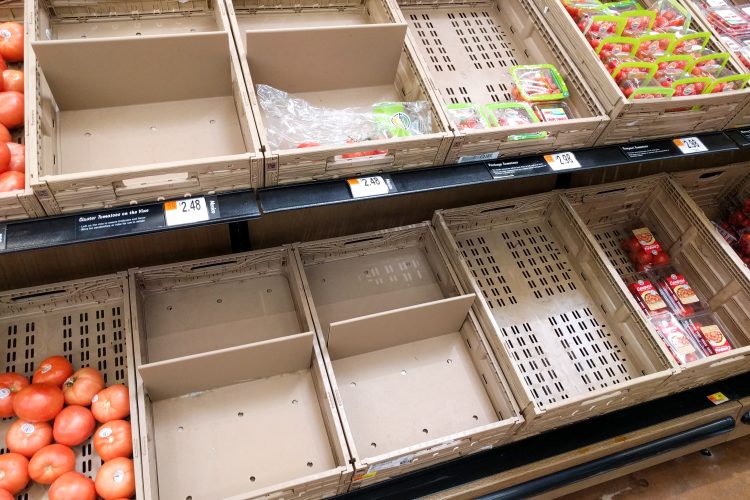
Government advisor Henry Dimbleby has blamed the recent fruit and vegetable shortages in supermarkets on a “weird supermarket culture”.

empty supermarket shelves

In a recent statement given to The Guardian, Henry Dimbleby, co-founder of restaurant chain Leon and food strategy advisor for the UK Government, branded recent fruit and vegetable shortages as a “market failure”, blaming Britain’s “weird supermarket culture”.

New Food recently reported that numerous supermarkets have been limiting their sales of various fruit and vegetables as a result of import shortages from Spain and North Africa.

Now, Dimbleby has told The Guardian that other countries in Europe are not having to face the same problems as the UK as they do not have the same “cultural problems”.

“There’s just this weird supermarket culture. A weird competitive dynamic that’s emerged in the UK, and nowhere else in the world has it, and I don’t know why that is,” Dimbleby told The Guardian.

While the shortages themselves caused a stir on social media, the UK’s Environment Secretary, Thérèse Coffey, also generated widespread conversation with a comment about consumers turning to home-grown produce, such as turnips, to navigate empty supermarket shelves.

However, the turnip comments have been labelled “frustrating” by Dimbleby, as he thinks that Brits are concerned about Coffey’s words instead of “structural issues in the food system”.

Dimbleby told The Guardian: “I find it quite frustrating that everyone is suddenly worried about a gap of vegetables in February, when there are much bigger structural issues that need to resolve, and definitely the government on health has very explicitly gone backwards.”

UK committee chair express concern over fertiliser shortages

Predicting that the “market failure” is “going to get worse”, Dimbleby also defined the UK food system as “unique”, explaining that he doesn’t know “another system where the supermarkets have these fixed-price contracts with suppliers”.

“So, basically, you have no effective market. It’s a very difficult one for the government to solve, but it does need to be resolved,” said Dimbleby.

The fruit and vegetable shortages in supermarkets are currently on-going, however, in a statement, Coffey predicted that they “will be a temporary issue that should be resolved in two to four weeks”. However, with Dimbleby stating that the shortages are part of a wider “market failure”, it could take numerous adjustments to get shelves reliably restocked.

Commenting on Dimbleby’s statement, Chris Elliott, Professor of Food Safety and Microbiology at Queen’s University Belfast, noted that “we have come to rely very heavily on supermarkets to secure our food in the UK.

“While the pandemic showed us how well they could do this the stresses and strains continue to mount on the global food system and we need to take a much more holistic view of food security in the UK going forward.

“We need all actors in the food supply system (both private sector and government) to come together and really start to generate a policy fit for purpose,” concluded Elliott.

‘Top Chef’ Byron Gomez on cuisine, culture and bringing Costa Rica to Colorado with Pollo Tico

‘Top Chef’ Byron Gomez on cuisine, culture and bringing Costa Rica to Colorado with Pollo Tico

Byron Gomez has prepared haute cuisine in some of this country’s finest restaurants. But on a recent day, in his food-hall stall on Pearl Street in Boulder, he is savoring something less high-brow, but oh-so-delicious. 

He calls it the “chicken oyster.” It’s a moist bit of meat hidden in a crevice behind the backbone of a rotisserie chicken that has rested overnight in Costa Rican spices before being slathered in a taste-bud-shaking secret sauce called Salsa Lizano.

That bit of food that brings him such joy serves as a symbol for a wildly unusual culinary career that has taken Gomez on a full-circle foodie journey in his 34 years.

It began in a modest family kitchen in Costa Rica where, as a toddler, he savored his native country’s foods so much that he would sneak out of his bed to sleep on the kitchen floor. 

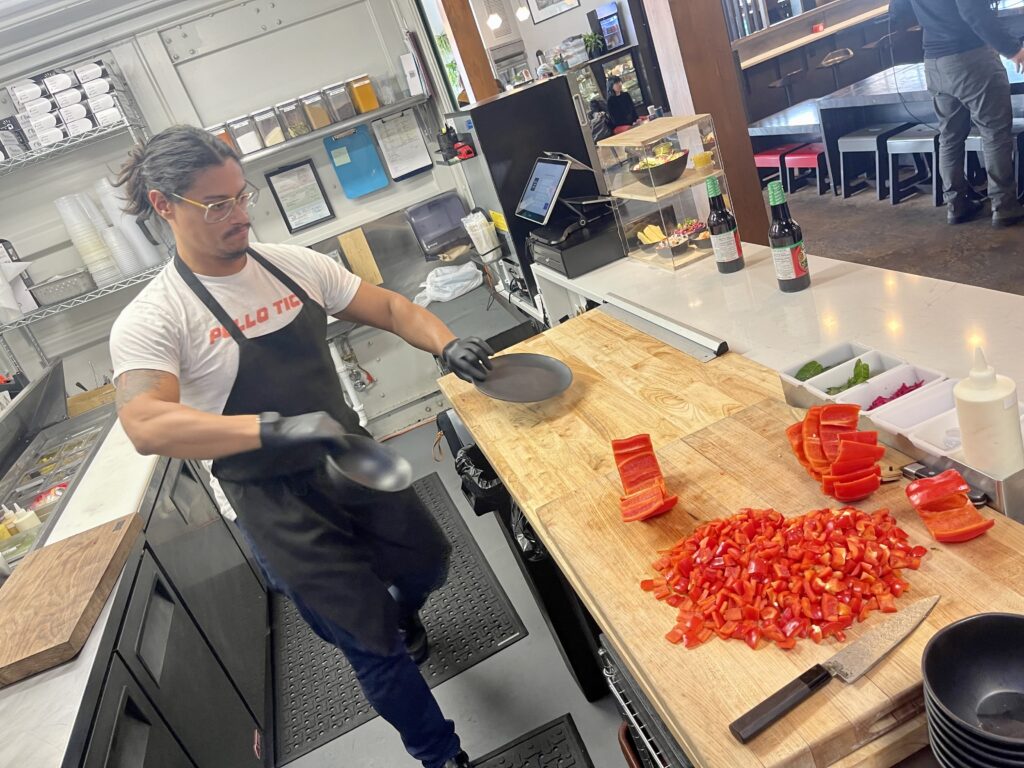
Hop from there to a Burger King in Long Island where his family had immigrated when he was nine. Gomez was too shy to be good at the counter, but he was moved into food prep because he was an excellent tomato slicer. 

Move on to constructing delicate dishes at Michelin-starred fine-dining restaurants owned by a world-famous chef in New York City. Throw in a stint on the culinary competition Top Chef.

 All that winds finally to Pollo Tico, Gomez’s fast-casual, self-described “chicken joint” in the Avanti Boulder food hall.

“This introduces my culture and who I am,” Gomez told Colorado Matters host Ryan Warner during a visit to Gomez’s tiny Lizano-bottle-lined kitchen. 

The chicken is served up with Costa Rica’s most recognizable dishes — arroz con pollo (chicken and rice), gallo pinto (beans and rice), maduros (fried green plantains), and chayote escabeche (pickled squash). Salsa Lizano goes on everything.

Chef Byron Gomez Pollo TicoRyan Warner/CPR News
Salsa Lizano is an ingredient staple at Pollo Tico in Boulder.

Gomez’s time on Top Chef

These were not the foods that Gomez toiled over when he was a finalist on Season 18 of Top Chef, a brutal competition where the chefs spent 18 hours a day sweating over food challenges and the rest of the time totally closed away from a world in the thick of a pandemic. 

As a Top Chef finalist, Gomez showed off his culinary chops learned in top-culinary-world restaurants, including Cafe Boulad and Eleven Madison Park. He prepared a crab dish, a surf and turf entre, a pasta dish seasoned with coffee. 

The closest he got to his native cuisine was a Peruvian chicken dish. He is still kicking himself for those choices.

“I was watching the show at home with my bowl of ice cream and yelling at the TV, asking ‘Why did you do that?’”

It was that anger about not highlighting his ethnicity that led him back to his roots.

“I had the most Michelin stars of anyone in the cast,” he said. “But I realized I was cooking other people’s cuisines. Everyone else was rooted in ethnicity, but I was left asking, ‘Well, what am I?’”

Chef Byron Gomez Pollo TicoRyan Warner/CPR News
Byron Gomez owns Pollo Tico in Boulder, featuring Costa Rican-styled rotisserie chicken.

Sunday dinners with family

That answer lay in his memories of the big Sunday dinners his family would have in Costa Rica. His mother was well-known for her cooking skills, and friends and relatives would gather at the Gomez home for meals. 

The women would be cooking up a feast in the kitchen. The men would be watching soccer as they waited for the meal. And Gomez would be gravitating to the kitchen.

When his family migrated to Long Island, the Sunday feasts continued in an altered form. His family couldn’t get all their native foods, and what they could get didn’t taste the same. Still, other Costa Ricans would gravitate to the Gomez house and pack in for Sunday gatherings.

Gomez’s eventual mentor, Daniel Boulad, the Michelin-starred chef he still calls “papa,” helped him to realize those gatherings were where his culinary dreams might lay. He had instilled in him the idea that he should always continue to test the limits of his skill and creativity.

Gomez landed a job at Café Boulad by highlighting his work ethic and desire to learn. He had no formal culinary training, unless prepping burgers and cooking ethnic dishes at a mom-and-pop café counted. But he had the drive and talent and, after stewing over submitting an application for a month, he was rewarded.

He spent five years working under Boulad. He describes it as a pressure-cooker existence similar to the Hulu culinary drama “The Bear,” or to the late Anthony Bourdain’s portrayal of sometimes hellish working conditions in the book “Kitchen Confidential.”

Chef Byron Gomez Pollo TicoRyan Warner/CPR News
Chef Byron Gomez working on food prep in Pollo Tico.

The next Shake Shack?

As his own boss now, Gomez still works hard, but can take time to hit the gym every day and to appear on the circuit of food festivals. 

He will be at Food & Wine festivals in Aspen and Charleston, South Carolina, this summer. He hopes to secure another slot on Top Chef.

Also on tap in Gomez’ journey is a fine-dining mobile dining room concept that he brainstormed about during the COVID-19 pandemic lockdown. It’s a concept that he said will “flip the rood truck thing on its head.”

He also has plans to open more Pollo Ticos. In fact, he is thinking big about that, too. He believes Pollo Tico could become the next Shake Shack — as soon as patrons figure out that his restaurant is not Pollo Taco, and that Costa Rican food is quite different from omnipresent Mexican cuisine.

“My duty is to bring the beauty of who we are to this country,” he said.


Gallo Pinto

Food tsar blames shortages on UK’s ‘weird supermarket culture’ | Farming

Food tsar blames shortages on UK’s ‘weird supermarket culture’ | Farming

The government’s food tsar has blamed Britain’s “weird supermarket culture” for recent food shortages, calling it a “market failure”.

Experts have criticised ministers for “leaving food policy to Tesco”, and meeting large food chains rather than suppliers, who have been struggling with rising costs while locked into contracts with supermarkets.

Henry Dimbleby, the co-founder of the restaurant chain Leon, who advises ministers on a food strategy for England, said Europe was not facing such issues because they did not have the same cultural problems.

He said: “There’s just this weird supermarket culture. A weird competitive dynamic that’s emerged in the UK, and nowhere else in the world has it, and I don’t know why that is.”

Dimbleby earlier criticised the government’s response to his recommendations, saying it was “not a strategy”.

He said he found the current situation “frustrating” as people were focusing on remarks about turnips, rather than structural issues with the food system. “I find it quite frustrating that everyone is suddenly worried about a gap of vegetables in February, when there are much bigger structural issues that need to resolve, and definitely the government on health has very explicitly gone backwards,” he said.

Dimbleby disagreed with the environment secretary, Thérèse Coffey, who denied that the recent shortages of eggs and vegetables was a “market failure”. He said: “This is a problem of market failure in the specifically British food system. It’s going to get worse. The UK food system is, I think, unique – I don’t know another system where the supermarkets have these fixed-price contracts with suppliers. So, basically, you have no effective market. It’s a very difficult one for the government to solve, but it does need to be resolved.”

Dimbleby said that in the UK lettuce prices in supermarkets were kept stable, whether there was a shortage or a glut, meaning farmers could not sell all their crop when they had too much, or get incentives to produce more during a shortage. He added: “If there’s bad weather across Europe, because there’s a scarcity supermarkets put their prices up – but not in the UK. And therefore at the margin, the suppliers will supply to France, Germany, Ukraine.”

This week, the farming minister, Mark Spencer, held a summit with large food chains but did not invite farming groups.

Timothy Lang, an emeritus professor of food policy at the University of London, said he was “absolutely not in the least” surprised by the recent food shortages. “It’s utterly regrettable,” he said. “This government did nothing because it was ideologically not prepared to consider nuances and difficulties. They’re locked into a minimalist, don’t intervene, leave-it-to-Tesco approach to food policy.”

He accused the government of ignoring Dimbleby’s food strategy, saying: “His final report of our plan dealt very well with household food insecurity and other things like the junk food cycle, advertising marketing, because he thought those were winnable things from this government. And he was ignored.”

Dimbleby believes the problem will get worse, and said he had foreseen this for some time, urging the government to “sort it out”.

He said: “In 2004 there was a particularly bad frost and we had the same issue then. And it will continue to get worse due to climate change. These periods of freak events that used to be not very often, because of climate change are going to happen more and more often. These problems won’t be resolved until we look at what I outlined in my food strategy – we need to fix the problems of climate change, and health, and the way the food markets in the UK are structured leave us vulnerable to this, so we’d better sort it out.”

skip past newsletter promotion

The National Farmers’ Union (NFU) is asking the government to support its call for more workers to pick crops, more affordable and sustainable energy, and fairness in food supply chains. UK growers have been saying since well before the recent shortages in fresh produce became visible that they were facing a string of challenges, some intensified by the pandemic and Brexit.

The NFU estimated fresh produce worth £60m was left to rot in fields last year, as growers could not get enough workers to pick their fruit and vegetables at the right time.

The NFU president, Minette Batters, said: “The consequences of undervaluing growers can be seen on supermarket shelves right now. Shelves are empty. This is a reality we’ve been warning government about for many months. Without urgent action there are real risks that empty shelves may become more commonplace.” She was also critical of the government meeting supermarkets rather than producers.

The Department for Environment, Food and Rural Affairs said: “We agree that the domestic horticulture sector is crucial to the resilience of our food system as well as an important part of our wider economy. We know that farmers and growers are facing global pressures, including from the invasion of Ukraine.

“Our new farming schemes will support farmers to produce food profitably and sustainably, including £600m in grants for equipment to help farmers become more productive. This is part of the significant action we have taken to support the sector so far, alongside allocating 45,000 seasonal workers and wider government support on energy bills through the energy bills relief scheme.

“Although there are currently some issues with the supply of fresh vegetables, caused by the poor weather in Spain and north Africa, the UK has a highly resilient food chain and is well equipped to deal with disruption.”

Good Culture partners with Dairy Farmers of America on probiotic milk

Good Culture partners with Dairy Farmers of America on probiotic milk

Dive Brief:

  • Good Culture has launched a new product line, Probiotic Milks, made with the agriculture collective Dairy Farmers of America (DFA).
  • In a statement, the company said its “disruptive and new take on milk,” which is available in 2{d2b09b03d44633acb673e8080360919f91e60962656af8ade0305d5d8b7e4889} and whole varieties, contains 1 billion probiotic cultures per 12-ounce serving.
  • The launch furthers Good Culture’s aim to grow its portfolio offerings and capitalize on the continuing trends of wellness and gut health, with the help of a leading dairy group.

Dive Insight:

Good Culture is taking probiotics into a new category with the backing of a leading player in the milk space.

The better-for-you cottage cheese and sour cream maker — which has received $81.8 million to date from investors like General Mills and actress Kristen Bell, according to Crunchbase data — last year raised $64 million in a Series C funding round. The company said the funding would go toward launching new products in the cultured foods space.

With this expansion, Good Culture has the opportunity to broaden its reach to a new consumer base.

“With the continued growth and consumer interest in probiotics and gut health, we’re really excited to bring this great-tasting milk with probiotics to store shelves in partnership with the Good Culture brand, which is so well known for producing on-trend, cultured dairy products,” Rachel Kyllo, senior vice president of marketing for DFA, said in a statement.

The decision to work with the DFA gives Good Culture a partner that is highly familiar with the milk space. The dairy giant has a variety of milk brands in its portfolio, including Dean’s, Lehigh Valley Dairy, Dairy Maid Dairy and Kemps.

Once commonly associated with yogurt, probiotics continue to infiltrate new food categories such as snacks and beverages as consumer interest in immunity rises. Nearly half of people consume probiotics in some form each day, with dairy being their preferred way to obtain them, according to a 2022 survey of 16,000 consumers by Chr. Hansen.

Other better-for-you brands have seized on the gut health dairy craze. Danone’s dairy brand Horizon Organic has a milk and yogurt line called Growing Years that contains prebiotics. Kefir, a fermented milk product popularized by brands such as Lifeway, is projected to grow at a compound annual growth rate of 6.4{d2b09b03d44633acb673e8080360919f91e60962656af8ade0305d5d8b7e4889} through 2027, according to a Mordor Intelligence analysis.

But expanding into milk could prove to be challenging. Last year, yogurt giant Chobani debuted lactose-free Ultra-Filtered Milk — featuring 2.5 times more protein than traditional milk — that it discontinued after fewer than three months on the market.