
My grandmother’s indulgent recipes show how Indian women express their love | Indian food and drink

My grandmother’s indulgent recipes show how Indian women express their love | Indian food and drink

I never learned how to eat an orange. It is a shameful admission. But it is because every winter, when oranges arrived in the Mumbai markets, my grandmother would make her kheer komola – sweetened milk condensed over a stovetop for hours and then cooled and mixed with fresh orange pulp. That’s how I consumed oranges through most of my childhood, with all the goodness of the fruit forked out and mixed with condensed milk. Why would I eat an orange any other way?

Bengalis are infamous for their consumption of sweets. A dessert after every meal was a requirement in our Bengali household – yes, even after breakfast. Ingenuity was sought. The rains brought a variation of the kheer. My grandmother, who I called Didu, would take on the task of peeling and deseeding a dozen custard apples for the family, coaxing out the hard black seeds from each fleshy white globule with her fingers. I often asked her why she couldn’t pick an easier fruit and she would always tell me to ask her the question after I’d had my first spoonful.

When Didu passed away at the age of 96, two years ago, my family wanted to commemorate her by recreating the dishes she appeared to make with so much ease well into her early 90s. She was a celebrated cook, but when we discussed her recipes, we were astonished by the amount of labour that went into each of these dishes, recipes she offered to make to mark birthdays, marriage anniversaries, to welcome guests or simply to enjoy during an important India-Pakistan cricket match.

The crispy fried onions that were an integral part of her yakhni pulao had to be sliced and salted and squeezed in a specific way to prevent them from over caramelising and becoming bitter. Her dimer devil (closer to Scotch eggs than devilled eggs) was a couture upgrade of the basic version that comprised half a boiled egg wrapped in minced mutton and then breaded and fried. She used to mould the minced mutton – spiced with cumin, coriander, turmeric, sliced green chilli, ginger and garlic – around the boiled egg, dust it in flour, give it an egg wash and dip it in breadcrumbs. To get a really crisp texture, she would do this twice. Her recipe had additional layers of mashed potato flanking the minced mutton to make the egg more imposing and grand in appearance. When you sliced through with a knife, you could hear the breading give way. The layers were even all around. Nothing short of slicing through an elaborate dacquoise. It was food as craft.

Anindita Ghose’s grandmother, Didu, with several dishes in front of her.
Kitchen queen: Anindita Ghose’s beloved grandmother, Didu

It was also food as care, when she made a sugarless rice pudding, year after year, for my father’s diabetic friend. For a son-in-law who struggled with deboning fish, both she and my mother went to great lengths to debone large hunks of freshwater fish, mash it with spices and pan-roast it as cutlets.

When my brother was moving to California for his masters degree, among his books and clothes was a jar of the fried dough balls we call kucho goja. They are usually dipped in a sugar syrup that is left to form a crust on the surface, but my brother was instructed how to do this in his dormitory instead, so that the treats could have an extended shelf life. It was food as a memory. (He polished them off in a week.)

“Have you eaten?” Indian mothers ask their children and husbands when they return home. The 19th-century Japanese writer Natsume Sōseki is said to have encouraged his students to translate “I love you” to “The moon is beautiful, isn’t it?” Its literal phrasing was too direct for the Japanese. “Have you eaten?” is Sōseki’s wisdom for Indians. A certain vocabulary is implicit in the exchange of food. Tea is presented to guests without inquiries being made in the north and east. In the southern parts of India, it is more likely to be coffee. As tea and coffee cannot be served by itself, there are accompaniments. We are more at ease today with serving things out of packets, but I remember visiting family in Calcutta during the summer holidays, and someone was always going out the back door as we were entering the front door. Then, 15 minutes later, shingaras and milk sweets would appear wrapped in newspaper, and these were presented on pale ceramic plates with floral patterns.

If we visited two homes the same evening, we had to eat twice, so as to not offend the host. If it was a planned visit, the accompaniments were usually prepared at home. My grandmother’s tea-time specialities were the kucho gojas and koraishutir kochuri (fried bread stuffed with peas). My other grandmother, my mother’s mother, was a champion of the dimer porota (egg roll with onions and chillies) and the Indian French toast that is savoury and loaded with onion and pepper, and certainly not something the French would recognise.

In an extended family, each woman seems to assume a trademark dish early on. That becomes her food identity in large gatherings. She is begged to make it, she is lauded for it. An aunt makes a steamed yoghurt pudding with raisins, another makes melt-in-your-mouth kebabs flavoured with rose water. My mother is an excellent cook with all manner of dishes in her repertoire, but what I need from her when I visit are the simplest of things – pink lentils, stir-fried cauliflower, fish croquettes. Food as comfort. She knows what to make, and pack for me to take back, just from looking at my face.

For food as comfort, there is no time like death. We don’t cook when there’s a death in the family. Relatives, friends and women from the neighbourhood bring food for the mourners. In reverence to the deceased, it is simple fare, austere even. But the end of the mourning period is marked with a grand feast. The menu usually comprises the favourite dishes of the departed. For Bengalis, two kinds of fish preparations are a must.

Food can be flattery. Food can be regard. I remember a heated discussion after my aunt (the one known for her steamed yoghurt) first visited her son’s girlfriend. Her son had proposed already, but she was worried the girl’s family was not serious about the marriage, because they served okra – lowly okra – for lunch.

Food memories do not always come with the trappings of love and warmth. In theories of social stratification, the preparation of food is deeply tied to the sexual division of labour. Until recently, “knows how to cook” was a perfectly acceptable requirement in matrimonial listings. In a country where millions of women often have no choice but to cook for large families – whether it is in airless kitchens in cities or bent over rustic charcoal stoves in villages – it is labour that is best not romanticised. But somehow within those limitations, a certain skill with cooking becomes a badge of resourcefulness, artistry, self-expression and identity.

Many later feminists have reframed the kitchen as a space of agency, even resistance. Didu’s sister, who survived a difficult marriage and came to live with her in Calcutta, used to make golden and glorious crisp potato slivers. She is perhaps the last person in my family I’ve known to use the traditional boti, a long curved blade that sits on a wooden platform held down by foot, and provides excellent control to the user. In a pre-food processor age, it allowed for the potato to be cut very finely. She made them in large batches and sealed them in glass jars. When we visited grandparents in Calcutta, we couldn’t have a single meal without these. If she went away for a few days, we would plead with her to come back. She also made various kinds of chutneys with mango and jaggery for us to take home after the summer holidays, ensuring she was with us until we met again the following summer.

Only as an adult did I realise the deep intelligence in these acts. I based a character in my debut novel, The Illuminated, on this grand-aunt. In the story, the otherwise disenfranchised young widow, Lata, widowed at 20, “rules the tastebuds”. Food is power. And it can be a weapon, too. For the man in his mid-40s who told me he remains in a marriage that is long over, it is a trap. He can’t leave the house because he is too accustomed to his wife’s breakfast spread. She instructs the cook to make what he has been used to since he was a child. I remember laughing when he started describing the food that had enslaved him. But I did understand his helplessness.

The Illuminated by Anindita Ghose (Head of Zeus, £15.99) is available from guardianbookshop at £13.91
Global affair: OSU students return home with food, culture at International Bazaar | Entertainment

Global affair: OSU students return home with food, culture at International Bazaar | Entertainment

Saani Mohammed stands below a connected banner of international flags in traditional Ghanaian attire and basks in the exposure for his country.

Finally, he feels seen, he said.

Not just a statistic or body walking across Oklahoma State University’s campus.

Mohammed finally acted as if he was home. He was. Kinda.

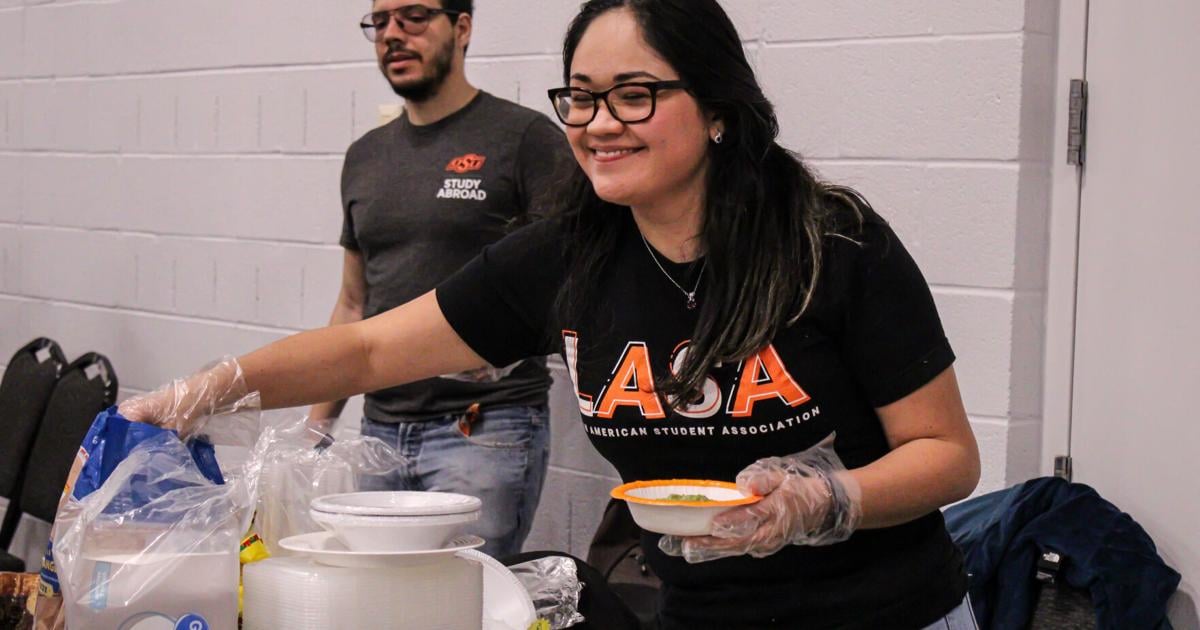
OSU’s International Student Organization hosted its annual International Bazaar, a three-hour fun fest filled with dozens of global foods, strong flavor and music, on Saturday afternoon in the Wes Watkins Center.

“This is big exposure for us,” Mohammed said. “Mostly Africa is not portrayed in the positive light. But we have our food here. Some of us have our national cultural dresses. People seem them and they’re like, ‘Who are these people?’ Then we talk about it. It makes us feel included.”

More than 200 students and Stillwater residents bounced from 12 booths and sampled deserts and entrees from more than 12 countries or regions.

It’s times like Saturday that show food and community can bring folks together.

“The purpose of today is to show Stillwater community the diversity of international students that we have here on campus,” Salome Suarez, International Student Organization president said. “Each area club has prepared different dishes from their own country. We want everybody to see how the dishes are from other parts of the world.”

Foods ranged from the Bangladeshi students’ tandoori chicken to the Latino American students’ cheese empanadas. Lots of desert, too.

Within hours, the exhibit hall transformed into a multicultural kitchen.

Tim Huff, ISO’s adviser, said the event began more than three decades ago. It’s one of ISO’s five annual events and the purpose remains.

“It gives all these students a home,” Huff said. “They feel like they belong when they’re here. You can see them just relax and get into it. It’s very important to see the true nature and culture of these kids because they settle in here.”

Many of the foods appeared similar. Lots of chicken and different meats. But cultural differences appeared in the bite and the food’s preparation.

The Nepalese Student Organization sold about 750 momos, steamed dumplings filled with chicken and vegetables.

Niranjan Pokhrel, a horticulture master’s student from Nepal said the group started making the food at 6 p.m. Friday night. The job wasn’t finished until 3:30 a.m.

It’s no easy task.

“It takes a lot of effort to make that,” he said. “It’s also a skill thing. Not everyone can make it. We had some people’s friends and seniors were really good at making it.”

In Persian culture, kitchens are the realm of women, Yaser Shamsi, Iran native and doctorate student in OSU’s English department, said. Men perform tasks of manual labor such as moving large pots. But women make the food.

“Even looking at the way people celebrate things and the way people cook (are different),” Shamsi said. “You can cook the same ingredient when you just buy it from a shop like Walmart. But when it goes home and it goes through the process that happens in the kitchen, it is the culture, the background and the people that makes the final dish that you see here.”

His wife made most of the Iranian items, such as falafel.

“Having a community of Iranian people just makes me feel as if it’s not that far away from family,” Shamsi said. “OSU is really international friendly. This is one of the events that I really appreciate.”

OSU boasted 1,519 international students in fall 2022, according to OSU international student statistics provided to The O’Colly.

Mayank Talreja, a master’s student from India, represents OSU’s largest international community. The country’s 418 students make it OSU’s biggest international population.

The Indian Student Association also won the event’s best desert content with its kalakand, an Indian milk cake.

“That is what encourages us and gives me a motivation to do something for students,” Talreja said. “We help students transition their life from India to a new country here. It’s been great that a lot of friends are here from our country.”

ISO will also host its Culture Night on April 8 in the Seretean Center for the Performing Arts, another opportunity for OSU’s international students.

Society has never produced so much food, yet we live in a world where only the rich get to be healthy | Van Badham

Society has never produced so much food, yet we live in a world where only the rich get to be healthy | Van Badham

Western society bears a weight that it struggles to shift. Two new stories perhaps expose why.

The initial is an investigation by Australia’s drug regulator into on the internet influencers and platforms endorsing a diabetic issues drug for weight-decline. Ozempic is on the pharmaceutical benefits plan for therapy of style 2 diabetic issues but has been approved “off label” by health professionals to people having difficulties to take care of their weight.

TikTok influencers have discovered it and – irrespective of the risk of aspect-results which include pancreatic swelling, diarrhoea and thyroid tumours – there is now a worldwide scarcity of the things. The AMA is demanding the drug be quarantined for diabetics although supplies are restored.

The next story involves Elise Stefanik of New York – one particular of the maximum-rating Republicans in the US Congress – preparing federal laws to drive the provision of significant-calorie flavoured milk to kids in university lunch systems. Her “Save Chocolate Milk!” campaign outcomes from Democratic New York City mayor, Eric Adams, proposing its removing from faculty lunch menus.

Adams’ issue is that supplying sugary beverages to small children leads to diabetes and weight problems soon after his personal diabetes diagnosis, Adams resorted to veganism. Stefanik’s marketing campaign spruiks for the dairy sector, demonising the diabetic mayor as a “health nanny”.

Australia may well appear significantly away from the Republican pressure-feed of chocolate milk and propaganda, but the effective psychological and financial forces that underlie a cynical political calculus churn jointly in this article, way too.

According to the Planet Well being Corporation definition, 1.9 billion adults are thought of over weight. Of these, additional than 650 million people are categorized as overweight.

In Australia, wellness authorities counsel becoming over weight is more hazardous to us than alcoholic beverages, and only next in “preventable well being risk” to cigarette smoking. Ab muscles wellness information claims 67{d2b09b03d44633acb673e8080360919f91e60962656af8ade0305d5d8b7e4889} of Australian older people are over weight, an improve on 63.4{d2b09b03d44633acb673e8080360919f91e60962656af8ade0305d5d8b7e4889} a decade ago. Final 12 months, Australia’s former conservative authorities launched a “National Being overweight Strategy”, worried Australia was facing health and fitness dangers of cardiovascular ailment, kind 2 diabetic issues, and cancers.

That governing administration did recognise fat is affected by advanced “social, environmental, and financial factors”, but their framework of encouraging “healthy choices” as a treatment unhelpfully individualises a collective trouble. Initially, shaming men and women into weight reduction doesn’t perform: investigation has proven – because 1959 – 95{d2b09b03d44633acb673e8080360919f91e60962656af8ade0305d5d8b7e4889} of body weight reduction makes an attempt fail. Two-thirds of dieters get back the fat they reduce.

2nd, the structural giveaway below is an admission that the poorest “experience the biggest burden of condition connected to excessive weight”. Our societies have never ever created so a great deal meals, nevertheless we are living in a capitalist perversion where by fresh new, healthy meals – and the time to prepare it – are priced as a luxurious, while hugely processed things are cheap, easy and aggressively mass-marketed.

The data’s long in that it is not a failure of collective willpower that’s jeopardising our health and fitness, but a diet plan of negative meals that is culturally familiar, minimal in nutrition and tremendous offered.

Australia weekend

It wasn’t ideological conversion that remodeled me from rabid anti-McDonald’s activist at college to sucking down cheeseburgers as a young grownup in London: it was being unhappy, trapped in reduced-income informal jobs and looking at a recognisable very hot meal marketed for only £2 on a chilly day. As the marketing and advertising departments of Massive Junk know: undesirable foods is low-cost ease and comfort with a great earnings margin.

Still whilst westerners have by no means been so massive, societal beauty criteria continue being uncomfortably svelte. The Ozempic scarcity indicates the toughness of “body positivity” campaigns is nonetheless to dint the “thinspiration” supplied by social media influencers, superstars and many years of routine. Immediately after my cheeseburger winter, not even London’s walkability and subsidised fitness centers have been enough to change its final results younger, dating, graphic-aware, I resorted to a excess weight loss drug.

It labored, largely thanks to chemical terrorism the hazard of straying from its encouraged diet program was explosive steatorrhea. If you want to drop your hunger currently, appear that up (or just click on on that hyperlink).

I went off the drug, and the comfort meals and kilos all arrived again. My relationship with body weight, food and my body is as complicated, contextual and contorted as any individual else’s, a multi-vulnerability that will allow capitalism to chunk us at all finishes.

I’m unlikely to resort to a weight loss product or service now. Not just mainly because 10 several years of “you’re a fats bitch”-degree online salutations influenced in me a doughnut-taking in defiance, nor that with the self-assurance of maturity I deserted arbitrary splendor requires. It’s since when my cake-loving mom was diagnosed with most cancers, her type 2 diabetes precluded her from life-extending chemotherapy, possessing compromised her kidney purpose.

I made use of our time-wealthy pandemic lockdown confinement to diligently – expensively – “health nanny” her into the floor. She got additional months, and ultimately even chemo … but too late.

In the procedure, I missing 21kg probably for the reason that of our low-junk diet regime, possibly owing to sleepless terror of diabetes, or my broken coronary heart. It hasn’t arrive back again. I’ve lost my style for sugar. But was it grief or a suddenly even larger mid-lifetime spending budget for food items and of time that confirmed me what empty ease and comfort doughnuts ended up?

If it will take purchasing a drug to cancel out the outcomes of the junk pushed down our throats, it is not our flesh that’s weighing us down. It’s the illusion confected by capitalism’s drive-feeders that what we eat is ever much of a alternative at all.

Cultural Ramifications of the Globalization of Food

Cultural Ramifications of the Globalization of Food

In 1957, a Japanese man named Momofuku Ando created his first batch of flash-fried ramen noodles, utilizing surplus flour given as aid by the United States after the conclusion of World War II. While Ando’s project originally began with only 18 kilograms of flour and a hand-me-down noodle machine, over 118 billion servings of Ando’s instant ramen are now consumed yearly, with major consumers spanning Australia, Asia, the United States, and the Middle East. The story of instant ramen is hardly unique; globalization within the past few centuries has allowed for cuisines and—by proxy—cultures to have unprecedented expanse across the world. Tomatoes, a current staple in Italian cuisine, originated in the Andes Mountains in South America and were brought to Italy through the Columbian Exchange during the mid-1500s. Later on, industrialization in the 19th century allowed complete dishes, such as spaghetti, to propagate throughout the world with enormous popularity. Today, even entire restaurant franchises can globalize, such as Starbucks with locations in 80 countries.

Such global interconnectedness is a double-edged sword; what nations gain in cultural unity and a diversified palate often comes at the price of interdependency, exploitation of less developed regions and natural resources, and increased demand for advanced infrastructure. The ongoing war in Ukraine has recently exposed some of these faults, with staggering food shortages resulting from Ukraine and Russia producing more than 18 percent of the world’s cereal grains and 72 percent of all sunflower seed oil. However, the Ukrainian conflict marks neither the first nor last time that food is significant in international politics. Given a looming climate crisis, increased awareness of ethical issues surrounding food production, and continued globalization, humanity is at a crucial turning point in its relationship with food. Within this generation, food could become a tool for war, or for peace.

Food Sustainability and the Global Serving Size

With the advent of social media and improvements in transportation and storage, food trends spread faster and wider than ever before, exacerbating unsustainability and overconsumption. Information about foods previously seen as unfamiliar or exotic is widely accessible online, encouraging the spread of new cuisines through virtual interest groups and social media. While trendy foods such as brightly colored dragon fruit drinks, acai bowls, and avocado toast seem innocuous at first glance, the demand for produce outside of where it is naturally grown is a significant contributor to greenhouse gas emissions; as of 2021, transportation of food constitutes approximately one fifth of all emissions associated with food production. When this pollution is combined with the increasing popularity of these foods (US consumption of avocados alone has increased three-fold since 2000), the impact of food globalization is clear. Currently, 50 percent of all habitable land is used for agriculture, and increased demand for certain foods could cause further straining of already saturated industries . Commercial monoculture, the large-scale cultivation of one specific crop, is also contributing to soil degradation, erosion, and the usage of artificial fertilizers and toxic pesticides. Ironically, humanity already produces enough food per year to feed 10 billion people (around 1.5 times the current global population), yet 697 million people suffer from high levels of food insecurity globally. This is largely due to a lack of refrigerating technology in certain regions, which makes it more difficult to prevent food spoilage, and waste issues in other countries where food is cheap and easy to replace.

The existing environmental concerns around food globalization are exacerbated when applied to foods that are difficult to cultivate. The spread and overharvesting of sturgeon caviar, a delicacy originating in the Caspian Sea and currently cultivated in 20 countries, has led to near complete decimation of the wild Atlantic Sturgeon population, with reports this year stating that the Delaware River breeding population has been reduced by 99 percent since the late 1800s. The loss of biodiversity as a result of extinction could potentially lead to “cascading effects” as species dependent on extinct animals become endangered themselves, causing high levels of economic damage to communities dependent on food production.

The World’s Demand for Exploitation

While the globalization of food has expanded the culinary palate of those who can afford it, structural shortcomings surrounding infrastructure and labor regulations have led to the exploitation of workers and entire communities in underdeveloped regions. Impoverished groups are not only more vulnerable to malnutrition, but are also used as a source of cheap labor to satisfy the ever-growing demand for trendy food elsewhere. In Brazil, the explosive and largely unregulated growth of the acai berry industry in the 2000s due to the fruit’s popularity with social media influencers has led to rampant child labor within the country and economic dependency on fruit yields, which has decreased the ability of even adult workers to negotiate better conditions. These violations often go unpunished by regulations such as fair trade certifications, which are lax enough in their inspections that issues can be hidden or not reported at all. Furthermore, approximately 40 percent of all agricultural employees in Brazil are waged workers who do not actually own the land they work on and live below the poverty line. These workers are also often prevented from unionizing and are more susceptible to forced labor and illnesses such as HIV.

Beyond the exploitation of workers, economic dependency on agricultural commodities can even spark violence within dependent regions. In Madagascar, the country with the 10th lowest global GDP per capita in 2022, reliance on the extremely lucrative and labor-intensive vanilla trade has led to the formation of informal armed bands that defend the fields where the crop is ground. An estimated 15 percent of the annual vanilla harvest is stolen every year, and between 2016 and 2018, 150 people were killed as a result of ongoing thievery and defense. Despite the dangers present, the highly volatile pricing found in the vanilla trade creates dependency among the people as one of the few ways farmers can break the cycle of poverty for future generations.

Food as a Vehicle for Peace

Though food insecurity can serve as a vessel for spreading violent conflict, the spread of cuisines possesses a unique ability to unite communities through the sharing and understanding of culture. On a smaller scale, studies have shown that smells associated with food are interconnected with the region of the brain that controls emotions, which can spark powerful reactions. Certain traits of food, such as crunchiness, have even been found to be universally appealing to humans regardless of cultural origin. By sampling and enjoying a variety of global foods, individuals gain a better understanding of and greater empathy towards different cultures. In the wake of former President Donald Trump’s drafting of a travel ban on residents from Syria and Iran in 2017, many restaurants protested by adding Syrian and Iranian dishes to their menus. Similarly, efforts to unite Israeli and Palestinian mothers through the sharing of family recipes were shown to aid the women in viewing each other “not as villains, but as humans just like themselves.” On a larger scale, the intermingling of cultures “underpins social cohesion, peace, and security.” With urban populations expected to increase to nearly 6 billion people by 2045, interactions between various cultures will increasingly occur, and cuisines can help facilitate positive relationships among cultural groups. While negative perceptions of different cultures can lead to conflict, cultural unity is crucial to creating lasting peace.

Constructing a Kinder Plate

Clearly, humanity cannot reverse the globalization of food, but it can minimize the damaging effects of overproduction and overconsumption while still retaining as many cultural benefits as possible. One popular argument is that the prevalence of multinational companies reduces the capabilities of individual communities to become self-sufficient, as food distribution is completely managed by outsiders with ulterior motives. Therefore, the only way to ensure food access for everyone is to place it in the hands of the people themselves. This goal coincides with the recent movement for consumers to purchase locally grown produce, which can be used in preparing cultural dishes. Since 1986, the number of community shared agriculture programs in the United States has increased from two to over 1000, and farm-to-school food programs have increased by 50 percent from 2006 to 2009 alone. Other suggestions seek to combat food insecurity through increasing individual access to credit, urban farming, and empowering women to become economic contributors to their families. In 2022, the World Bank provided US$350 million to Chad, Ghana, and Sierra Leone in order to increase access to agricultural advising and more efficient and climate-friendly technology. Similarly, a US$130 million loan was also provided to Tunisia to aid in wheat imports that were affected by the conflict in Ukraine.

Technological development may also serve as a catalyst for more sustainable global consumption. The development of plant-based meat alternatives in recent years has created the ability to feed more people using between 41 percent and 98 percent less land than typical meat farming. Within the past five years, developments in cellular agriculture (the cultivation of animal cells to produce lab-grown meat) have even enabled the cultivation of seafood without aquaculture, further opening the door to sustainable agriculture. Furthermore, farmland and biodiversity can be protected through regenerative agriculture, which restores depleted soils through crop rotation and composting.

While solutions to the inequities caused by the globalization of food are imperfect and not as globalized as the consumption of the foods they are meant to preserve, they are the first step in fostering justice in a world of unequal economic growth. With the continued rise of social media platforms, international cuisines, and diversity in urban areas, food will continue to be a powerful commodity in both spreading culture and exacerbating excess production and exploitation. The full ramifications of humanity’s actions remain to be seen, but the most significant task is to bring populations together through food rather than apart through conflict.

Maha Shivratri 2023: Food recipes you can prepare for Shivaratri fast

Maha Shivratri 2023: Food recipes you can prepare for Shivaratri fast

Maha Shivratri 2023 recipes: Listed here is the listing of 5 healthier foods recipes to prepare for a rapid this Maha Shivartri 2023.

India Today Web Desk

New Delhi,Up to date: Feb 17, 2023 18:00 IST

By India Right now World-wide-web Desk: Maha Shivratri is a single of the most auspicious festivals in India. Each and every calendar year, it is celebrated with good zeal during the country. Several Shiva worshippers rapidly on this working day by adhering to the austere Nirjala Vrat.

Nirjala Vrat is when persons do not consume or consume all over the working day. Devotees can also exercise a milder type of speedy by ingesting fruit, milk, and some vegetables and grains. Verify out the list under for receiving a broader concept with regards to what to consume whilst executing a mild fast.

Here is the record of 5 nutritious food stuff recipes to prepare for a rapidly this Maha Shivartri 2023:

1. DHOKLA

Initial, roast the rice in a skillet and put together the batter by mixing the rice, rocksalt, chili paste, ginger paste, and yogurt. For building the food Vrat-pleasant, a substitute for typical salt is furnished with rock salt.

Depart the mixture to ferment for at minimum 24 several hours. Future, grease the pan with oil and pour the batter into it. Now spot the tray on the steamer for 20 minutes. Leave it to awesome and the dhokla is all set to serve.

2. SABUDANA KHICHDI

Potatoes, peanuts, and sabudana are employed to put together sabudana khichdi. It is eaten for the duration of fasting days like Navratri, Ekadashi, Mahashivratri, and so on. To make it, wash the sabudana in a bowl and maintain it soaking for 2-3 hours until it softens.

Afterwards, prepare dinner the potatoes, and crush the peanuts into powder form. Now lower the boiled potatoes and sauté them in ghee in a pan. Now saute the peanut and the sabudana combination in the pan and provide it with a tablespoon of lemon juice.

3. SABUDANA VADA

Sabudana vada includes sabudana, potatoes, roasted peanuts, spices, herbs, and seasonings. To commence with the mouth-watering rapid or vrat recipe, very first, boil and mash the potatoes and prepare a mix prior to getting ready the sabudana vada.

Following, roast the peanuts just before grinding them into a coarse powder. Now blend the potatoes, soaked sabudana, chopped coriander leaves, lemon juice, and peanuts in a mixing bowl with a small rock salt. The combination should really be deep-fried in the variety of a vada .

4. FRUITS AND DRY FRUIT SALAD

Fruits are an important element of each individual Hindu festival. Commonly, we give fruits and milk to the deities through pooja or temple visits. It is also really advantageous for your wellness to take in these through a quick.

Folks also prepare fruit chaats, fruit salads, and fruit milkshakes if they are hungry. You can snack on dry fruits these kinds of as almonds, walnuts, dates, raisins, and dried apricots. They have lots of health and fitness benefits.

Alton’s Gumbo 2 Geaux celebrates Cajun culture, food

Alton’s Gumbo 2 Geaux celebrates Cajun culture, food

ALTON — Authentic Cajun kitchen Gumbo 2 Geaux is the closest anyone will get to New Orleans in this River City.

Gumbo 2 Geaux, at 1808 Washington Ave., in the heart of Upper Alton, is owned by Troy and Kyndra Green, who went to Roxana High School. Both of the Greens grew up in or around Baton Rouge, Louisiana, but Kyndra Green moved to Roxana when she was in seventh grade. Two days after graduation she moved back to attend Louisiana State University, where she met her husband. 

The Greens opened Gumbo 2 Geaux last October in Alton. Its menu is at ordergumbo.com where it lists daily specials. Fat Tuesday is next week but Saturday Gumbo 2 Geaux will have fun specials in honor of Mardi Gras.

On Sunday, from 11 a.m.-4 p.m.,Gumbo 2 Geaux will be at Flock, 210 Ridge St., at Landmarks Boulevard, serving gumbo, red beans and rice and king cake, until sold out. This is a treat because the restaurant is closed on Sunday.

On Sunday, March 12, Gumbo 2 Geaux will be featured at Jacoby Arts Center’s Jazz Brunch along with live music from the Alton High School Jazz Combo. Tickets cost $30 per person and are available at jacobyartscenter.org. Gumbo 2 Geaux will be serving a grits bar, king cake and more.

The restaurant hours are 11 a.m.-7 p.m. Monday-Saturday; it’s closed Sunday. Starting March 1, the restaurant will be extending its hours to 8 p.m.

“I am a Cajun woman,” Kyndra Green said. “We lost everything in a flood in 2016, from a low-pressure system that did not move for two days. That’s why I felt compelled to take our culture to a safer area.

“The reality is a lot of people cannot evacuate because of their circumstances, and I feel like, if you can, preserve it,” she said. “From South Louisiana, we are capable of carrying that in our heart, in our soul, wherever we go. Our restaurant has not only become a destination for authentic Cajun food, but it has become active preservation for Cajun culture.”

The Greens decided to come back to Illinois to start over. They moved with their first born, Theodore James, 7, while they were pregnant with their second child, William Oliver, 6, who is the only member of the family born in Alton, and not in South Louisiana.

“He’s our little Alton boy,” his mother said.

When COVID happened, and restaurants closed, folks were asking Green to make her granny Linda Cormier’s gumbo recipe. That’s when they got the idea and established the goal to buy a business and sell the gumbo to go.

“My grandma is very important to me,” Green said. “She is the literal reason I am who am and know what I know, not just in food. but in life.”

Green even shared the basis of her grandmother’s gumbo recipe.

“My entire life, my grandma said, ‘Kyndra, if you have good quality meat, and good quality onion and bell pepper, just salt and (cayenne) pepper, just focus on the meat with good salt and good pepper, that is what makes Cajun food truly Cajun food.’ That is why, when it’s prepared correctly, it is delicious.”

She describes Gumbo 2 Geaux as “authentic Cajun, not perfect Cajun.”

“It’s very subjective,” she said. “You can go five miles north, south, east, or west of Lafayette, and the gumbo will be different, depending on whose granny made it.”

She also shared that people fail at Cajun food when they use too much, too many different spices, when salt and cayenne pepper are sufficient.

“That is where the mistake is made,” she said.

“We love and appreciate this community so much,” Kyndra Green said. “Y’all keep us busy and we are happy to be here serving y’all! Hopefully this helps some of you who have been trying to get in and try our food. Keep it up and I’m more than happy to extend our hours once again for summer..

“Y’all enjoy this sunshine today,” she added. “Spring is coming – just a slice of what’s on the way.”

For more information, follow Gumbo 2 Geaux’s Facebook page.