Have you ever wondered what chefs discuss behind closed doors? A new book dropping today has some answers.
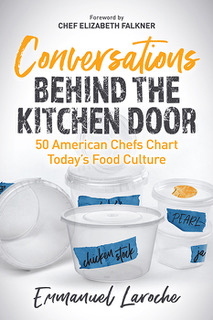
“Conversations Behind the Kitchen Door: 50 American Chefs Chart Today’s Food Culture” by Emmanuel Laroche offers insights from leading chefs and readers will walk away with advice and inspiration from noted chefs, restaurant owners, bartenders, and industry leaders, all of whom have shared their stories in their own words. Subjects include where they got their start, what they learned from mentors, how they mastered proper techniques, and trends to expand their culinary horizons.
Born and raised in France, Laroche is vice president of marketing with Symrise North America a global manufacturer of flavors for the food and beverage industry. In 2015, Emmanuel developed an exclusive partnership with StarChefs for Symrise and began moderating panel discussions with successful culinary professionals. In 2018, he launched the podcast, Flavors Unknown, featuring a series of conversations with acclaimed and award-winning chefs, pastry chefs, and mixologists from around the United States.
Modern Restaurant Management (MRM) magazine caught up with Laroche to learn more about why he wrote this book, the state of restaurant culture and more.
Why write this book and why now?
My passion for food started when I was a kid in France. When I was six or seven years old, my mother taught me how to cook a Quiche Lorraine from scratch. I grew up in a family where food was ubiquitous at home and while traveling and in a country with a strong culinary heritage.
When I came to the United States, my French family and friends consistently teased me about the absence of culinary traditions in America. Twenty years ago, I was not able to properly answer them. Today, after four seasons of my podcast, ‘Flavors Unknown,” where I interview acclaimed American chefs, pastry chefs, and mixologists, and many tasting adventures across the country, I felt I had enough knowledge and content to write a book to formulate an answer.
“Conversations Behind the Kitchen Door” is also a way to bring more people to listen my podcast. They are personal projects linked to my passion for food and the desire to understand people who produce it, transform it, celebrate it, and share their passion for food with others. I am in charge of marketing for a global food ingredient company and travel often for my day job. The pandemic gave me the time to write the book.
How has the pandemic affected restaurant culture?
A lot has been already written on the topic. During the pandemic, I had the chance to host two podcast episodes featuring panel discussions with several chefs from different part of the country and representing distinct restaurant profiles. After these episodes, my conversations with culinary leaders continue to highlight that a of people left the hospitality business for good. Chefs from various horizons mention first that skilled workforce is difficult to find and that there is a labor shortage and a short food supply.
Since the pandemic, many chefs created fast-casual concepts and we see more and more tasting and prix-fix menus. I am very pleased to have witnessed a lot more community spirit and support between restaurants and with farmers and purveyors.
What traits or characteristics are necessary for a good restaurant leader?
In the last chapter of the book called “The Kitchen as a Metaphor for Life”, I relate something that chef David Burke told me. He said four things are important in this business: having an open mind, a good work ethic, a hunger for success, and enthusiasm. From all the other conversations, I highlight, in the same chapter, many advice about leadership. I picked a few of them; be present and accessible, create a positive environment, promote respect, implement standards, and keep in mind that great feedback is earned.
A good restaurant leader needs to understand how to balance discipline, creativity, and consistency.
A good restaurant leader needs to understand how to balance discipline, creativity, and consistency. Discipline as a mean to deliver results, creativity as in finding creative solutions to achieve something, and consistency as in having a common purpose and that is expected from everyone to deliver food every day to the highest standards.
What lessons did you learn in the process of writing the book?
I learned many lessons while writing this book, about leadership, about food, and about me as an individual. I previously mentioned some learning about leadership. About food, I should cook local and buy more in season as produce taste better and is cheaper. My time spent with chef Drew Adams in the woods alongside the Potomac River in D.C. convinced me that I should explore more about foraging. I now make everything possible to access higher quality ingredients and support farmers’ markets and local businesses.
The objective of this book is to demonstrate that people shouldn’t be afraid of experimenting in the kitchen, and only use recipes as guidelines. Not everybody has the same ingredients that restaurants have, and everybody has different markets and different seasons.
For me as an individual, I learned that the future is about collaboration. I should always look for opportunities and anticipate and prepare for the unexpected. I shouldn’t be afraid of failing. And finally, resilience is the secret ingredient to success. I love traveling and go on culinary adventure. All culinary leaders I had on the podcast challenge the new generation of cooks to travel to broader their horizons. They suggest tasting everything, take pictures, write notes, and bring ingredient back. In the chapter “The Flavor-Memory Database”, I give a list of twenty travel tips for setting up a tasting tour.
What do you hope readers take away from the book?
People who are emotionally connected with the food and drinks they like, will enjoy learning about the journeys and stories of the chefs that prepare it. This book will help readers know how to choose quality ingredients, develop relationships with famers at farmer’s markets, and find inspiration while traveling. People interested in the state of the food industry today and how it has shaped eating habits, with advice from chefs on how to be more creative in the kitchen. Food enthusiasts will learn about how America eats today and understand how chefs think. Culinary students will learn the importance of establishing short term and long-term goals and finding a mentor to guide and challenge them. Cooks will find new sources of inspiration and tips on how to evolve in the industry. And finally, chefs will find out what their peers are doing.
The pandemic has fundamentally changed the restaurant industry and despite food business closures, bankruptcies, and uncertainty, the hospitality industry has proven to be more resilient than expected.
“Go and Travel” is probably the main recommendation I took away from my conversation with culinary leaders. It is a great source of inspiration. It resonates with my DNA. I identified seven common paths when it comes to chef’s creative process (that can be use on their own or in combination). I share them in the chapter called “Creative Decisions.”
A lot of the culinary leaders I talked to were also mentors. I share in the book eight key pieces of advice most of them learned from their mentors and passed on to others.
What do you see as key challenges facing restaurants in 2023?
There is still a cost-of-living crisis, and the restaurant industry remains very competitive, and we will continue to see chefs using their creative thinking and collaboration approach with farmers and purveyors to find way to keep cost down. One thing I learned from all my conversations is that chefs are resilient. The pandemic has fundamentally changed the restaurant industry and despite food business closures, bankruptcies, and uncertainty, the hospitality industry has proven to be more resilient than expected.
Food trucks and ghost kitchens are here to stay and with the behavioral and attitude shifts towards food for the new generations, new opportunities for food and beverage innovation will emerge. More people are working from home which will offer opportunities for breakfast and lunch fast casual ideas. More creative packaging will come into play as convenience will continue to drive innovation. Plant-based food is here to stay as well as more people are adopting the flexitarian diet. How can chefs make plant-based food more desirable?
What keeps you passionate about restaurants and the industry?//
The passion I have for food since my childhood in France never needed away. I still want to explore. I have the chance to participate to more than sixty tastings a year. Do I experience FOMO (Fear Of Missing Out), a syndrome so many times mentioned when referring to Millennials? Probably I do. When I travel I always prepare my trip searching the web for unique restaurants, coffee roasters, breweries, and local bakeries. When I interview culinary leaders, I am curious about their innovation and their creative process. Chef Elizabeth Falkner says in the foreword she wrote for my book, “Emmanuel genuinely seems like he is trying to solve a puzzle, which is why this book is an important piece of writing.”
What advice would you give to someone starting out in the industry?
I give eight advice from chefs and their mentors in the chapter “The Kitchen as a Metaphor for Life”. Here are four of them: lose the ego!, set-up goals early in your career, find amazing mentors who can guide and challenge you, and respect everyone and everything. And to be successful, focus on making the local customers happy, as you need to attract the neighborhood. They will be the ones helping to pay the bills.
What is your favorite or the most colorful anecdotes in the book?
From the chefs:
There are lot of small anecdotes like when chef Shamil Velazquez mentioned that he applied to the CIA when he was in 9th grade, or when chef Brother Luck shared that he went into working at restaurants as an opportunity to eat at the end of the night.
One colorful story is about the moment when chef Fiore Tedesco decided to stop playing drums in a band and go into cooking.
One emotional story is when chef Bonnie Morales mentioned that the name of her restaurant Kachka is connected with the hard story of her grand-mother escaping a ghetto in Belarus during WWII.
What are a few of the most surprising things you learned from the chefs you interviewed for Conversations Behind the Kitchen Door?
Only a few of the people I talked to consider themselves as artists. It was an idealistic mental image I had of them. During my conversations, I learned that the creative side of their job becomes less and less of a focal point. As they progress in their career, execution, techniques, process, leadership, and simplicity take over.
The U.S. Food and Drug Administration (FDA) recently completed its first pre-market consultation for a human food made with animal cell culture technology in response to a submission by UPSIDE Foods assessing the safety of a food produced from cultured chicken cells.1 In its response letter to the company’s submission, FDA stated that it did not identify a basis for concluding that the production process as described in the submission would be expected to result in food that bears or contains any substance or microorganism that would adulterate the food. This marks the first time FDA has completed a pre-market consultation for a human food derived from cultured animal cells.
Background
Cell culture technology for food production has advanced significantly in recent years, sparking the development of a regulatory framework with oversight shared between FDA and the U.S. Department of Agriculture (USDA). In March 2019, FDA and USDA’s Food Safety and Inspection Service (FSIS) reached an interagency agreement whereby both agencies agreed to jointly oversee the production of human food products derived from the cells of livestock and poultry.2 Under this joint regulatory framework, FDA conducts a pre-market consultation to evaluate production materials and processes and oversees cell collection, cell banks, and cell growth and differentiation. During the cell harvest stage, oversight transitions to FSIS to oversee the production and labeling of human food products derived from these livestock and poultry cells.
FDA noted in its press release that the pre-market consultation process is a voluntary process by which firms can submit data to FDA for evaluation. Even after the firm (i.e., UPSIDE) completes this pre-market consultation process and FDA states that it has no further questions about the firm’s safety conclusion, the firm must still meet all applicable USDA and FDA requirements before its food products can be lawfully marketed. The additional USDA requirements apply only to products involving cultivated animal cells subject to the Federal Meat Inspection Act (FMIA) or the Poultry Products Inspection Act (PPIA) for the purpose of producing human food. For cultivated cells not subject to FMIA or PPIA (e.g., cultivated seafood cells), there are no additional USDA requirements.
Next Steps
In its press release, FDA also stated that it is “committed to supporting innovation in the food supply” and is ready to work with additional firms in this space.3 Within the next few months, the agency plans to issue guidance to assist firms that intend to produce human foods from cultured animal cells to prepare for pre-market consultations. The agency intends to provide a formal opportunity for public comment on this guidance.
* * *
We will continue to monitor all regulatory actions related to animal cell culture technology as it relates to food production.
Credit: Image by PeopleImages via iStock/Getty Images Plus.
There’s a reason we spend hours elbow deep in pots and pans every holiday season. Yes, the food is delicious, but more enduring than any casserole are the memories of cooking with friends and family. It’s those moments, rather than the recipes themselves, that NPR is highlighting in new food series All Things We’re Cooking.
In February, NPR managing editor Gerry Holmes was reminiscing over a cookbook his mother had created—a gift even more precious after she passed. The reflection prompted Holmes to speak with chief cultural editor Nicholas Charles, and the idea for All Things We’re Cooking was born.
Over the past five months, the team has led an outreach strategy across NPR and its member stations, asking listeners and readers to send in their most meaningful family recipes—a collaboration between the audience and newsrooms. Charles says once they began asking for submissions, people were eager to share stories about the loved ones behind the dishes.
While working on the series, editors aimed to capture the diversity of NPR’s audience. Charles hopes this project is something all readers and listeners can relate to, and an opportunity for them to “see themselves” and their cultures in NPR’s storytelling.
“One of the first things you know about your family is the smell, odors, all the wonderful things that come out of the kitchen,” he says. “Especially immigrant families, it connects them back to their heritage…it connects you back to history, and heritage and memories.”
Some episodes will feature the voices of people who shared their family recipes, telling stories in their own words. Desiree Hicks, senior supervising editor at NPR, says she is excited for NPR’s audience to have an opportunity to hear “directly from the folks [featured] in these stories,” and make their own personal connections.
Segments will be uploaded online over the next six weeks, and aired on some stations. The first batch of stories launched November 20 and highlights six people. Articles first dive into the meaning and importance of the dishes, followed by the recipes themselves. By the end of December, nearly 30 stories and recipes will be published as a part of the series.
Editorial Fellow
Keely recently graduated with her master’s in journalism from American University and has reported on local DC, national politics, and business. She has previously written for The Capitol Forum.
AUGUSTA — Mark Ambrose loaded a little bit of everything onto his plate, from Iraqi sambosas to turkey, macaroni and cheese, and pie, walking away with a dish that celebrated both the cultures and people that make up Augusta Adult and Community Education’s English Language Learner program.
His feast was part of the adult education program’s first-ever Blessings Dinner, held on Tuesday at the Buker Community Center.
Though Ambrose did not cook a meal for the celebration, his classmates brought dishes from their cultures — some that are typically eaten during the winter holiday season and others that are timeless favorites.
It was a Thanksgiving meal with a twist, since not everyone is familiar with the traditional American dinner of turkey, cranberry sauce and mashed potatoes, but most share a common love for food.
Guests greet each other Tuesday during a Thanksgiving meal hosted by Augusta Adult and Community Education for students enrolled in the English Language Learner program at the Buker Community Center in Augusta. Andy Molloy/Kennebec Journal
Kelli Gilzow-Stowell brought the idea of the Blessings Dinner with her from Lewiston, where it takes place every year.
“The focus is celebrating the blessings of the students,” she said. “Just allowing them to share their food and celebrating togetherness is a blessing.”
Most of the students in the English Language Learners course are from different countries — some of them hail from Mexico, Syria, Iraq and Mongolia, nations that were represented in the cuisines shared Tuesday.
Augusta Adult and Community Education Director Kayla Sikora did bring two turkeys, which were cooked and carved by workers at the Augusta Civic Center.
But for sides, students brought Kahafe — a sweet Syrian dish — vegan enchilada casserole, sambosas, macaroni and cheese, and ponche, among other homemade dishes.
“We wanted to provide a sense of community and show one of our traditions and hope (the students) would bring in food and their culture in,” Sikora said.
Guadalupe Santioemma made ponche, a warm, traditional Mexican drink made with apples and cinnamon typically consumed during Christmastime. Santioemma is a student in the program and said she decided to make a drink because it’s something everyone forgets to bring to a community dinner.
Aham Daaboul made Kanafeh, honey-soaked Syrian sweets, that he brought along with his granddaughter, Mariam, and great-niece, Shouq, who enjoyed running around the event and eating the samboas, or triangular puff pastries stuffed with meat and vegetables.
Mariam Daaboul was hesitant to try some of the new offerings, but said the dish her family brought, Kahafe, is “really, really good.”
Though many of the students will not celebrate Thanksgiving on Thursday, their attendance at Tuesday’s event meant having a “sense of community” and offered a way to be together and share their culture.
Bushra Nasif, left, greets Mariam Daaboul, 13, with a kiss Tuesday at the Buker Community Center in Augusta during a Thanksgiving meal hosted by the Augusta Adult and Community Education for students enrolled in the English Language Learner program. Andy Molloy/Kennebec Journal
Ambrose, who will attend a Thanksgiving event Thursday, decided to come as it was “something special” going on. This year, he said he is thankful to “be alive, for friends and for gatherings,” such as the Blessings Dinner.
“It’s great to come and be thankful, whether there is one thing, or a few,” he said.
With the event celebrating community and culture, closer to home in Augusta, the Capital Area Technical Center’s culinary program made an array and assortment of pies for the event and other people brought Russian almond cookies and cranberry bread for those who saved room for dessert.
Invalid username/password.
Please check your email to confirm and complete your registration.
Use the form below to reset your password. When you’ve submitted your account email, we will send an email with a reset code.
« Previous
Recounts confirm Election Day winners in 3 state races
Leaves are falling, and the smell of pumpkin spice permeates the air. It’s that time of the year when family and friends gather to give thanks and, of course, eat some delicious food. Get ready to celebrate this Thanksgiving with mouth-watering recipes that are so good you will want to eat them all year round:
Cranberry Brie Pastry Tarts from Half Baked Harvest
These bite-sized cranberry brie pastry tarts are the best appetizers for any occasion, especially Thanksgiving. The red cranberries add a festive touch to the delicious sweet and savory snack, and the brie brings out a subtle yet buttery taste. They will be gone as soon as you bring them out, so try these pastry tarts this holiday season.
Brussels Sprouts with Garlic from The New York Times
The New York Times’ Brussels sprouts are crispy, delicious and a perfect combination of flavors. With just six ingredients, this Thanksgiving dish is the best solution for anyone who needs a simple recipe. The combination of balsamic vinegar and garlic fills your mouth with overwhelmingly unique yet delicious flavors. Once you try these sweet caramelized Brussels sprouts, they will be your go-to recipe for years to come.
Buttery Rolls from Bon Appétit
Rolls are the perfect addition to almost any Thanksgiving dinner, and these pull-apart rolls from Bon Appétit are essential. These fluffy, buttery rolls take some time as they are made from scratch, but trust me, the process is worth it. The end result will leave you and your guests wanting more.
Classic Stuffing from Epicurious
What is Thanksgiving without stuffing? Stuffing can be hard to master, with so many different ingredients to choose from and ways to cook the dish. This recipe from Epicurious simplifies the process and creates the perfect flavor combination of bread, celery, onions and herbs. Try this classic vegetarian-friendly stuffing and wow your guests with your cooking skills.
Swiss Chard and Sweet Potato Gratin from Smitten Kitchen
Although this is not a dish you always see at Thanksgiving, Smitten Kitchen’s Swiss Chard and Sweet Potato Gratin is a fan favorite and the ultimate side if you are looking to make something more unique. Swiss chard is not the easiest item to prep, but it will be worth it once you try the gratin. The fusion of sweet potato and swiss chard creates an unusual yet delectable fall dish that will keep you coming back for more.
Creamy Mashed Potatoes from Spend with Pennies
Mashed potatoes are a Thanksgiving staple — you almost never see a table without a large dish of appetizingly creamy mashed potatoes. If you are on mashed potato duty this year and feel the pressure, this recipe from Spend with Pennies will solve all of your cooking worries. This dish pairs well with any sauces as well as gravy, so feel free to keep it simple or throw in extra spices or cheese to add a dash of flavor.
Green Bean Casserole from Allrecipes
You can’t have Thanksgiving without a mouth-wateringly delicious green bean casserole on the table. The dish is the perfect way to add some vegetables to your meal. Allrecipes makes the process easy for you with just four ingredients in this scrumptious dish: green beans, canned soup, cheese and French-fried onions. Give it a try this Thanksgiving.
Martha’s Macaroni and Cheese from Smitten Kitchen
Mac and cheese is always a go-to comfort food, and during Thanksgiving, it adds a warm, homey touch to the meal. Martha’s Macaroni and Cheese from Smitten Kitchen is a cheesy and delicious addition to any holiday festivities. This flavorful pasta, along with its crunchy bread topping, pairs well with anything from broccoli to bacon. Trust me, this mac and cheese will be gone as soon as you set it down.
Apple Crisp from The Chunky Chef
Curling up in a blanket and watching a movie while eating a warm apple crisp with ice cream sounds like the ideal way to end your Thanksgiving. This Old Fashioned Apple Crisp recipe from The Chunky Chef is an easy and decadent dessert to make after a long day of festivities. Smelling the apples and cinnamon wafting from the oven will be enough to make you want to bake another batch.
The Great Pumpkin Pie from Sally’s Baking Addiction
When I think of the fall season or Thanksgiving, pumpkin pie is one of the first things that comes to mind. The dessert is the perfect way to complete your Thanksgiving holiday, and this recipe from Sally’s Baking Addiction will top off the meal and wow your guests. Despite being so full they cannot eat anymore, the combination of cinnamon, nutmeg and pumpkin baked into the pie will keep everyone coming back for a second slice.
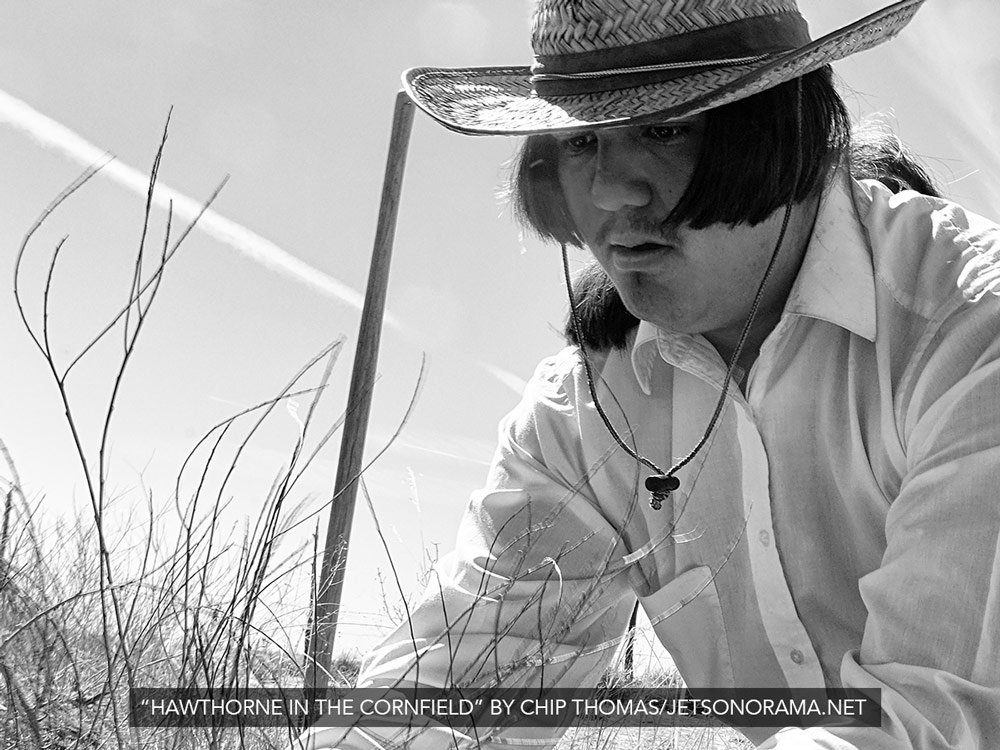
“HAWTHORNE IN THE CORNFIELD” BY CHIP THOMAS/JETSONORAMA.NET
Editors’ note: This article is from the fall 2022 issue of the Nonprofit Quarterly, “The Face of Climate Change.” and was first published by NPQ on April 4, 2022, and is republished here with minor alterations.
Food changes into blood, blood into cells, cells change into energy which changes up into life . . . food is life.
–Vertamae Smart-Grosvenor, culinary griot
This work we’re doing in food culture is ultimately healing work. And those foods, and seeds, and the land are the agents of healing:
They are the healers, they are the curanderas, they are the medicine people who are increasing our capacity to look at the grief all around us . . .
it’s only the seeds, and the land, and the food, that have the capacity to take that grief, and to metabolize and digest it.
Imagine a future where the ways we grow, cook, and gather around food affirm our relationships to the places we live, to the people who came before us, and to future generations. Imagine a future where we recognize care as the essence of all labor and appreciate all people’s labor, no matter the form it takes. Imagine that we joyfully nourish each other, that we all know we belong, and that we recognize and as kin. What images come to mind? What longing is sparked in us?
Right now, we are living through escalating crises, both within living ecologies and socially constructed systems.1 A dominant worldview shaped by settler colonialism and white supremacy has proliferated practices of extraction and exploitation that benefit few at the expense of many. Our commercial food system is an expression of this. Industrialized supply chains abuse people and the planet, feeding exploitation and injustice.
A respectful, reciprocal food culture can help us imagine, build, and sustain possibilities for a more equitable future, in which our world’s natural abundance is shared.
But systems and practices do not exist in a vacuum; they are an expression of the culture that underpins them. As many Black, Indigenous, and diasporic people of color food leaders have long asserted, dominant food narratives—from bootstrapping2 to “you are what you eat” diet shaming3—often explicitly affirm logics of individualism, ignoring structural inequities and oppression and perpetuating support for massive globalized, profit-driven food industries that kill people and destroy ecologies.4 To transform our food system, address our legacies of harm, and interrupt our reckless relationship to ecosystems, we need to look beyond food supply chains to the culture underpinning how we produce and share food. We need to advance narratives that celebrate interdependency and care. Stated otherwise, we need to transform our food culture.
Food culture consists of the relationships and experiences we engage through food—the way food shapes our experiences of the world and of ourselves and each other. A respectful, reciprocal food culture can help us imagine, build, and sustain possibilities for a more equitable future, in which our world’s natural abundance is shared. Food-culture organizers, predominantly Black, Indigenous, and diasporic people of color, are already inviting us to engage with food as life force, as culture. They remind us that food culture is a powerful organizing force that feeds the body, lives in embodied relationships, and animates the world. Food is a world-builder and place-maker, and the way many of us find a sense of home and belonging. As such, when we transform food culture, we transform culture as a whole—from how we relate to one another, to our stories of who we are, and our visions for who we can become. In the process, we empower ourselves to transform the systems that govern our world.
Setting the Table: Food as Teacher, Food as Healer
“People want to put us in boxes all the time,” Mohawk seedkeeper, writer, and activist Rowen White tells a crowd of squares assembled on Zoom. Last November, our organization, Food Culture Collective (previously Real Food Real Stories), hosted a conversation between White and Black liberation cook-activist Jocelyn Jackson, for a virtual Around the Table event on decolonizing food culture.5 These two visionary food-culture workers lit up the screen and the hearts of those listening with their descriptions of “storied” food cultures that nourish complexity and accountability. “[People] always say, she does food systems work,” White continued, “and I’m like, I don’t do food systems work! I do something way more expansive than that.”
A passionate advocate for Indigenous seed and food sovereignty, White serves as the educational director and lead mentor of Sierra Seeds, a cooperative seed company committed to cultivating a network of seed
stewards in Northern California. She is also the founder of the Indigenous Seed Keepers Network. White frames her work as a lifelong “apprenticeship to seeds.” Through seeds, she sees a path of “rehydrating” cultural values of reciprocity, care, and collective nourishment—those “original agreements” that affirm a symbiotic relationship among all beings. In her workshops, speeches, and writings on seeds, culture, and ancestral knowledge, White invites the public into a deeper, reciprocal relationship with the land.
Jocelyn Jackson—cofounder of the People’s Kitchen Collective, a community dining and political education project based in Oakland, California—has often experienced the true breadth, impact, and political clarity of her work shoehorned into expected categories. She’s been described as everything from a dietician to a culinary instructor—in fact, Jackson is a culture worker who uses recipes, ingredients, and shared meals to dialogue with ancestors, claim collective power, and evoke visions of justice. With a background in law and education, Jackson founded JUSTUS Kitchen to create healing food experiences that inspire folks to reconnect with themselves, the earth, and one another, inviting us to grow together toward collective liberation.
For example, in 2021, Jackson launched an interactive, virtual tablescape, “Fixed Price Menu,” in partnership with ARRAY Alliance and the Law Enforcement Accountability Project (LEAP).6 Jackson created the conceptual menu and table setting for Philando Castile, the thirty-two-year-old Black man killed by police, and Jeronimo Yanez, the officer who murdered him. At Yanez’s place setting she put some of Castile’s favorite foods— honoring Castile’s humanity. In this way Jackson asked, “What culture did Yanez feed on that would allow him to take life so swiftly?”
Using food as an art form—as a way to reflect on how Castile’s and Yanez’s story unfolded—Jackson invited audiences to cook the recipes, contemplate the story, and consider our own responsibility and accountability. As Jackson explained in our Around the Table conversation, “That’s ultimately what’s going on every time we eat a meal. We’re talking about a liberation moment. We’re talking about a cultural moment. We’re talking about a sacred moment.” It was fortifying, Jackson told us, to have food recognized as playing an essential role in exploring police brutality, abolition, and accountability.7
Both Jackson and White are part of a growing movement around food-culture reclamation and revitalization that is challenging how we think about food systems change. Supply-chain systems analysis reduces food to nutrients, narrowing our understanding of the many ways that food shapes our lives. In contrast, food-culture bearers, organizers, and creatives recognize that food is intersectional—inexorably tied to practices of healing, identity formation, belonging,8 and placemaking. Food-culture work offers us a praxis with which to affirm our mutuality with each other and the ecologies that feed us as we grow our collective well-being. This work has the potential to shift our global trajectory away from escalating social and climate chaos. To borrow the language of visionary author Toni Cade Bambara, food offers us the seeds and rich soil to shift our worldview and cultivate an irresistible future.
Challenging White Supremacist Logic
U.S. food systems are fundamentally shaped by violent land grabs9 and plantation economies,10 growing into today’s megacorporations that produce ecologically destructive and nutritionally empty food for a buck.11 The same colonial logic that established and upheld these violent systems has shaped how most of us think and talk about food, including the development of a “good food movement” that reinforces systemic inequities and a racial hierarchy that prioritizes whiteness.12
Indeed, what is often described as the organic, sustainable, slow, good, or regenerative food movement has celebrated mostly white farmers and chefs who championed fresh, “wholesome” food, often without acknowledging the legacies of institutionalized racism and land theft that facilitated these white farmers’ and food leaders’ access to resources.13 Nor has the movement adequately acknowledged the Black, Indigenous, and diasporic communities of color whose work and leadership it drew from. For example, the Black origins of Community Supported Agriculture (CSA) were eclipsed by white farmers,14 and Indigenous fights against government-provided commodity foods were marginalized.15 This has had tangible physical and economic repercussions for entire communities. For example, when public and business decision makers underinvest in Black or Immigrant neighborhoods and tribal communities, they create conditions of food apartheid.16
One potent example of such selective celebration illustrates the problem. Around the same time that Alice Waters was solidifying her position as the “mother of farm-to-table,”17 Black culinary griot, anthropologist, and artist Vertamae Smart-Grosvenor published her seminal autobiographical cookbook and memoir, Vibration Cooking: Or, the Travel Notes of a Geechee Girl.18 In this groundbreaking work, Smart-Grosvenor wove together “recipes” evoking instinctual and inherited knowledge with stories of her upbringing in South Carolina’s Lowcountry and commentaries on cultural dynamics, from culinary appropriation to gentrification.
When the third edition of the book was published, in 1992, Smart-Grosvenor described it as a book that “slipped through the cracks for more than two decades and lived.”19 White critics struggled to categorize the book and were unsure of how to describe Smart-Grosvenor. Even in her 2016 NewYorkTimes obituary, Smart- Grosvenor was described as someone “who liked to call herself a ‘culinary griot’” (emphasis added), implicitly casting doubt on the validity of her work.20
The white-dominated narratives of the “food movement” have failed to give essential lineage holders of food- culture work, like Smart-Grosvenor, their due. Generations of vital Black, Indigenous, and diasporic people of color–led food- culture work have been underresourced and overshadowed—with the expertise of food- culture workers unfairly questioned, and their access to funding and infrastructure support unfairly constrained. As White reminds us, “Colonial culture tries to make what we do smaller, or fit it into their paradigm, or their understanding of what it is.”21 Crucially, many BIPOC food-culture workers whose work has been diminished or dismissed offer a powerful map toward a food culture that affirms reciprocity and mutual belonging, and ensures a livable future.
Food Is Culture
Over the past decade, growing numbers of organizations across issues and sectors have recognized that systems are rooted in culture and that systems change requires a cultural shift.22 To quote Jeff Chang in “A Conversation about Cultural Strategy,”
. . . culture has two definitions: (1) The prevailing beliefs, values and customs of a group; a group’s way of life. (2) A set of practices (including all forms of storytelling and artmaking) that contain, transmit, or express ideas, values, habits and behaviors between individuals and groups.23
When we understand culture as beliefs, values, customs, and practices, we see how our beliefs and practices around food are culture, and how our intentionality around food culture is crucial to creating a sustainable, just, and joyful world.
When we approach food work as cultural work, we are able to crack open, reimagine, and rewrite the implicit assumptions of fiercely held narratives, transforming the shared spaces, practices, and norms that make up culture.
Our current food system is an expression of the core values of dominant food culture. So, to heal our food system, we must heal our shared food culture. At a 2021 Food Culture Collective storytelling gathering, food scholar, writer, and editor of the seminal anthology Sistah Vegan,24 A. Breeze Harper put it simply: “Racial justice, decolonization, and a sustainable food system cannot exist in—or on—soil that continues to be ‘purified’ through white supremacy and monocultural belief systems.”25 When we approach food work as cultural work, we are able to crack open, reimagine, and rewrite the implicit assumptions of fiercely held narratives, transforming the shared spaces, practices, and norms that make up culture.
Speaking to the centrality of storytelling in her approach to food work, Black food scholar–activist Lindsey Lunsford recently told us, “The things that come natural are easy to write off as being unimportant or nonsubstantial.”26 In the same way that humans couldn’t describe the color blue before we began producing blue pigment––despite the fact that the fundamental elements of air and water are now defined by the hue–– food-culture work has always been fundamental to our world, even if our colonized languages and worldviews haven’t allowed some of us to “see” it.
Sign up for our free newsletters
Subscribe to NPQ’s newsletters to have our top stories delivered directly to your inbox.
By signing up, you agree to our privacy policy and terms of use, and to receive messages from NPQ and our partners.
Understanding food work as cultural work calls many people and communities into the movement to collectively reclaim and transform our relationship to food, at all scales. A food systems analysis invited consumers to ask: Where does your food come from? Food-culture work calls us all into the question: What culture do we feed?
Bringing Narratives of Wholeness to Life
Food-culture work is necessary to alter existing extractive and exploitative power structures. Unlike a “vote- with-your-fork” politic that centers consumption as the space of action, food-culture work affirms our individual and collective power to shape culture beyond consumption.27
Indigenous communities and leaders have long offered an understanding of human relationship to food and land as sacred, in ways that are profoundly distinct from the worldviews that dominate food culture in the United States. “There’s a circle of relationships that happen in our territories that people have forgotten about, about how we live in reciprocity and don’t take more than we need,” Corinna Gould—Lisjan Ohlone leader, community spokeswoman, and cofounder of the Sogorea Te’ Land Trust—told a Food Culture Collective audience in 2020. Gould and the women of Sogorea Te’ have played a leading role in defining rematriation asa practice that facilitates the return of Indigenous land to Indigenous people and stewardship.28 Unlike the legal term “repatriate,” which is defined by a transfer of ownership, “rematriate” includes a more profound practice of healing and decolonization. This work offers cultural transformation far beyond the territories of the Lisjan Ohlone people on the eastern shores of the San Francisco Bay; Sogorea Te’s modeling invites us all to inhabit narratives of care and abundance to heal our soils, our communities, and our relationships with all our living relations (human and beyond)—including #LandBack to Indigenous stewardship.29
Nikiko Masumoto, a third-generation Japanese-American peach farmer, queer writer, and performance artist, offers another example of a land-based food-culture practitioner cultivating transformational narratives in her work. Both Masumoto’s organic farming practice and her creative work nourish stories of belonging and wholeness alive in the Central Valley of California, which she calls home. As she shared with a Food Culture Collective audience in 2016, her food work invites others into an understanding of the “cultural landscape that is already embedded, but often erased, in the food that we eat.” The land Masumoto now farms was originally purchased by her grandfather a few years after he, like so many Japanese Americans, was incarcerated in an internment camp. Prior to World War II, Masumoto’s grandfather had worked as a farmhand; anti-Asian immigration laws had prevented many Asian Americans from owning land, and resentment of the Japanese community’s ownership stake in agricultural land directly fueled the political justification for internment and forcible removal.30 As Masumoto told a reporter in 2017, she is a descendant of her grandfather’s “resilience to really claim a place of belonging.”31
Indigenous communities and leaders have long offered an understanding of human relationship to food and land as sacred, in ways that are profoundly distinct from the worldviews that dominate food culture in the United States.
Land-based food-culture workers like White, Gould, and Masumoto go beyond connecting us to the land; they connect us to the stories and legacies embedded in the soils we cultivate. “What does it look like to weave in the stories of the people, of the land, who feed us?” wondered Pandora Thomas, founder of EarthSEED Permaculture Center and Farm, on a phone call this winter. Founded with a powerful cultural intention, EarthSEED is a 14-acre solar-powered organic farm, orchard, and educational center in Sonoma County, California, stewarded with Afro-Indigenous permaculture principles. “We sing, we celebrate, we mourn,” she continued—“there’s all this cultural beauty that is expressed in bringing food from the ground to our lives.”
This celebration and witnessing of the cultural aspects of food, farming, and land stewardship are clearly something we’re hungering for. The last decade has seen a broader public embrace food-culture figures, from Anishinaabe botanist Robin Wall Kimmerer, whose 2013 Braiding Sweetgrass became a national best seller, to Leah Penniman of Soul Fire Farm, whose 2018 guide-meets-manifesto, Farming While Black, spoke to the work of reclaiming dignity as Black agriculturalists.32 Both works have resonated with an audience that reaches far beyond people working directly in food and farming, demonstrating a broad appetite for culturally based approaches to land and farming.
This work of renewing and healing relationships with the land is growing along with a wave of people reclaiming and reviving ancestral culinary traditions. Indigenous writers like Devon Abbott Mihesuah (Recovering Our Ancestors’ Gardens, 2005)33 and Black writers like Jessica Harris (High on the Hog, 2012, which served as the foundation for last year’s hit Netflix series hosted by Stephen Satterfield)34 and Bryant Terry (starting with Grub, in 2006, and, most recently, Black Food, in 2021)35 have elevated and centered foodways that have been intentionally suppressed and erased in U.S. history. In 2015, Luz Calvo and Catriona Esquibel took up the call to Decolonize Your Diet with a cookbook reclaiming health-giving Mesoamerican foods.36 Numerous ancestral food projects have sprung up in the intervening years. Two of the best known are from Sean Sherman and team at The Sioux Chef, and Michael Twitty’s Afroculinaria;37 there are many more. These cultural food projects are not just about preserving traditional foodways—by resurfacing a relationship to food that celebrates sovereignty and reciprocity, we expand our capacity to dream into decolonized visions of the future.
At a 2019 Food Culture Collective event, Filipina-American chef, educator, and activist Aileen Suzara asked the audience, “Is it possible to recover the things that you were supposed to forget?” Suzara was called to food work as a means of reckoning with the aftershocks of colonization and military occupation she witnessed in her family. In 2017, Suzara founded Sariwa, a project celebrating the healing properties of Filipino food. Like many immigrant families, the pressure to assimilate had forcibly distanced Suzara from her ancestors’ traditional foodways and the experience of belonging embedded within them. Her longing for an ancestral connection with food resonates with many living in diaspora; food has long been weaponized as a tool of oppression, dispossession, and forced assimilation by ruling powers. For Suzara and other BIPOC food-culture workers, food is a pathway for people to collectively remember the past, to “change a painful narrative” shaped by settler colonialism that perpetuates shame, trauma, and erasure—to reclaim power and nourish narratives that honor their communities’ history and agency in authoring their futures.
Shane Bernardo, a Detroit-based culture and community organizer, echoed Suzara on a call this winter: “When we are able to talk about our stories in a less isolated way, we take our power back… The most powerful thing is that we are able to take our power back and stop being victims.” In his work as cofounder of Food As Healing, Bernardo seeks to reestablish a sacred relationship to land and food, and make explicit the connection between community health and dominant systems of harm. Bernardo, who grew up working in his Philippine family’s grocery store, “came into the knowing of this work” after his father became an ancestor in 2010. “When my father passed on,” said Bernardo, “I saw how the chronic health diseases of a person in the diaspora are connected to the displacement of my people and my ancestors. The work of reclaiming my people’s foodways has my people’s blood on it.” When we reclaim our practices, moving beyond dominant systems and white supremacist logic, we can achieve, in Bernardo’s words, the “ecosystem shift” we need to truly heal.
Renewing a Generous Story of Food
We—the writers of this essay—are women working in food and cultural strategy, one white and two mixed- race. We write from a place of longing, with gratitude for those doing culturally based food work, and with our own sense of accountability. Two of us, Jovida and Shizue, have had the privilege in our work at Food Culture Collective to facilitate, amplify, and platform farmers, organizers, healers, foodmakers, chefs, elders, and creatives. Through the personal stories these individuals shared with us, they have made it clear that a framework of “fixing our food system” does not do justice to their sense of purpose or intended impact. In addition, we—Jovida and Shizue—are based in the Bay Area, California, where the farm-to-table narrative was coined, and both of our parents were (at least tangentially) active in the white-centered back-to-the-land farming movement of the ’60s and ’70s. We have an intimate understanding of the blindspots and limitations of the food narratives we inherited and were poised to perpetuate. Our cowriter, Julie, weaves in insights from her work growing transformative cultural and economic power, her mixed Ecuadorian-
American identity, and her perspective from Michigan,
home to vibrant Black- and Indigenous-led food movements.
We do food-culture work not to change how we eat but to change how we live. We each have struggled to feel connected to our ancestral cultures—a struggle tied to a long history of forced assimilation and imperialism.
This is true for Shizue in relationship to her Japanese ancestors and for Julie in relationship to her Ecuadorian roots—it’s also true for each of us in connection to the cultural traditions of Celtic, Germanic, and English peoples in our respective family trees, and for Jovida in connection to her Ashkenazi ancestors: the living expression of our families’ cultures were lost to the flattening power of assimilation into whiteness.38 In those ancestral threads lie the memories of a different relationship to food, land, and belonging. As White reminds us, the seeds of ancestral wisdom within us are waiting to be rehydrated.
At the Food Culture Collective roundtable last November, White explained how she dislikes the phrase food system because it “feels sterile, reductionist, and hollow….it was birthed out of the same forces that created the destruction of the beautifully storied cultures that we all descend from.” Instead, she seeks to affirm the powerful, expansive, intersectional role of food in our lives. White encourages us to reclaim a relationship to food that embraces our storied lineages—lineages that affirm a food culture rooted in the belief that care for all people, lands, and waters is possible.39
Food-culture workers have been guiding our way; to get there, we all need to be part of shaping it. Food- culture work is dynamic and evolving, its impacts as far-reaching and diverse as its practitioners. Embracing food culture as an orientation to food transformation requires a shift in how we think about and relate to food at an elemental level, not simply in our terminology. The first step in this process is to witness and recognize food-culture work being done around us—and to center the leadership of people revitalizing and revisioning culturally based food and land practices.
Food-culture work offers a dynamic and intersectional approach to addressing the most critical issues of our time––from climate justice and global health, to policing and gun violence, to land rematriation and food sovereignty, and far beyond. In the words of Black food scholar, culture worker, and visionary thought leader Psyche Williams-Forson, “Demanding what sustains us culturally . . . in ways that will allow us to thrive and be whole, comforted, satiated and alive is not a fight from which we should shrink.”40
To transform how we live, and ensure a healthy future on this planet, we need to shift power away from the cultures that support exploitation and destruction toward cultures that instead nourish our collective healing, liberation, and joy. For those wondering how to begin, we offer a few suggestions:
Listen: Give generous attention, while being open to learning something unexpected.
For those who identify as Black, Indigenous, and diasporic people of color: Remember that everyone has the power to embrace multiple ways of knowing, and listen to their intuition and wisdom.41 White supremacist culture has taught us not to do that, but that’s exactly what we need to do. As Rowen White reminds us, there are many ways into cultural rehydration, re-enlivening the “deep intelligences inside our bodies” to nourish our healing, joy, and visions for the future.
For people who identify as white: Remember that white people have also experienced disconnection from ancestral roots.42 Everyone can listen to and learn from the echoes of our ancestors. Embracing pleasure and joy as we revive and remix our own culinary traditions is essential to rehydrating the wisdom embedded in our White folks who do this inner listening might also discover grief over cultural loss or feel called to take stock of the painful, violent histories that their ancestors may have directly contributed to—or, at the very least, benefited from.43 At the same time, it is vital that everyone listen to, witness, and appreciate the power and leadership of BIPOC
food-culture workers, without fetishizing, tokenizing, or appropriating their cultural stories or lineages.
Engage: Consider, as we connect with food-culture work.
For everyone: Ask the question, How might we (re)claim our power to truly nourish ourselves and our communities, to shape our everyday lives, systems, and governance around mutual nourishment and care, around solidarity and celebration? When we orient toward what we want to create in the world, we can better identify opportunities to move toward our vision.
For people working on food systems change: Follow the wisdom and leadership of BIPOC
food-culture keepers. Invest in cultural power—alongside economic and political power—as key to effective strategy. Practice naming the cultural context and power dynamics within which we work. How are we shifting power and resources to address structural harms? How are we aligning our organizational resources with values that support mutual flourishing?44
Activate: Move with awareness and purpose.
For everyone: Strengthen the muscles of reclaiming and reimagining food culture with creativity, joy, and connection. Be open to playfully exploring the ways we grow, cook, and gather around food. White suggests, “Whether it’s seeds, or food, or in the kitchen, or art, or poetry, or whatever is your passion: you had ancestors that did that too . . . Whatever it is that your passion is, it’s the way that you stitch yourself back into that culture. And we need all of us!”45 These inner signals can guide us in reweaving life-affirming relationships with land, water, food, and community.
For people who identify as white: Deepen and grow your understanding of how S. food systems are rooted in and shaped by a history of land theft, genocide, slavery, and imperialism. We must take active steps to rebalance power and repair past and ongoing violence and extraction. Ask questions like, How are we explicitly acting on our commitments to Black, Indigenous, and diasporic communities of color? Commit to a personal practice of accountability, reparations, and rematriation that could include paying a voluntary land tax,46 channeling resources to BIPOC-led food-culture projects, and finding ways to follow and support BIPOC leadership without adding demands for time and attention.
For people working in nonprofit organizations: Now is the time for coalition building across issues and Join a network that embraces deep narrative and cultural strategies, or collaborate across food, arts, culture, climate, and social justice spaces (just to name a few) to deepen relationships, cross-pollinate, and forward intersectional solutions that promise long-term transformation rather than short-term wins.47 Embrace innovative models of community wealth and economic self-determination, and resist the idea that grants are the best and only way to resource the work. As HEAL Food Alliance states clearly, “No single organization, alliance, or sector can transform the system working alone or in isolation; we need our diverse skills, resources, and bases.”48
For people working in philanthropy: Recognize and invest in cultural power—alongside economic and political power—as key to effective strategy. Invest in authentic partnerships with BIPOC
food-culture workers and bearers who are leading, and have historically led, the work to reclaim and reimagine our relationship with food in service of our collective flourishing. (Re)Read the HEAL-led coalition open letter49 and follow up,50 and consider the questions posed there: How are you cultivating authentic partnership with BIPOC communities, ending inequitable grantmaking strategies, redirecting multiyear, unrestricted funding from white-led groups to BIPOC-led organizations, and examining your own endowment investments and funding trends?
There is a cultural reawakening happening all around us. We can choose to be a part of it—to nourish it in ourselves, support it in others, and honor and resource those leading the way. We all shape and create food culture. Once we recognize this, we can all work to cultivate a food culture rooted in celebration and solidarity, reorienting our collective trajectory toward a future of mutual flourishing.
Jocelyn Jackson and Rowen White in conversation with Shizue Roche Adachi, “How Do We Decolonize and Reimagine Food Culture?,” Around the Table, Food Culture Collective (previously Real Food Real Stories), December 8, 2021, org/journal/decolonize-food-culture.
Jocelyn Jackson, “Fixed Price Menu: A Conceptual Menu + Tablescape Installation,” Jocelyn Jackson Culinary Arts, LEAP (Law Enforcement Accountability Project), accessed August 9, 2022, leapaction.org/jocelyn-jackson.
Evan Bissell, Notes on a Cultural Strategy for Belonging (Berkeley, CA: Haas Institute for a Fair and Inclusive Society, University of California, Berkeley, October 2019).
Robin Wall Kimmerer, Braiding Sweetgrass: Indigenous Wisdom, Scientific Knowledge and the Teachings of Plants (Minneapolis, MN: Milkweed Editions, 2015); and Leah Penniman, Farming While Black: Soul Fire Farm’s Practical Guide to Liberation on the Land (White River Junction, VT: Chelsea Green Publishing, 2018).
Devon Mihesuah, Recovering Our Ancestors’ Gardens: Indigenous Recipes and Guide to Diet and Fitness (Lincoln, NE: University of Nebraska Press, 2005).
Jessica Harris, High on the Hog: A Culinary Journey from Africa to America (New York: Bloomsbury, 2012).
Anna Lappé and Bryant Terry, Grub:IdeasforanUrbanOrganicKitchen (New York: Penguin, 2006); and Bryant Terry, , Black Food: Stories, Art, and Recipes from Across the African Diaspora (New York: 4 Color Books, 2021).
Luz Calvo and Catriona Rueda Esquibel, Decolonize Your Diet: Plant-Based Mexican-American Recipes for Health and Healing (Vancouver, Canada: Arsenal Pulp Press, 2015).
“We Are the Sioux Chef,” The Sioux Chef, accessed August 9, 2022, sioux-chef.com/; and Afroculinaria, accessed August 9, 2022, afroculinaria.com/.
Elissa Sloane Perry and Aja Couchois Duncan, “Multiple Ways of Knowing: Expanding How We Know,” NonprofitQuarterly, April 27, 2017, nonprofitquarterly.org/multiple-ways-knowing-expanding-know/.
“Ancestral Healing for Anti-Racist White Folks—Jardana Peacock & Kelly Germaine-Strickland,” Irresistible, podcast audio, January 30, 2018, irresistible.org/podcast/14.






Invalid username/password.
Please check your email to confirm and complete your registration.
Use the form below to reset your password. When you’ve submitted your account email, we will send an email with a reset code.