Simple breakfast for dinner beef-inspired recipes!

Simple breakfast for dinner beef-inspired recipes!

MADISON, Wis. (WMTV) -There’s something comforting and satisfying about a hot breakfast! Not to mention, eating a protein-rich breakfast keeps you feeling full, longer, which may result in less snacking throughout the day.

Angie Horkan with Wisconsin Beef Council has the scoop on beefy recipes for breakfast, brunch, lunch or dinner.

Ingredients:
  • 1 recipe Mexican-Style Beef Sausage
  • 2 cans (7-1/2 ounces each) refrigerated buttermilk flavored biscuits
  • 1-1/2 cups reduced-fat shredded Cheddar cheese
  • 1/2 cup chopped green onion
  • 1/4 cup olive oil
  • 1/2 cup Mexican crema or dairy sour cream
Cooking:

1. Prepare Mexican-Style Beef Sausage. Set aside.
Mexican-Style Beef Sausage: Combine 1 pound Ground Beef, 2 tablespoons red wine vinegar, 1-1/2 teaspoons dried oregano leaves, 1-1/2 teaspoons smoked paprika, 1-1/2 teaspoons chile powder, 1 teaspoon garlic powder, 1/2 teaspoon salt and 1/2 teaspoon chipotle chile powder in large bowl, mixing lightly but thoroughly. Heat large nonstick skillet over medium heat until hot. Add sausage mixture; cook 8 to 10 minutes, breaking into 1/2-inch crumbles and stirring occasionally.
Cook’s Tip: Cooking times are for fresh or thoroughly thawed Ground Beef. Ground beef should be cooked to an internal temperature of 160°F. Color is not a reliable indicator of ground beef doneness.

2. Preheat oven to 350°F.
Open biscuit cans; cut each biscuit into quarters. Place biscuits into large bowl. Add sausage mixture, cheese, onion and oil; gently toss until well combined.

3. Generously coat Bundt pan with cooking spray. Place sausage and biscuit mixture in prepared pan. Bake in 350°F oven 30 to 35 minutes until top is golden brown and biscuits are set. Remove from oven; immediately invert onto serving plate. Let rest for 10 minutes. Drizzle with crema, as desired.

Ingredients:
  • 1 pound Ground Beef (93{d2b09b03d44633acb673e8080360919f91e60962656af8ade0305d5d8b7e4889} lean or leaner)
  • 4 small red-skinned new potatoes (about 6 ounces), cut into 6 wedges each
  • 1/2 cup water
  • 1 cup thinly sliced yellow onion
  • 1 small zucchini, cut lengthwise in half, then crosswise into 1/4-inch thick slices
  • 1 teaspoon salt, divided
  • 1/2 teaspoon pepper, divided
  • 6 large eggs
  • 2 tablespoons chopped fresh basil
  • 3 tablespoons shredded Italian cheese blend
  • 1/2 cup chopped tomato
Cooking:

1. Heat oven to 350°F. Combine potatoes and water in 10-inch nonstick ovenproof skillet; bring to a boil. Reduce heat; cover and simmer 8 to 10 minutes or until potatoes are tender. Remove from skillet; keep warm. Pour off remaining water from skillet, if necessary.

2. Brown Ground Beef with onion in same skillet over medium heat 6 minutes, breaking beef up into 3/4-inch crumbles. Add zucchini. Cook 2 to 3 minutes or until zucchini is just tender. Pour off drippings. Return potatoes to skillet. Add 1/2 teaspoon salt and 1/4 teaspoon pepper; mix thoroughly.
Cook’s Tip: Cooking times are for fresh or thoroughly thawed Ground Beef. Ground Beef should be cooked to an internal temperature of 160ºF. Color is not a reliable indicator of Ground Beef doneness.

3. Whisk eggs, basil and remaining 1/2 teaspoon salt and 1/4 teaspoon pepper in large bowl. Pour evenly over beef mixture. Sprinkle with cheese. Bake in 350°F oven about 18 to 20 minutes or until eggs are set.

4. Sprinkle frittata with tomato. Cut into 4 to 6 wedges.

Click here to download the NBC15 News app or our NBC15 First Alert weather app.

4 simple tips to embolden your home cooking, gleaned from Andrea Nguyen’s “Ever-Green Vietnamese”

4 simple tips to embolden your home cooking, gleaned from Andrea Nguyen’s “Ever-Green Vietnamese”

Vegan. Vegetarian. Pescatarian. Flexitarian. Keto. So quite a few of modern nutritional tactics suit into a effectively-founded mildew, with cookbooks and websites galore devoted to assisting a person uphold them. Although this can simplify the lookup for a routine that you know and feel strongly about, for those who are a lot more, let us say, diet plan-agnostic, these definitions can appear limiting. Particularly when it arrives to taking pleasure in the traditional dishes of one’s heritage.

In certain, how can a single enjoy pho without beef stock? Or ban cuon without the need of fish sauce for the nuoc cham to dip it into? In many ways, as Andrea Nguyen demonstrates in her future cookbook, “Ever-Green Vietnamese: Super-Fresh new Recipes, Starring Vegetation from Land and Sea,” which will be published April 25. The veteran cookbook creator of award-profitable titles including “Vietnamese Any Working day” and “The Pho Cookbook” has unleashed her model of a plant-primarily based cookbook and as opposed to recent, widely acclaimed vegan and vegetarian cookbooks on Asian cuisines (like Hetty McKinnon’s “To Asia, With Appreciate,” Hannah Che’s “The Chinese Vegan Kitchen area” and Joanne Lee Molinaro’s “The Korean Vegan Cookbook“), Nguyen helps make area for meat and seafood in some recipes, even though concentrating generally on greens.

In February, Nguyen described in her newsletter, Move the Fish Sauce, how her publisher, Ten Pace Press, informed her they could simply promote a vegetarian Vietnamese cookbook prepared by her. But, Nguyen wrote to subscribers, “It wouldn’t be me. I adore veggies but am not vegetarian.” So alternatively, “Ever-Eco-friendly Vietnamese” is “about greens but it really is not vegetarian.”

Moreover, we will not require rigid labels or fancy buzzwords like “flexitarian” to discover the conventional starring roles that crops have constantly played in Vietnamese cuisine, Nguyen argues.

“Viet culinary society has been and continues to be shaped by scrappy cooks who make the most of confined sources, the the greater part of which are harvested from the earth,” she writes in the future book’s introduction.

The very same could be stated for many other cuisines of the earth as very well. And it is really a philosophy that you can carry into your have kitchen area for more healthful, sustainable and affordable everyday cooking, no matter whether you’re chasing a classic dish or producing a little something up on the fly.

In this article are a several ideas and tips on how to do that which I have gleaned from the recipes through “Ever-Environmentally friendly Vietnamese.”

Increase the vegetable quotient in dishes in which meat normally stars 

Do you think of a beef and vegetable stir-fry as possessing at minimum 50{d2b09b03d44633acb673e8080360919f91e60962656af8ade0305d5d8b7e4889} beef or far more? Maybe eating places do this to increase the notion of benefit with their choices. But you will not want to. Think additional like 25{d2b09b03d44633acb673e8080360919f91e60962656af8ade0305d5d8b7e4889} or much less beef and select delicious greens like mushrooms and eco-friendly beans, as Nguyen does in her recipe for Gingery Vegetable and Beef Stir Fry (recognize how she sites “vegetable” 1st). There is certainly also a recipe for Hen-Vegetable Pho in “At any time-Green Vietnamese” (in addition to a vegan pho recipe) which incorporates a lot of vegetables from the commence of earning the broth, to the fantastically garnished, concluded bowl.

Build umami with sea greens

Vegan fish sauce — yes, you study that the right way — exists in bottles, wherever it truly is usually applied by Vietnamese vegetarians. But this critical component and seasoning can also be produced from scratch at house. Nguyen’s recipe starts with an infusion of wakame and kombu seaweed and some pineapple juice to match the sweetness of the fermented fish brine. The two dried seaweed types also aspect closely into a vegan broth for the Deluxe Vegan Pho, exactly where “kombu contributes a spherical mouthfeel like that of meat collagen although the wakame injects a briny back take note like that of dried seafood,” Nguyen writes. And for garnish, Nguyen likes to sprinkle nori dust in every little thing, from a loaded vegetable fried rice to a vegan sate sauce. Continue to keep all these dried seaweeds on hand in your pantry.

Concentrate on the sauces, not the protein type 

In Nguyen’s recipe for Hainan-fashion crispy tofu and rice in “At any time-Eco-friendly Vietnamese,” she acknowledges that when it arrives to the well known Singaporean nationwide dish, Hainan rooster, people are likely to obsess about the delicately cooked and seasoned rooster. “But for me, this one particular-dish speculate is more about the luxurious garlicky rice and different ginger-inflected sauces,” she writes. It could be any protein, meat or tofu, to delight in dipping into an array of piquant sauces. From a gingery soy sauce with vinegar and agave syrup to a chunky inexperienced onion-ginger sauce to a chile-garlic sauce, these enjoyable (and entirely plant-dependent) sauces can make a blah dish sing. To get the utmost taste, test building sauces like these fresh new from scratch and fret fewer about choosing and cooking your protein, regardless of what it may be.

Really don’t be concerned of MSG. And Marmite. 

You will find a full world of plant-primarily based flavor enhancers. MSG has gotten a pretty bad rap amongst them. But monosodium glutamate — made in 1908 by Japanese chemist Kikunae Ikeda, who coined the time period “umami,” the flavor it produces — is not the risky food stuff additive you may possibly have been misled about. “Research from the 1970s to nowadays exhibits no definite connection amongst MSG and claimed symptoms, these as coronary heart palpitations, complications and perspiring,” writes Nguyen in “Ever-Green Vietnamese.” So incorporating a pinch right here and there to zhuzh up your vegetable-based dishes won’t harm. Marmite, the yeast extract made in 1902 from beer brewing by-solutions, is a thick paste which Nguyen suggests adds a beefy, savory depth to sauces and dishes. She employs it in her recipe for vegan fish sauce, as perfectly as vegan soup broths and a tofu-mushroom curry. Whilst if you cannot locate or prefer not to use either MSG or Marmite, substitutes incorporate Maggi seasoning sauce, Bragg liquid aminos and soy sauce.

This malabi rose water pudding recipe is a simple, silken joy

This malabi rose water pudding recipe is a simple, silken joy

Malabi (Rose Water Milk Pudding)

Active time:30 mins

Total time:30 mins, plus 3 hours chilling time

Servings:6

Active time:30 mins

Total time:30 mins, plus 3 hours chilling time

Servings:6

Comment

I don’t remember what I had for lunch yesterday, but I know which direction I was facing the first time I had malabi. (Southeast.) If not for the urging of my server, I might have skipped right past it on the menu. To think I almost missed it.

This exquisite dessert has enraptured me like no other.

With likely ancestral roots in Persia, malabi is a staple conclusion to Middle Eastern meals, long ubiquitous in Israel, for example — in restaurants, in storefronts ’round about town, from mall kiosks and street carts.

Malabi is rose water milk pudding — delicate in flavor, firm but creamy, not too sweet — most often topped with a simple berry sauce and chopped pistachios. The final flourish is up to the chef. Mine is topped with shredded halvah. Others, coconut flakes and dried fruit. It’s to be enjoyed as a whole: Sink your spoon in for each bite and savor the sum of its parts.

It’s impossible for me to think about malabi and not consider it through the prism of a pandemic-altered world, and how easily food — steeped in time and place, carved into memory, craved — connects us with ease to our past, our present and our future. What more easily than a specific dish can remind us equally of where we’ve been and of where we next wish to go?

I’ve thought a great deal about malabi in the past few years. I’ve missed it. A close friend and I, sharing a devotion to fine sweets, used to meet about once a month to eat malabi at MishMish, a Mediterranean restaurant in Montclair, N.J. We soon started to order lighter fare for our mains to ensure plenty of room for dessert. Malabi was, for us, entirely the point.

The first summer of the pandemic, in the new abnormal, our only option was to order it as takeout. I arrived to find a handled brown paper bag with my name on it waiting for me on a small table outside, right about where I once sat eating malabi for the very first time. Through the front glass, I glimpsed rows of tables, empty and dark, and saw no one when I took the bag and left.

Back home, my friend Aleta arrived, and we ate our malabi at opposite ends of my outdoor table. We were glad to have it, of course, but it wasn’t the same, because the world, and we, sitting far apart, were no longer the same. Neither of us suggested we do it again.

The restaurant soon closed. I spoke to the chef and owner, Meny Vaknin, a few months later, and he told me I could still buy malabi over the counter at the restaurant’s sister establishment, Marcel, a casual eatery at the opposite end of town. It wouldn’t come with the berry sauce and pistachios, nor with the shredded halvah, but he invited me to call ahead and he’d have those parts ready for me.

It seemed fitting for what was then our ongoing reality: something prized, something sweet, separated into parts, gathered and assembled as best we were able.

Things are better now. As we’ve emerged, falteringly at times, many of us have been fortunate to find what we loved, what nourished us, still there — or perhaps finding its way back. Marcel now stocks malabi in small Mason jars with the berry sauce included.

I used to contemplate what for me would represent that we’d truly made it through to the other side, and it always arrived in one simple vision: friends, at a table in a crowded restaurant, indoors, unmasked, talking, laughing. Eating malabi.

Malabi (Rose Water Milk Pudding)

The velvety little secret of a milk pudding is that it’s an ideal dessert for dinner parties. It both demands to be made ahead and stores beautifully. All that’s left to do is spoon on the simple berry sauce and add any toppings before serving.

Preparing the cornstarch mixture first allows you to whisk the milk and cream without pause, important, as it can scald easily on the bottom of the pot.

If lumps form (a cornstarch culprit), simply ladle malabi into your ramekins or jars over a mesh strainer.

For the berry sauce, strawberries, blueberries, raspberries, blackberries, either solo or mixed, work well. Vaknin serves his malabi with a half strawberry, half blueberry sauce with lemon zest. Strain through a mesh strainer to avoid seeds and skins.

Shredded halvah is so lovely on top but may prove elusive. You can sprinkle your malabi with regular halvah, grated, but I tend to skip it if I can’t have the melt-in-your-mouth shredded.

Consider using small Mason jars, often available at local hardware stores, for easy storage, transport and a delightful serve (especially outdoors). And who doesn’t like to eat out of a jar?

Make Ahead: The malabi must be refrigerated until set, at least 3 hours. The berry sauce should be cooled or refrigerated before serving.

Storage: Refrigerate the pudding, covered, for up to 5 days. If the surface weeps, fold a small piece of towel and touch gently where needed to wick up the moisture. Refrigerate the sauce in an airtight container for up to 7 days.

Where to Buy: Rose water can be found at well-stocked supermarkets, Middle Eastern markets and online. Shredded halvah can be found at kosher and Middle Eastern markets and online.

Want to save this recipe? Click the bookmark icon at the top of this page, then go to Saved Stories in My Post.

Scale this recipe and get a printer-friendly, desktop version here.

  • Scant 1/3 cup (40 grams) cornstarch (may substitute potato starch)
  • 2 1/3 cups (560 milliliters) whole milk, divided
  • 2 cups (475 milliliters) heavy cream
  • 1/2 cup (100 grams) granulated sugar
  • 1 teaspoon vanilla extract
  • Pinch fine salt
  • 2 teaspoons rose water
  • One (10-ounce/284-gram) bag frozen berries or 1 pint fresh
  • 2 tablespoons granulated sugar, plus more to taste
  • Finely grated zest of 1/2 lemon (optional)

For the suggested toppings

  • Coarsely chopped unsalted, roasted pistachios
  • Fresh berries of your choosing
  • Shredded halvah
  • Chopped dried apricots
  • Shredded or flaked unsweetened coconut

In a small bowl or measuring cup, whisk together the cornstarch with 1/3 cup (80 milliliters) milk until smooth.

In a medium pot over medium-high heat, combine the remaining 2 cups (480 milliliters) milk, cream, sugar, vanilla and salt, whisking continuously, until it reaches a gentle boil, about 8 minutes.

When the mixture begins to rise, reduce the heat to low. Re-whisk the milk-cornstarch slurry to recombine and slowly add it, whisking continuously, and increase the heat to medium. Continue to whisk until the mixture returns to a gentle boil and thickens slightly — enough to coat the back of a spoon, about 1 minute. Remove from the heat and whisk in the rose water.

Ladle about 3/4 cup (180 milliliters) of the mixture into 8-ounce ramekins, small bowls or jars, leaving about 1 inch at the top to allow room for the berry sauce and toppings.

Cover and refrigerate for at least 3 hours or until set.

Make the berry sauce: While the malabi chills, in a small pot over low to medium-low heat, combine the berries, sugar and lemon zest, if using, and cook, stirring frequently, until the mixture gently simmers and the berries break down, about 10 minutes. (If your berries are frozen, this may take a few more minutes.) Taste and add more sugar, if desired, then remove from the heat. Use an immersion blender to puree the sauce until smooth. Strain through a mesh strainer to avoid seeds and skins, if needed. Let cool completely.

Just before serving, spoon about 2 tablespoons of the berry sauce and about 1 tablespoon of pistachios over the malabi. If desired, add any other toppings of your choosing.

Per serving (3/4 cup malabi, 2 tablespoons sauce, 1 tablespoon pistachios)

Calories: 523; Total Fat: 36 g; Saturated Fat: 20 g; Cholesterol: 120 mg; Sodium: 162 mg; Carbohydrates: 46 g; Dietary Fiber: 3 g; Sugar: 162 g; Protein: 7 g

This analysis is an estimate based on available ingredients and this preparation. It should not substitute for a dietitian’s or nutritionist’s advice.

Adapted by food writer Jessica Stolzberg from a recipe by chef Meny Vaknin of Marcel in Montclair, N.J.

Tested by Ann Maloney; email questions to voraciously@washpost.com.

Scale this recipe and get a printer-friendly, desktop version here.

Browse our Recipe Finder for more than 10,000 Post-tested recipes.

Did you make this recipe? Take a photo and tag us on Instagram with #eatvoraciously.

5 Simple Swaps for More Nutritious Meals

5 Simple Swaps for More Nutritious Meals

You may have go-to recipes for your meal-prepped lunches and weeknight dinners, but have considered how to shake them up to add some more nutrition? For a low lift, you can give your favorite foods a major nutritional boost.

Do you usually add mayo to your Caesar salad? Try using avocado instead to infuse the dish with heart-healthy fats. And instead of topping that salad with your typical croutons, try getting your crunch factor from antioxidant-rich pecans (toasted, of course).

If you typically use cream cheese and/or sour cream to make your spinach-artichoke dip, try subbing in Greek yogurt to achieve that tangy creaminess with some added protein.

The world is your swappable oyster.

1. Mayo → mashed avocado

Avocados offer creamy-dreamy goodness with a hefty dose of fiber, heart-healthy fats and potassium. The green-hued fruit has undeniable star power that shines through in just about any dish. As if you needed more proof than guac, there are salads with avocado and avocado toast … I could go on and on. So, I will! Mashed avocado makes for a scrumptious spread for sammies and wraps. One important note: It has to be ripe so it’s creamy enough to spread. (If you find it’s too stiff, you may need to mash it in a bowl with a fork before spreading.) I use about 1/4 to 1/3 avocado per wrap, and you can slather it right down the center or around the entire perimeter. If you choose to use it on a sandwich, you may want to toast your bread first so the bread doesn’t break apart. And don’t tell anyone: I even use avocado instead of mayo in my Caesar Dressing.

Caprese Caesar Wrap

Joy Bauer

2. Croutons → toasted pecans

Crunch! Crunch! That’s the sound of crispy satisfaction coming straight from your salad bowl. No, they’re not croutons, they’re toasted pecans, which offer a similar texture and feel but with heart-healthy fats and antioxidants. And the flavor? Buttery, nutty and gently sweet. Note that toasting pecans intensifies the flavor and crunch, so it’s a must. Here’s the easiest way to make toasted pecans.

Grilled Chicken Caesar Salad

Courtesy Joy Bauer

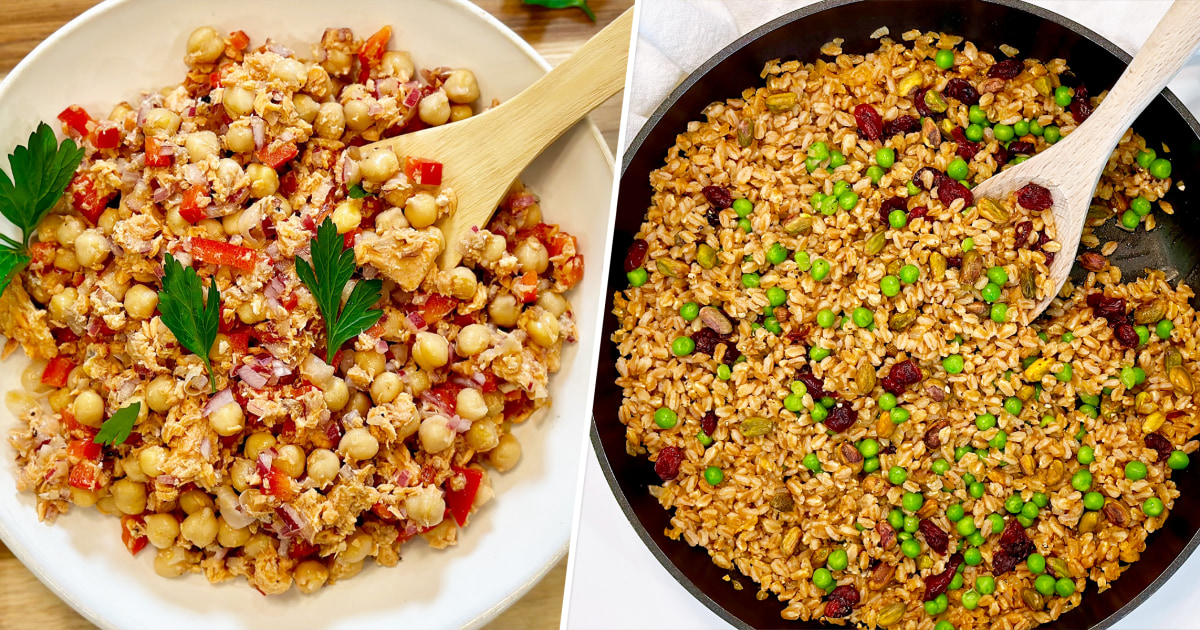
3. Brown rice → farro 

Brown rice is an obvious winner. The whole grain delivers vitamins, minerals and some fiber, and it’s versatile enough to complement to just about any meal. While brown rice has earned a regular spot in many homes, farro is an ancient grain worth getting to know. That’s because it provides more than double the amount of fiber and protein compared to brown rice and is just as easy to make. It has a lighter flavor than brown rice, slightly nutty and a bit sweet (some even say with subtle hints of cinnamon). I love its texture — it’s chewy and puffy, so it’s quite filling and satisfying. It’s an ideal side to meat, chicken and fish, but it’s also great chilled and added to any sort of cold salad. In fact, I make a Farro Pilaf with various aromatics and tasty mix-ins like pistachios and dried cranberries that’s always a crowd-pleaser.

Joy Bauer's Farro Pilaf
Joy Bauer’s Farro PilafJoy Bauer

4. Sour cream → Greek yogurt

Sour cream is the topping of choice for baked potatoes, chilis, tacos and nachos. But I personally have a thing for Greek yogurt when my dish needs a dollop of deliciousness. Unlike regular yogurt, Greek yogurt is strained, making it thicker, tangier and more similar to sour cream in texture and taste, with the added perk of extra protein. Add a spoonful or two to these Loaded Sweet Potatoes or this Butternut Squash Chili, and dig in!

Baked Feta Spinach-Artichoke Dip

Joy Bauer

5. Canned tuna → canned salmon

If you’re going to go fish, why not try canned salmon? All canned fish are packed with protein and are a budget-friendly way to hit your weekly fish quota. And of course, there’s no need for canned tuna to be canned for good, but swapping to salmon offers a number of benefits, including more heart-healthy omega-3 fats and bone-strengthening vitamin D. Now that’s the reel deal! Try this Wild Salmon and Chickpea Salad for a scrumptious fix.

Joy Bauer's Wild Salmon and Chickpea Salad
Joy Bauer’s Wild Salmon and Chickpea SaladJoy Bauer

Cooking Tips: 5 Simple Yet Superb Ways To Use Leftover Aloo Gobhi Sabzi

Cooking Tips: 5 Simple Yet Superb Ways To Use Leftover Aloo Gobhi Sabzi

Aloo gobhi is one of the most commonly made vegetables in Indian households, and that’s why it is also found left over most often. We are never surprised to get a sandwich for breakfast, stuffed with last night’s aloo gobhi sabzi. And we don’t mind it because we love this delicious dish anyway. Simple to make and full of flavours, with the right amount of crunch from shallow fried gobhi, this sabzi is at the heart of every traditional Indian thali. But if you want to enjoy this dish again in the next meal in different forms, the following recipes are perfect. 

Here’re 5 Easy Recipes To Use Leftover Aloo Gobhi: 

1. Aloo Gobhi Paratha – Our recommendation 

Stuffed parathas always work their charm on us in the morning. And what can be better than the full-of-flavours stuffing our favourite aloo gobhi sabzi? We suggest adding chopped onions to the sabzi before mashing it to be rolled into the paratha. Trust us, this aloo gobhi paratha will win your heart. 

Also Read: Use Your Leftovers To Rustle Up This Tasty Chicken Salad Wrap

2. Aloo Gobhi Toast 

This dish needs no introduction. It’s almost a staple in every Indian household. All you have to do is place a handful of slightly mashed sabzi on buttered bread slices and toast to make a hearty sandwich. But if you ask us, the best way to make aloo gobhi toast is by toasting the sandwich in ghee on tawa, desi style! 

3. Aloo Gobhi Tikki 

Surprised? Yes, this sabzi can be turned into a lip-smacking crispy tikki that will be a show-stealer in your evening tea-time session. Mix the leftover aloo gobhi sabzi with some mashed boiled aloo, and add some tiny torn bread pieces to absorb the moisture from the sabzi. Throw in some green chillies, salt and chaat masala, and make some scrumptious tikkis from the mixture in a matter of minutes. 

Also Read: 5 Yummy Ways To Use Your Left Over Parathas

604r3foo

Tikki is one of the most loved snacking options. Image Credit: iStock

4. Aloo Gobhi Bread Pakoda 

Another snack from aloo gobhi that will surprise and impress you at the same time. Just replace the usual aloo stuffing with mashed aloo gobhi sabzi, place it in between diagonally cut bread slices, dip in seasoned batter and fry it to golden glory. Bread pakoda never fails to please us, and this version will also do the same. Plus, you have a quicker recipe to make bread pakoda for snacks now! 

5. Aloo Gobhi Roll 

We love rolls for the convenience of eating them. Use last night’s aloo gobhi sabzi to make rolls for your or your kids’ tiffin boxes to eat on the go. Make a large, thin chapati and break pour whisked egg on one cooked side. Flip and cook from the other side again. Once done, smear the roti with green chutney and tomato sauce, and roll it with aloo gobhi sabzi, sliced onions and green chillies inside. You will love this roll for a quick brunch or lunch. 

Also read: How To Use Leftover Food? 5 Interesting Breakfast Recipes You Can Make The Next Day

These recipes will reignite your love for aloo gobhi sabzi. Try them and let us know which one was your favourite.  

Featured Video Of The Day

Honey Chilli Chicken Popper Recipe | How To Make Honey Chilli Chicken Popper

Rujuta Diwekar Suggests 3 Simple Tricks To Include Healthy Fats In Your Diet

Rujuta Diwekar Suggests 3 Simple Tricks To Include Healthy Fats In Your Diet

In the the latest past, we have observed a drastic change in the way folks diet. Relatively than getting rid of overall food teams from the diet plan, there is a change towards ingesting a healthful and healthy well balanced eating plan. Historic methods are staying introduced again, and individuals are seeking out the knowledge handed on as per Indian traditions and our grandmothers. Fat are a single food group that individuals have been consistently steering clear of in a bid to get rid of bodyweight. But of late, a number of nutritionists have spoken about how there are some wholesome fats that could actually advantage the diet plan and velocity up the fat decline journey. Superstar nutritionist Rujuta Diwekar also not long ago shared a video about healthy fat that really should be introduced back again into the diet program.

Rujuta Diwekar shared this video as part of her ’12-week physical fitness project’ for 2023. In the clip, she spoke about the fact that not all fats are harmful. In simple fact, some fat can really be healthy for us and there are methods that we can carry them back again into our food plan. The superstar nutritionist prompt that fat were utilised by the overall body in a lot of means, which is why it is an essential ingredient of the diet program that simply cannot be overlooked. The addition of balanced fats to the diet plan will be certain healthier bones, a far better mood, a healthier heart and far more.

Here Are 3 Easy Tricks To Contain Wholesome Fat In Your Diet plan Proposed By Rujuta Diwekar:

1. Make Tadka In Kachi Ghani Oils (Chilly-Pressed Oils)

Celeb nutritionist Rujuta Diwekar recommended bringing again the humble tadka and introducing it to various dishes which include khichdi, pulao, dals and additional. In accordance to the specialist, conventional oils were extracted at decrease temperatures and this intended that the fatty acids, vitamins and other vitamins and minerals are intact. This consists of mustard oil for north and east India, groundnut or sesame for central and western, and coconut oil for the South. “No jumping on the bandwagon of “coronary heart healthier” or other these types of promises designed by refined vegetable, rice bran, safflower or comparable oils. Avoid oil-free or body fat-free of charge at all expenditures,” instructed Diwekar.

(Also Browse: 7 Power-Packed Recipes With Heaps Of Energising Nuts)

qd54f04g

Both of those coconut oil and clean coconut can be utilized to endow the physique with healthier fat. Image: iStock

2. Use Coconut As Garnish

Coconut is 1 of the most amazing healthful fat out there and it has several wellbeing gains for our bodies. Rujuta Diwekar uncovered that it is anti-bacterial, and anti-viral, supports gut health and also can help relaxed your nerves. “So, garnish your food items with it, transform it into laddoos and barfis, make chutneys out of it, have the coconut malai and even the dry coconut with jaggery or just peanuts,” proposed the movie star nutritionist.

3. Cashews For Mid-Meal Snack

Cashews may perhaps have gained a negative popularity, but basically, they are just one of the greatest resources of healthy fat out there. The humble nut is enriched with minerals, nutritional vitamins and amino acids that support the generation of serotonin which assists promote a superior night’s sleep. “It is really tryptophan (an amino acid) and vitamin B combination that helps make kaju a normal anti-depressant. It is really the summer months nut and you can consume the cashew fruit too (tremendous rich in Vit C),” said Diwekar.

Watch the entire online video shared by Rujuta Diwekar here:

Showcased Video clip Of The Working day

Honey Chilli Rooster Popper Recipe | How To Make Honey Chilli Hen Popper